JEE Main · Chemistry → Steady

Aldehydes, Ketones and Carboxylic Acids appeared 46 times across 3 years — 5.3% of Chemistry. This question is from Preparation of Aldehydes.

Year 2026 2025 2024 Total
Questions 14 21 11 46

Match List-I with List-II
List-IList-II (Name of Reaction)
(A) RCN [(ii)H₃O⁺](i)SnCl₂, HCl RCHO(I) Etard reaction
(B)
Preparation of Aldehydes diagram for Q42 - JEE Main 2025 Evening
The Match List displays chemical transformations side-by-side with their respective named organic chemical reactions.
(II) Gatterman-Koch reaction
(C)
Preparation of Aldehydes diagram for Q42 - JEE Main 2025 Evening
The Match List displays chemical transformations side-by-side with their respective named organic chemical reactions.
(III) Rosenmund reduction
(D)
Preparation of Aldehydes diagram for Q42 - JEE Main 2025 Evening
The Match List displays chemical transformations side-by-side with their respective named organic chemical reactions.
(IV) Stephen reaction
Choose the correct answer from the options given below:

Solution & Explanation

Core Logic

Let's match each aldehyde preparation method with its official named organic reaction:

  • (A) RCN arrow RCHO using SnCl₂/HCl followed by hydrolysis: This is the classic Stephen reaction arrow (IV).
  • (B) Reducing an acyl chloride (RCOCl) to an aldehyde using H₂ over Pd-BaSO₄: This partial reduction is known as the Rosenmund reduction arrow (III).
  • (C) Oxidizing toluene to benzaldehyde using chromyl chloride (CrO₂Cl₂) in CS₂: This selective oxidation method is the Etard reaction arrow (I).
  • (D) Converting benzene to benzaldehyde using CO and HCl in the presence of anhydrous AlCl₃/CuCl: This formylation process is the Gatterman-Koch reaction arrow (II).
  • Combining these assignments yields the final sequence: (A)-(IV), (B)-(III), (C)-(I), (D)-(II).

Step-by-Step Layout

The visual reaction components correspond directly to the official structural transformations:

Preparation of Aldehydes solution diagram for Q42 - JEE Main 2025 Evening
The Match List displays chemical transformations side-by-side with their respective named organic chemical reactions.
Preparation of Aldehydes solution diagram for Q42 - JEE Main 2025 Evening
The Match List displays chemical transformations side-by-side with their respective named organic chemical reactions.
Preparation of Aldehydes solution diagram for Q42 - JEE Main 2025 Evening
The Match List displays chemical transformations side-by-side with their respective named organic chemical reactions.

Pattern Recognition

Quick identification keys:

  • Nitrile arrow Aldehyde = Stephen
  • Acid Chloride arrow Aldehyde = Rosenmund
  • Toluene arrow Chromyl Complex = Etard
  • Benzene arrow Carbon Monoxide = Gatterman-Koch
Chapter Mix

Class 12 Chemistry: Aldehydes, Ketones and Carboxylic Acids

Reference Study Guides

More Aldehydes, Ketones and Carboxylic Acids Previous-Year Questions — Page 10

Q jee_main_2024_31_jan_morning Reactions with Grignard Reagent
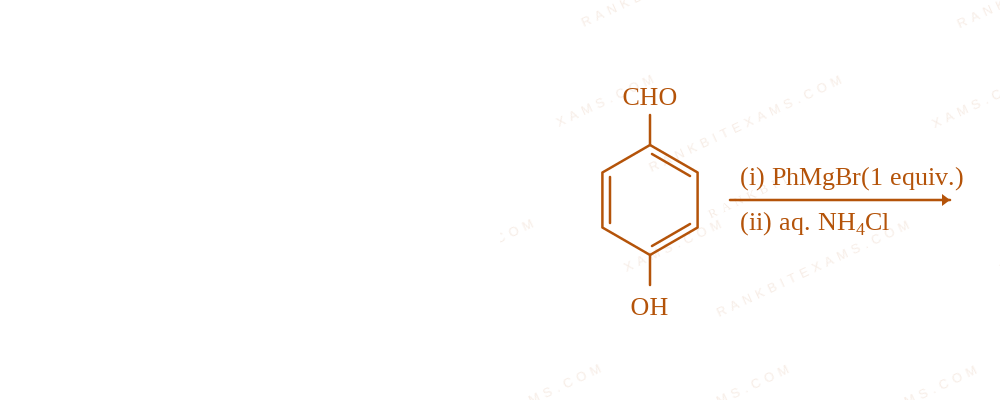
The product of the following reaction is P.
Reactions with Grignard Reagent diagram for Q84 - JEE Main 2024 Morning
The image shows p-hydroxybenzaldehyde reacting with one equivalent of PhMgBr followed by aqueous ammonium chloride.
The number of hydroxyl groups present in the product P is
Numerical Answer. Answer: 0 to 0

Solution

Core Logic

The given reactant is p-hydroxybenzaldehyde, which contains both a phenolic -OH group (acidic) and an aldehyde group (electrophilic).

When one equivalent of Grignard reagent (PhMgBr) is added, it behaves primarily as a strong base due to the presence of an acidic proton. Acid-base reactions are extremely fast compared to nucleophilic additions.

The acidic phenolic -OH reacts with PhMgBr:

PhMgBr + HO-C₆H₄-CHO arrow Ph-H (Benzene) + BrMg-O-C₆H₄-CHO

Upon workup with aq. NH₄Cl, the phenoxide ion simply regenerates the starting p-hydroxybenzaldehyde. However, the question asks for the number of hydroxyl groups present in the formed product (Benzene).
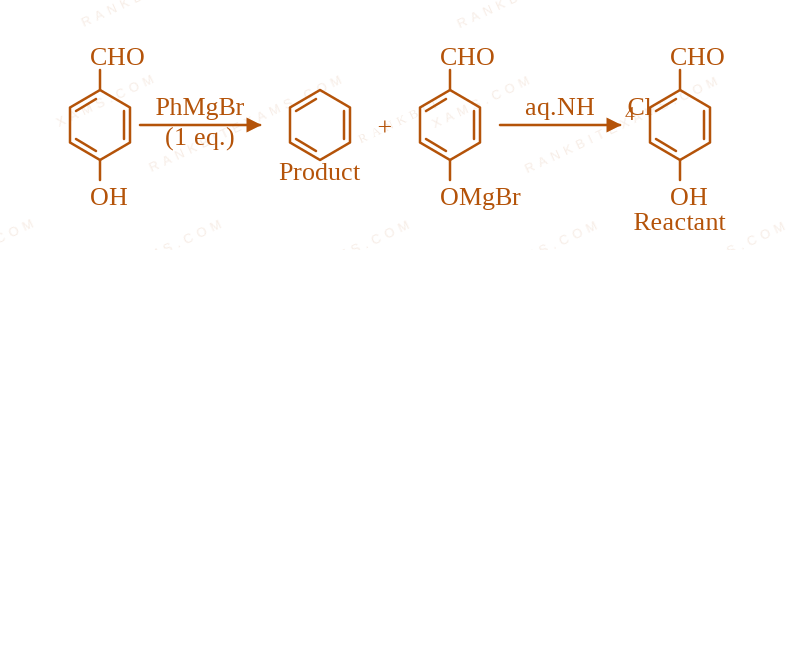
Reactions with Grignard Reagent diagram for Q84 - JEE Main 2024 Morning
The image shows p-hydroxybenzaldehyde reacting with one equivalent of PhMgBr followed by aqueous ammonium chloride.

The distinct product formed in the reaction is Benzene. Benzene has 0 hydroxyl groups.

Pattern Recognition

Whenever a Grignard reagent encounters a molecule with an acidic hydrogen (alcohol, phenol, amine, alkyne), it will invariably act as a base first. If only 1 equivalent is used, nucleophilic addition to carbonyls will NOT happen.

Chapter Mix

Class 12 Chemistry: Aldehydes, Ketones and Carboxylic Acids Class 12 Chemistry: Alcohols, Phenols and Ethers

More Aldehydes, Ketones and Carboxylic Acids Questions — jee_main_2025_24_jan_evening

Practice all Aldehydes, Ketones and Carboxylic Acids previous-year questions →

Rankbit System
JEE Physics: Waves (+15.5%) | Electrostatics: Concentric Shells (-29.7%) | Modern Physics: Photoelectric Clones (+34.2%) | Mathematics: Definite Integrals (+18.1%) | Chemistry: Coordination Splitting (-11.4%) | JEE Physics: Waves (+15.5%) | Electrostatics: Concentric Shells (-29.7%) | Modern Physics: Photoelectric Clones (+34.2%) | Mathematics: Definite Integrals (+18.1%) | Chemistry: Coordination Splitting (-11.4%)