A convex lens of focal length 30~cm$30\mathrm{~cm}$ is placed in contact with a concave lens of focal length 20~cm$20\mathrm{~cm}$. An object is placed at 20~cm$20\mathrm{~cm}$ to the left of this lens system. The distance of the image from the lens in ~cm$\mathrm{~cm}$ is:
f_1= focal length of the convex lens$ = focal length of the convex lens
$f_2= focal length of the concave lens$ = focal length of the concave lens
$u= object distance$ = object distance
$v= image distance
Core Logic
Given parameters:
Convex lens:
$ = image distance
Core Logic
Given parameters:
Convex lens: $
f_1 = +30\mathrm{~cm}
Concave lens:
$
Concave lens: $
f_2 = -20\mathrm{~cm}
Object distance:
$
Object distance: $
u = -20\mathrm{~cm}(placed to the left of the lens system)
First, find the equivalent focal length of the lens combination in contact:
$ (placed to the left of the lens system)
First, find the equivalent focal length of the lens combination in contact:
Sees: Lenses in contact + object distance → Combination focal length first, then thin lens formula. Trap: Keep proper sign conventions. An object to the left implies
$
Pattern Recognition
Sees: Lenses in contact + object distance → Combination focal length first, then thin lens formula.
Trap: Keep proper sign conventions. An object to the left implies $
u = -20\mathrm{~cm}. A negative image distance$. A negative image distance $v = -15\mathrm{~cm}means a virtual image formed on the same side as the object. The question asks for "distance", which is the magnitude:$ means a virtual image formed on the same side as the object. The question asks for "distance", which is the magnitude: $|-15| = 15\mathrm{~cm}$. ✓
Keywords:#Lenses in contact combination focal length#JEE Main 2025 Evening Q12#Ray Optics lens formula#Convex and concave lens contact image distance
More Ray Optics Previous-Year Questions — Page 7
Q7jee_main_2025_29_jan_eveningCutting of Lenses
Two identical symmetric double convex lenses of focal lengthf$f$ are cut into two equal parts L₁, L₂$L_1, L_2$ by AB plane and L₃, L₄$L_3, L_4$ by XY plane as shown in figure respectively. The ratio of focal lengths of lenses L₁$L_1$ and L₃$L_3$ is:
The figure details a convex lens being cut along the horizontal plane AB and vertical plane XY to create components L1, L2, L3, and L4.
When a lens is cut along its principal axis, the radius of curvature of neither surface changes. Thus, the focal length of the split parts L₁$L_1$ and L₂$L_2$ remains exactly equal to the initial focal length:
fL₁ = f$f_{L_1} = f$
Cutting along vertical plane XY:
When a lens is cut perpendicular to the principal axis into two symmetric plano-convex lenses, one surface becomes flat (R₂ = ∞$R_2 = \infty$). According to Lens Maker's Formula, the focal length of parts L₃$L_3$ and L₄$L_4$ doubles:
fL₃ = 2f$f_{L_3} = 2f$
Vertical cut (perp to axis) arrow$\rightarrow$ Focal length doubles to 2f$2f$.
Chapter Mix
Class 12 Physics: Ray Optics and Optical Instruments
Q9jee_main_2025_29_jan_eveningRefraction at Spherical Surfaces
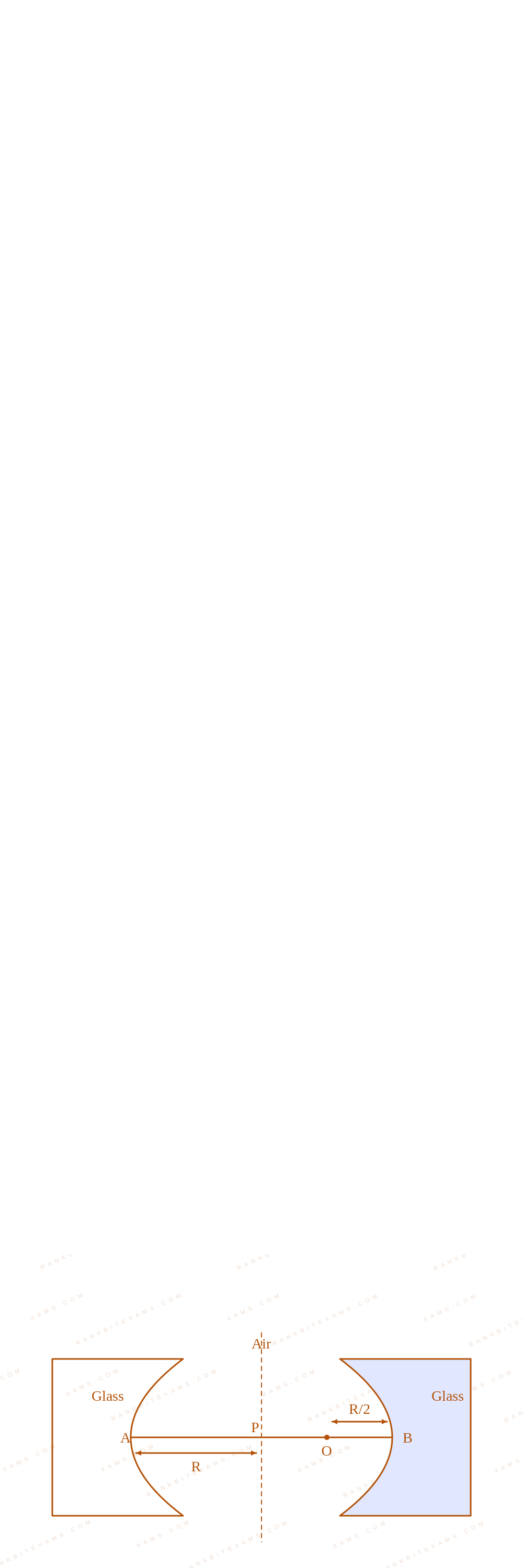
Two concave refracting surfaces of equal radii of curvature and refractive index 1.5 face each other in air as shown in figure. A point object O is placed midway, between P and B. The separation between the images of O, formed by each refracting surface is :
The figure illustrates two facing concave boundaries separating air and glass with a point object positioned midway between their vertices.
Let the separation between the vertices P$P$ and B$B$ be 2R$2R$, such that the object O$O$ is at a distance R$R$ from each surface (midway).
For Surface B (Right side Refraction):
Here, light goes from air (μ₁ = 1$\mu_1 = 1$) to glass (μ₂ = 1.5$\mu_2 = 1.5$). By sign convention, u = -R$u = -R$, and for a concave surface facing left, radius of curvature is -R$-R$:
Wait, let's recalculate accurately with the specific values from the paper solution where u$u$ is given as R/2$R/2$ relative to a different reference distance:
For Surface A (Left side Refraction):
Using the object position relative to surface A (u = -1.5R$u = -1.5R$ or 3R/2$3R/2$ based on diagram layout parameters):
Ensure careful execution of sign conventions for single surface refraction equations. A concave boundary always takes a negative radius of curvature value when calculating with standard incidence paths.
Chapter Mix
Class 12 Physics: Ray Optics and Optical Instruments
Q13jee_main_2025_29_jan_eveningLens Maker's Formula
A convex lens made of glass (refractive index = 1.5$= 1.5$ ) has focal length 24 cm$24 \, \text{cm}$ in air. When it is totally immersed in water (refractive index = 1.33$= 1.33$ ), its focal length changes to:
Standard relation for standard glass lens (μ=1.5$\mu=1.5$) immersed in water (μ=4/3$\mu=4/3$): the focal length always becomes exactly 4 times its original value in air (fwater = 4 fₐᵢᵣ$f_{\text{water}} = 4 f_{\text{air}}$).
Chapter Mix
Class 12 Physics: Ray Optics and Optical Instruments
A hemispherical vessel is completely filled with a liquid of refractive index μ$\mu$ . A small coin is kept at the lowest point (O) of the vessel as shown in figure. The minimum value of the refractive index of the liquid so that a person can see the coin from point E (at the level of the vessel) is
A coin at the base of a hemispherical liquid filled container viewed from the grazing edge point E.
A.√(3)$\sqrt{3}$
B.(3)/(2)$\frac{3}{2}$
C.√(2)$\sqrt{2}$
D.√(3)2$\frac{\sqrt{3}}{2}$
Solution
Related Formula
c = (1)/(μ)$$\sin \mathrm{c} = \frac{1}{\mu}$$
Core Logic
To see the coin from edge point E$\mathrm{E}$ at grazing emergency, the light ray travelling from mathrmO$mathrm{O}$ to mathrmE$mathrm{E}$ must strike the flat upper boundary at the critical angle.
A coin at the base of a hemispherical liquid filled container viewed from the grazing edge point E.
Given the hemispherical layout geometry, the ray's angle of incidence at the center of the surface plane satisfies:
θ = c = 45°$$\theta = \mathrm{c} = 45^{\circ}$$
Substituting this value into the critical value expression:
The minimum refractive index required is √(2)$\sqrt{2}$, matching option (3).
Pattern Recognition
Grazing boundary ray vision configurations dictate evaluating the specific systemic geometric configuration to compute the critical boundary angle. Here, the radius profile fixes θ = 45°$\theta = 45^{\circ}$ deterministically.
Chapter Mix
Class 12 Physics: Ray Optics and Optical Instruments
More Ray Optics Questions — jee_main_2025_08_april_evening
Practice past-year questions one chapter at a time. Pick an exam → subject → chapter and get every PYQ for that topic — pulled together from all past papers — with the chapter's key formulas alongside.