A convex lens of focal length 30~cm is placed in contact with a concave lens of focal length 20~cm. An object is placed at 20~cm to the left of this lens system. The distance of the image from the lens in ~cm is:

Solution & Explanation

Related Formula
$ 1feq = (1)/(f₁) + (1)/(f₂)(1)/(v) - (1)/(u) = (1)/(f)

where,

where, $f_1= focal length of the convex lensf_2= focal length of the concave lensu= object distancev= image distance

Core Logic

Given parameters:

  • Convex lens:
  • First, find the equivalent focal length of the lens combination in contact:

$
1feq = (1)/(30) + (1)/(-20) = (2 - 3)/(60) = -(1)/(60) feq = -60~cm
Step 1: Image Distance Calculation

Use the thin lens formula:

(1)/(v) - (1)/(u) = 1feq(1)/(v) - (1)/(-20) = (1)/(-60) (1)/(v) + (1)/(20) = -(1)/(60)(1)/(v) = -(1)/(60) - (1)/(20) = (-1 - 3)/(60) = -(4)/(60) = -(1)/(15)v = -15~cm
Pattern Recognition

Sees: Lenses in contact + object distance → Combination focal length first, then thin lens formula. Trap: Keep proper sign conventions. An object to the left implies

Pattern Recognition

Sees: Lenses in contact + object distance → Combination focal length first, then thin lens formula. Trap: Keep proper sign conventions. An object to the left implies $u = -20\mathrm{~cm}. A negative image distancev = -15\mathrm{~cm}means a virtual image formed on the same side as the object. The question asks for "distance", which is the magnitude:|-15| = 15\mathrm{~cm}$. ✓

Chapter Mix

Class 12 Physics: Ray Optics

Reference Study Guides

More Ray Optics Previous-Year Questions — Page 3

Q47 jee_main_2026_23_january_evening Lenses
The size of the images of an object, formed by a thin lens are equal when the object is placed at two different positions 8 cm and 24 cm from the lens. The focal length of the lens is ____ cm.
Numerical Answer. Answer: 16 to 16

Solution

Related Formula

Magnification formula for thin lens in terms of f and u:

m = (f)/(f + u)
Core Logic

Since the sizes of the images are equal at two different object positions but the focal length doesn't change, one image must be real and the other virtual. Hence, their magnifications are equal in magnitude but opposite in sign. m₁ = -m₂

Step 1: Set Up Magnification Equations

Object distance 1: u₁ = -8 cm (virtual image case, closer to lens) Object distance 2: u₂ = -24 cm (real image case)

Using proper sign convention:

(f)/(f + (-8)) = -( (f)/(f + (-24)) )
Step 2: Solve for Focal Length
(f)/(f - 8) = -(f)/(f - 24)

Assuming f ≠ 0:

f - 24 = -(f - 8)

f - 24 = -f + 8 2f = 32

f = 16 cm
Pattern Recognition

For a convex lens, if equal size images are formed at two different object distances u₁ and u₂, then f = (u₁ + u₂)/(2) if both distances are strictly positive magnitude values.

Chapter Mix

Class 12 Physics: Ray Optics and Optical Instruments

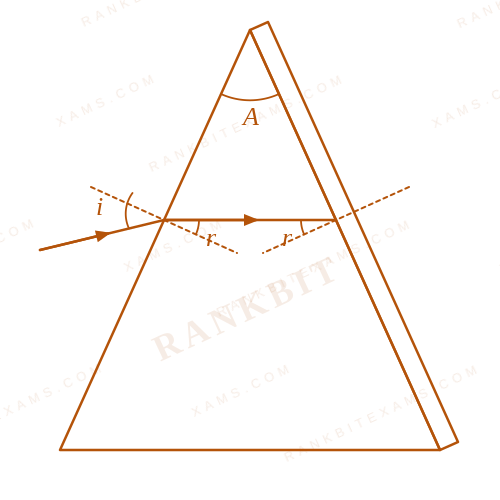
Q31 jee_main_2026_24_january_morning Prism
The exit surface of a prism with refractive index n is coated with a material having refractive index (n)/(2). When this prism is set for minimum angle of deviation it exactly meets the condition of critical angle. The prism angle is ____
  • A. 60°
  • B. 15°
  • C. 30°
  • D. 45°

Solution

Related Formula
Minimum Deviation: r₁ = r₂ = (A)/(2) Critical Angle: θc = (μ₂)/(μ₁)
Core Logic

Ray diagram through a coated prism

For minimum deviation, i = e and r = (A)/(2). At the exit surface, the light ray exactly meets the condition of the critical angle.

Ray diagram through a coated prism

For Total Internal Reflection (TIR) condition matching critical angle: r = θc

r = θc r = (n/2)/(n) = (1)/(2)
Step 1: Solve for Prism Angle

Since r = (1)/(2), we have r = 30°. Since r = (A)/(2) at minimum deviation:

(A)/(2) = 30°

A = 60°

Pattern Recognition

Critical angle at an interface is always ⁻¹(μᵣₐᵣₑ/μdense). If μᵣₐᵣₑ is exactly half of μdense, the critical angle is exactly 30^°.

Chapter Mix

Class 12 Physics: Ray Optics and Optical Instruments
Q33 jee_main_2026_24_january_morning Optical Instruments
In a microscope of tube length 10 cm two convex lenses are arranged with focal length of 2 cm and 5 cm. Total magnification obtained with this system for normal adjustment is (5)k. The value of k is ____
  • A. 2
  • B. 5
  • C. 3.5
  • D. 4

Solution

Related Formula
M = ( )/(f₀) · (D)/(fₑ)
Core Logic

Given parameters: Focal length of objective, f₀ = 2 cm Focal length of eyepiece, fₑ = 5 cm Tube length, = 10 cm Least distance of distinct vision, D = 25 cm

Step 1: Calculate Total Magnification

For normal adjustment (final image at infinity), the magnification formula is:

M = ( ( )/(f₀) ) ( (D)/(fₑ) ) M = ( (10)/(2) ) ( (25)/(5) ) = 5 × 5 = 25

Since M = 25 = 5², and the problem states M = (5)^k, we compare to find k=2.

Pattern Recognition

For normal adjustment of a compound microscope, M = mₒ × mₑ ≈ (L/fₒ) × (D/fₑ).

Chapter Mix

Class 12 Physics: Ray Optics and Optical Instruments

Q28 jee_main_2026_24_january_evening Lenses and Magnification
Five persons P₁ , P₂ , P₃ , P₄ and P₅ recorded object distance (u) and image distance (v) using same convex lens having power +5D as (25,96), (30,62), (35,37), (45,35) and (50,32) respectively. Identify correct statement
  • A. Readings recorded by all persons are correct
  • B. Reading recorded by P₃ persons are incorrect
  • C. Reading recorded by P₃ and P₂ persons are incorrect
  • D. Reading recorded by P₄ and P₅ persons are incorrect

Solution

Related Formula
P = 100f (in cm)
Core Logic

Given Power P = +5D

(1)/(f) = 5 ⇒ f = 20 cm

If the object is between f and 2f (between 20cm and 40cm), the image must be formed beyond 2f (i.e., v > 40cm) and it is magnified.

Step 1: Check P3 Reading

For P₃, u = 35cm (which is between 20cm and 40cm). Thus, the image distance v must be greater than 40cm. However, the recorded reading is v = 37cm, which is incorrect.

Pattern Recognition

For a convex lens, if u lies between f and 2f, v must be greater than 2f. A simple boundary check on the 2f mark (40cm) reveals faulty readings instantly without solving the lens formula.

Chapter Mix

Class 12 Physics: Ray Optics and Optical Instruments

Q45 jee_main_2026_24_january_evening Mirrors and Magnification
Distance between an object and three times magnified real image is 40 cm. The focal length of the mirror used is ____ cm.
  • A. - 15/2
  • B. - 10
  • C. - 20
  • D. - 15

Solution

Related Formula
m = -(v)/(u) (1)/(v) + (1)/(u) = (1)/(f)
Core Logic

For a real image, magnification m is negative: m = -3

-3 = -(v)/(u) v = 3u

Given the distance between object and image is 40 cm: For real images formed by a concave mirror, both u and v are on the same side. The distance between them is |v| - |u| = 40 cm.

Step 1: Determine Object and Image Distances

3|u| - |u| = 40

2|u| = 40 |u| = 20 cm |v| = 60 cm

Applying sign convention:

u = -20 cm, v = -60 cm
Step 2: Compute Focal Length
(1)/(f) = (1)/(-60) + (1)/(-20) (1)/(f) = (-1 - 3)/(60) = -(4)/(60) f = -15 cm
Pattern Recognition

Real magnified image means concave mirror. The separation is (m-1)|u|. Therefore |u| = Δ / (m-1). Then strictly apply (1)/(f) = (1)/(v) + (1)/(u) with signs.

Chapter Mix

Class 12 Physics: Ray Optics and Optical Instruments

More Ray Optics Questions — jee_main_2025_08_april_evening

Practice all Ray Optics previous-year questions →

Rankbit System
JEE Physics: Waves (+15.5%) | Electrostatics: Concentric Shells (-29.7%) | Modern Physics: Photoelectric Clones (+34.2%) | Mathematics: Definite Integrals (+18.1%) | Chemistry: Coordination Splitting (-11.4%) | JEE Physics: Waves (+15.5%) | Electrostatics: Concentric Shells (-29.7%) | Modern Physics: Photoelectric Clones (+34.2%) | Mathematics: Definite Integrals (+18.1%) | Chemistry: Coordination Splitting (-11.4%)