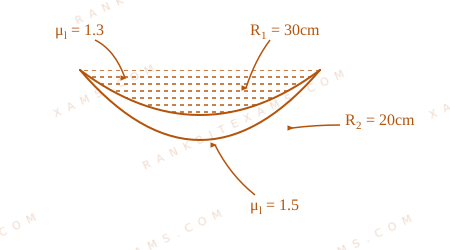
A concave-convex lens of refractive index 1.5 and the radii of curvature of its surfaces are 30mathrm~cm and 20mathrm~cm, respectively. The concave surface is upwards and is filled with a liquid of refractive index 1.3. The focal length of the liquid-glass combination will be

Solution & Explanation

### Related Formula frac1f_texteq = frac1f_textliquid + frac1f_textglass frac1f = (mu - 1)left(frac1R_1 - frac1R_2right) ### Core Logic Let's find the focal length of each individual lens in the combination: 1. **Liquid Lens**: - Refractive index, mu_l = 1.3 - The upper surface is flat (exposed to air): R_1 = infty - The lower surface matches the upward concave surface of the glass lens: R_2 = -30mathrm~cm frac1f_textliquid = (1.3 - 1) left(frac1infty - frac1-30right) = 0.3 times frac130 = frac1100mathrm~cm^-1 2. **Glass Lens**: - Refractive index, mu_g = 1.5 - First surface radius (concave upward), R_1 = -30mathrm~cm - Second surface radius (convex downward), R_2 = -20mathrm~cm (following light path downward) frac1f_textglass = (1.5 - 1) left(frac1-30 - frac1-20right) = 0.5 left(-frac130 + frac120right) = 0.5 left(frac160right) = frac1120mathrm~cm^-1
Ray Optics combination diagram
### Step 1: Combination Focal Length Add the powers of both lenses: frac1f_texteq = frac1100 + frac1120 = frac6 + 5600 = frac11600 f_texteq = frac60011mathrm~cm ### Pattern Recognition Sees: Glass lens with liquid poured on top → Think of it as a double lens system (liquid lens + glass lens). Trap: Be extremely careful with sign conventions for radii of curvature of the boundaries! Assume light travels from air through the liquid and then through the glass. This defines a consistent spatial propagation direction. ✓ ### Evaluation Rubric / Model Answer null ### Chapter Mix Class 12 Physics: Ray Optics

More Ray Optics Previous-Year Questions — Page 6

Q14 jee_main_2025_07_april_evening Refractive Index
Given below are two statements: one is labelled as Assertion (A) and the other is labelled as Reason (R). Assertion (A) : Refractive index of glass is higher than that of air. [cite: 130] Reason (R): Optical density of a medium is directly proportionate to its mass density which results in a proportionate refractive index. [cite: 131] In the light of the above statements, choose the most appropriate answer from the options given below: [cite: 132]
  • A. (A) is not correct but (R) is correct [cite: 133]
  • B. Both (A) and (R) are correct and (R) is the correct explanation of (A) [cite: 134]
  • C. (A) is correct but (R) is not correct [cite: 135]
  • D. Both (A) and (R) are correct but (R) is not the correct explanation of (A) [cite: 136]

Solution

### Core Logic Refractive index represents the ratio of the speed of light in vacuum to its speed in a given medium[cite: 719]. Glass slows light down more than air does, hence mu_textglass approx 1.5 > mu_textair approx 1.0, which makes Assertion (A) correct[cite: 130]. However, optical density is defined by a medium's capacity to refract light and is completely conceptually distinct from inertial mass density (mass per unit volume)[cite: 719]. For example, turpentine has a lower mass density than water but possesses a higher optical density and refractive index. Therefore, Reason (R) is fundamentally incorrect[cite: 722]. ### Pattern Recognition Optical density vs mass density is a signature conceptual trick in refraction theory[cite: 719]. They share the word 'density' but have entirely different physical meanings and no fixed mathematical proportionality[cite: 719, 722]. ### Evaluation Rubric / Model Answer null ### Chapter Mix Class 12 Physics: Ray Optics and Optical Instruments
Q20 jee_main_2025_07_april_evening Total Internal Reflection
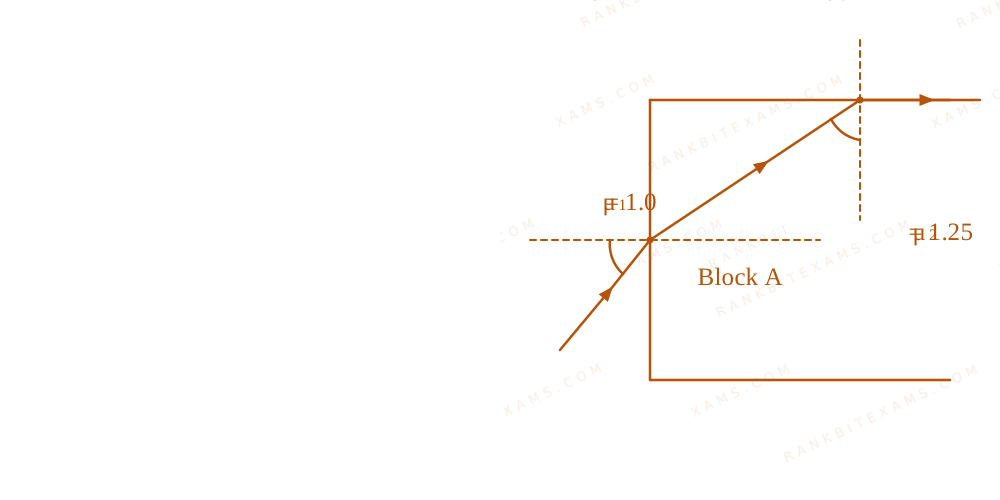
A transparent block A having refractive index mu=1.25 is surrounded by another medium of refractive index mu=1.0 as shown in figure. A light ray is incident on the flat face of the block with incident angle theta as shown in figure. What is the maximum value of theta for which light suffers total internal reflection at the top surface of the block?
Total Internal Reflection diagram for Q20 - JEE Main 2025 Evening
The diagram displays a light ray entering a rectangular block from a medium of lower refractive index, hitting the top wall at the critical boundary angle.
[cite: 169, 170, 171]
  • A. tan^-1(4/3) [cite: 175]
  • B. tan^-1(3/4) [cite: 176]
  • C. sin^-1(3/4) [cite: 177]
  • D. cos^-1(3/4) [cite: 178]

Solution

### Related Formula sintheta_c = fracmu_1mu_2 [cite: 810] mu_1 sintheta = mu_2 sin r [cite: 807] ### Core Logic From the boundary geometry at the top interface, the angle of refraction r at the first surface satisfies: [cite: 806] r + theta_c = 90^circ implies r = 90^circ - theta_c [cite: 806] Applying Snell's law at the first entry interface: [cite: 170, 807] mu_1 sintheta = mu_2 sin r = mu_2 sin(90^circ - theta_c) = mu_2 costheta_c [cite: 172, 173, 807, 809] Since sintheta_c = fracmu_1mu_2 = frac1.01.25 = frac45, we have costheta_c = sqrt1 - left(frac45right)^2 = frac35[cite: 169, 810, 811]. Substituting back into the expression: [cite: 811] 1.0 cdot sintheta = 1.25 times frac35 = frac54 times frac35 = frac34 [cite: 169, 811] theta = sin^-1left(frac34 ight) [cite: 811] ### Pattern Recognition Maximum angle at the entry face ensures minimum angle of incidence at the subsequent wall[cite: 806, 807]. Setting that exact internal angle equal to the critical threshold condition values solves for the operational scanning range edge directly[cite: 808]. ### Evaluation Rubric / Model Answer null ### Chapter Mix Class 12 Physics: Ray Optics and Optical Instruments
Q14 jee_main_2025_24_jan_evening Lenses and Magnification
A photograph of a landscape is captured by a drone camera at a height of 18 km. The size of the camera film is 2 \, cm times 2 \, cm and the area of the landscape photographed is 400 \, km^2 . The focal length of the lens in the drone camera is:
  • A. 1.8 cm
  • B. 2.8 cm
  • C. 2.5 cm
  • D. 0.9 cm

Solution

### Related Formula Areal Magnification: m^2 = fracA_textimageA_textobject = left(fracff+u ight)^2 approx left(fracfu ight)^2 since object distance u = -18\ mathrmkm is vastly larger than f. ### Core Logic Given parameters:
Ray context geometry for drone camera scaling layout Q14
- Object height distance, H = 18\ mathrmkm = 18 times 10^3\ mathrmm - Film size area, A_textimage = 2\ mathrmcm times 2\ mathrmcm = 4\ mathrmcm^2 = 4 times 10^-4\ mathrmm^2 - Landscape area, A_textobject = 400\ mathrmkm^2 = 400 times 10^6\ mathrmm^2 Linear magnification factor: fracyx = sqrtfracA_textimageA_textobject = sqrtfrac4 times 10^-4400 times 10^6 = sqrt10^-12 = 10^-6 Using the simple pinhole/thin lens perspective ratio: fracfH = 10^-6 implies f = 18 times 10^3 times 10^-6 = 18 times 10^-3\ mathrmm = 1.8\ mathrmcm ### Pattern Recognition For aerial satellite imaging contexts where u gg f, linear sizing scales directly as fractextfilm sidetextground side = fracfH. ### Evaluation Rubric / Model Answer null ### Chapter Mix Class 12 Physics: Ray Optics and Optical Instruments
Q2 jee_main_2025_24_jan_morning Power of a Lens
What is the relative decrease in focal length of a lens for an increase in optical power by 0.1 D from 2.5 D ? ['D' stands for dioptre]
  • A. 0.04
  • B. 0.40
  • C. 0.1
  • D. 0.01

Solution

### Related Formula The relationship between optical power P and focal length F is given by: F = frac1P Relative decrease in focal length is defined as: fracDelta FF = fracF - F'F ### Core Logic Given initial power P = 2.5text D[cite: 19, 600]. After an increase of 0.1text D, the new power is[cite: 19, 603]: P' = 2.5 + 0.1 = 2.6text D ### Step 1: Calculate Focal Length Change Find the initial and final focal lengths [cite: 602, 604]: F = frac12.5 = frac25 F' = frac12.6 = frac513 Now, calculate the relative decrease: fracF - F'F = 1 - fracF'F = 1 - fracPP' = 1 - frac2.52.6 = frac0.12.6 = frac126 approx 0.04 ### Pattern Recognition For a small change, we can approximate using differentiation: P = frac1F implies dP = -fracdFF^2 implies fracdFF = -fracdPP. Thus, the relative change magnitude is frac0.12.5 = frac125 = 0.04. ### Evaluation Rubric / Model Answer null ### Chapter Mix Class 12 Physics: Ray Optics and Optical Instruments
Q12 jee_main_2025_24_jan_morning Silvering of Lenses
A thin plano convex lens made of glass of refractive index 1.5 is immersed in a liquid of refractive index 1.2. When the plane side of the lens is silver coated for complete reflection, the lens immersed in the liquid behaves like a concave mirror of focal length 0.2 m. The radius of curvature of the curved surface of the lens is :-
  • A. 0.15 m
  • B. 0.10 m
  • C. 0.20 m
  • D. 0.25 m

Solution

### Related Formula The net focal power of a silvered tracking lens system is given by: P = 2P_L + P_M frac1f = frac2f_L + frac1f_M ### Core Logic As shown in diagram
Silvering of Lenses diagram for Q12 - JEE Main 2025 Morning
, the plane flat side boundary interface has an infinite radius of curvature (R_2 = infty), meaning its mirror focal component is f_M = infty implies P_M = 0. The power depends entirely on the refraction step: frac1f = frac2f_L ### Step 1: Lens Maker Formulation Find the focal expression of the immersed lens element [cite: 91, 679]: frac1f_L = left(fracmu_textglassmu_textliquid - 1 ight)left(frac1R ight) = left(frac1.51.2 - 1 ight)frac1R = frac0.31.2frac1R = frac14R Now insert this into the total system tracking balance relation : frac1f = 2 left(frac14R ight) = frac12R Given the final effective concave configuration matches f = 0.2text m : frac10.2 = frac12R implies 2R = 0.2 implies R = 0.10text m ### Pattern Recognition Silvering a plano-flat back boundary means light traverses the initial curved face interface exactly twice, mapping to R = 2 cdot f cdot (mu_textrel - 1). ### Evaluation Rubric / Model Answer null ### Chapter Mix Class 12 Physics: Ray Optics and Optical Instruments

More Ray Optics Questions — jee_main_2025_08_april_evening

Practice all Ray Optics previous-year questions →

Rankbit System
JEE Physics: Waves (+15.5%) | Electrostatics: Concentric Shells (-29.7%) | Modern Physics: Photoelectric Clones (+34.2%) | Mathematics: Definite Integrals (+18.1%) | Chemistry: Coordination Splitting (-11.4%) | JEE Physics: Waves (+15.5%) | Electrostatics: Concentric Shells (-29.7%) | Modern Physics: Photoelectric Clones (+34.2%) | Mathematics: Definite Integrals (+18.1%) | Chemistry: Coordination Splitting (-11.4%)