JEE Main · Chemistry ↓ Falling

Haloalkanes and Haloarenes appeared 38 times across 3 years — 4.4% of Chemistry. This question is from Preparation and Reactions of Styrene derivatives.

Year 2026 2025 2024 Total
Questions 11 15 12 38

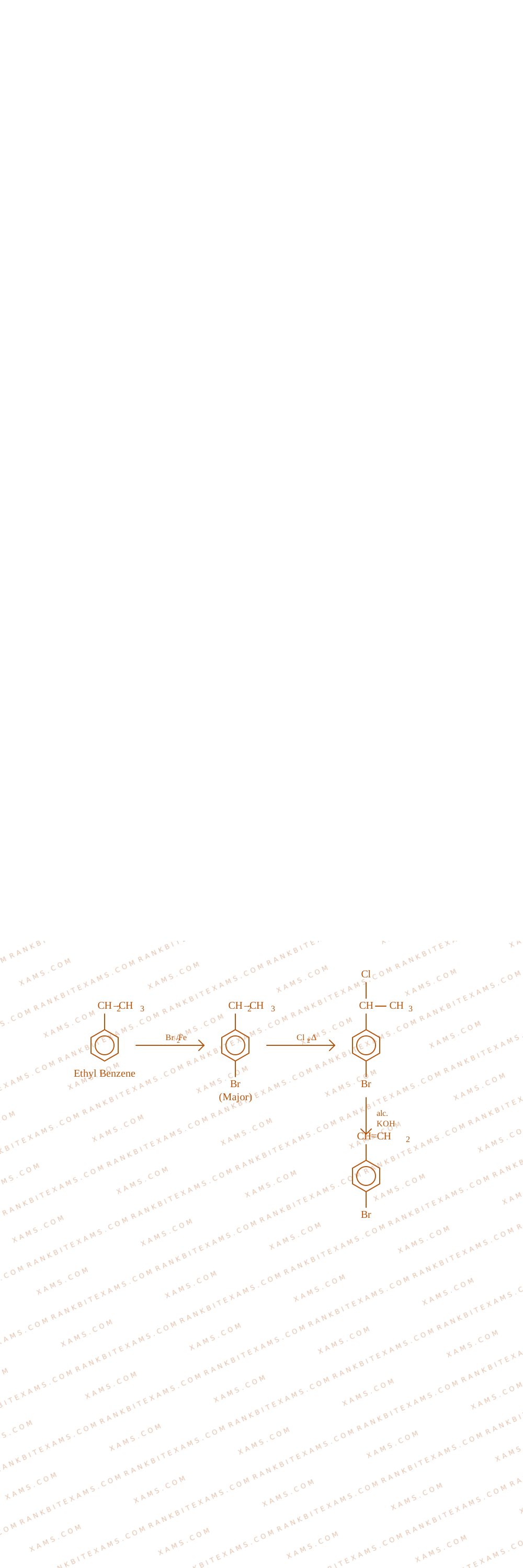
Choose the correct set of reagents for the following conversion: Ethyl benzene 4-bromostyrene {{Q_IMG1}}

Conversion scheme of ethylbenzene to 4-bromostyrene for Q29
The figure illustrates the multi-step conversion starting from ethylbenzene to yield a brominated styrene derivative.
Conversion scheme of ethylbenzene to 4-bromostyrene for Q29
The figure illustrates the multi-step conversion starting from ethylbenzene to yield a brominated styrene derivative.

Solution & Explanation

Core Logic

To synthesize 4-bromostyrene starting from ethyl benzene, we must carry out ring functionalization prior to developing the side-chain double bond:

  • Ring Bromination: Treatment of ethylbenzene with Br₂ in the presence of Fe (or FeBr₃) acts via electrophilic aromatic substitution. The ethyl group is an ortho/para director, yielding 1-bromo-4-ethylbenzene as the major product owing to steric mitigation.
  • Side-Chain Halogenation: Free radical substitution with Cl₂ under thermal conditions (Δ) or UV light specifically chlorinates the benzylic position because the benzylic radical is exceptionally stable via resonance.
  • Elimination: Heating with alcoholic KOH drives an E2 elimination of the benzylic chloride, cleanly synthesizing the terminal alkene linkage of the styrene system.
    Detailed mechanism of 4-bromostyrene synthesis from ethylbenzene
    The figure illustrates the multi-step conversion starting from ethylbenzene to yield a brominated styrene derivative.
Pattern Recognition

If you perform side-chain halogenation/alkene generation first, the ring substitution later would lack para-selectivity control and risk reacting across the alkene path. Hence, ring substitution MUST precede double bond creation.

Chapter Mix

Class 12 Chemistry: Haloalkanes and Haloarenes Class 11 Chemistry: Hydrocarbons

More Haloalkanes and Haloarenes Previous-Year Questions — Page 8

Q jee_main_2024_31_jan_evening IUPAC Nomenclature of Haloalkanes
Identify structure of 2,3-dibromo-1-phenylpentane.
  • A.
  • B.
  • C.
  • D.

Solution

Core Logic

Decode the IUPAC name: 2,3-dibromo-1-phenylpentane.

  • Parent chain is pentane (5 carbon chain: C1-C2-C3-C4-C5).
  • Substituents:
  • Phenyl group at position 1.
  • Bromo groups at positions 2 and 3.
  • Option (3) correctly displays a 5-carbon straight chain. The first carbon attaches to the benzene ring (phenyl group), and the second and third carbons each hold a bromine atom.
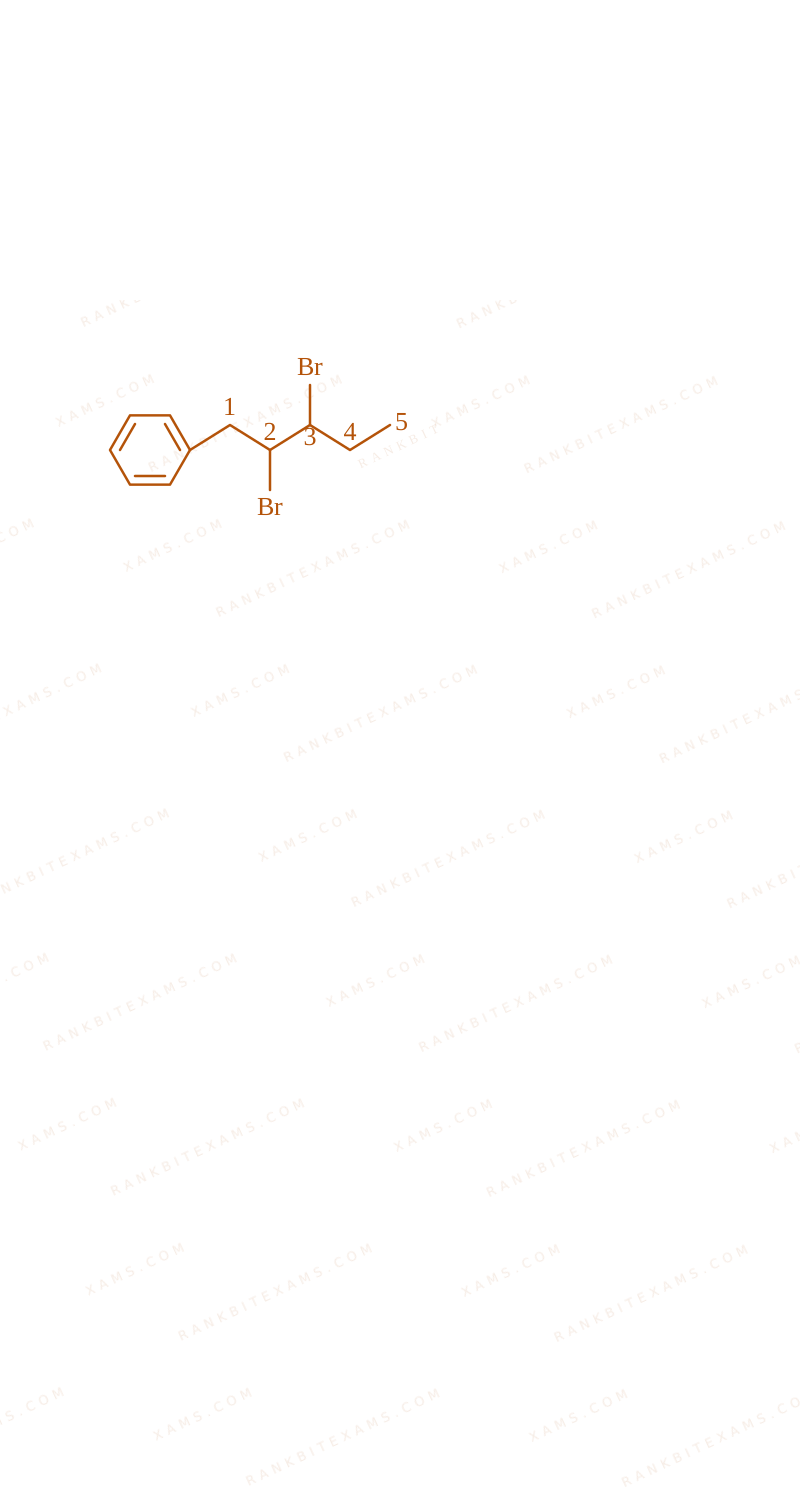
    IUPAC Nomenclature of Haloalkanes diagram for Q67 - JEE Main 2024 Evening
    IUPAC Nomenclature of Haloalkanes diagram for Q67 - JEE Main 2024 Evening

Chapter Mix

Class 12 Chemistry: Haloalkanes and Haloarenes

Q jee_main_2024_31_jan_morning Elimination and Addition Reactions
The product (C) in the below mentioned reaction is: CH₃-CH₂-CH₂-Br [Δ]KOH(alc) A [Δ]HBr B [Δ]KOH(aq) C
  • A. Propan-1-ol
  • B. Propene
  • C. Propyne
  • D. Propan-2-ol

Solution

Step 1: Elimination to form Propene
CH₃-CH₂-CH₂-Br KOH (alc), Δ CH₃-CH=CH₂ (Compound A: Propene)
Step 2: Electrophilic Addition of HBr

Addition of HBr follows Markovnikov's rule:

CH₃-CH=CH₂ + HBr Δ CH₃-CH(Br)-CH₃ (Compound B: 2-Bromopropane)
Step 3: Nucleophilic Substitution

Reaction with aqueous KOH leads to SN2/SN1 substitution of Br^- with OH^-:

CH₃-CH(Br)-CH₃ KOH (aq), Δ CH₃-CH(OH)-CH₃ (Compound C: Propan-2-ol)
Pattern Recognition

Alc. KOH gives elimination (alkene). Aq. KOH gives substitution (alcohol). HBr on unsymmetrical alkene gives Markovnikov addition.

Chapter Mix

Class 12 Chemistry: Haloalkanes and Haloarenes

Q86 jee_main_2024_31_jan_morning Elimination and Substitution
CH₃CH₂Br + NaOH arrow Product A CH₃CH₂Br + NaOH / H₂O arrow Product B The total number of hydrogen atoms in product A and product B is
Numerical Answer. Answer: 10 to 10

Solution

Core Logic

Reaction 1: If the reagent is alcoholic NaOH (implied due to formation of a distinct product A to contrast B), elimination occurs:

CH₃CH₂Br + NaOH (alc) arrow CH₂=CH₂ (Ethene)

Hydrogen atoms in ethene (C₂H₄) = 4.

Reaction 2: If the reagent is aqueous NaOH (NaOH / H₂O), nucleophilic substitution (SN2) occurs:

CH₃CH₂Br + NaOH (aq) arrow CH₃CH₂OH (Ethanol)

Hydrogen atoms in ethanol (C₂H₆O) = 6.

Total hydrogen atoms = 4 + 6 = 10.

Chapter Mix

Class 12 Chemistry: Haloalkanes and Haloarenes

Rankbit System
JEE Physics: Waves (+15.5%) | Electrostatics: Concentric Shells (-29.7%) | Modern Physics: Photoelectric Clones (+34.2%) | Mathematics: Definite Integrals (+18.1%) | Chemistry: Coordination Splitting (-11.4%) | JEE Physics: Waves (+15.5%) | Electrostatics: Concentric Shells (-29.7%) | Modern Physics: Photoelectric Clones (+34.2%) | Mathematics: Definite Integrals (+18.1%) | Chemistry: Coordination Splitting (-11.4%)