JEE Main · Chemistry ↓ Falling

Haloalkanes and Haloarenes appeared 38 times across 3 years — 4.4% of Chemistry. This question is from Preparation and Reactions of Styrene derivatives.

Year 2026 2025 2024 Total
Questions 11 15 12 38

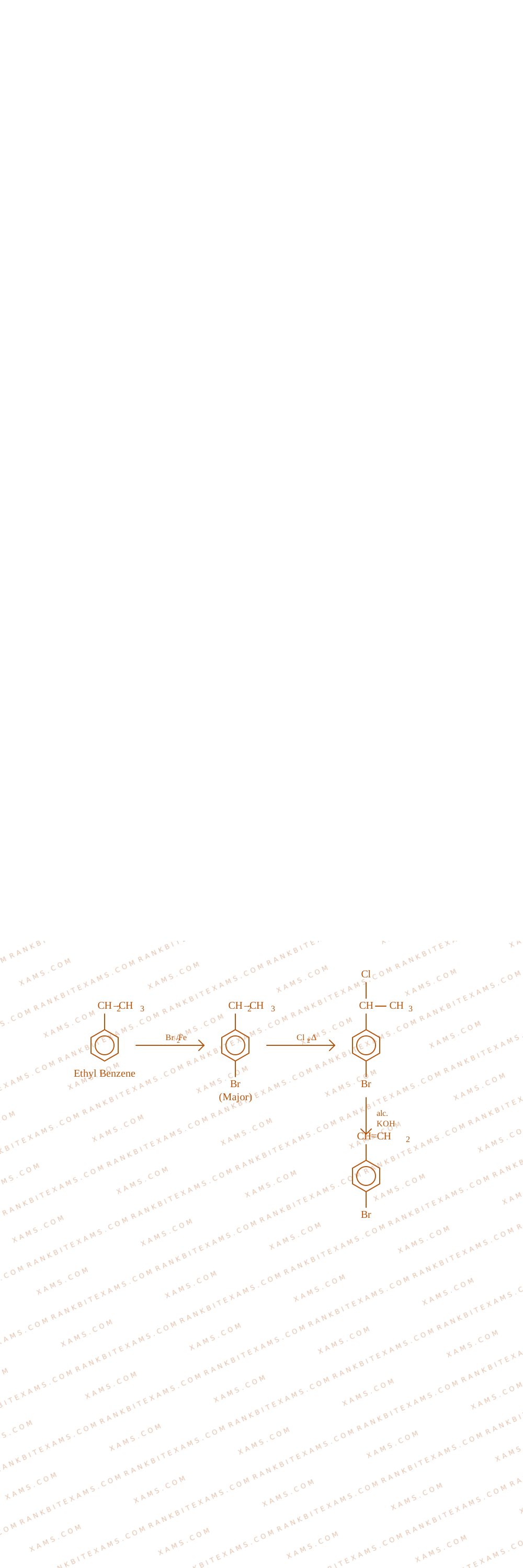
Choose the correct set of reagents for the following conversion: Ethyl benzene 4-bromostyrene {{Q_IMG1}}

Conversion scheme of ethylbenzene to 4-bromostyrene for Q29
The figure illustrates the multi-step conversion starting from ethylbenzene to yield a brominated styrene derivative.
Conversion scheme of ethylbenzene to 4-bromostyrene for Q29
The figure illustrates the multi-step conversion starting from ethylbenzene to yield a brominated styrene derivative.

Solution & Explanation

Core Logic

To synthesize 4-bromostyrene starting from ethyl benzene, we must carry out ring functionalization prior to developing the side-chain double bond:

  • Ring Bromination: Treatment of ethylbenzene with Br₂ in the presence of Fe (or FeBr₃) acts via electrophilic aromatic substitution. The ethyl group is an ortho/para director, yielding 1-bromo-4-ethylbenzene as the major product owing to steric mitigation.
  • Side-Chain Halogenation: Free radical substitution with Cl₂ under thermal conditions (Δ) or UV light specifically chlorinates the benzylic position because the benzylic radical is exceptionally stable via resonance.
  • Elimination: Heating with alcoholic KOH drives an E2 elimination of the benzylic chloride, cleanly synthesizing the terminal alkene linkage of the styrene system.
    Detailed mechanism of 4-bromostyrene synthesis from ethylbenzene
    The figure illustrates the multi-step conversion starting from ethylbenzene to yield a brominated styrene derivative.
Pattern Recognition

If you perform side-chain halogenation/alkene generation first, the ring substitution later would lack para-selectivity control and risk reacting across the alkene path. Hence, ring substitution MUST precede double bond creation.

Chapter Mix

Class 12 Chemistry: Haloalkanes and Haloarenes Class 11 Chemistry: Hydrocarbons

More Haloalkanes and Haloarenes Previous-Year Questions — Page 7

Q jee_main_2024_30_january_evening Stereochemistry of Halogenation
2-chlorobutane + Cl₂ arrow C₄H₈Cl₂ (isomers) Total number of optically active isomers shown by C₄H₈Cl₂, obtained in the above reaction is
Numerical Answer. Answer: 6 to 6

Solution

Core Logic

Free radical chlorination of 2-chlorobutane yields different constitutional isomers of dichlorobutane, each potentially existing as various stereoisomers.

Substrate: CH₃-CH(Cl)-CH₂-CH₃ (exists as 2 enantiomers: d and l) Chlorination can occur at 4 different carbons:

  • At C1: CH₂(Cl)-CH(Cl)-CH₂-CH₃ (1,2-dichlorobutane) arrow Two chiral centers, unsymmetrical. Forms 4 optically active isomers (2 pairs of enantiomers).
  • At C2: CH₃-C(Cl)₂-CH₂-CH₃ (2,2-dichlorobutane) arrow No chiral center. Achiral (0 optically active).
  • At C3: CH₃-CH(Cl)-CH(Cl)-CH₃ (2,3-dichlorobutane) arrow Symmetrical with 2 chiral centers. Forms 3 stereoisomers: 1 meso (achiral) and 2 optically active (1 enantiomeric pair).
  • At C4: CH₃-CH(Cl)-CH₂-CH₂(Cl) (1,3-dichlorobutane, numbering from other end) arrow One chiral center. Forms 2 optically active isomers (1 enantiomeric pair).
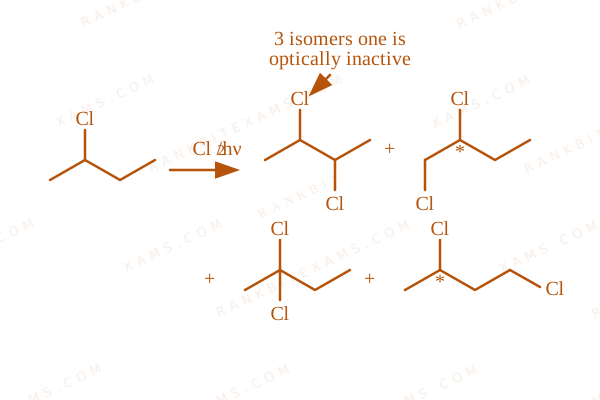
  • Optically active isomers of dichlorobutane diagram for Q89 - JEE Main 2024 Evening
    Optically active isomers of dichlorobutane diagram for Q89 - JEE Main 2024 Evening

Step 1: Sum the Optically Active Isomers

Total optically active isomers = 4 (from 1,2-dichloro) + 2 (from 2,3-dichloro) + 2 (from 1,3-dichloro) = 8.

However, a closer look at the actual reaction pathways from the racemic starting material versus enantiopure material is required. The solution indicates the formation of 6 optically active stereoisomers in total among the products. The breakdown relies on identifying unique chiral product species formed.

Pattern Recognition

When tracking total optically active products from a reaction, physically draw every stereocenter variation and eliminate meso compounds. Meso compounds have a plane of symmetry and are optically inactive.

Chapter Mix

Class 12 Chemistry: Haloalkanes and Haloarenes Class 11 Chemistry: Organic Chemistry Some Basic Principles and Techniques
Q63 jee_main_2024_30_january_evening Nucleophilic Substitution Reactions
Given below are two statements: Statement I: High concentration of strong nucleophilic reagent with secondary alkyl halides which do not have bulky substituents will follow SN2 mechanism. Statement II: A secondary alkyl halide when treated with a large excess of ethanol follows SN1 mechanism. In the light of the above statements, choose the most appropriate from the questions given below:
  • A. Statement I is true but Statement II is false.
  • B. Statement I is false but Statement II is true.
  • C. Both statement I and Statement II are false.
  • D. Both statement I and Statement II are true.

Solution

Core Logic

Statement I: Rate of SN2 ∝ [R-X][Nu^-]. Therefore, SN2 reaction is strongly favoured by a high concentration of a good/strong nucleophile and less steric crowding in the substrate molecule. Secondary alkyl halides without bulky substituents can undergo SN2 efficiently under these conditions. Thus, Statement I is true.

Statement II: Ethanol is a weak nucleophile and a polar protic solvent. When a secondary alkyl halide undergoes solvolysis (reaction where solvent is the nucleophile, like ethanol in large excess), it predominantly follows the SN1 mechanism involving a carbocation intermediate. Thus, Statement II is also true.

Step 1: Final Conclusion

Both Statement I and Statement II are correct.

Pattern Recognition

Strong nucleophile + high concentration = bimolecular pathway (SN2). Weak nucleophile (solvolysis) + polar protic solvent = unimolecular pathway (SN1).

Chapter Mix

Class 12 Chemistry: Haloalkanes and Haloarenes

Q jee_main_2024_30_jan_morning Classification
Example of vinylic halide is
  • A.
  • B.
  • C.
  • D.

Solution

Core Logic

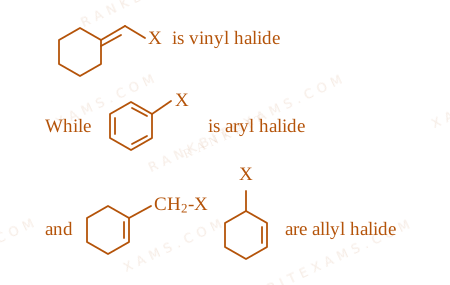
A vinylic halide is a compound where the halogen atom is directly bonded to an sp² hybridized carbon of an aliphatic double bond (C=C).

Step 1: Identifying the functional groups

Option 1: The halogen (X) is directly attached to the double-bonded carbon of the ring. This is a vinyl halide.

Classification solution diagram for Q69 - JEE Main 2024 Morning
Option 2: The halogen is attached to an aromatic ring directly. This is an aryl halide.
Classification solution diagram for Q69 - JEE Main 2024 Morning
Options 3 & 4: The halogen is attached to an sp³ hybridized carbon adjacent to a C=C double bond. These are allylic halides.
Classification solution diagram for Q69 - JEE Main 2024 Morning

Chapter Mix

Class 12 Chemistry: Haloalkanes and Haloarenes

Q74 jee_main_2024_30_jan_morning Classification
Given below are two statement one is labeled as Assertion (A) and the other is labeled as Reason (R). Assertion (A): CH₂=CH-CH₂-Cl is an example of allyl halide Reason (R): Allyl halides are the compounds in which the halogen atom is attached to sp² hybridised carbon atom. In the light of the two above statements, choose the most appropriate answer from the options given below:
  • A. (A) is true but (R) is false
  • B. Both (A) and (R) are true but (R) is not the correct explanation of (A)
  • C. (A) is false but (R) is true
  • D. Both (A) and (R) are true and (R) is the correct explanation of (A)

Solution

Core Logic

Assertion (A): CH₂=CH-CH₂-Cl is an allyl halide. This statement is True. The halogen is attached to the carbon adjacent to the double bond (allylic position).

Reason (R): Allyl halides are compounds in which the halogen atom is attached to an sp² hybridized carbon atom. This statement is False. In allyl halides, the halogen is attached to an sp³ hybridized carbon atom which is next to an sp² hybridized carbon (C=C double bond).

Step 1: Conclusion

Therefore, (A) is true but (R) is false.

Pattern Recognition

Allylic = sp³ C adjacent to C=C. Vinylic = sp² C of the C=C itself.

Chapter Mix

Class 12 Chemistry: Haloalkanes and Haloarenes

Q jee_main_2024_31_jan_evening Nucleophilic Aromatic Substitution
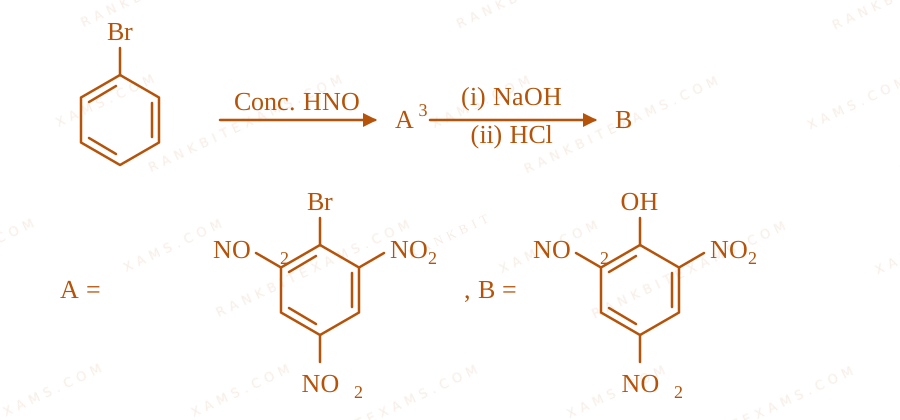
Identify A and B in the following reaction sequence.
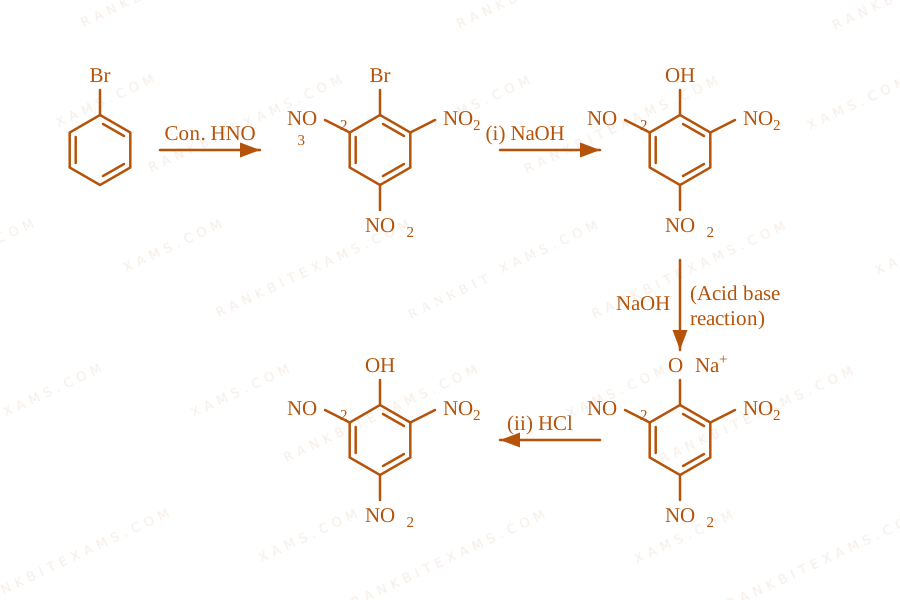
Nucleophilic Aromatic Substitution diagram for Q63 - JEE Main 2024 Evening
The image shows a reaction scheme starting from bromobenzene undergoing nitration followed by substitution.
  • A.
  • B.
  • C.
  • D.

Solution

Core Logic
  • When bromobenzene reacts with concentrated HNO₃ (nitration), the bromine atom is ortho/para directing. However, under drastic conditions with excess concentrated nitrating mixture, 1-bromo-2,4,6-trinitrobenzene is formed (Compound A).
  • When 1-bromo-2,4,6-trinitrobenzene (Compound A) is treated with NaOH, the presence of three strong electron-withdrawing -NO₂ groups activates the aromatic ring toward Nucleophilic Aromatic Substitution (SNAr). The -Br is easily replaced by -OH to form 2,4,6-trinitrophenol (picric acid).
  • Subsequent acidification with HCl yields the neutral picric acid (Compound B).
  • Nucleophilic Aromatic Substitution diagram for Q63 - JEE Main 2024 Evening
    The image shows a reaction scheme starting from bromobenzene undergoing nitration followed by substitution.

Pattern Recognition

Multiple NO₂ groups drastically increase the susceptibility of halobenzenes to SNAr. Bromine is replaced completely by OH^- under alkaline conditions.

Chapter Mix

Class 12 Chemistry: Haloalkanes and Haloarenes Class 12 Chemistry: Alcohols, Phenols and Ethers

Rankbit System
JEE Physics: Waves (+15.5%) | Electrostatics: Concentric Shells (-29.7%) | Modern Physics: Photoelectric Clones (+34.2%) | Mathematics: Definite Integrals (+18.1%) | Chemistry: Coordination Splitting (-11.4%) | JEE Physics: Waves (+15.5%) | Electrostatics: Concentric Shells (-29.7%) | Modern Physics: Photoelectric Clones (+34.2%) | Mathematics: Definite Integrals (+18.1%) | Chemistry: Coordination Splitting (-11.4%)