JEE Main · Chemistry ↓ Falling

Coordination Compounds appeared 68 times across 3 years — 7.9% of Chemistry. This question is from Isomerism in Coordination Compounds.

Year 2026 2025 2024 Total
Questions 19 34 15 68

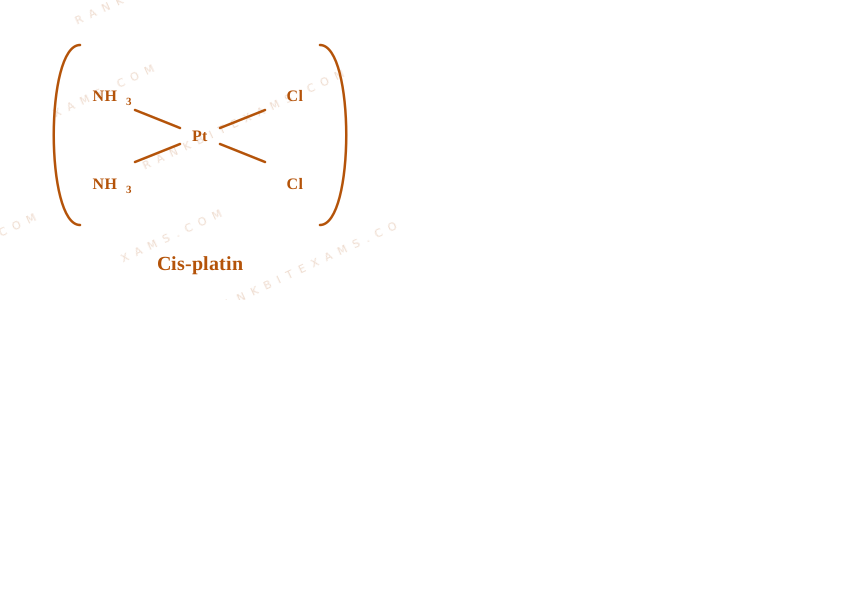
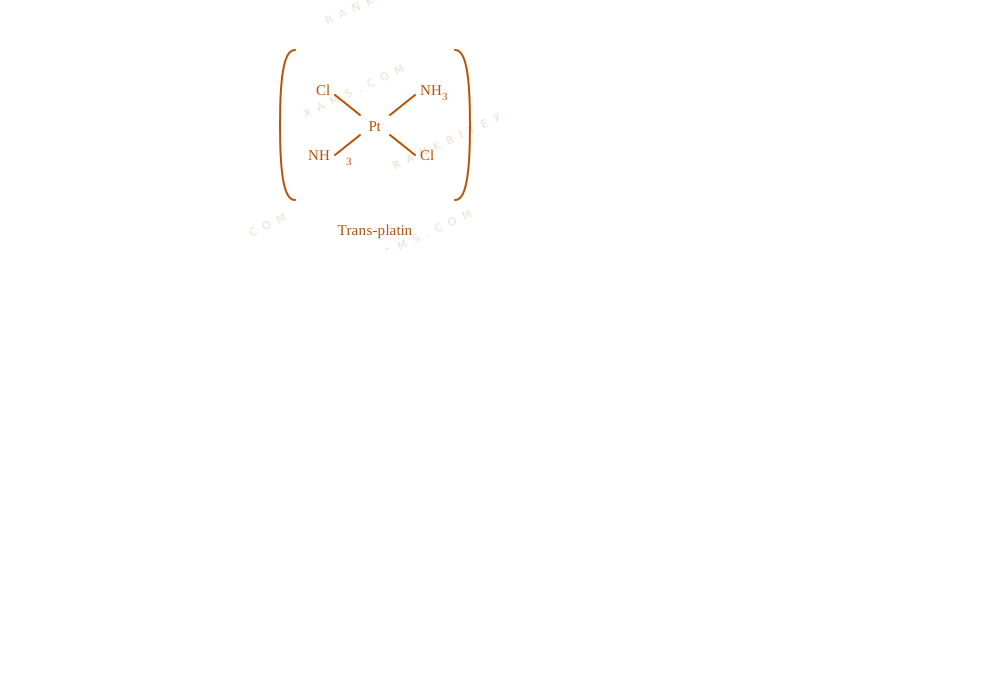
Given below are two statements: Statement I: A homoleptic octahedral complex, formed using monodentate ligands, will not show stereoisomerism. Statement II: cis- and trans-platin are heteroleptic complexes of Pd. In the light of the above statements, choose the correct answer from the options given below:

Solution & Explanation

Core Logic

Let us evaluate both statements individually:

  • Statement I: A homoleptic complex contains only one type of ligand. For an octahedral complex using monodentate ligands, the general formula is [Ma₆]. Since all coordination positions are populated identically by the exact same ligand, swapping spatial positions produces no structural difference, hence it cannot demonstrate geometrical or optical isomerism. Statement I is true.
    Stereochemical representation of octahedral homoleptic system
    Stereochemical representation of octahedral homoleptic system
  • Statement II: Cis-platin and trans-platin have the chemical formula [Pt(NH₃)₂Cl₂]. While they are indeed heteroleptic complexes, they are coordination coordinates of Platinum (Pt), not Palladium (Pd). Statement II is false.
    Stereochemical representation of octahedral homoleptic system
    Stereochemical representation of octahedral homoleptic system
Pattern Recognition

Always read element symbols with immense focus in coordination chemistry. Changing a single letter from Pt to Pd creates a false assertion trap designed to test parsing alertness rather than chemical difficulty.

Chapter Mix

Class 12 Chemistry: Coordination Compounds

Reference Study Guides

More Coordination Compounds Previous-Year Questions — Page 2

Q59 jee_main_2026_23_january_morning Crystal Field Splitting in Tetrahedral Complexes
Given below are two statements: Statement I: [CoBr₄]²⁻ ion will absorb light of lower energy than [CoCl₄]²⁻ ion. Statement II: In [CoI₄]²⁻ ion, the energy separation between the two set of d-orbitals is more than [CoCl₄]²⁻ ion. In the light of the above statements, choose the correct answer from the options given below :
  • A. Both Statement I and Statement II are false
  • B. Statement I is true but Statement II is false
  • C. Statement I is false but Statement II is true
  • D. Both Statement I and Statement II are true

Solution

Core Logic

Evaluate the ligand field strength from the spectrochemical series. Halide ligands are weak field ligands, with the order of their strength being I^- < Br^- < Cl^- < F^-.

Step 1: Statement I Evaluation

Since Cl^- is a stronger ligand than Br^-, the crystal field splitting energy (Δₜ) for [CoCl₄]²⁻ is greater than that of [CoBr₄]²⁻. Energy absorbed (E) is directly proportional to Δₜ. Therefore, [CoBr₄]²⁻ will absorb lower energy than [CoCl₄]²⁻. Statement I is True.

Step 2: Statement II Evaluation

Comparing [CoI₄]²⁻ and [CoCl₄]²⁻: I^- is a weaker ligand than Cl^-. Therefore, the energy separation (Δₜ) in [CoI₄]²⁻ will be less than in [CoCl₄]²⁻. Statement II states it is more, which is False.

Pattern Recognition

Spectrochemical series memorization shortcut for halides: I Brought Some Cloth (I- < Br- < S2- < Cl-).

Chapter Mix

Class 12 Chemistry: Coordination Compounds
Q63 jee_main_2026_23_january_morning Nickel DMG Complex
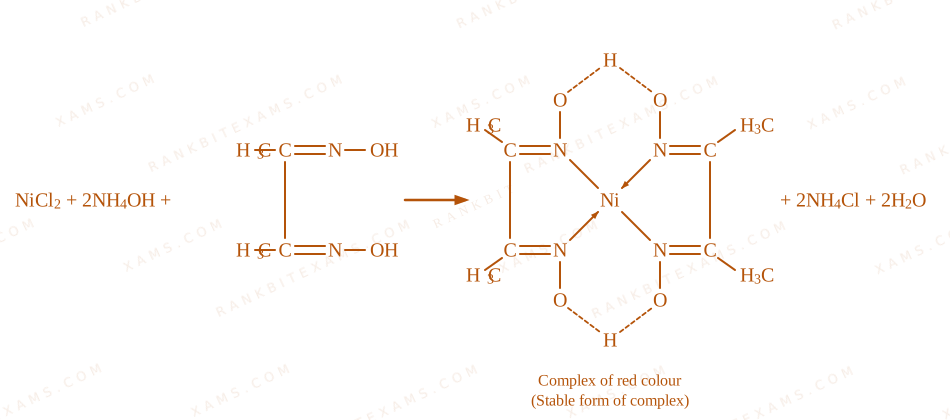
The statements that are incorrect about the nickel (II) complex of dimethylglyoxime are: A. It is red in colour B. It has a high solubility in water at pH = 9 C. The Ni ion has two unpaired d-electrons D. The N-Ni-N bond angle is almost close to 90° E. The complex contains four five-membered metallacycles (metal containing rings) Choose the correct answer from the options given below :
  • A. C and E only
  • B. A, D and B only
  • C. B, C and E only
  • D. C and D only

Solution

Core Logic

Analyze the structural and electronic properties of the [Ni(dmg)₂] complex.

Nickel DMG Complex diagram for Q63 - JEE Main 2026 Morning

Step 1: Evaluating Each Statement

(A) It is a rosy red precipitate. (True) (B) It forms a precipitate in a basic medium (like ammonium hydroxide), indicating it is insoluble in water at pH=9. (False) (C) The Ni²⁺ ion is 3d⁸. DMG is a strong field ligand in a square planar geometry, causing electron pairing (dsp² hybridization). Number of unpaired electrons = 0. (False) (D) Square planar geometry ensures N-Ni-N bond angles are close to 90^°. (True) (E) The complex contains two 5-membered rings and two 6-membered rings formed by hydrogen bonding. (False)

Step 2: Identifying Incorrect Statements

Statements B, C, and E are incorrect.

Pattern Recognition

Ni-DMG complex = Rosy red ppt, Square Planar (dsp²), Diamagnetic (n=0), Hydrogen bonded (extra stability).

Chapter Mix

Class 12 Chemistry: Coordination Compounds Class 11 Chemistry: Chemical Bonding and Molecular Structure

Q75 jee_main_2026_23_january_morning Crystal Field Splitting Energy Calculation
The crystal field splitting energy of [Co(oxalate)₃]³⁻ complex is 'n' times that of the [Cr(oxalate)₃]³⁻ complex. Here 'n' is ____. [Assume Δ₀ gg P]
Numerical Answer. Answer: 2 to 2

Solution

Related Formula
CFSE = ( -0.4 × n_t2g + 0.6 × neg ) Δ₀

(Note: Pairing energy is neglected with respect to Δ₀ based on assumption)

Core Logic

Since Δ₀ gg P (Strong field logic / low spin complexes), electrons will pair up in the lower energy t2g orbitals before occupying the higher energy eg orbitals. Identify the oxidation state and d-electron count for the central metal in both complexes.

Step 1: Cobalt Complex Analysis

Complex: [Co(ox)₃]³⁻ Cobalt oxidation state = +3. Electronic configuration of Co³⁺: [Ar] 3d⁶. Under Δ₀ gg P, the d⁶ configuration is t2g2,2,2 eg0,0 (i.e., t2g⁶ eg⁰). CFSECo³⁺ = 6 × (-0.4 Δ₀) = -2.4 Δ₀

Step 2: Chromium Complex Analysis

Complex: [Cr(ox)₃]³⁻ Chromium oxidation state = +3. Electronic configuration of Cr³⁺: [Ar] 3d³. Configuration is t2g1,1,1 eg0,0 (i.e., t2g³ eg⁰). CFSECr³⁺ = 3 × (-0.4 Δ₀) = -1.2 Δ₀

Step 3: Calculating n

Ratio n = CFSE of Co³⁺CFSE of Cr³⁺ n = (|-2.4 Δ₀|)/(|-1.2 Δ₀|) = 2

Crystal Field Splitting Energy Calculation diagram for Q75 - JEE Main 2026 Morning

Pattern Recognition

d⁶ low-spin always gives max CFSE for octahedral (-2.4 Δ₀). d³ is strictly half of that (-1.2 Δ₀). Ratio is always 2.

Chapter Mix

Class 12 Chemistry: Coordination Compounds

Q55 jee_main_2026_23_january_evening Valence Bond Theory
Identify the CORRECT set of details from the following: A. [Co(NH₃)₆]³⁺ : Inner orbital complex; d²sp³ hybridized B. [MnCl₆]³⁻ : Outer orbital complex; sp³d² hybridized C. [CoF₆]³⁻ : Outer orbital complex; d²sp³ hybridized D. [FeF₆]³⁻ : Outer orbital complex; sp³d² hybridized E. [Ni(CN)₄]²⁻ : Inner orbital complex; sp³ hybridized Choose the correct answer from the options given below:
  • A. C & D only
  • B. A, B & D only
  • C. A, C & E only
  • D. A, B, C, D & E

Solution

Core Logic

Evaluate each complex individually using Valence Bond Theory:

(A) [Co(NH₃)₆]³⁺: Central metal is Co³⁺ (3d⁶). NH₃ acts as a strong field ligand (SFL) for Co³⁺, causing pairing. This leads to d²sp³ hybridization, forming an inner orbital complex. (Correct)

(B) [MnCl₆]³⁻: Central metal is Mn³⁺ (3d⁴). Cl⁻ is a weak field ligand (WFL), so no pairing occurs. It utilizes outer 4d orbitals for hybridization (sp³d²), forming an outer orbital complex. (Correct)

(C) [CoF₆]³⁻: Central metal is Co³⁺ (3d⁶). F⁻ is a weak field ligand (WFL), causing no pairing. It undergoes sp³d² hybridization (outer orbital complex). The statement says it is d²sp³ hybridized, which is incorrect. (Incorrect)

(D) [FeF₆]³⁻: Central metal is Fe³⁺ (3d⁵). F⁻ is a weak field ligand (WFL), leading to no pairing. It undergoes sp³d² hybridization, making it an outer orbital complex. (Correct)

(E) [Ni(CN)₄]²⁻: Central metal is Ni²⁺ (3d⁸). CN⁻ is a strong field ligand (SFL), causing pairing. It undergoes dsp² hybridization (inner orbital complex/square planar), not sp³. (Incorrect)

Step 1: Final Conclusion

Only statements A, B, and D are correct.

Pattern Recognition

Spectrochemical series dictates SFL vs WFL. Co³⁺ with NH₃ is a classic exception to memorize: NH₃ behaves as a SFL with Co³⁺ (pairing occurs), whereas it acts as a WFL with many +2 ions.

Chapter Mix

Class 12 Chemistry: Coordination Compounds

Q74 jee_main_2026_23_january_evening Crystal Field Theory
Total number of unpaired electrons present in the central metal atoms/ions of [Ni(CO)₄], [NiCl₄]²⁻, [PtCl₂(NH₃)₂], [Ni(CN₄)]²⁻ and [Pt(CN₄)]²⁻ is __.
Numerical Answer. Answer: 2 to 2

Solution

Core Logic

Let's determine the electronic configuration, oxidation state, and ligand nature for each complex:

  • [Ni(CO)₄]:
  • Oxidation state of Ni = 0. Configuration: 3d⁸ 4s². CO is a strong field ligand. The 4s electrons are pushed into the 3d orbital, making it a 3d¹⁰ configuration. It is sp³ hybridized and diamagnetic. Unpaired electrons = 0.

  • [NiCl₄]²⁻:
  • Oxidation state of Ni = +2. Configuration: 3d⁸. Cl^- is a weak field ligand, so no pairing of the d⁸ electrons occurs. The configuration is t2g⁶ eg². It is sp³ hybridized. Unpaired electrons = 2.

  • [PtCl₂(NH₃)₂]:
  • Oxidation state of Pt = +2. Configuration: 5d⁸. For 4d and 5d series metals, nearly all ligands act as strong field ligands. This causes pairing, leading to a dsp² hybridized square planar geometry. Unpaired electrons = 0.

  • [Ni(CN)₄]²⁻:
  • Oxidation state of Ni = +2. Configuration: 3d⁸. CN^- is a strong field ligand, forcing electron pairing. It becomes dsp² hybridized. Unpaired electrons = 0.

  • [Pt(CN)₄]²⁻:
  • Oxidation state of Pt = +2. Configuration: 5d⁸. As established, 5d metals strictly form low spin complexes. CN^- causes pairing (dsp²). Unpaired electrons = 0.

Step 1: Total Sum

Summing all unpaired electrons across all listed complexes: 0 + 2 + 0 + 0 + 0 = 2.

Pattern Recognition

Metals from 4d and 5d series (like Pd, Pt) ALWAYS form inner-orbital/low-spin complexes regardless of the ligand strength. So, d⁸ configurations in Pd²⁺ and Pt²⁺ will always pair up to yield zero unpaired electrons.

Chapter Mix

Class 12 Chemistry: Coordination Compounds

More Coordination Compounds Questions — jee_main_2025_08_april_evening

Practice all Coordination Compounds previous-year questions →

Rankbit System
JEE Physics: Waves (+15.5%) | Electrostatics: Concentric Shells (-29.7%) | Modern Physics: Photoelectric Clones (+34.2%) | Mathematics: Definite Integrals (+18.1%) | Chemistry: Coordination Splitting (-11.4%) | JEE Physics: Waves (+15.5%) | Electrostatics: Concentric Shells (-29.7%) | Modern Physics: Photoelectric Clones (+34.2%) | Mathematics: Definite Integrals (+18.1%) | Chemistry: Coordination Splitting (-11.4%)