JEE Main · Chemistry ↓ Falling

Coordination Compounds appeared 68 times across 3 years — 7.9% of Chemistry. This question is from Isomerism in Coordination Compounds.

Year 2026 2025 2024 Total
Questions 19 34 15 68

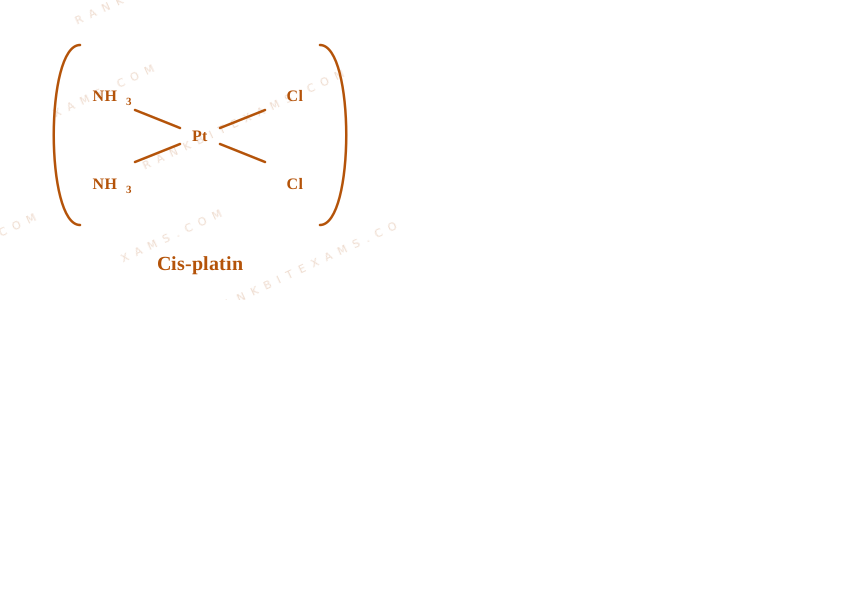
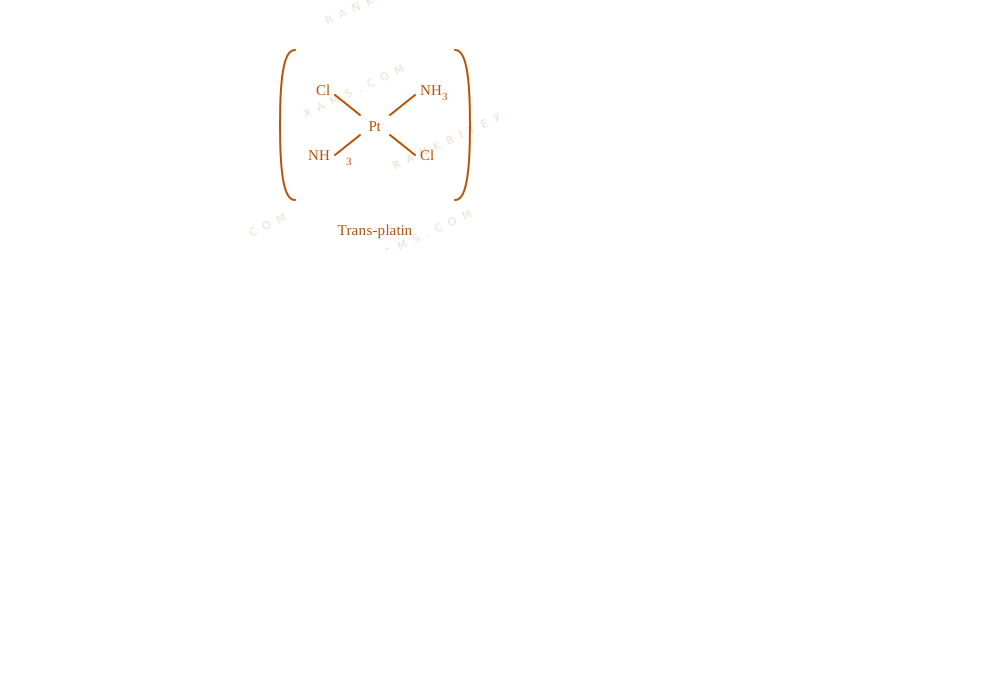
Given below are two statements: Statement I: A homoleptic octahedral complex, formed using monodentate ligands, will not show stereoisomerism. Statement II: cis- and trans-platin are heteroleptic complexes of Pd. In the light of the above statements, choose the correct answer from the options given below:

Solution & Explanation

Core Logic

Let us evaluate both statements individually:

  • Statement I: A homoleptic complex contains only one type of ligand. For an octahedral complex using monodentate ligands, the general formula is [Ma₆]. Since all coordination positions are populated identically by the exact same ligand, swapping spatial positions produces no structural difference, hence it cannot demonstrate geometrical or optical isomerism. Statement I is true.
    Stereochemical representation of octahedral homoleptic system
    Stereochemical representation of octahedral homoleptic system
  • Statement II: Cis-platin and trans-platin have the chemical formula [Pt(NH₃)₂Cl₂]. While they are indeed heteroleptic complexes, they are coordination coordinates of Platinum (Pt), not Palladium (Pd). Statement II is false.
    Stereochemical representation of octahedral homoleptic system
    Stereochemical representation of octahedral homoleptic system
Pattern Recognition

Always read element symbols with immense focus in coordination chemistry. Changing a single letter from Pt to Pd creates a false assertion trap designed to test parsing alertness rather than chemical difficulty.

Chapter Mix

Class 12 Chemistry: Coordination Compounds
Reference Study Guides

More Coordination Compounds Previous-Year Questions — Page 10

Q33 jee_main_2025_24_jan_evening Qualitative Analysis of Cations
Find the compound 'A' from the following reaction sequences. A aqua-regia B (1) KNO2 | NH4OH, (2) AcOH yellow ppt
  • A. \text{ZnS}
  • B. \text{CoS}
  • C. \text{MnS}
  • D. \text{NiS}

Solution

Core Logic

This pathway corresponds to the standard confirmatory test for cobalt (Co²⁺) ions in qualitative inorganic analysis:

  • CoS dissolves in aqua regia to yield cobalt chloride (CoCl₂):
CoS + aqua regia arrow CoCl₂
  • Treating this solution with potassium nitrite (KNO₂) in the presence of acetic acid (AcOH) oxidizes Co²⁺ to Co³⁺, precipitating potassium cobaltinitrite as a characteristic yellow solid:
CoCl₂ + 7KNO₂ + 2CH₃COOH arrow K₃[Co(NO₂)₆] (yellow) + 2NaCl + NO + 2CH₃COOK + H₂O
Pattern Recognition

A yellow precipitate formed specifically upon adding KNO₂ and acetic acid is a definitive signature of potassium cobaltinitrite, K₃[Co(NO₂)₆]. This confirms the starting sulfide was CoS.

Chapter Mix

Class 12 Chemistry: Coordination Compounds Class 11 Chemistry: Qualitative Analysis
Q37 jee_main_2025_24_jan_evening Spectrochemical Series and Colour
When Ethane-1, 2-diamine is added progressively to an aqueous solution of Nickel (II) chloride, the sequence of colour change observed will be:
  • A. \text{Pale Blue } \rightarrow \text{ Blue } \rightarrow \text{ Green } \rightarrow \text{ Violet}
  • B. \text{Pale Blue } \rightarrow \text{ Blue } \rightarrow \text{ Violet } \rightarrow \text{ Green}
  • C. \text{Green } \rightarrow \text{ Pale Blue } \rightarrow \text{ Blue } \rightarrow \text{ Violet}
  • D. \text{Violet } \rightarrow \text{ Blue } \rightarrow \text{ Pale Blue } \rightarrow \text{ Green}

Solution

Core Logic

An aqueous nickel (II) chloride solution contains the green hexaquarickel(II) complex, [Ni(H₂O)₆]²⁺. Ethane-1,2-diamine ('en') is a bidentate ligand that binds more strongly than water, shifting the crystal field splitting parameter (Δₒ) to higher energies as it replaces water molecules:

  • Initial state:
[Ni(H₂O)₆]²⁺ (Green)
  • Adding 1 equivalent of 'en' forms a mono-en complex:
[Ni(H₂O)₆]²⁺ + en arrow [Ni(H₂O)₄(en)]²⁺ (Pale Blue) + 2H₂O
  • Adding a 2nd equivalent forms a bis-en complex:
[Ni(H₂O)₄(en)]²⁺ + en arrow [Ni(H₂O)₂(en)₂]²⁺ (Blue / Purple) + 2H₂O
  • Adding a 3rd equivalent forms the tris-en complex:
[Ni(H₂O)₂(en)₂]²⁺ + en arrow [Ni(en)₃]²⁺ (Violet) + 2H₂O

This progressive ligand replacement shifts the absorption spectrum, changing the solution's visible color from Green arrow Pale Blue arrow Blue arrow Violet.

Pattern Recognition

Replacing weak-field ligands (like H₂O) with stronger bidentate chelating ligands (like 'en') increases crystal field splitting. For Ni²⁺, this ligand substitution always follows the specific chromatic progression: Green arrow Pale Blue arrow Blue arrow Violet.

Chapter Mix

Class 12 Chemistry: Coordination Compounds

Q38 jee_main_2025_24_jan_evening Crystal Field Theory
The conditions and consequence that favours the t2g³ eg¹ configuration in a metal complex are:
  • A. \text{weak field ligand, high spin complex}
  • B. \text{strong field ligand, high spin complex}
  • C. \text{strong field ligand, low spin complex}
  • D. \text{weak field ligand, low spin complex}

Solution

Core Logic

Consider an octahedral coordination environment for a d⁴ transition metal ion configuration:

  • Weak Field Ligand (WFL):
  • The crystal field splitting energy is smaller than the pairing energy (Δₒ < P). Consequently, electrons prefer to occupy the higher-energy eg orbitals rather than pair up in the lower-energy t2g orbitals. This leads to a high spin complex with the configuration:

t2g³ eg¹
  • Strong Field Ligand (SFL):
  • The splitting energy is larger than the pairing energy (Δₒ > P). Electrons pair up in the t2g orbitals before occupying the eg subshell, resulting in a low spin complex with the configuration:

t2g⁴ eg⁰
Pattern Recognition

An electron occupying an eg orbital before the t2g orbitals are fully paired requires a weak-field ligand. This configuration maximizes the number of unpaired electrons, which is the defining characteristic of a high-spin complex.

Chapter Mix

Class 12 Chemistry: Coordination Compounds

Q28 jee_main_2025_24_jan_morning Werner's Theory of Coordination Compounds
One mole of the octahedral complex compound Co(NH₃)₅Cl₃ gives 3 moles of ions on dissolution in water. One mole of the same complex reacts with excess of AgNO₃ solution to yield two moles of AgCl(s). The structure of the complex is:
  • A. [Co(NH₃)₅Cl]Cl₂
  • B. [Co(NH₃)₄Cl].Cl₂.NH₃
  • C. [Co(NH₃)₄Cl₂]Cl.NH₃
  • D. [Co(NH₃)₃Cl₃].2NH₃

Solution

Related Formula
Moles of AgCl precipitated = Moles of ionizable Cl⁻ ions outside the coordination sphere
Core Logic

Since 1 mole of the complex yields 2 moles of AgCl(s), there must be exactly 2 chloride ions outside the coordination sphere to undergo precipitation:

[Co(NH₃)₅Cl]Cl₂ arrow [Co(NH₃)₅Cl]²⁺(aq) + 2Cl⁻(aq)

This dissociation produces a total of 3 moles of ions per mole of the complex, perfectly consistent with the problem constraints.

Pattern Recognition

Number of precipitated AgCl moles directly equates to the count of counter-anions located outside the square brackets.

Chapter Mix

Class 12 Chemistry: Coordination Compounds

Q36 jee_main_2025_28_jan_evening Valence Bond Theory and Hybridization
Match List-I with List-II.
List-I (Complex)List-II (Hybridisation of central metal ion)
(A) [CoF₆]³⁻(I) d²sp³
(B) [NiCl₄]²⁻(II) sp³
(C) [Co(NH₃)₆]³⁺(III) sp³d²
(D) [Ni(CN)₄]²⁻(IV) dsp²
Choose the correct answer from the options given below :
  • A. (A)-(I), (B)-(IV), (C)-(III), (D)-(II)
  • B. (A)-(III), (B)-(II), (C)-(I), (D)-(IV)
  • C. (A)-(I), (B)-(II), (C)-(III), (D)-(IV)
  • D. (A)-(III), (B)-(IV), (C)-(I), (D)-(II)

Solution

Related Formula

Coordination Number 6 corresponds to either d²sp³ or sp³d² configuration templates. Coordination Number 4 corresponds to either sp³ or dsp² configuration templates.

Core Logic

Analyzing metal orbital dynamics under varying ligand fields:

  • (A) [CoF₆]³⁻: Co³⁺ (3d⁶) with a weak field ligand (F^-) arrow no pairing occurs arrow utilizes outer orbitals arrow sp³d².
  • (B) [NiCl₄]²⁻: Ni²⁺ (3d⁸) with a weak field ligand (Cl^-) arrow no pairing occurs arrow tetrahedral profile arrow sp³.
  • (C) [Co(NH₃)₆]³⁺: Co³⁺ (3d⁶) with a strong field ligand (NH₃) arrow electrons pair up arrow inner orbital configuration arrow d²sp³.
  • (D) [Ni(CN)₄]²⁻: Ni²⁺ (3d⁸) with a strong field ligand (CN^-) arrow forced pairing opens a 3d slot arrow square planar geometry arrow dsp².
Step 1: Final Pairing Match

The completed matching configuration aligns cleanly with: (A)-(III), (B)-(II), (C)-(I), (D)-(IV).

Pattern Recognition

Isolate coordination frameworks quickly:

  • Nickel(II) with weak field ligands (Cl^-) yields sp³, while with strong field ligands (CN^-) it yields dsp².
  • Cobalt(III) with weak field ligands (F^-) yields sp³d², while with strong field ligands (NH₃) it yields d²sp³.
Chapter Mix

Class 12 Chemistry: Coordination Compounds

More Coordination Compounds Questions — jee_main_2025_08_april_evening

Practice all Coordination Compounds previous-year questions →

Rankbit System
JEE Physics: Waves (+15.5%) | Electrostatics: Concentric Shells (-29.7%) | Modern Physics: Photoelectric Clones (+34.2%) | Mathematics: Definite Integrals (+18.1%) | Chemistry: Coordination Splitting (-11.4%) | JEE Physics: Waves (+15.5%) | Electrostatics: Concentric Shells (-29.7%) | Modern Physics: Photoelectric Clones (+34.2%) | Mathematics: Definite Integrals (+18.1%) | Chemistry: Coordination Splitting (-11.4%)