### Core Logic
Let us apply Valence Bond Theory (VBT) and crystal field rules to evaluate each coordination complex:
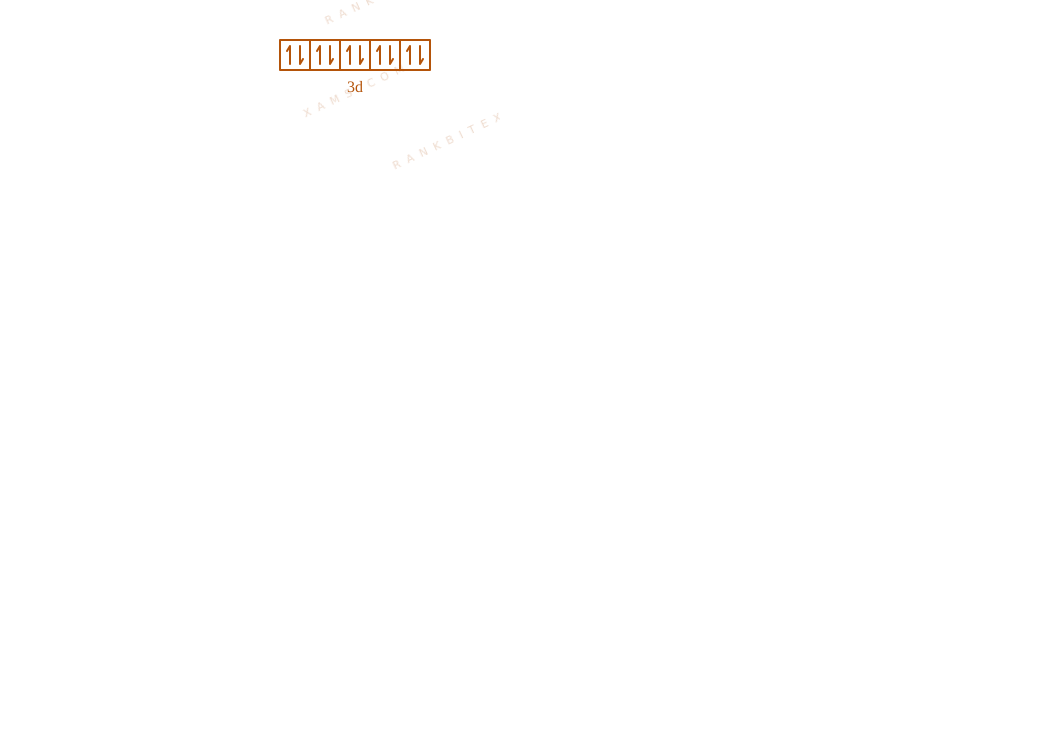
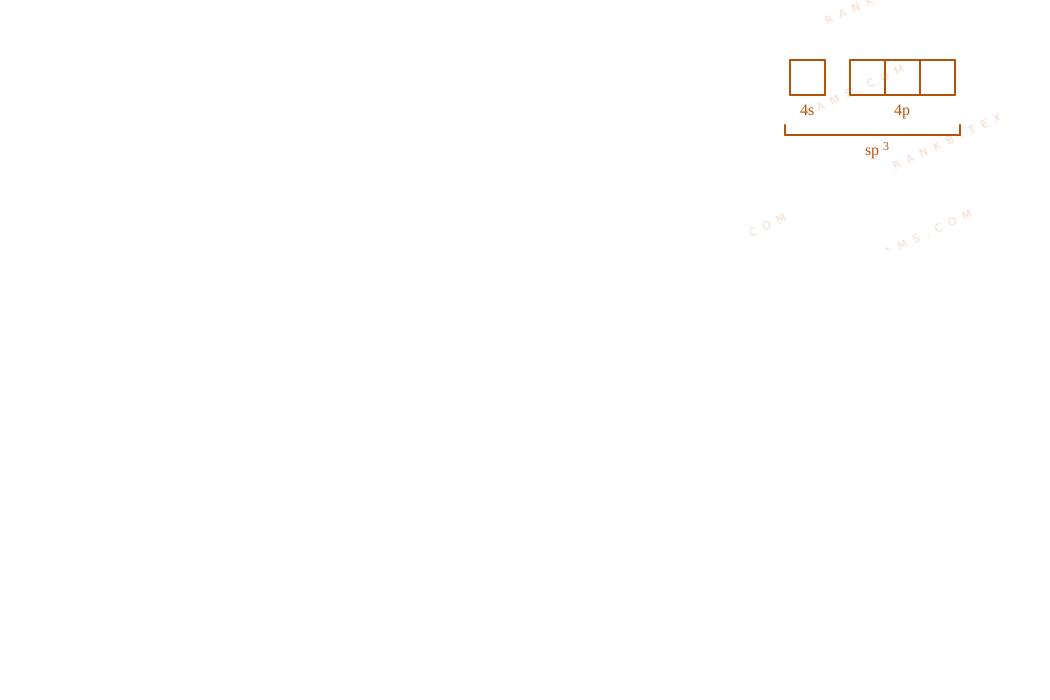
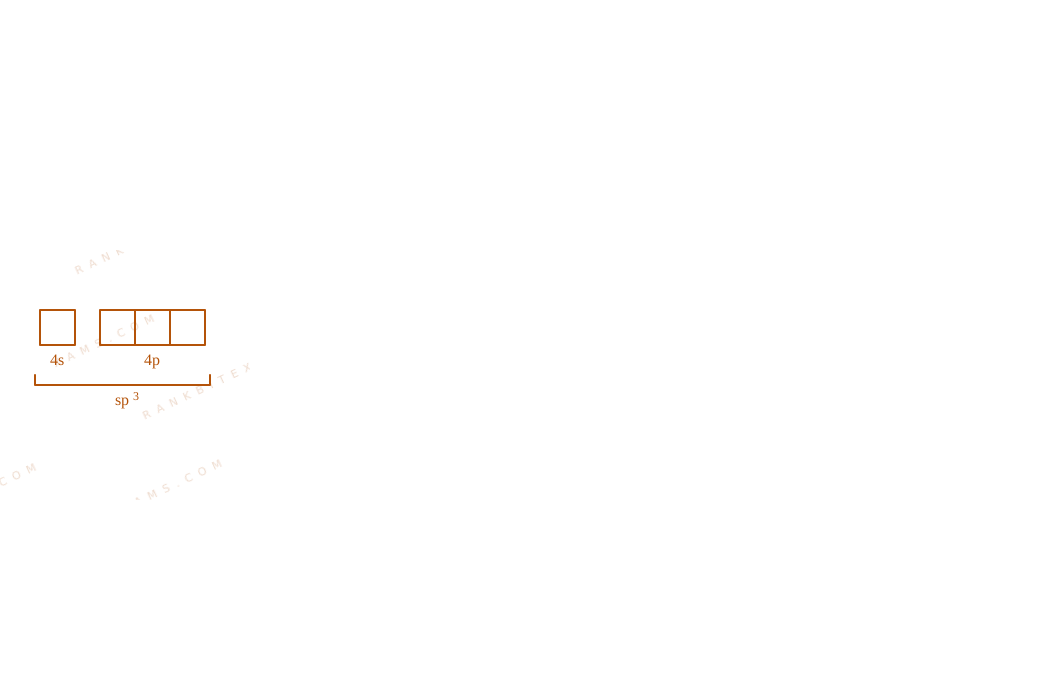
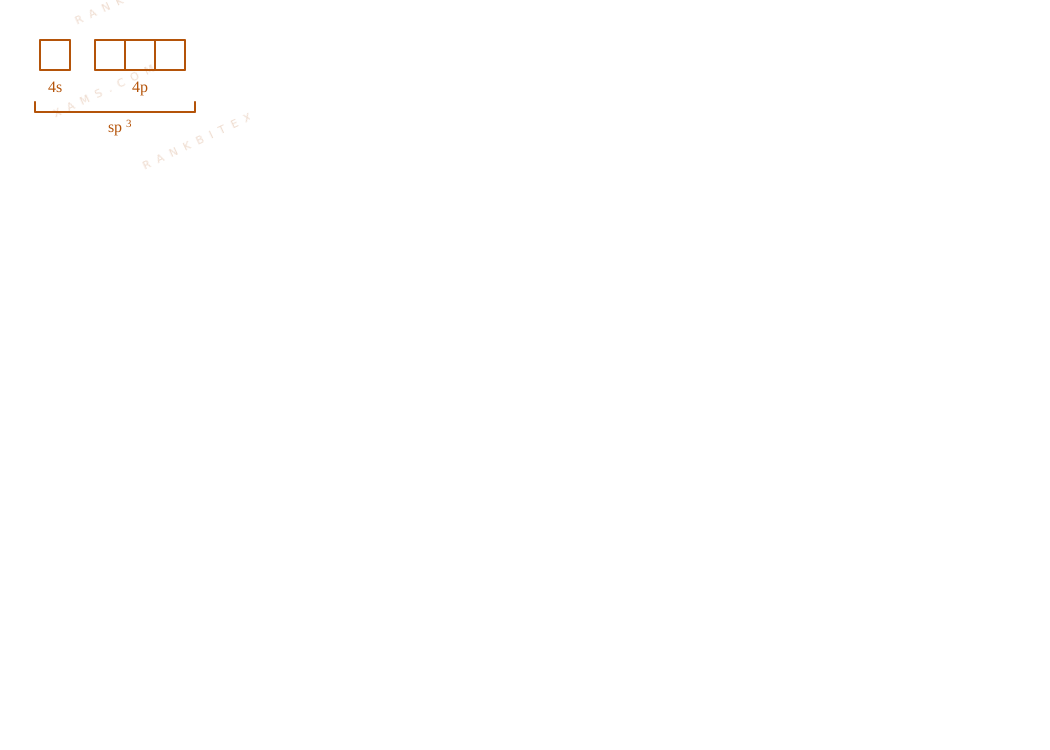
* **A. [textNi(CO)_4]$[\text{Ni(CO)}_4]$**: Nickel is in the 0$0$ oxidation state (3d^8 4s^2$3d^8 4s^2$). Carbon monoxide (textCO$\text{CO}$) is a strong field ligand, forcing the 4s$4s$ electrons into the 3d$3d$ shell to produce a fully paired 3d^10$3d^{10}$ configuration. The vacant 4s$4s$ and three 4p$4p$ orbitals hybridize into an **sp^3$sp^3$ tetrahedral** geometry. All spins are paired, so mu = 0 text BM$\mu = 0 \text{ BM}$. Thus, textA rightarrow textIII$\text{A} \rightarrow \text{III}$. Valence orbital diagram for nickel tetracarbonyl sp3 system
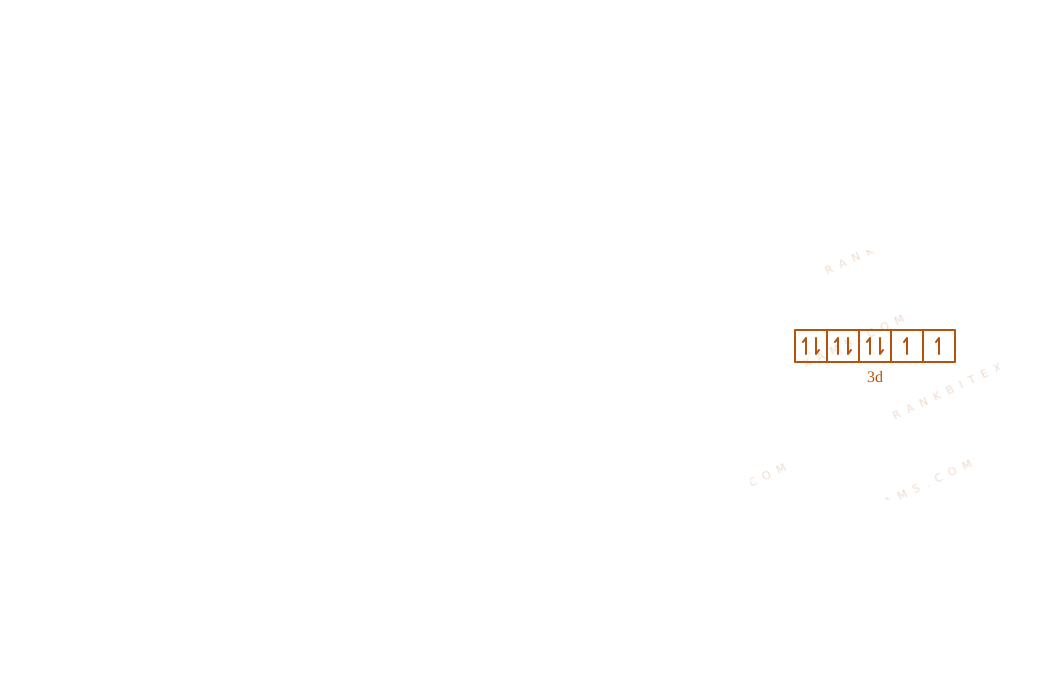
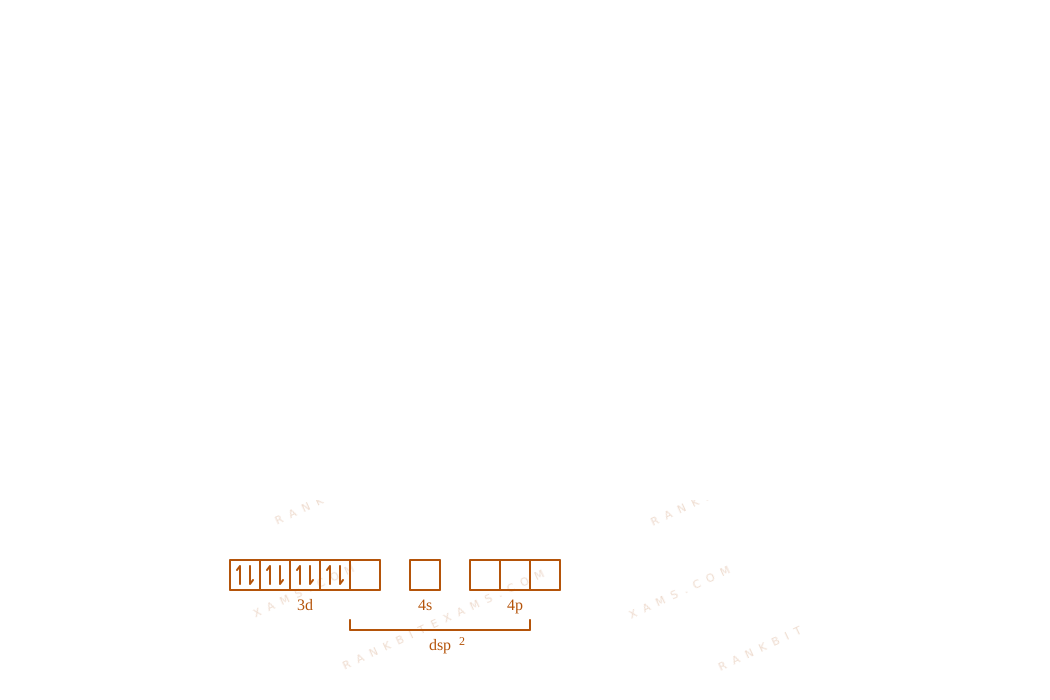
* **B. [textNi(CN)_4]^2-$[\text{Ni(CN)}_4]^{2-}$**: Nickel is in the +2$+2$ state (3d^8$3d^8$). Cyanide (textCN^-$\text{CN}^-$) is a strong field ligand, forcing the pairing of the two unpaired 3d$3d$ electrons. This leaves one internal 3d$3d$ orbital vacant, leading to **dsp^2$dsp^2$ square planar** hybridization with zero unpaired electrons (mu = 0 text BM$\mu = 0 \text{ BM}$). Thus, textB rightarrow textII$\text{B} \rightarrow \text{II}$. Valence orbital diagram for nickel tetracarbonyl sp3 system
* **C. [textNiCl_4]^2-$[\text{NiCl}_4]^{2-}$**: Nickel is in the +2$+2$ state (3d^8$3d^8$). Chloride (textCl^-$\text{Cl}^-$) is a weak field ligand, leaving the two 3d$3d$ electrons unpaired (n = 2$n = 2$). The system adopts **sp^3$sp^3$ tetrahedral** hybridization with a spin-only moment of mu = sqrt2(2+2) = sqrt8 approx 2.8 text BM$\mu = \sqrt{2(2+2)} = \sqrt{8} \approx 2.8 \text{ BM}$. Thus, textC rightarrow textI$\text{C} \rightarrow \text{I}$. Valence orbital diagram for nickel tetracarbonyl sp3 system
* **D. [textMnBr_4]^2-$[\text{MnBr}_4]^{2-}$**: Manganese is in the +2$+2$ state (3d^5$3d^5$). Bromide (textBr^-$\text{Br}^-$) is a weak field ligand, preserving five unpaired parallel spins (n = 5$n = 5$). The geometry is **sp^3$sp^3$ tetrahedral** with a maximum spin-only moment of mu = sqrt5(5+2) = sqrt35 approx 5.9 text BM$\mu = \sqrt{5(5+2)} = \sqrt{35} \approx 5.9 \text{ BM}$. Thus, textD rightarrow textIV$\text{D} \rightarrow \text{IV}$. Valence orbital diagram for nickel tetracarbonyl sp3 system
### Step 1: Alignment Summary
Consolidating our results:
textA-III, B-II, C-I, D-IV$$\text{A-III, B-II, C-I, D-IV}$$
This matches Option (3).
### Pattern Recognition
Nickel complexes provide classic benchmarks: Nickel zero tetracarbonyl is always tetrahedral diamagnetic. Nickel +2$+2$ tetracyanide is square planar diamagnetic due to strong ligand field pairing. Spotting these properties cuts down the problem solving time significantly.
### Evaluation Rubric / Model Answer
null
### Chapter Mix
Class 12 Chemistry: Coordination Compounds
Valence orbital diagram for nickel tetracarbonyl sp3 systemValence orbital diagram for nickel tetracarbonyl sp3 systemValence orbital diagram for nickel tetracarbonyl sp3 system
Keywords:#nickel coordination VBT#tetrahedral magnetic moment calculation#square planar diamagnetic complex#JEE Main 2025 Chemistry Q44
More Coordination Compounds Previous-Year Questions — Page 2
Q40jee_main_2025_02_april_morningCrystal Field Theory
Given below are two statements :
Statement (I): In octahedral complexes, when Delta_0 < P$\Delta_0 < P$ high spin complexes are formed. When Delta_0 > P$\Delta_0 > P$ low spin complexes are formed.
Statement (II) : In tetrahedral complexes because of Delta_mathrmt < mathrmP$\Delta_{\mathrm{t}} < \mathrm{P}$, low spin complexes are rarely formed.
In the light of the above statements, choose the most appropriate answer from the options given below:
A.(1)\ textStatement I is correct but Statement II is incorrect.$(1)\ \text{Statement I is correct but Statement II is incorrect.}$
B.(2)\ textBoth Statement I and Statement II are incorrect$(2)\ \text{Both Statement I and Statement II are incorrect}$
C.(3)\ textStatement I is incorrect but Statement II is correct$(3)\ \text{Statement I is incorrect but Statement II is correct}$
D.(4)\ textBoth Statement I and Statement II are correct$(4)\ \text{Both Statement I and Statement II are correct}$
Solution
### Related Formula
Crystal field splitting values relation for matching configuration choices:
Delta_mathrmt = frac49Delta_0$$\Delta_{\mathrm{t}} = \frac{4}{9}\Delta_0$$
### Core Logic
Let's verify both rules based on Crystal Field Theory principles:
* **Statement I**: In octahedral configurations, if pairing penalty energy P$P$ exceeds field split magnitude Delta_0$\Delta_0$, electrons prefer moving to upper sub-shells, creating high-spin states. Conversely, if Delta_0 > P$\Delta_0 > P$, forced pairing occurs, creating low-spin complexes. (Statement I is accurate).
* **Statement II**: Because tetrahedral configurations separate by an extremely narrow gap magnitude Delta_mathrmt$\Delta_{\mathrm{t}}$ (about half of octahedral field splits), the value almost never exceeds standard pairing energy P$P$. Electrons consistently choose higher sub-levels rather than pairing up, meaning low-spin arrangements are extremely rare. (Statement II is accurate).
### Step 1: Verdict
Therefore, both Statement I and Statement II are correct.
### Pattern Recognition
Tetrahedral configurations are systematically assumed to be high-spin unless special structural properties dictate otherwise, due to the Delta_mathrmt < P$\Delta_{\mathrm{t}} < P$ constraint.
### Evaluation Rubric / Model Answer
null
### Chapter Mix
Class 12 Chemistry: Coordination Compounds
Qjee_main_2025_03_april_eveningMagnetic Properties and Hybridization of Complexes
Identify the diamagnetic octahedral complex ions from below;
A. [mathrmMn(mathrmCN)_6]^3-$[\mathrm{Mn}(\mathrm{CN})_6]^{3-}$
B. [mathrmCo(mathrmNH_3)_6]^3+$[\mathrm{Co}(\mathrm{NH}_3)_6]^{3+}$
C. [mathrmFe(mathrmCN)_6]^4-$[\mathrm{Fe}(\mathrm{CN})_6]^{4-}$
D. [mathrmCo(mathrmH_2mathrmO)_3mathrmF_3]$[\mathrm{Co}(\mathrm{H}_2\mathrm{O})_3\mathrm{F}_3]$
Choose the correct answer from the options given below :
A. B and D Only
B. A and D Only
C. A and C Only
D. B and C Only
Solution
### Related Formula
According to Crystal Field Theory (CFT):
- A complex is diamagnetic if all electrons are paired up (unpaired electrons, n=0$n=0$).
- Strong field ligands (like mathrmCN^-$\mathrm{CN}^-$, mathrmNH_3$\mathrm{NH}_3$ with Co^3+$Co^{3+}$) cause pairing of electrons if Delta_o > P$\Delta_o > P$.
{{SOLUTION_IMG}}
### Core Logic
Analyze each complex:
- **A. [mathrmMn(mathrmCN)_6]^3-$[\mathrm{Mn}(\mathrm{CN})_6]^{3-}$**:
- Mn^3+$Mn^{3+}$ has d^4$d^4$ configuration.
- Strong field ligand mathrmCN^-$\mathrm{CN}^-$ causes pairing in t_2g$t_{2g}$ orbitals: t_2g^4 e_g^0$t_{2g}^4 e_g^0$.
- There are 2 unpaired electrons rightarrow$\rightarrow$ *Paramagnetic*.
- **B. [mathrmCo(mathrmNH_3)_6]^3+$[\mathrm{Co}(\mathrm{NH}_3)_6]^{3+}$**:
- Co^3+$Co^{3+}$ has d^6$d^6$ configuration.
- mathrmNH_3$\mathrm{NH}_3$ acts as strong field ligand with Co^3+$Co^{3+}$, causing complete pairing: t_2g^6 e_g^0$t_{2g}^6 e_g^0$.
- No unpaired electrons rightarrow$\rightarrow$ *Diamagnetic*.
### Step 1: Analyze complexes C and D
- **C. [mathrmFe(mathrmCN)_6]^4-$[\mathrm{Fe}(mathrm{CN})_6]^{4-}$**:
- Fe^2+$Fe^{2+}$ has d^6$d^6$ configuration.
- Strong field ligand mathrmCN^-$\mathrm{CN}^-$ causes complete pairing: t_2g^6 e_g^0$t_{2g}^6 e_g^0$.
- No unpaired electrons rightarrow$\rightarrow$ *Diamagnetic*.
- **D. [mathrmCo(mathrmH_2mathrmO)_3mathrmF_3]$[\mathrm{Co}(\mathrm{H}_2\mathrm{O})_3\mathrm{F}_3]$**:
- Co^3+$Co^{3+}$ has d^6$d^6$ configuration.
- Weak field ligands (mathrmF^-$\mathrm{F}^-$, mathrmH_2mathrmO$\mathrm{H}_2\mathrm{O}$) do not cause pairing: t_2g^4 e_g^2$t_{2g}^4 e_g^2$.
- There are 4 unpaired electrons rightarrow$\rightarrow$ *Paramagnetic*.
### Step 2: Conclusion
Only complexes B and C are diamagnetic, matching Option (4).
### Pattern Recognition
Octahedral d^6$d^6$ ions (such as Co^3+$Co^{3+}$ or Fe^2+$Fe^{2+}$) coupled with strong-field ligands are exceptionally stable and always form low-spin, fully paired, diamagnetic complexes (t_2g^6 e_g^0$t_{2g}^6 e_g^0$).
### Evaluation Rubric / Model Answer
null
### Chapter Mix
Class 12 Chemistry: Coordination Compounds

Q44jee_main_2025_07_april_morningIsomerism in Coordination Compounds
An octahedral complex having molecular composition mathrmCo cdot 5NH_3 cdot Cl cdot SO_4$\mathrm{Co \cdot 5NH_3 \cdot Cl \cdot SO_4}$ has two isomers A and B. The solution of A gives a white precipitate with mathrmAgNO_3$\mathrm{AgNO_3}$ solution and the solution of B gives a white precipitate with mathrmBaCl_2$\mathrm{BaCl_2}$ solution. The type of isomerism exhibited by the complex is:
### Core Logic
The complex molecular composition is mathrmCo cdot 5NH_3 cdot Cl cdot SO_4$\mathrm{Co \cdot 5NH_3 \cdot Cl \cdot SO_4}$. Let's formulate the formulas for the two isomers:
1. **Isomer A**: Gives a white precipitate of mathrmAgCl$\mathrm{AgCl}$ when reacted with mathrmAgNO_3$\mathrm{AgNO_3}$. This means free chloride ions (mathrmCl^-$\mathrm{Cl}^-$) are present in the outer ionization sphere:
[mathrmCo(NH_3)_5(SO_4)]mathrmCl$$[\mathrm{Co(NH_3)_5(SO_4)}]\mathrm{Cl}$$
2. **Isomer B**: Gives a white precipitate of mathrmBaSO_4$\mathrm{BaSO_4}$ when reacted with mathrmBaCl_2$\mathrm{BaCl_2}$. This means free sulphate ions (mathrmSO_4^2-$\mathrm{SO}_4^{2-}$) are present in the outer ionization sphere:
[mathrmCo(NH_3)_5Cl]mathrmSO_4$$[\mathrm{Co(NH_3)_5Cl}]\mathrm{SO_4}$$
Since these two isomers yield different ions in solution due to exchange of ligands between the coordination sphere and the ionization sphere, they exhibit **Ionisation isomerism**.
### Pattern Recognition
Test for ions:
- mathrmAgNO_3$\mathrm{AgNO_3}$ PPT rightarrow$\rightarrow$ free halide ion in outer sphere.
- mathrmBaCl_2$\mathrm{BaCl_2}$ PPT rightarrow$\rightarrow$ free sulphate ion in outer sphere.
- Outer-inner ion exchanges are always called **Ionisation isomerism**.
### Evaluation Rubric / Model Answer
null
### Chapter Mix
Class 12 Chemistry: Coordination Compounds
Q50jee_main_2025_07_april_morningValence Bond Theory
The number of paramagnetic complexes among [mathrmFeF_6]^3-$[\mathrm{FeF}_{6}]^{3-}$, [mathrmFe(CN)_6]^3-$[\mathrm{Fe(CN)}_{6}]^{3-}$, [mathrmMn(CN)_6]^3-$[\mathrm{Mn(CN)}_{6}]^{3-}$, [mathrmCo(C_2mathrmO_4)_3]^3-$[\mathrm{Co(C}_{2}\mathrm{O}_{4})_{3}]^{3-}$, [mathrmMnCl_6]^3-$[\mathrm{MnCl}_{6}]^{3-}$ and [mathrmCoF_6]^3-$[\mathrm{CoF}_{6}]^{3-}$, which involve mathrmd^2mathrmsp^3$\mathrm{d}^{2}\mathrm{sp}^{3}$ hybridization is ______.
Numerical Answer.Answer: 2 to 2
Solution
### Core Logic
Let's systematically analyze the coordination, ligand strength, hybridization, and magnetic behavior of each complex:
1. **[mathrmFeF_6]^3-$[\mathrm{FeF}_{6}]^{3-}$**:
- mathrmFe^3+$\mathrm{Fe}^{3+}$ (3mathrmd^5$3\mathrm{d}^5$). mathrmF^-$\mathrm{F}^-$ is a weak-field ligand (WFL). No pairing occurs.
- Outer-orbital complex: mathrmsp^3mathrmd^2$\mathrm{sp}^3\mathrm{d}^2$.
- Paramagnetic (5$5$ unpaired electrons).
2. **[mathrmFe(CN)_6]^3-$[\mathrm{Fe(CN)}_{6}]^{3-}$**:
- mathrmFe^3+$\mathrm{Fe}^{3+}$ (3mathrmd^5$3\mathrm{d}^5$). mathrmCN^-$\mathrm{CN}^-$ is a strong-field ligand (SFL). Pairing occurs.
- Config: mathrmt_2mathrmg^5\ mathrme_mathrmg^0$\mathrm{t}_{2\mathrm{g}}^5\ \mathrm{e}_{\mathrm{g}}^0$ (one unpaired electron remains implies$\implies$ **Paramagnetic**).
- Inner-orbital complex: **mathrmd^2mathrmsp^3$\mathrm{d}^2\mathrm{sp}^3$**.
3. **[mathrmMn(CN)_6]^3-$[\mathrm{Mn(CN)}_{6}]^{3-}$**:
- mathrmMn^3+$\mathrm{Mn}^{3+}$ (3mathrmd^4$3\mathrm{d}^4$). mathrmCN^-$\mathrm{CN}^-$ is an SFL. Pairing occurs.
- Config: mathrmt_2mathrmg^4\ mathrme_mathrmg^0$\mathrm{t}_{2\mathrm{g}}^4\ \mathrm{e}_{\mathrm{g}}^0$ (two unpaired electrons remain implies$\implies$ **Paramagnetic**).
- Inner-orbital complex: **mathrmd^2mathrmsp^3$\mathrm{d}^2\mathrm{sp}^3$**.
4. **[mathrmCo(C_2mathrmO_4)_3]^3-$[\mathrm{Co(C}_2\mathrm{O}_4)_3]^{3-}$**:
- mathrmCo^3+$\mathrm{Co}^{3+}$ (3mathrmd^6$3\mathrm{d}^6$). Oxalate is a chelating SFL here. Full pairing occurs.
- Config: mathrmt_2mathrmg^6\ mathrme_mathrmg^0$\mathrm{t}_{2\mathrm{g}}^6\ \mathrm{e}_{\mathrm{g}}^0$ (zero unpaired electrons implies$\implies$ Diamagnetic).
- Inner-orbital complex: mathrmd^2mathrmsp^3$\mathrm{d}^2\mathrm{sp}^3$.
5. **[mathrmMnCl_6]^3-$[\mathrm{MnCl}_{6}]^{3-}$**:
- mathrmMn^3+$\mathrm{Mn}^{3+}$ (3mathrmd^4$3\mathrm{d}^4$). mathrmCl^-$\mathrm{Cl}^-$ is a WFL. No pairing occurs.
- Outer-orbital complex: mathrmsp^3mathrmd^2$\mathrm{sp}^3\mathrm{d}^2$.
- Paramagnetic (4$4$ unpaired electrons).
6. **[mathrmCoF_6]^3-$[\mathrm{CoF}_{6}]^{3-}$**:
- mathrmCo^3+$\mathrm{Co}^{3+}$ (3mathrmd^6$3\mathrm{d}^6$). mathrmF^-$\mathrm{F}^-$ is a WFL. No pairing occurs.
- Outer-orbital complex: mathrmsp^3mathrmd^2$\mathrm{sp}^3\mathrm{d}^2$.
- Paramagnetic (4$4$ unpaired electrons).
Thus, only [mathrmFe(CN)_6]^3-$[\mathrm{Fe(CN)}_{6}]^{3-}$ and [mathrmMn(CN)_6]^3-$[\mathrm{Mn(CN)}_{6}]^{3-}$ are both **paramagnetic** and involve **mathrmd^2mathrmsp^3$\mathrm{d}^2\mathrm{sp}^3$** hybridization.
### Pattern Recognition
VBT shortcut:
- Strong-field ligand complexes with d^4text--d^6$d^4\text{--}d^6$ central ions form inner-orbital mathrmd^2mathrmsp^3$\mathrm{d}^2\mathrm{sp}^3$ complexes.
- Of those, check the number of electrons: d^6$d^6$ is completely paired (diamagnetic), but d^5$d^5$ ([Fe(CN)_6]^3-$[Fe(CN)_6]^{3-}$) and d^4$d^4$ ([Mn(CN)_6]^3-$[Mn(CN)_6]^{3-}$) both leave unpaired electrons in the t_2g$t_{2g}$ orbitals (paramagnetic).
### Evaluation Rubric / Model Answer
Detailed individual classification of each complex based on VBT/CFT to yield the correct count of 2$2$ inner-orbital paramagnetic complexes.
### Chapter Mix
Class 12 Chemistry: Coordination Compounds
Q31jee_main_2025_08_april_eveningIsomerism in Coordination Compounds
Given below are two statements:
Statement I: A homoleptic octahedral complex, formed using monodentate ligands, will not show stereoisomerism.
Statement II: cis- and trans-platin are heteroleptic complexes of Pd.
In the light of the above statements, choose the correct answer from the options given below:
A.textBoth Statement I and Statement II are false.$\text{Both Statement I and Statement II are false.}$
B.textStatement I is false but Statement II is true.$\text{Statement I is false but Statement II is true.}$
C.textBoth Statement I and Statement II are true.$\text{Both Statement I and Statement II are true.}$
D.textStatement I is true but Statement II is false.$\text{Statement I is true but Statement II is false.}$
Solution
### Core Logic
Let us evaluate both statements individually:
* **Statement I**: A homoleptic complex contains only one type of ligand. For an octahedral complex using monodentate ligands, the general formula is [Ma_6]$[Ma_6]$. Since all coordination positions are populated identically by the exact same ligand, swapping spatial positions produces no structural difference, hence it cannot demonstrate geometrical or optical isomerism. **Statement I is true.** Stereochemical representation of octahedral homoleptic system
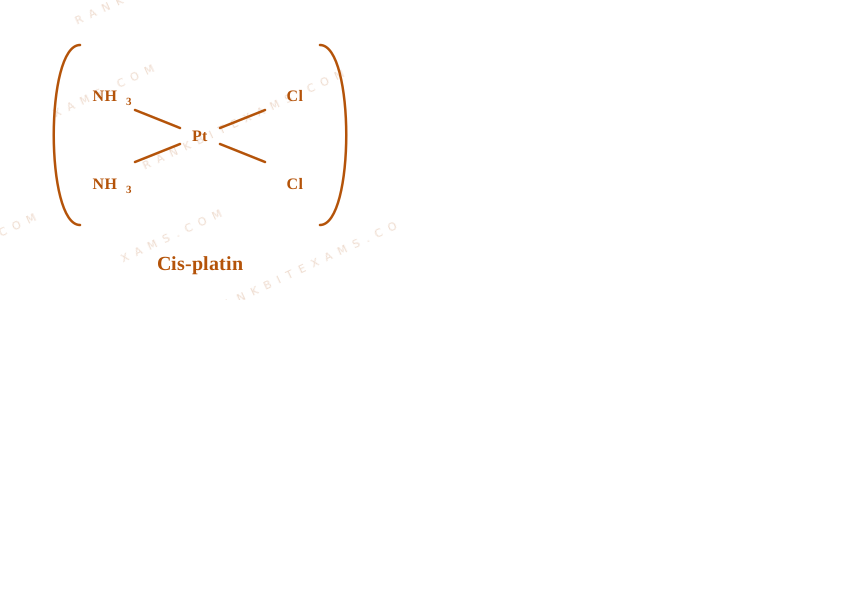
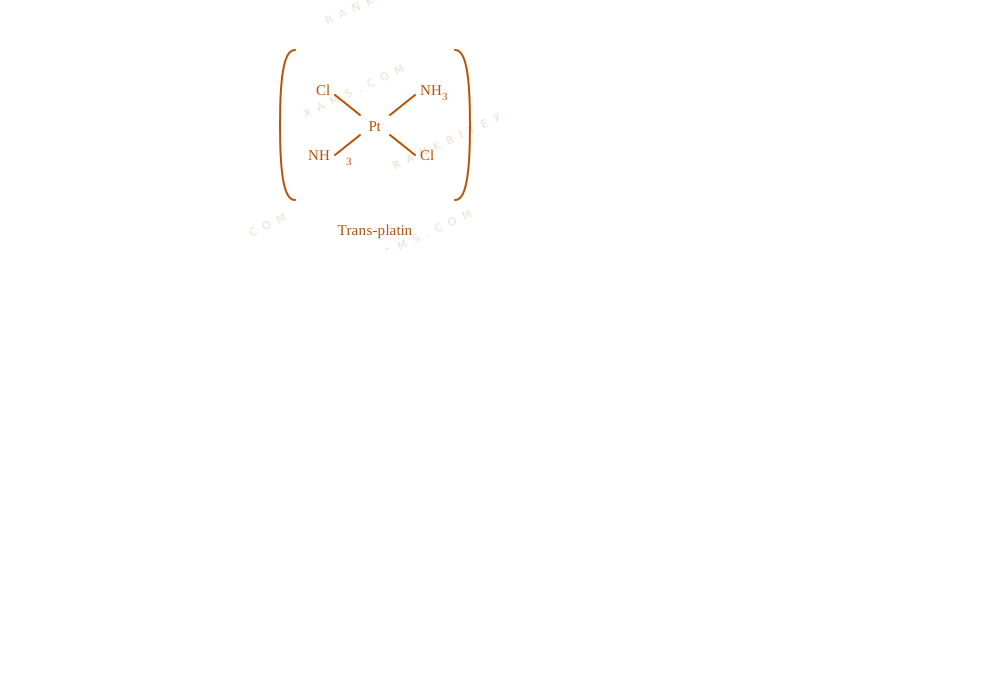
* **Statement II**: Cis-platin and trans-platin have the chemical formula [Pt(NH_3)_2Cl_2]$[Pt(NH_3)_2Cl_2]$. While they are indeed heteroleptic complexes, they are coordination coordinates of **Platinum (Pt$Pt$)**, not Palladium (Pd$Pd$). **Statement II is false.** Stereochemical representation of octahedral homoleptic system
### Pattern Recognition
Always read element symbols with immense focus in coordination chemistry. Changing a single letter from Pt to Pd creates a false assertion trap designed to test parsing alertness rather than chemical difficulty.
### Evaluation Rubric / Model Answer
null
### Chapter Mix
Class 12 Chemistry: Coordination Compounds
More Coordination Compounds Questions — jee_main_2025_08_april_evening
We Map Every Repeating Question in Competitive Exams.
Say goodbye to generic mock test fatigue. RankBit uses smart analysis to group past exam questions into their foundational Repeating Question Types. Find chapter weightage, track repeating questions, and score higher with targeted practice.
Select Your Target Exam
Choose an exam track below to find formulas per chapter and patterns.
Syncing Exam Intelligence
Mapping formulas and patterns across all tracks…
PATH A — FULL LENGTH PRACTICE
Full Mock Test Hub
Simulate real NTA exam conditions with fully tracked mocks. Time yourself against past papers.
Practice past-year questions one chapter at a time. Pick an exam → subject → chapter and get every PYQ for that topic — pulled together from all past papers — with the chapter's key formulas alongside.