Aldehydes, Ketones and Carboxylic Acids appeared 46 times across 3 years — 5.3% of Chemistry.
This question is from Reactions of Cycloalkenes and Alkynes.
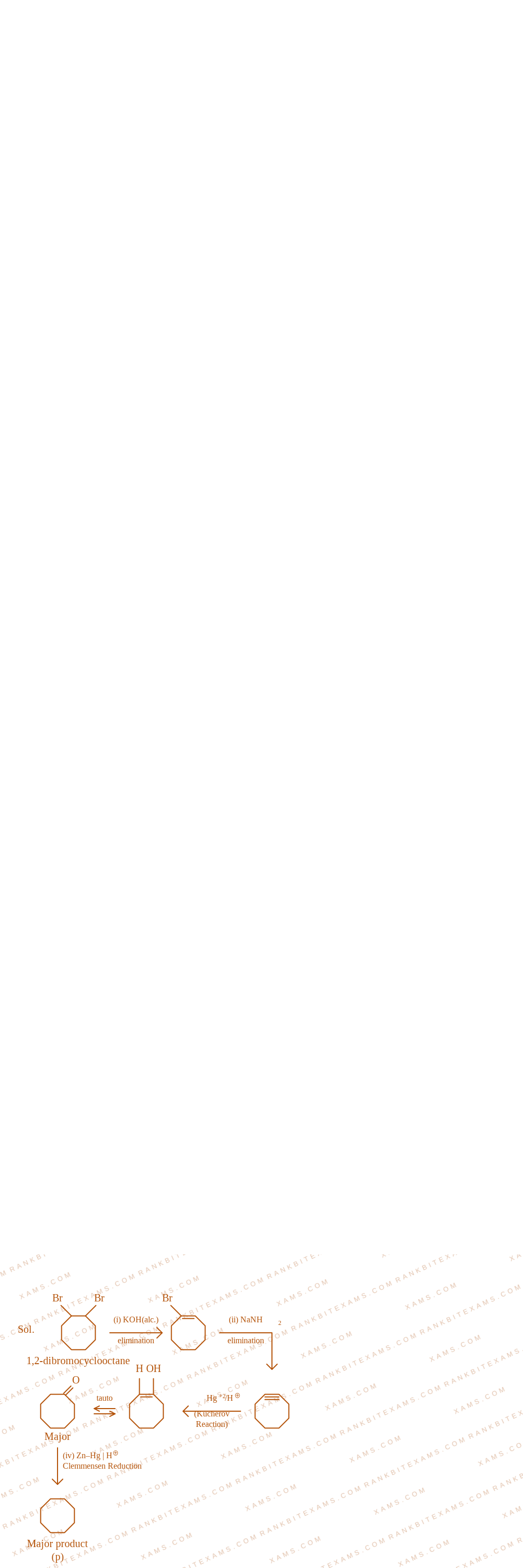
Let us systematically follow the transformation steps:
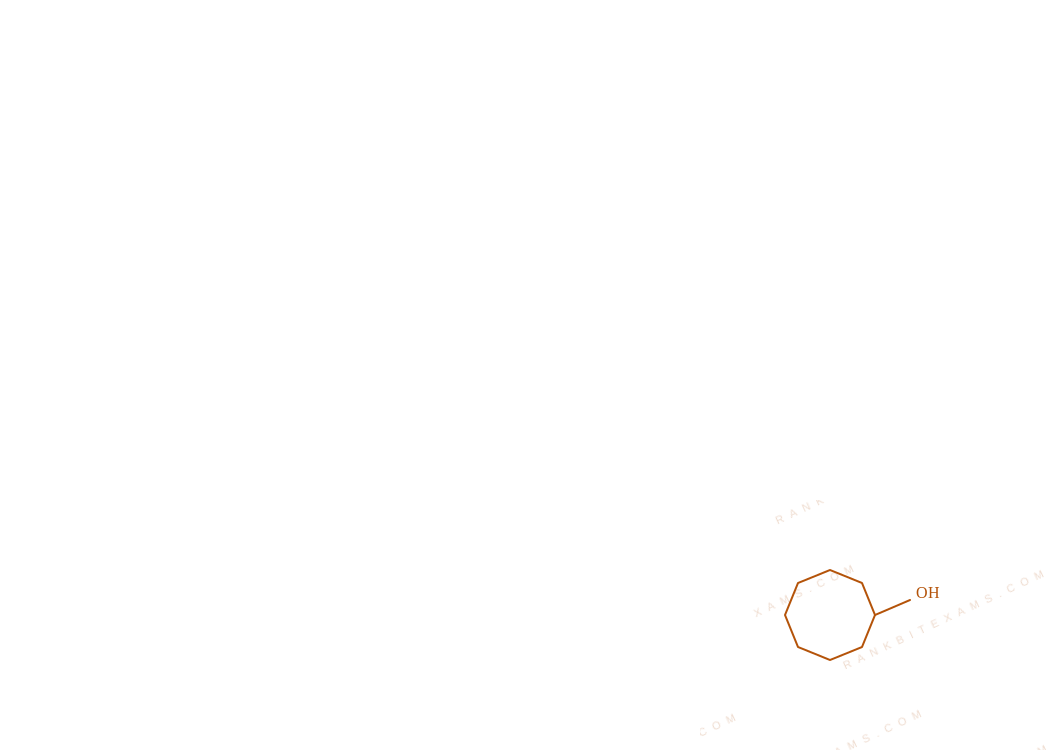
First Elimination: 1,2-dibromocyclooctane reacts with alcoholic KOH$\text{KOH}$ to remove one molecule of HBr$\text{HBr}$, resulting in a bromocyclooctene intermediate.
Second Elimination: Treatment with the stronger base NaNH₂$\text{NaNH}_2$ removes the second molecule of HBr$\text{HBr}$, forming an alkyne inside the 8-membered ring: cyclooctyne.
Kucherov Reaction: Hydration of cyclooctyne using Hg²⁺/H^+$\text{Hg}^{2+}/H^+$ creates an enol intermediate that undergoes tautomerization to form a stable ketone: cyclooctanone.
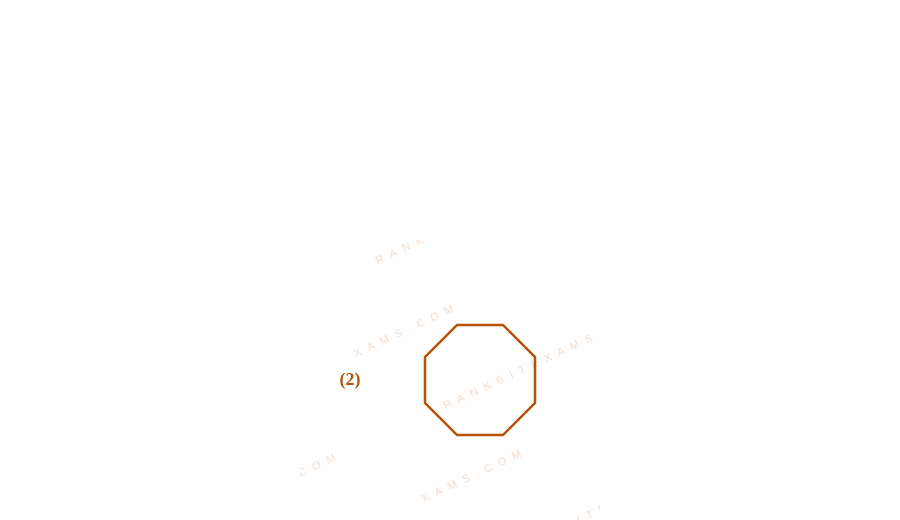
Clemmensen Reduction: Subjecting cyclooctanone to zinc amalgam and hydrochloric acid (Zn-Hg/HCl$\text{Zn-Hg/HCl}$) completely reduces the carbonyl group (>C=O$>C=O$) to a methylene group (-CH₂-$-\text{CH}_2-$), finishing with cyclooctane. Complete mechanistic sequence mapping for cyclooctane product formation
Pattern Recognition
A vicinal dihalide treated with sequential strong bases creates an alkyne path. Alkyne hydration creates a ketone body. Finally, Clemmensen reduction takes the ketone down to a simple hydrocarbon skeleton. Recognizing this terminal reduction loop establishes cyclooctane as the undisputed answer.
Chapter Mix
Class 12 Chemistry: Aldehydes, Ketones and Carboxylic Acids
Class 11 Chemistry: Hydrocarbons
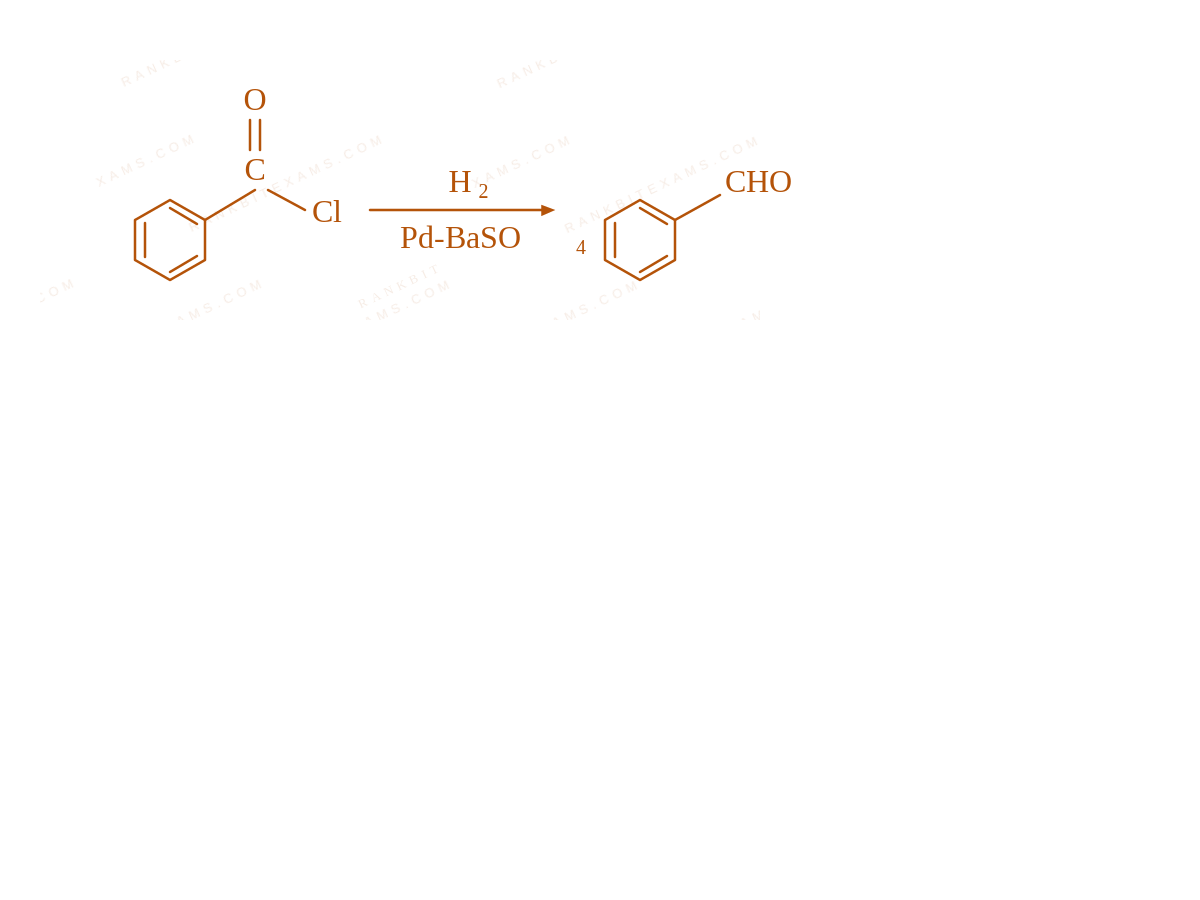
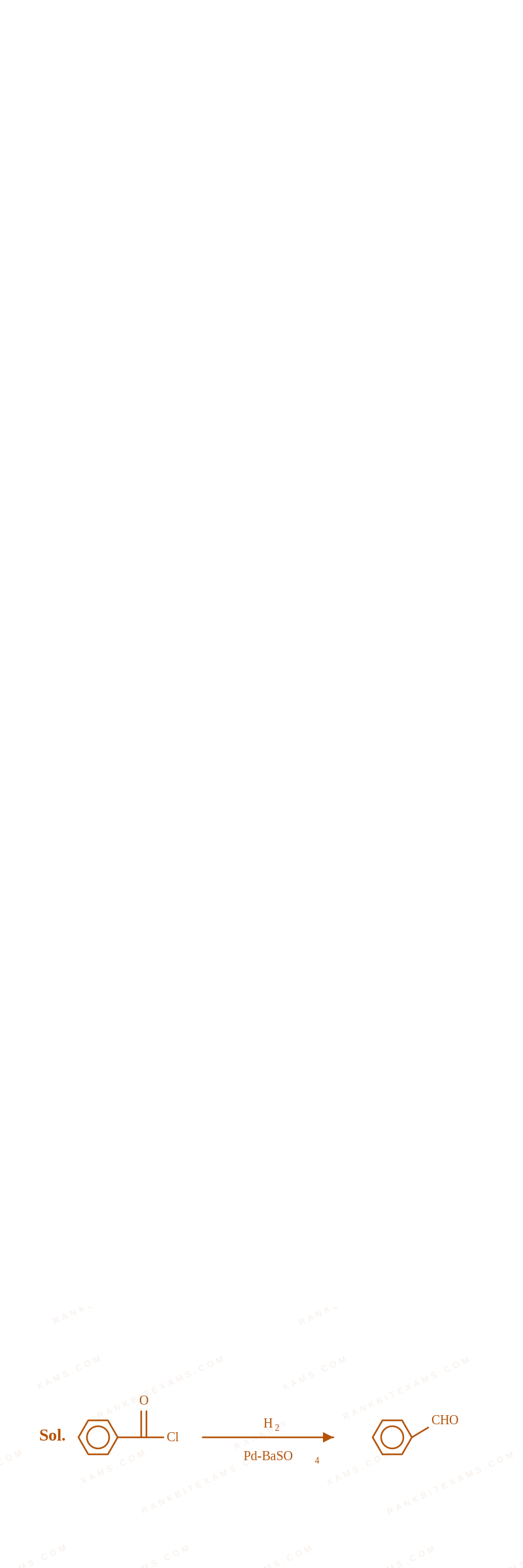
The reaction depicts the partial reduction of an acid chloride (benzoyl chloride) to an aldehyde (benzaldehyde) using hydrogen gas in the presence of a poisoned palladium catalyst (Pd supported on BaSO₄$BaSO_4$).
The image shows the catalytic hydrogenation of benzoyl chloride to benzaldehyde in the presence of Pd-BaSO4.
This specific reaction is known as the Rosenmund reduction.
Pattern Recognition
Acid Chloride + H₂, Pd/BaSO₄$H_2, Pd/BaSO_4$arrow$\rightarrow$ Aldehyde is strictly the Rosenmund reduction. The BaSO₄$BaSO_4$ poisons the catalyst to prevent over-reduction to an alcohol.
Chapter Mix
Class 12 Chemistry: Aldehydes, Ketones and Carboxylic Acids
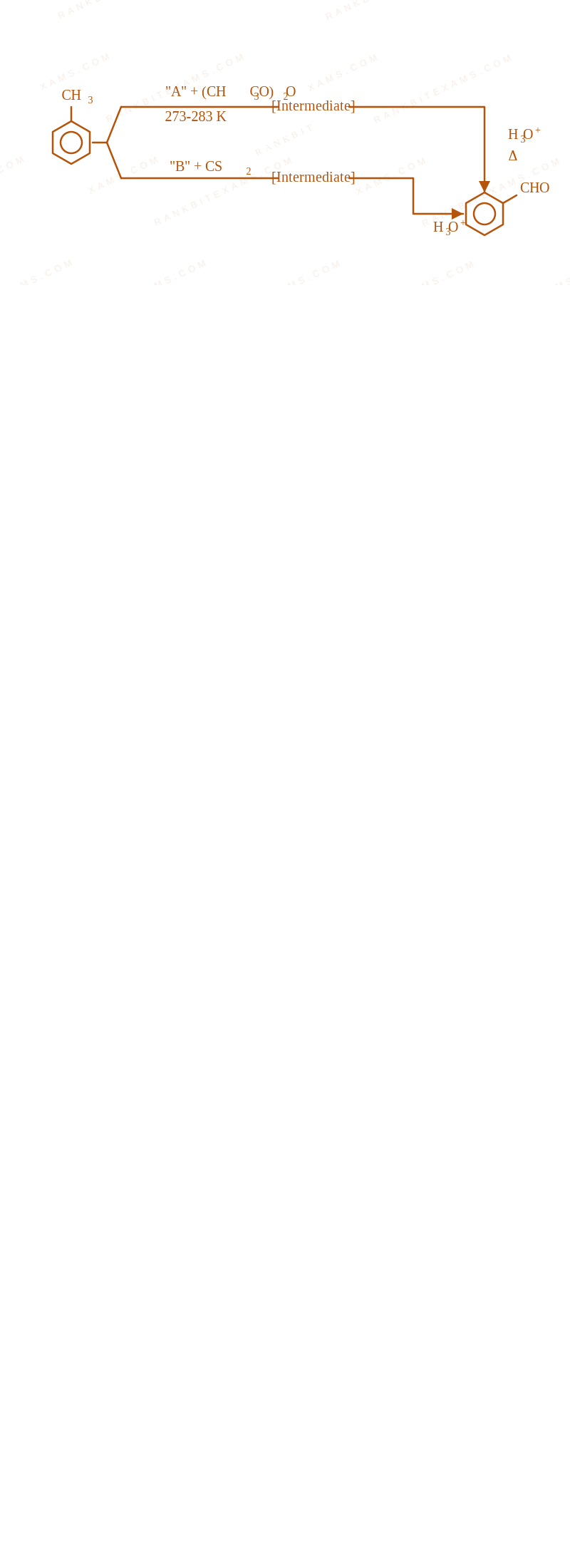
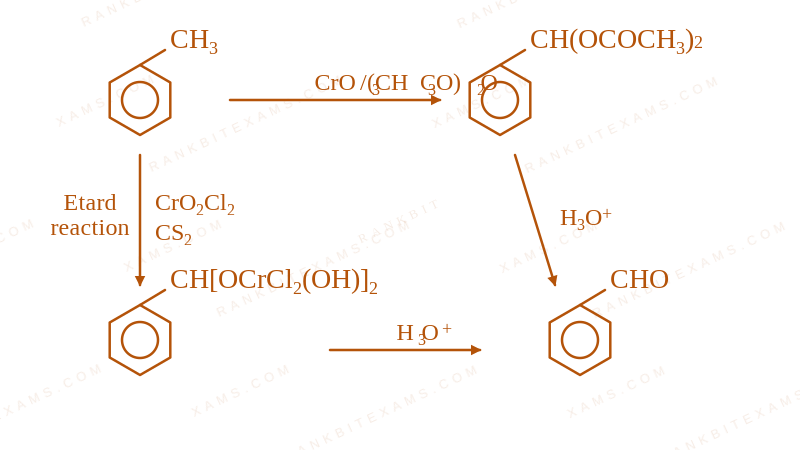
Pathway 1 (Upper): Toluene is treated with Reagent 'A' and acetic anhydride (CH₃CO)₂O$(CH_3CO)_2O$ to form an intermediate (benzylidene diacetate), which on hydrolysis gives benzaldehyde. The reagent used here is Chromic oxide (CrO₃$CrO_3$). Thus, A is CrO₃$CrO_3$.
Pathway 2 (Lower): Toluene is treated with Reagent 'B' in CS₂$CS_2$ to form a chromium complex intermediate, which on hydrolysis yields benzaldehyde. This is the Etard reaction, and the reagent used is Chromyl chloride (CrO₂Cl₂$CrO_2Cl_2$). Thus, B is CrO₂Cl₂$CrO_2Cl_2$.
The image shows the oxidation of toluene to benzaldehyde via two different pathways requiring reagents A and B.
Step 1: Selection
Therefore, A = CrO₃$CrO_3$ and B = CrO₂Cl₂$CrO_2Cl_2$.
Pattern Recognition
Etard reaction always uses Chromyl chloride (CrO₂Cl₂$CrO_2Cl_2$). Oxidation of toluene with acetic anhydride uses Chromic acid (CrO₃$CrO_3$). Both stop the oxidation at the aldehyde stage via intermediate formation.
Chapter Mix
Class 12 Chemistry: Aldehydes, Ketones and Carboxylic Acids
Ethanal (CH₃CHO$CH_3CHO$) reacts with semicarbazide (H₂N-NH-CO-NH₂$H_2N-NH-CO-NH_2$) via nucleophilic addition followed by elimination of water to form a semicarbazone.
Step 1: Product Analysis
The product is Ethanal semicarbazone: CH₃-CH=N-NH-CO-NH₂$CH_3-CH=N-NH-CO-NH_2$.
Counting the nitrogen atoms in this structure:
The imine nitrogen (=N-$=N-$)
The amine nitrogen (-NH-$-NH-$)
The amide nitrogen (-NH₂$-NH_2$)
Total = 3 Nitrogen atoms.
Chapter Mix
Class 12 Chemistry: Aldehydes, Ketones and Carboxylic Acids
Qjee_main_2024_31_jan_eveningPreparation of Aldehydes and Ketones
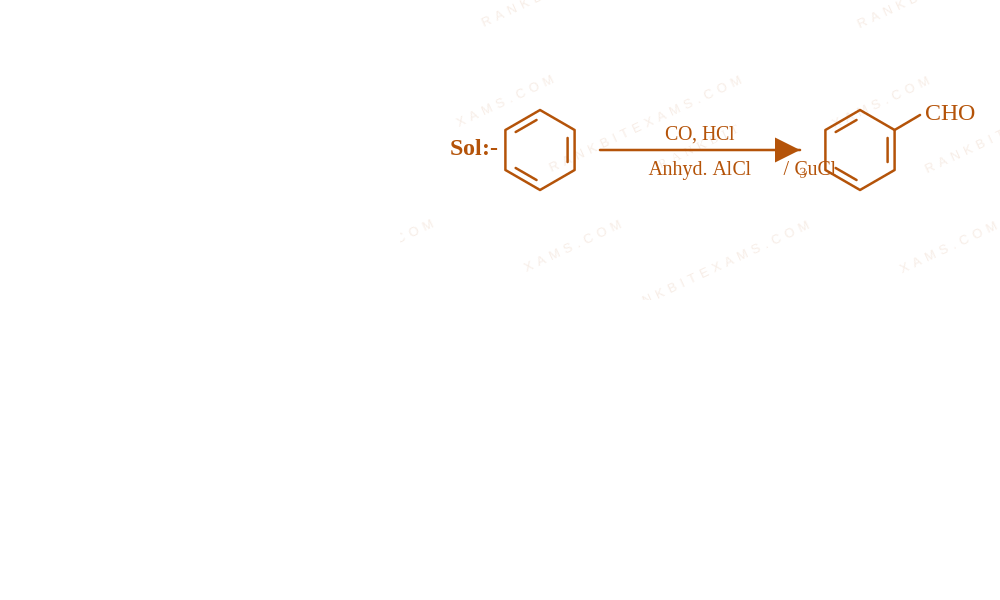
Identify the name reaction.
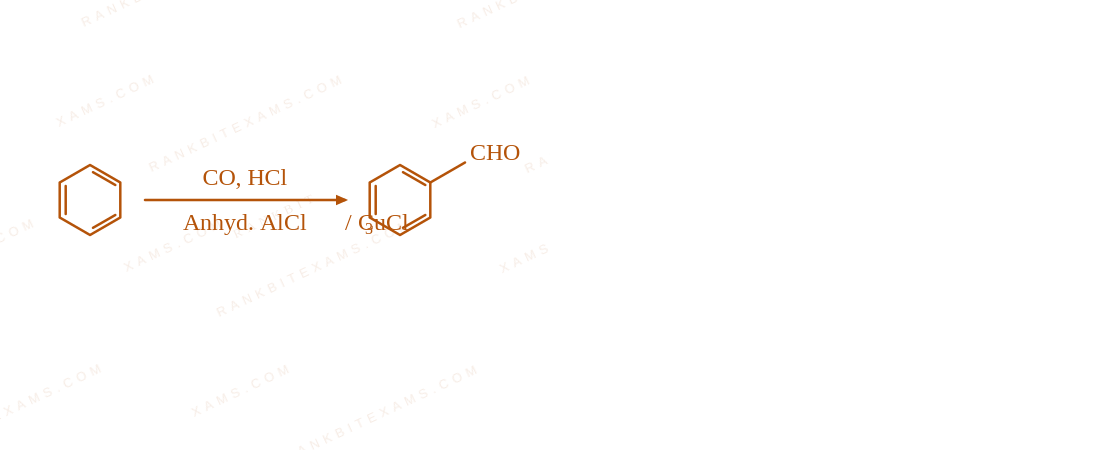
The image shows the conversion of benzene to benzaldehyde using CO, HCl, and Anhydrous AlCl3/CuCl.
The reaction of benzene with carbon monoxide (CO$CO$) and hydrogen chloride (HCl$HCl$) in the presence of anhydrous aluminium chloride (AlCl₃$AlCl_3$) and cuprous chloride (CuCl$CuCl$) to give benzaldehyde is known as the Gatterman-Koch reaction.
The image shows the conversion of benzene to benzaldehyde using CO, HCl, and Anhydrous AlCl3/CuCl.
Pattern Recognition
CO + HCl arrow$CO + HCl \rightarrow$ Formyl chloride intermediate (in situ) with Lewis acid arrow$\rightarrow$ formylation of benzene. This is definitively the Gatterman-Koch formylation.
Chapter Mix
Class 12 Chemistry: Aldehydes, Ketones and Carboxylic Acids
More Aldehydes, Ketones and Carboxylic Acids Questions — jee_main_2025_08_april_evening
Practice past-year questions one chapter at a time. Pick an exam → subject → chapter and get every PYQ for that topic — pulled together from all past papers — with the chapter's key formulas alongside.