
JEE Main · Chemistry → Steady

Aldehydes, Ketones and Carboxylic Acids appeared 46 times across 3 years — 5.3% of Chemistry. This question is from Reactions of Cycloalkenes and Alkynes.

Year 2026 2025 2024 Total
Questions 14 21 11 46

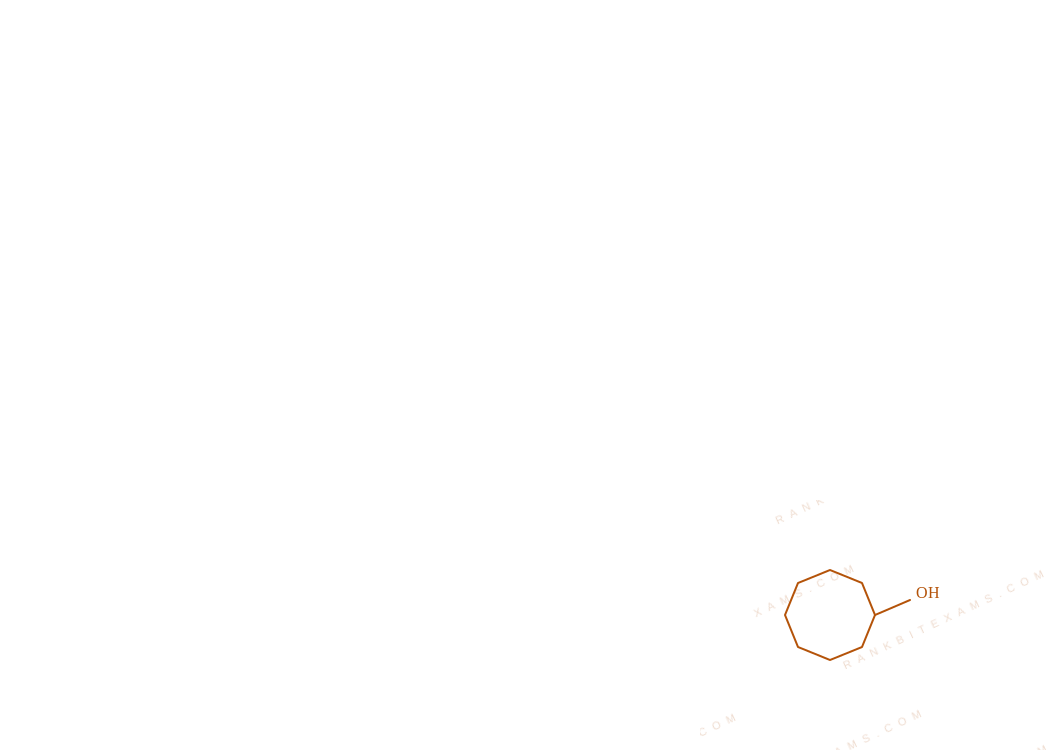
Identify the major product 'P' in the given reaction sequence starting from 1,2-dibromocyclooctane: 1,2-dibromocyclooctane (i) KOH (alc.) (ii) NaNH₂ (iii) Hg²⁺/H^+ (iv) Zn-Hg/HCl 'P (Major product)'

Solution & Explanation

Core Logic

Let us systematically follow the transformation steps:

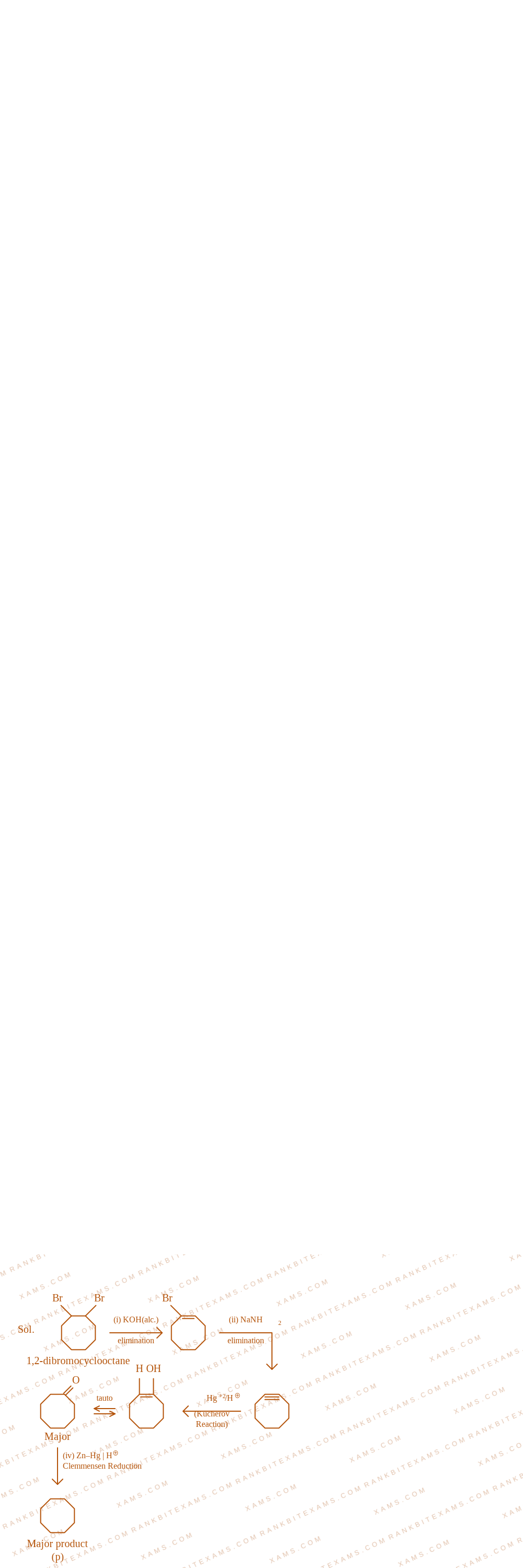
  • First Elimination: 1,2-dibromocyclooctane reacts with alcoholic KOH to remove one molecule of HBr, resulting in a bromocyclooctene intermediate.
  • Second Elimination: Treatment with the stronger base NaNH₂ removes the second molecule of HBr, forming an alkyne inside the 8-membered ring: cyclooctyne.
  • Kucherov Reaction: Hydration of cyclooctyne using Hg²⁺/H^+ creates an enol intermediate that undergoes tautomerization to form a stable ketone: cyclooctanone.
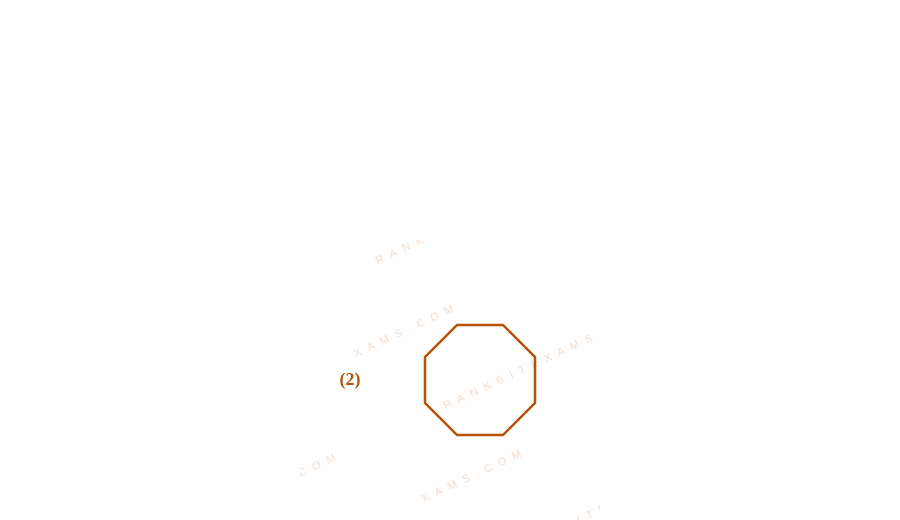
  • Clemmensen Reduction: Subjecting cyclooctanone to zinc amalgam and hydrochloric acid (Zn-Hg/HCl) completely reduces the carbonyl group (>C=O) to a methylene group (-CH₂-), finishing with cyclooctane.
    Complete mechanistic sequence mapping for cyclooctane product formation
    Complete mechanistic sequence mapping for cyclooctane product formation
Pattern Recognition

A vicinal dihalide treated with sequential strong bases creates an alkyne path. Alkyne hydration creates a ketone body. Finally, Clemmensen reduction takes the ketone down to a simple hydrocarbon skeleton. Recognizing this terminal reduction loop establishes cyclooctane as the undisputed answer.

Chapter Mix

Class 12 Chemistry: Aldehydes, Ketones and Carboxylic Acids Class 11 Chemistry: Hydrocarbons

Reference Study Guides

More Aldehydes, Ketones and Carboxylic Acids Previous-Year Questions — Page 10

Q jee_main_2024_31_jan_morning Reactions with Grignard Reagent
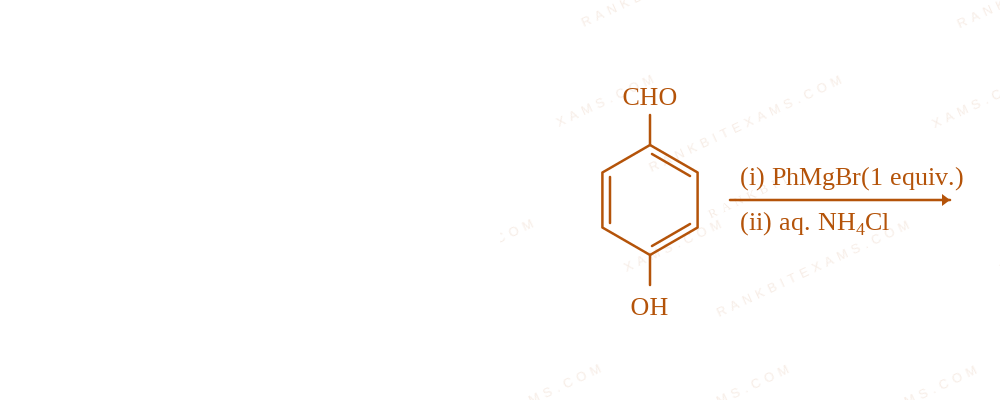
The product of the following reaction is P.
Reactions with Grignard Reagent diagram for Q84 - JEE Main 2024 Morning
The image shows p-hydroxybenzaldehyde reacting with one equivalent of PhMgBr followed by aqueous ammonium chloride.
The number of hydroxyl groups present in the product P is
Numerical Answer. Answer: 0 to 0

Solution

Core Logic

The given reactant is p-hydroxybenzaldehyde, which contains both a phenolic -OH group (acidic) and an aldehyde group (electrophilic).

When one equivalent of Grignard reagent (PhMgBr) is added, it behaves primarily as a strong base due to the presence of an acidic proton. Acid-base reactions are extremely fast compared to nucleophilic additions.

The acidic phenolic -OH reacts with PhMgBr:

PhMgBr + HO-C₆H₄-CHO arrow Ph-H (Benzene) + BrMg-O-C₆H₄-CHO

Upon workup with aq. NH₄Cl, the phenoxide ion simply regenerates the starting p-hydroxybenzaldehyde. However, the question asks for the number of hydroxyl groups present in the formed product (Benzene).
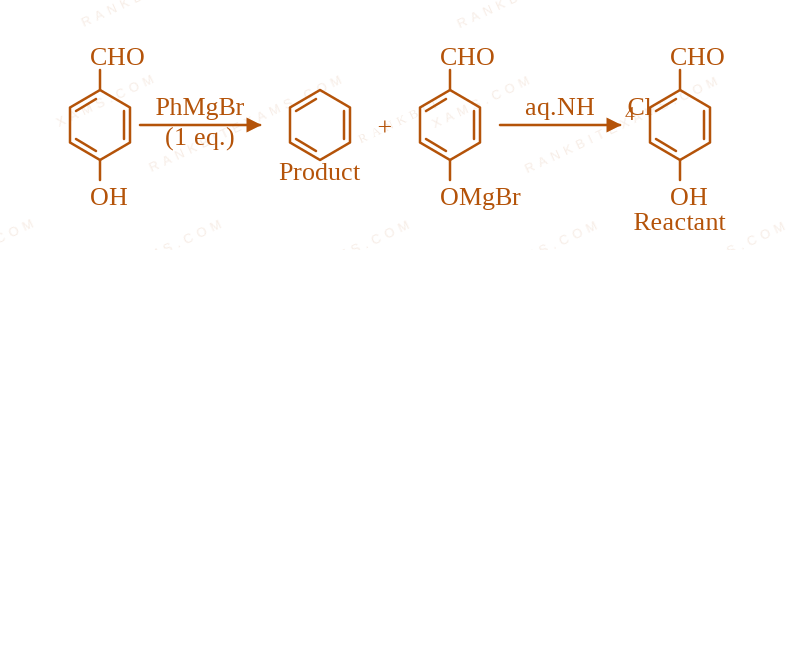
Reactions with Grignard Reagent diagram for Q84 - JEE Main 2024 Morning
The image shows p-hydroxybenzaldehyde reacting with one equivalent of PhMgBr followed by aqueous ammonium chloride.

The distinct product formed in the reaction is Benzene. Benzene has 0 hydroxyl groups.

Pattern Recognition

Whenever a Grignard reagent encounters a molecule with an acidic hydrogen (alcohol, phenol, amine, alkyne), it will invariably act as a base first. If only 1 equivalent is used, nucleophilic addition to carbonyls will NOT happen.

Chapter Mix

Class 12 Chemistry: Aldehydes, Ketones and Carboxylic Acids Class 12 Chemistry: Alcohols, Phenols and Ethers

More Aldehydes, Ketones and Carboxylic Acids Questions — jee_main_2025_08_april_evening

Practice all Aldehydes, Ketones and Carboxylic Acids previous-year questions →

Rankbit System
JEE Physics: Waves (+15.5%) | Electrostatics: Concentric Shells (-29.7%) | Modern Physics: Photoelectric Clones (+34.2%) | Mathematics: Definite Integrals (+18.1%) | Chemistry: Coordination Splitting (-11.4%) | JEE Physics: Waves (+15.5%) | Electrostatics: Concentric Shells (-29.7%) | Modern Physics: Photoelectric Clones (+34.2%) | Mathematics: Definite Integrals (+18.1%) | Chemistry: Coordination Splitting (-11.4%)