JEE Main · Mathematics ↓ Falling

Binomial Theorem appeared 37 times across 3 years — 4.3% of Mathematics. This question is from Remainder Problems.

Year 2026 2025 2024 Total
Questions 9 17 11 37

The remainder when ((64)(64))(64) is divided by 7 is equal to

Solution & Explanation

Related Formula

Binomial expansion for checking remainders:

(1 + kx)ⁿ = 1 + n(kx) + (n(n-1))/(2)(kx)² + ≡ 1 x
Core Logic

Let the target expression be N = ((64)⁶⁴)⁶⁴. Using power rules, N = 6464 × 64 = 6464².

Let the large exponent exponent be n = 64². We need to find the remainder of 64ⁿ when divided by 7.

Step 1: Express Base in Terms of Modulus

Observe that 64 = 63 + 1 = 7 × 9 + 1. Substituting this into the expression: N = (1 + 63)ⁿ

Expanding using the binomial theorem:

N = 1 + ⁿC₁(63) + ⁿC₂(63)² + + ⁿCₙ(63)ⁿ N = 1 + 63 · λ = 1 + 7(9λ)

Since 7(9λ) is perfectly divisible by 7, the remaining term is 1.

Pattern Recognition

Whenever the base can be written as km + 1, where m is the divisor, the value of (km + 1)ⁿ ≡ 1ⁿ ≡ 1 m instantly, regardless of the size or complexity of the exponent layout.

Chapter Mix

Class 11 Mathematics: Binomial Theorem

Reference Study Guides

More Binomial Theorem Previous-Year Questions — Page 2

Q14 jee_main_2026_23_january_morning Coefficients in Expansion
The sum of all possible values of n in N, so that the coefficients of x, x² and x³ in the expansion of (1 + x²)² (1 + x)ⁿ, are in arithmetic progression is:
  • A. 3
  • B. 7
  • C. 12
  • D. 9

Solution

Core Logic

Expand the expression:

(1 + x²)² (1 + x)ⁿ = (1 + 2x² + x⁴) · Σr=0ⁿ ⁿCᵣ x^r

We need the coefficients of x, x², and x³. For x¹: Multiplier is 1 · ⁿC₁x = ⁿC₁. For x²: Multiplier is 1 · ⁿC₂x² + 2x² · ⁿC₀ = ⁿC₂ + 2. For x³: Multiplier is 1 · ⁿC₃x³ + 2x² · ⁿC₁x = ⁿC₃ + 2ⁿC₁.

These three coefficients are in Arithmetic Progression (A.P.).

Step 1: Set up the A.P. Condition

If A, B, C are in A.P., then 2B = A + C.

2(ⁿC₂ + 2) = ⁿC₁ + (ⁿC₃ + 2ⁿC₁) 2((n(n-1))/(2) + 2) = 3n + (n(n-1)(n-2))/(6) (assuming n ≥ 3)
Step 2: Solve the Polynomial Equation
n(n-1) + 4 = 3n + (n(n-1)(n-2))/(6)

Multiply by 6:

6n² - 6n + 24 = 18n + n(n² - 3n + 2) 6n² - 6n + 24 = 18n + n³ - 3n² + 2n n³ - 9n² + 26n - 24 = 0

Testing integer roots, for n = 2: 8 - 36 + 52 - 24 = 0 ⇒ n=2 is a root (wait, A.P. works for n=2 also, let's check later). For n = 3: 27 - 81 + 78 - 24 = 0 ⇒ n=3 is a root. For n = 4: 64 - 144 + 104 - 24 = 0 ⇒ n=4 is a root.

Step 3: Verification of Roots

Check for n = 2 (since our formula assumed n ≥ 3, ²C₃=0): Coeff of x = 2, Coeff of x² = 1+2 = 3, Coeff of x³ = 0 + 2(2) = 4. Sequence is 2, 3, 4 which is an A.P. So n=2 is valid. The values of n are 2, 3, 4. Required sum of values = 2 + 3 + 4 = 9.

Pattern Recognition

Whenever binomial limits logically constrain formulas (like ⁿC₃ demanding n≥ 3), explicitly check the lower bounds manually (n=2) to avoid dropping edge-case roots from the algebraic polynomial factorization.

Chapter Mix

Class 11 Maths: Binomial Theorem
Q14 jee_main_2026_24_january_morning Properties of Binomial Coefficients
Let S = (1)/(25!) + (1)/(3!23!) + (1)/(5!21!) + up to 13 terms. If 13S = (2^k)/(n!), k in N, then n + k is equal to
  • A. 51
  • B. 52
  • C. 49
  • D. 50

Solution

Related Formula
ⁿCᵣ = (n!)/(r!(n-r)!) ⁿC₁ + ⁿC₃ + ⁿC₅ + = 2ⁿ⁻¹
Core Logic

Multiply and divide the series by 26! to create combinatorial terms.

S = (1)/(26!) ( (26!)/(25!1!) + (26!)/(3!23!) + (26!)/(5!21!) + (13 terms) )
Step 1: Binomial Transformation
S = (1)/(26!) ( ²⁶C₁ + ²⁶C₃ + ²⁶C₅ + + ²⁶C₂₅ )

Notice there are exactly 13 terms, capturing all odd coefficients for n=26.

Step 2: Evaluating the Sum

The sum of odd binomial coefficients is 2ⁿ⁻¹.

²⁶C₁ + ²⁶C₃ + + ²⁶C₂₅ = 2²⁵ S = (1)/(26!) × 2²⁵
Step 3: Matching the Result

We need 13S:

13S = 13 × 2²⁵26! = 13 × 2²⁵26 × 25! = 2²⁵2 × 25! = 2²⁴25!

Comparing with (2^k)/(n!), we get k = 24, n = 25.

n + k = 25 + 24 = 49
Pattern Recognition

Series with denominators having factorials that sum to a constant (e.g., 1+25=26, 3+23=26) should immediately be normalized into Binomial Coefficients by multiplying by the sum-factorial (26!).

Chapter Mix

Class 11 Maths: Binomial Theorem

Q1 jee_main_2026_28_january_evening Divisibility and Integral Parts
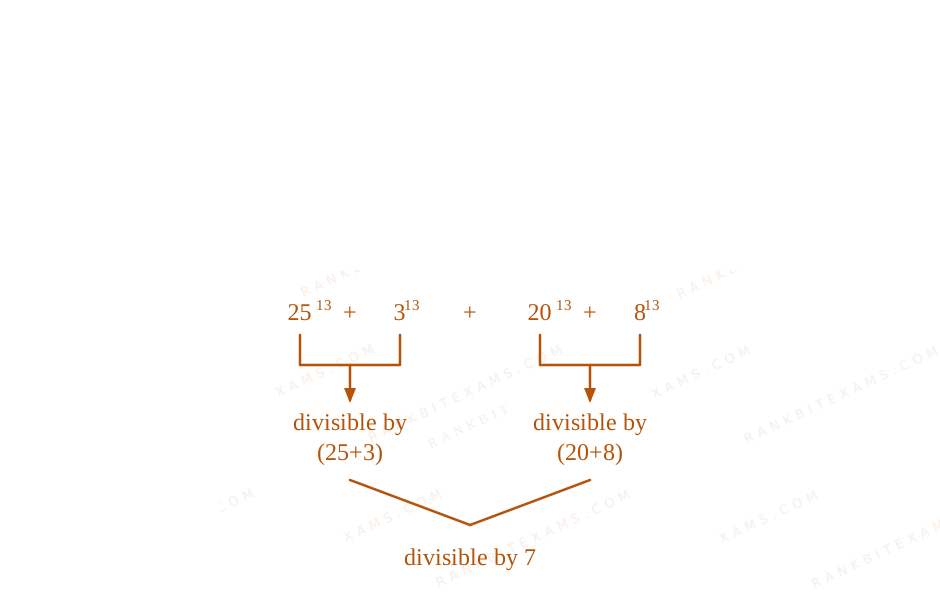
Given below two statements: Statement I: 25¹³ + 20¹³ + 8¹³ + 3¹³ is divisible by 7. Statement II: The integral part of (7 + 4√(3))²⁵ is an odd number. In the light of the above statements, choose the correct answer from the options given below:
  • A. Both Statement I and Statement II are false.
  • B. Both Statement I and Statement II are true.
  • C. Statement I is false but Statement II is true.
  • D. Statement I is true but Statement II is false.

Solution

Related Formula
xⁿ + aⁿ is divisible by (x+a) when n is odd.
Core Logic

For Statement I: Group the terms to apply the divisibility rule:

25¹³ + 3¹³ + 20¹³ + 8¹³

(25¹³ + 3¹³) is divisible by (25+3) = 28, which is a multiple of 7. (20¹³ + 8¹³) is divisible by (20+8) = 28, which is a multiple of 7. Thus, the entire expression is divisible by 7.

Divisibility logic for Q1

Execution

For Statement II: Let R = (7 + 4√(3))²⁵ = I + f where I is the integral part and 0 ≤ f < 1. Let R' = (7 - 4√(3))²⁵ = f' where 0 < f' < 1. Adding R and R':

R + R' = 2[²⁵C₀7²⁵ + ²⁵C₂7²³(4√(3))² + …] I + f + f' = even integer

Since 0 < f + f' < 2 and f + f' must be an integer, f + f' = 1. Therefore, I + 1 = even integer ⇒ I = odd integer. Both statements are correct.

Pattern Recognition

For expressions of the form (a + √(b))ⁿ, finding the conjugate (a - √(b))ⁿ and adding/subtracting isolates the integer terms.

Chapter Mix

Class 11 Maths: Binomial Theorem

Q2 jee_main_2026_28_january_evening Sum of Coefficients in Expansion
The sum of the coefficients of x⁴⁹⁹ and x⁵⁰⁰ in (1 + x)¹⁰⁰⁰ + x(1 + x)⁹⁹⁹ + x²(1 + x)⁹⁹⁸ + … + x¹⁰⁰⁰ is
  • A. ¹⁰⁰¹C₅₀₁
  • B. ¹⁰⁰²C₅₀₀
  • C. ¹⁰⁰²C₅₀₁
  • D. ¹⁰⁰⁰C₅₀₁

Solution

Related Formula
Sₙ = a(1 - rⁿ)/(1 - r) ⁿCᵣ + ⁿCᵣ₋₁ = ⁿ⁺¹Cᵣ
Core Logic

The given series is a geometric progression:

S = (1 + x)¹⁰⁰⁰ + x(1 + x)⁹⁹⁹ + … + x¹⁰⁰⁰

First term a = (1+x)¹⁰⁰⁰, Common ratio r = (x)/(1+x), Number of terms n = 1001.

Sum of GP:

S = (1 + x)¹⁰⁰⁰ (1 - ((x)/(1 + x))¹⁰⁰¹)1 - (x)/(1 + x) = (1 + x)¹⁰⁰¹ - x¹⁰⁰¹
Execution

We need the sum of coefficients of x⁴⁹⁹ and x⁵⁰⁰ in the resulting expression (1 + x)¹⁰⁰¹ - x¹⁰⁰¹. For x⁴⁹⁹, the coefficient is ¹⁰⁰¹C₄₉₉. For x⁵⁰⁰, the coefficient is ¹⁰⁰¹C₅₀₀.

Required sum:

¹⁰⁰¹C₄₉₉ + ¹⁰⁰¹C₅₀₀ = ¹⁰⁰²C₅₀₀

Series sum resolution

Pattern Recognition

Transform the complex polynomial series using the Geometric Progression sum formula, which simplifies it into a single binomial expansion.

Chapter Mix

Class 11 Maths: Sequence and Series Class 11 Maths: Binomial Theorem

Q65 jee_main_2025_02_april_evening Properties of Binomial Coefficients
If Σr = 0¹⁰( 10r + 1 - 110r) · 11r + 1 = α¹¹ - 11¹¹10¹⁰, then α is equal to:
  • A. 15
  • B. 11
  • C. 24
  • D. 20

Solution

Related Formula
Sum of binomial coefficients: Σk=0ⁿ nk x^k = (1 + x)ⁿ Shifted binomial sum: Σk=1ⁿ nk x^k = (1+x)ⁿ - 1
Core Logic

We split the summation into two parts, express each as a binomial series expansion, and equate the resulting algebraic fraction to solve for α.

Step 1: Split the summation

The general term inside the summation can be written as:

( 10r+1 - 110^r ) = 10 - (1)/(10^r) = 10 - 10 ( (1)/(10) )r+1

Substitute this back into the sum:

S = Σr=0¹⁰ [ 10 - 10 ( (1)/(10) )r+1 ] 11r+1 S = 10 Σr=0¹⁰ 11r+1 - 10 Σr=0¹⁰ 11r+1 ( (1)/(10) )r+1
Step 2: Evaluate both parts of the sum

For the first part, let s = r+1:

Σr=0¹⁰ 11r+1 = Σs=1¹¹ 11s = 2¹¹ - 1

For the second part, using s = r+1:

Σr=0¹⁰ 11r+1 ( (1)/(10) )r+1 = Σs=1¹¹ 11s ( (1)/(10) )^s = ( 1 + (1)/(10) )¹¹ - 1 = ( (11)/(10) )¹¹ - 1
Step 3: Combine and find alpha

Multiply both parts by 10:

S = 10 ( 2¹¹ - 1 ) - 10 [ ( (11)/(10) )¹¹ - 1 ] S = 10 · 2¹¹ - 10 - 10 · 11¹¹10¹¹ + 10 = 10 · 2¹¹ - 11¹¹10¹⁰

Express the first term with a denominator of 10¹⁰:

10 · 2¹¹ = 10¹¹ · 2¹¹10¹⁰ = 20¹¹10¹⁰

Thus, the total sum is:

S = 20¹¹ - 11¹¹10¹⁰

Comparing this with α¹¹ - 11¹¹10¹⁰, we find:

α = 20

Pattern Recognition

Binomial base scaling: Whenever you see a sum of the form Σ a^r nr, it is simply the expanded form of a shifted binomial expansion of (1 + a)ⁿ. Factoring out scaling constants yields standard analytical forms.

Chapter Mix

Class 11 Mathematics: Binomial Theorem

More Binomial Theorem Questions — jee_main_2025_07_april_morning

Practice all Binomial Theorem previous-year questions →

Rankbit System
JEE Physics: Waves (+15.5%) | Electrostatics: Concentric Shells (-29.7%) | Modern Physics: Photoelectric Clones (+34.2%) | Mathematics: Definite Integrals (+18.1%) | Chemistry: Coordination Splitting (-11.4%) | JEE Physics: Waves (+15.5%) | Electrostatics: Concentric Shells (-29.7%) | Modern Physics: Photoelectric Clones (+34.2%) | Mathematics: Definite Integrals (+18.1%) | Chemistry: Coordination Splitting (-11.4%)