JEE Main · Chemistry → Steady

Structure of Atom appeared 39 times across 3 years — 4.5% of Chemistry. This question is from Photoelectric Effect.

Year 2026 2025 2024 Total
Questions 14 16 9 39

Which of the following statements are correct, if the threshold frequency of caesium is 5.16 × 10¹⁴ ~Hz ?
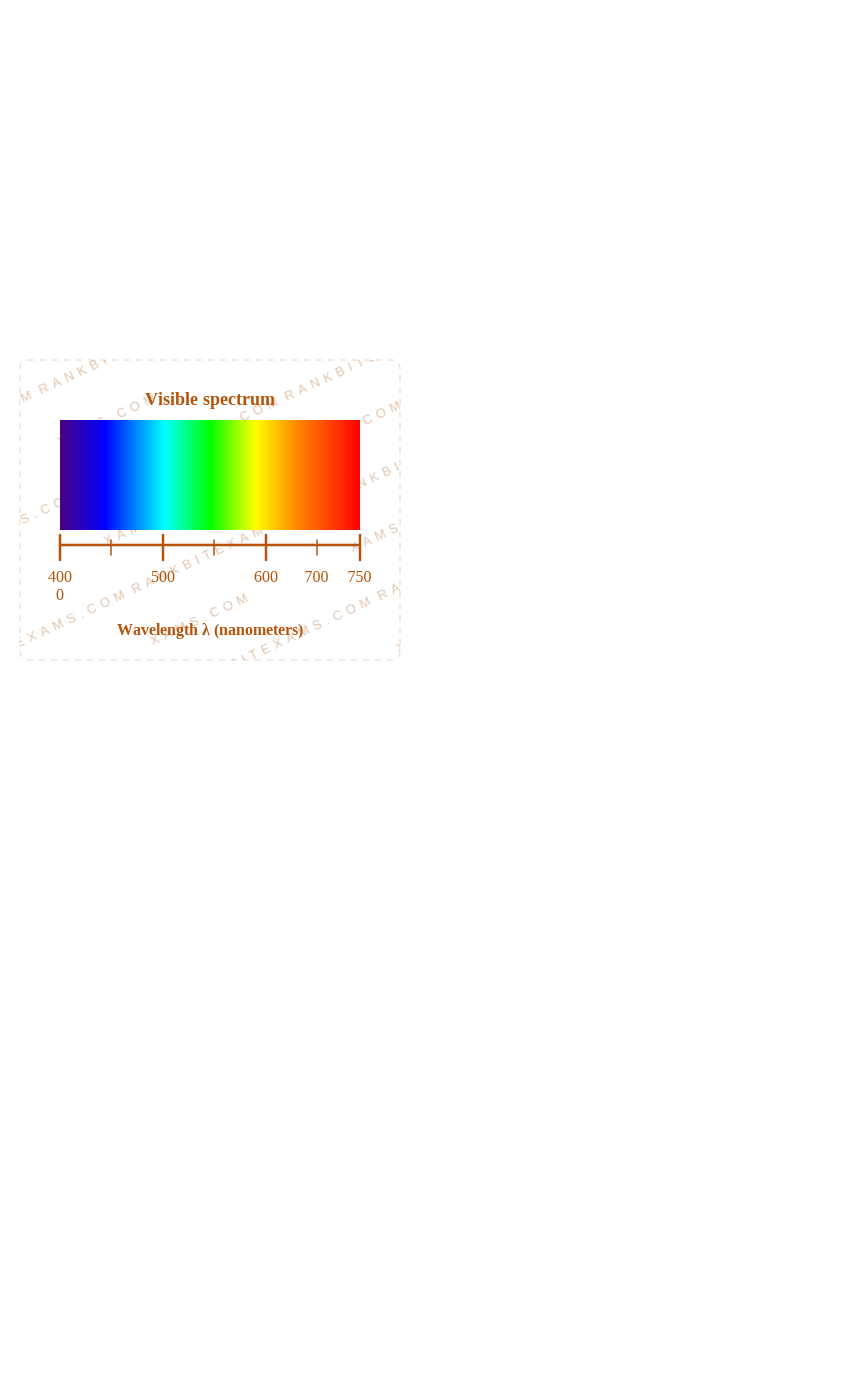
Visible spectrum wavelength diagram for Q32 - JEE Main 2025
The visible spectrum wavelength scale shows the relationship between red, yellow, and blue light frequency thresholds.
A. When Cs is placed inside a vacuum chamber with an ammeter connected to it and yellow light is focused on Cs the ammeter shows the presence of current. B. When the brightness of the yellow light is dimmed, the value of the current in the ammeter is reduced. C. When a red light is used instead of the yellow light, the current produced is higher with respect to the yellow light. D. When a blue light is used, the ammeter shows the formation of current. E. When a white light is used, the ammeter shows formation of current. Choose the correct answer from the options given below:

Solution & Explanation

Related Formula
λ = (c)/(ν)

where, c = 3.0 × 10⁸ m s⁻¹ ν₀ = 5.16 × 10¹⁴ Hz

Core Logic

Let's first calculate the threshold wavelength (λ₀) for Caesium:

λ₀ = 3.0 × 10⁸5.16 × 10¹⁴ ≈ 5.81 × 10⁻⁷ m = 581.4 nm

Comparing this with the visible spectrum:

  • Yellow light (580 nm) corresponds closely to the threshold wavelength. Hence, photoelectric emission occurs (Statement A is correct).
  • The photocurrent is directly proportional to the light intensity (brightness). Reducing brightness decreases the current (Statement B is correct).
  • Red light (620--750 nm) has a lower frequency than the threshold frequency, meaning no current is produced (Statement C is incorrect).
  • Blue light (450--490 nm) has a higher frequency than the threshold. Thus, current is produced (Statement D is correct).
  • White light contains all wavelengths (including blue, violet, etc.), which will produce a photoelectric current (Statement E is correct).
  • Therefore, statements A, B, D, and E are correct.

Pattern Recognition

The wavelength threshold is 581 nm (yellow-green region). Any light with shorter wavelength (higher frequency), like blue or white, will cause emission. Dimming simply decreases photon flux and hence current.

Chapter Mix

Class 11 Chemistry: Structure of Atom Class 12 Physics: Dual Nature of Radiation and Matter

More Structure of Atom Previous-Year Questions — Page 8

Q90 jee_main_2024_30_january_evening Atomic Spectra
Number of spectral lines obtained in He^+ spectra, when an electron makes transition from fifth excited state to first excited state will be
Numerical Answer. Answer: 10 to 10

Solution

Related Formula
Number of spectral lines = (Δ n (Δ n + 1))/(2)

where Δ n = n₂ - n₁

Core Logic

Identify the principal quantum numbers (n) for the given states:

  • Fifth excited state means n₂ = 5 + 1 = 6.
  • First excited state means n₁ = 1 + 1 = 2.
  • Calculate the difference:

Δ n = n₂ - n₁ = 6 - 2 = 4
Step 1: Calculate Total Spectral Lines

Substitute Δ n = 4 into the formula:

Maximum number of spectral lines = (4(4 + 1))/(2) = (4 × 5)/(2)

= 10

Chapter Mix

Class 11 Chemistry: Structure of Atom

Q68 jee_main_2024_30_jan_morning Quantum Mechanical Model
Given below are two statements: Statement-I: The orbitals having same energy are called as degenerate orbitals. Statement-II: In hydrogen atom, 3p and 3d orbitals are not degenerate orbitals. In the light of the above statements, choose the most appropriate answer from the options given
  • A. Statement-I is true but Statement-II is false
  • B. Both Statement-I and Statement-II are true.
  • C. Both Statement-I and Statement-II are false
  • D. Statement-I is false but Statement-II is true

Solution

Core Logic

Statement-I defines degenerate orbitals correctly: Orbitals that share the exact same energy level are called degenerate orbitals. Statement-II claims 3p and 3d are not degenerate in a hydrogen atom. For a single-electron system like Hydrogen (1s¹), the energy of an orbital depends only on the principal quantum number 'n'.

Step 1: Final conclusion

In a hydrogen atom, energy of 3s = 3p = 3d. Therefore, 3p and 3d are degenerate. Thus, Statement-II is false.

Pattern Recognition

Hydrogen atom (single electron species) = Energy dictated strictly by n. Multi-electron atoms = Energy dictated by (n + l) rule.

Chapter Mix

Class 11 Chemistry: Structure of Atom

Q jee_main_2024_31_jan_evening Quantum Numbers
The four quantum numbers for the electron in the outer most orbital of potassium (atomic no. 19) are
  • A. n = 4, l = 2, m = -1, s = +(1)/(2)
  • B. n = 4, l = 0, m = 0, s = +(1)/(2)
  • C. n = 3, l = 0, m = 1, s = +(1)/(2)
  • D. n = 2, l = 0, m = 0, s = +(1)/(2)

Solution

Core Logic

The atomic number of potassium (K) is 19. Its electronic configuration is: 1s², 2s², 2p⁶, 3s², 3p⁶, 4s¹. The outermost orbital of potassium is the 4s orbital.

For the 4s orbital: Principal quantum number, n = 4 Azimuthal quantum number, l = 0 (for s-subshell) Magnetic quantum number, m = 0 (since l = 0) Spin quantum number, s = ± (1)/(2)

Step 1: Final Matching

Comparing these values with the options, option (2) provides n = 4, l = 0, m = 0, s = +(1)/(2), which perfectly describes the outermost electron.

Chapter Mix

Class 11 Chemistry: Structure of Atom

Q89 jee_main_2024_31_jan_morning Photoelectric Effect and Ionization Energy
The ionization energy of sodium in kJ mol⁻¹. If electromagnetic radiation of wavelength 242 nm is just sufficient to ionize sodium atom is ________
Numerical Answer. Answer: 493 to 495

Solution

Related Formula
E = 1240λ (nm) eV Etotal = E × NA
Step 1: Energy per atom
E = (1240)/(242) eV = 5.12 eV

Converting eV to Joules:

E = 5.12 × 1.6 × 10⁻¹⁹ J/atom E = 8.192 × 10⁻¹⁹ J/atom
Step 2: Energy per mole

To find the ionization energy per mole, multiply by Avogadro's number (NA ≈ 6.022 × 10²³):

IE = 8.192 × 10⁻¹⁹ × 6.022 × 10²³ J/mol IE ≈ 493.3 × 10³ J/mol ≈ 494 kJ/mol
Chapter Mix

Class 11 Chemistry: Structure of Atom

Rankbit System
JEE Physics: Waves (+15.5%) | Electrostatics: Concentric Shells (-29.7%) | Modern Physics: Photoelectric Clones (+34.2%) | Mathematics: Definite Integrals (+18.1%) | Chemistry: Coordination Splitting (-11.4%) | JEE Physics: Waves (+15.5%) | Electrostatics: Concentric Shells (-29.7%) | Modern Physics: Photoelectric Clones (+34.2%) | Mathematics: Definite Integrals (+18.1%) | Chemistry: Coordination Splitting (-11.4%)