Related Formula
λ = (c)/(ν)$$\lambda = \frac{c}{\nu}$$
where,
c = 3.0 × 10⁸ m s⁻¹$c = 3.0 \times 10^8 \text{ m s}^{-1}$
ν₀ = 5.16 × 10¹⁴ Hz$\nu_0 = 5.16 \times 10^{14} \text{ Hz}$
Core Logic
Let's first calculate the threshold wavelength (λ₀$\lambda_0$) for Caesium:
λ₀ = 3.0 × 10⁸5.16 × 10¹⁴ ≈ 5.81 × 10⁻⁷ m = 581.4 nm$$\lambda_0 = \frac{3.0 \times 10^8}{5.16 \times 10^{14}} \approx 5.81 \times 10^{-7} \text{ m} = 581.4 \text{ nm}$$
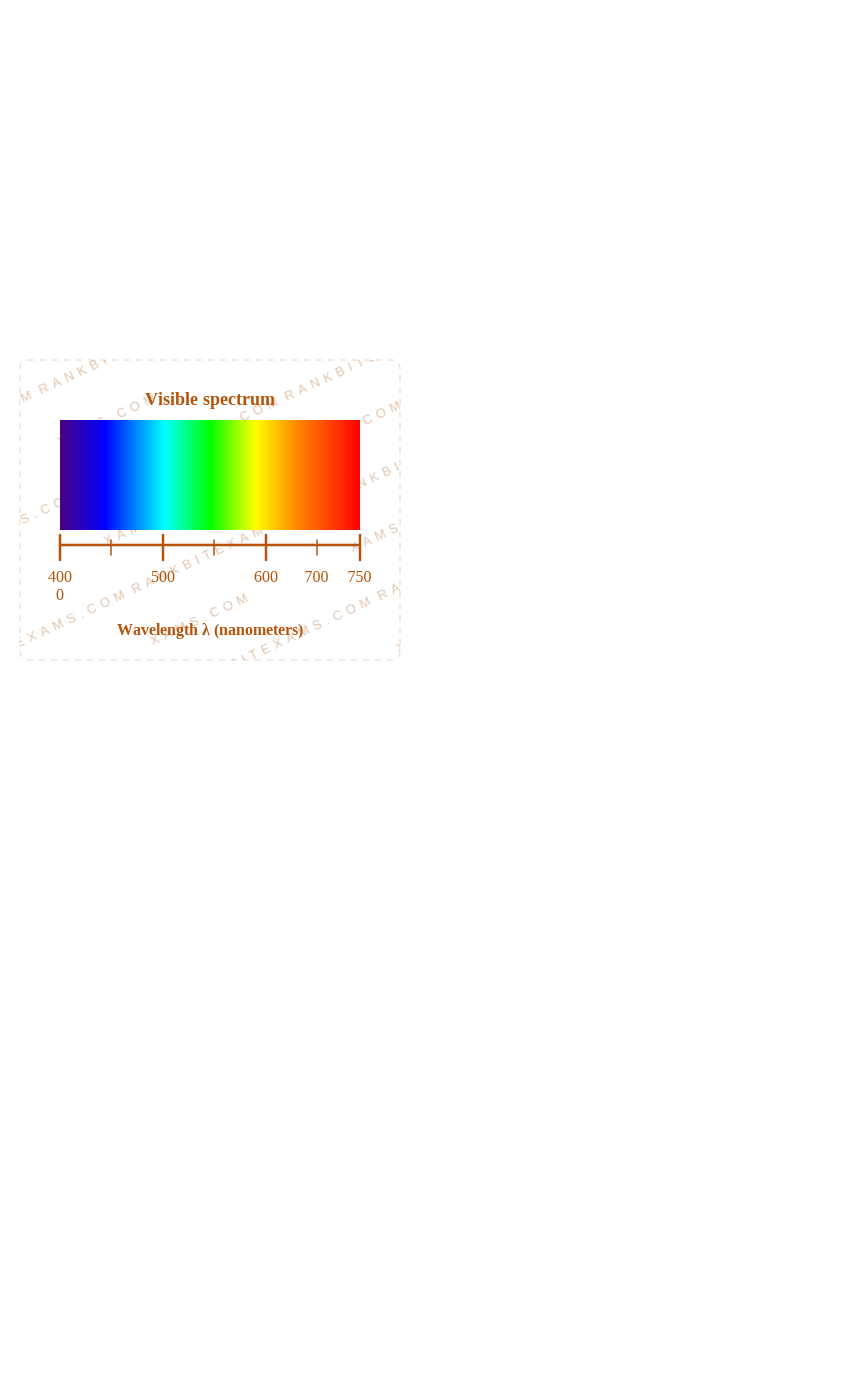
Comparing this with the visible spectrum:
- Yellow light (580 nm$\sim 580 \text{ nm}$) corresponds closely to the threshold wavelength. Hence, photoelectric emission occurs (Statement A is correct).
- The photocurrent is directly proportional to the light intensity (brightness). Reducing brightness decreases the current (Statement B is correct).
- Red light (620--750 nm$\sim 620\text{--}750 \text{ nm}$) has a lower frequency than the threshold frequency, meaning no current is produced (Statement C is incorrect).
- Blue light (450--490 nm$\sim 450\text{--}490 \text{ nm}$) has a higher frequency than the threshold. Thus, current is produced (Statement D is correct).
- White light contains all wavelengths (including blue, violet, etc.), which will produce a photoelectric current (Statement E is correct).
Therefore, statements A, B, D, and E are correct.
Pattern Recognition
The wavelength threshold is 581 nm$581 \text{ nm}$ (yellow-green region). Any light with shorter wavelength (higher frequency), like blue or white, will cause emission. Dimming simply decreases photon flux and hence current.
Chapter Mix
Class 11 Chemistry: Structure of Atom

Class 12 Physics: Dual Nature of Radiation and Matter