Which of the following statements are correct, if the threshold frequency of caesium is 5.16 times 10^14 mathrm~Hz ?
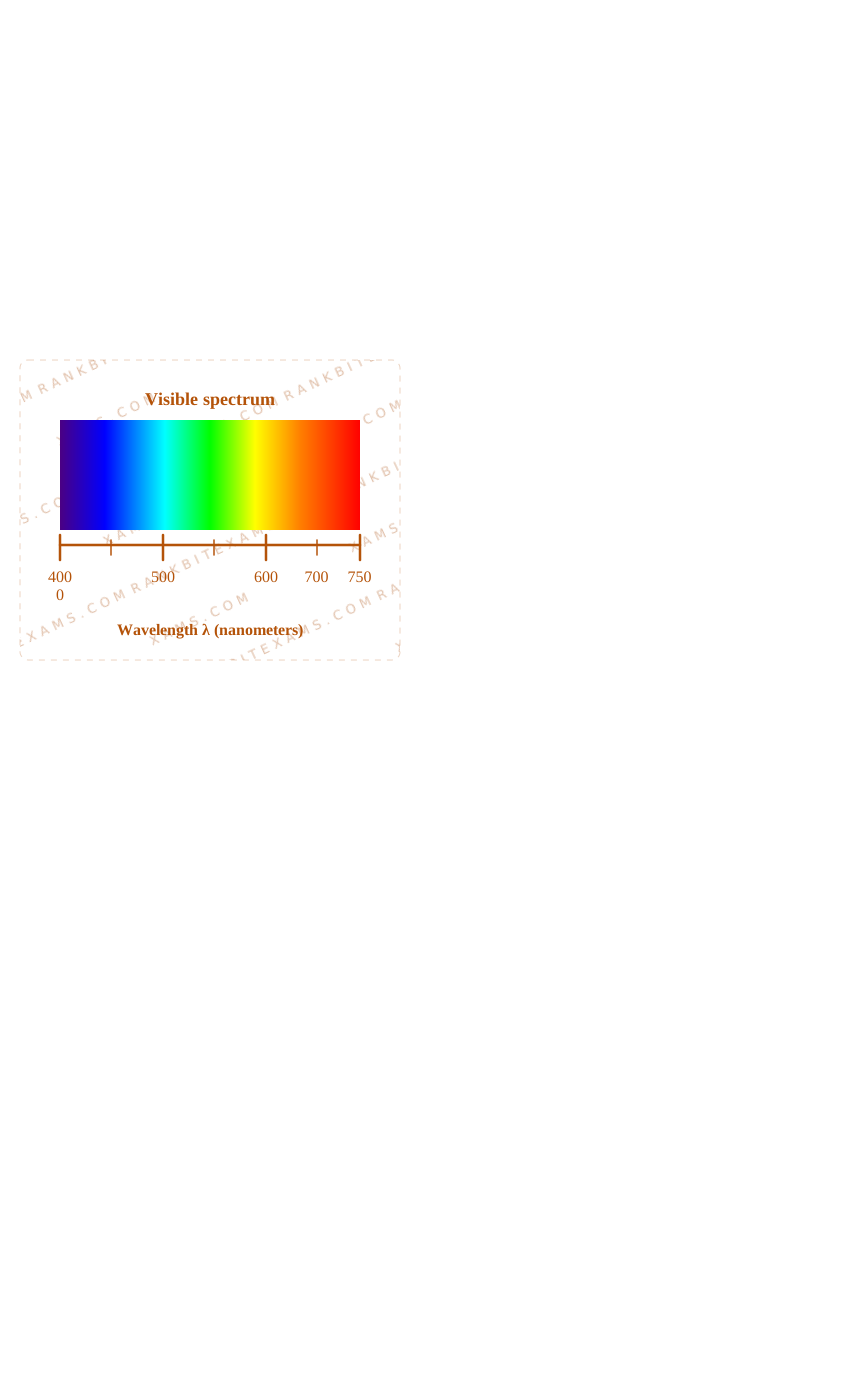
Visible spectrum wavelength diagram for Q32 - JEE Main 2025
The visible spectrum wavelength scale shows the relationship between red, yellow, and blue light frequency thresholds.
A. When mathrmCs is placed inside a vacuum chamber with an ammeter connected to it and yellow light is focused on mathrmCs the ammeter shows the presence of current. B. When the brightness of the yellow light is dimmed, the value of the current in the ammeter is reduced. C. When a red light is used instead of the yellow light, the current produced is higher with respect to the yellow light. D. When a blue light is used, the ammeter shows the formation of current. E. When a white light is used, the ammeter shows formation of current. Choose the correct answer from the options given below:

Solution & Explanation

### Related Formula lambda = fraccnu where, c = 3.0 times 10^8 text m s^-1 nu_0 = 5.16 times 10^14 text Hz ### Core Logic Let's first calculate the threshold wavelength (lambda_0) for Caesium: lambda_0 = frac3.0 times 10^85.16 times 10^14 approx 5.81 times 10^-7 text m = 581.4 text nm Comparing this with the visible spectrum: - Yellow light (sim 580 text nm) corresponds closely to the threshold wavelength. Hence, photoelectric emission occurs (Statement A is correct). - The photocurrent is directly proportional to the light intensity (brightness). Reducing brightness decreases the current (Statement B is correct). - Red light (sim 620text--750 text nm) has a lower frequency than the threshold frequency, meaning no current is produced (Statement C is incorrect). - Blue light (sim 450text--490 text nm) has a higher frequency than the threshold. Thus, current is produced (Statement D is correct). - White light contains all wavelengths (including blue, violet, etc.), which will produce a photoelectric current (Statement E is correct). Therefore, statements A, B, D, and E are correct. ### Pattern Recognition The wavelength threshold is 581 text nm (yellow-green region). Any light with shorter wavelength (higher frequency), like blue or white, will cause emission. Dimming simply decreases photon flux and hence current. ### Evaluation Rubric / Model Answer null ### Chapter Mix Class 11 Chemistry: Structure of Atom Class 12 Physics: Dual Nature of Radiation and Matter

Reference Study Guides

More Structure of Atom Previous-Year Questions — Page 5

Q66 jee_main_2024_29_jan_morning Quantum Numbers
The correct set of four quantum numbers for the valence electron of rubidium atom (Z = 37) is:
  • A. 5, 0, 0, +frac12
  • B. 5, 0, 1, +frac12
  • C. 5, 1, 0, +frac12
  • D. 5, 1, 1, +frac12

Solution

### Core Logic Rubidium (Rb) has the atomic number Z = 37. The noble gas core preceding it is Krypton (Kr, Z = 36). The electronic configuration is: Rb rightarrow [Kr] 5s^1 Thus, the valence electron resides in the 5s orbital. ### Step 1: Assigning Quantum Numbers For a 5s electron: - Principal quantum number, n = 5 (from the shell number). - Azimuthal quantum number, l = 0 (for an s-orbital). - Magnetic quantum number, m = 0 (since m ranges from -l to +l, and l=0). - Spin quantum number, s = +frac12 or -frac12. The correct set matching this is 5, 0, 0, +frac12. ### Evaluation Rubric / Model Answer null ### Chapter Mix Class 11 Chemistry: Structure of Atom

Q90 jee_main_2024_30_january_evening Atomic Spectra
Number of spectral lines obtained in mathrmHe^+ spectra, when an electron makes transition from fifth excited state to first excited state will be
Numerical Answer. Answer: 10 to 10

Solution

### Related Formula textNumber of spectral lines = fracDelta n (Delta n + 1)2 where Delta n = n_2 - n_1 ### Core Logic Identify the principal quantum numbers (n) for the given states: - Fifth excited state means n_2 = 5 + 1 = 6. - First excited state means n_1 = 1 + 1 = 2. Calculate the difference: Delta n = n_2 - n_1 = 6 - 2 = 4 ### Step 1: Calculate Total Spectral Lines Substitute Delta n = 4 into the formula: textMaximum number of spectral lines = frac4(4 + 1)2 = frac4 times 52 = 10 ### Evaluation Rubric / Model Answer null ### Chapter Mix Class 11 Chemistry: Structure of Atom
Q68 jee_main_2024_30_jan_morning Quantum Mechanical Model
Given below are two statements: Statement-I: The orbitals having same energy are called as degenerate orbitals. Statement-II: In hydrogen atom, 3p and 3d orbitals are not degenerate orbitals. In the light of the above statements, choose the most appropriate answer from the options given
  • A. textStatement-I is true but Statement-II is false
  • B. textBoth Statement-I and Statement-II are true.
  • C. textBoth Statement-I and Statement-II are false
  • D. textStatement-I is false but Statement-II is true

Solution

### Core Logic Statement-I defines degenerate orbitals correctly: Orbitals that share the exact same energy level are called degenerate orbitals. Statement-II claims 3p and 3d are not degenerate in a hydrogen atom. For a single-electron system like Hydrogen (1s^1), the energy of an orbital depends *only* on the principal quantum number 'n'. ### Step 1: Final conclusion In a hydrogen atom, energy of 3s = 3p = 3d. Therefore, 3p and 3d *are* degenerate. Thus, Statement-II is false. ### Pattern Recognition Hydrogen atom (single electron species) = Energy dictated strictly by n. Multi-electron atoms = Energy dictated by (n + l) rule. ### Evaluation Rubric / Model Answer null ### Chapter Mix Class 11 Chemistry: Structure of Atom
Q77 jee_main_2024_31_jan_evening Quantum Numbers
The four quantum numbers for the electron in the outer most orbital of potassium (atomic no. 19) are
  • A. text(1) n = 4, l = 2, m = -1, s = +frac12
  • B. text(2) n = 4, l = 0, m = 0, s = +frac12
  • C. text(3) n = 3, l = 0, m = 1, s = +frac12
  • D. text(4) n = 2, l = 0, m = 0, s = +frac12

Solution

### Core Logic The atomic number of potassium (K) is 19. Its electronic configuration is: 1s^2, 2s^2, 2p^6, 3s^2, 3p^6, 4s^1. The outermost orbital of potassium is the 4s orbital. For the 4s orbital: Principal quantum number, n = 4 Azimuthal quantum number, l = 0 (for s-subshell) Magnetic quantum number, m = 0 (since l = 0) Spin quantum number, s = pm frac12 ### Step 1: Final Matching Comparing these values with the options, option (2) provides n = 4, l = 0, m = 0, s = +frac12, which perfectly describes the outermost electron. ### Evaluation Rubric / Model Answer null ### Chapter Mix Class 11 Chemistry: Structure of Atom
Q89 jee_main_2024_31_jan_morning Photoelectric Effect and Ionization Energy
The ionization energy of sodium in textkJ mol^-1. If electromagnetic radiation of wavelength 242 nm is just sufficient to ionize sodium atom is ________
Numerical Answer. Answer: 493 to 495

Solution

### Related Formula E = frac1240lambda (textnm) text eV E_texttotal = E times N_A ### Step 1: Energy per atom E = frac1240242 text eV = 5.12 text eV Converting eV to Joules: E = 5.12 times 1.6 times 10^-19 text J/atom E = 8.192 times 10^-19 text J/atom ### Step 2: Energy per mole To find the ionization energy per mole, multiply by Avogadro's number (N_A approx 6.022 times 10^23): IE = 8.192 times 10^-19 times 6.022 times 10^23 text J/mol IE approx 493.3 times 10^3 text J/mol approx 494 text kJ/mol ### Evaluation Rubric / Model Answer null ### Chapter Mix Class 11 Chemistry: Structure of Atom

More Structure of Atom Questions — jee_main_2025_07_april_morning

Practice all Structure of Atom previous-year questions →

Rankbit System
JEE Physics: Waves (+15.5%) | Electrostatics: Concentric Shells (-29.7%) | Modern Physics: Photoelectric Clones (+34.2%) | Mathematics: Definite Integrals (+18.1%) | Chemistry: Coordination Splitting (-11.4%) | JEE Physics: Waves (+15.5%) | Electrostatics: Concentric Shells (-29.7%) | Modern Physics: Photoelectric Clones (+34.2%) | Mathematics: Definite Integrals (+18.1%) | Chemistry: Coordination Splitting (-11.4%)