JEE Main · Chemistry → Steady

Structure of Atom appeared 39 times across 3 years — 4.5% of Chemistry. This question is from Photoelectric Effect.

Year 2026 2025 2024 Total
Questions 14 16 9 39

Which of the following statements are correct, if the threshold frequency of caesium is 5.16 × 10¹⁴ ~Hz ?
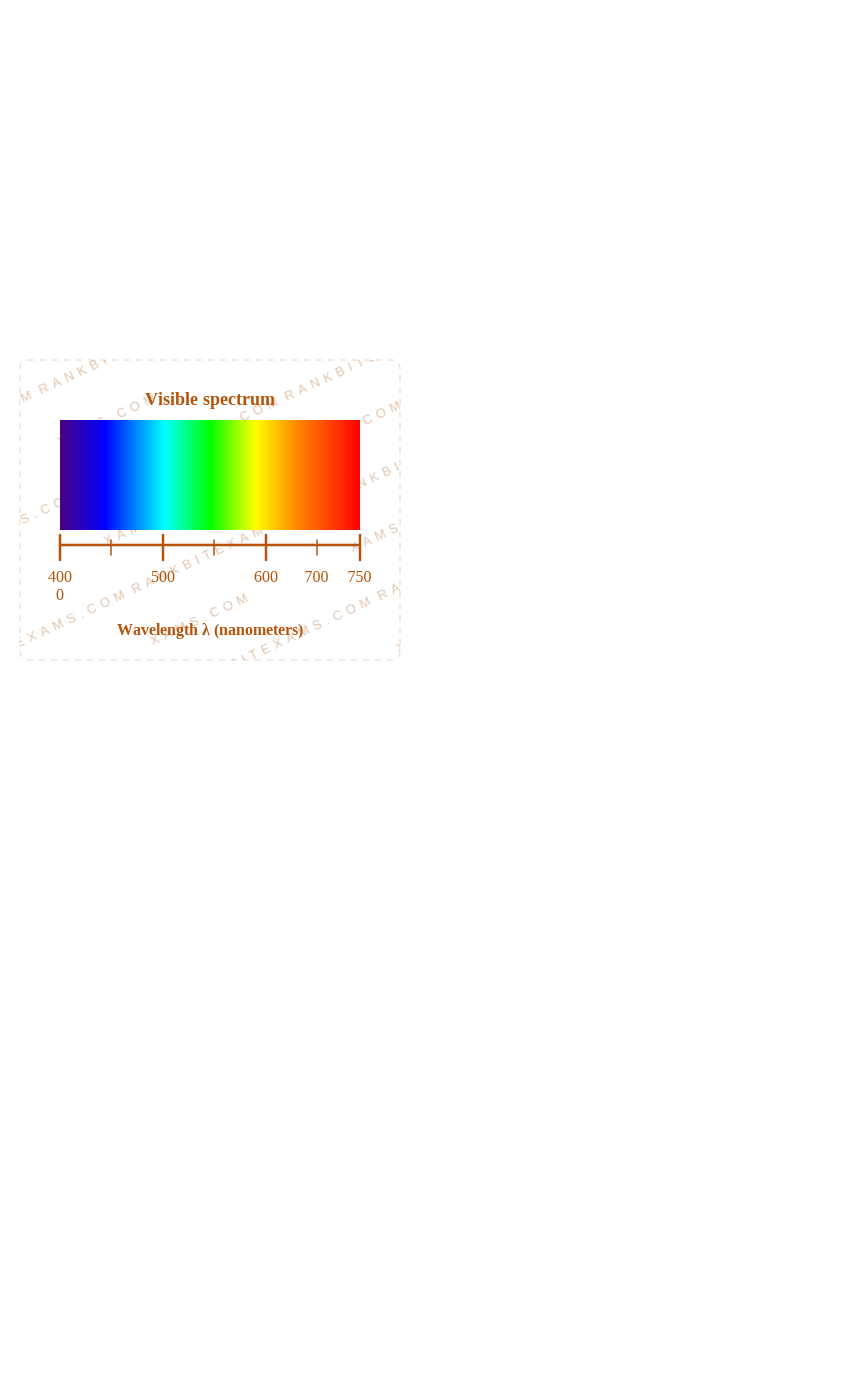
Visible spectrum wavelength diagram for Q32 - JEE Main 2025
The visible spectrum wavelength scale shows the relationship between red, yellow, and blue light frequency thresholds.
A. When Cs is placed inside a vacuum chamber with an ammeter connected to it and yellow light is focused on Cs the ammeter shows the presence of current. B. When the brightness of the yellow light is dimmed, the value of the current in the ammeter is reduced. C. When a red light is used instead of the yellow light, the current produced is higher with respect to the yellow light. D. When a blue light is used, the ammeter shows the formation of current. E. When a white light is used, the ammeter shows formation of current. Choose the correct answer from the options given below:

Solution & Explanation

Related Formula
λ = (c)/(ν)

where, c = 3.0 × 10⁸ m s⁻¹ ν₀ = 5.16 × 10¹⁴ Hz

Core Logic

Let's first calculate the threshold wavelength (λ₀) for Caesium:

λ₀ = 3.0 × 10⁸5.16 × 10¹⁴ ≈ 5.81 × 10⁻⁷ m = 581.4 nm

Comparing this with the visible spectrum:

  • Yellow light (580 nm) corresponds closely to the threshold wavelength. Hence, photoelectric emission occurs (Statement A is correct).
  • The photocurrent is directly proportional to the light intensity (brightness). Reducing brightness decreases the current (Statement B is correct).
  • Red light (620--750 nm) has a lower frequency than the threshold frequency, meaning no current is produced (Statement C is incorrect).
  • Blue light (450--490 nm) has a higher frequency than the threshold. Thus, current is produced (Statement D is correct).
  • White light contains all wavelengths (including blue, violet, etc.), which will produce a photoelectric current (Statement E is correct).
  • Therefore, statements A, B, D, and E are correct.

Pattern Recognition

The wavelength threshold is 581 nm (yellow-green region). Any light with shorter wavelength (higher frequency), like blue or white, will cause emission. Dimming simply decreases photon flux and hence current.

Chapter Mix

Class 11 Chemistry: Structure of Atom Class 12 Physics: Dual Nature of Radiation and Matter

More Structure of Atom Previous-Year Questions — Page 2

Q61 jee_main_2026_23_january_morning Quantum Numbers
Given, (A) n = 5, ml = -1 (B) n = 3, l = 2, ml = -1, mₛ = +(1)/(2) The maximum number of electron(s) in an atom that can have the quantum numbers as given in (A) and (B) respectively are:
  • A. 26 and 1
  • B. 4 and 1
  • C. 2 and 4
  • D. 8 and 1

Solution

Core Logic

Evaluate constraints set by the given quantum numbers to find available electron slots. Each unique orbital (n, l, ml) can hold exactly 2 electrons of opposite spin.

Step 1: Constraint A

For (A) n = 5, ml = -1: The possible azimuthal quantum numbers l range from 0 to n-1 = 4. However, ml goes from -l to +l. For ml = -1 to exist, l must be at least 1. Possible l values: l=1, l=2, l=3, l=4. Each of these subshells (5p, 5d, 5f, 5g) contains exactly one orbital where ml = -1. Total orbitals = 4. Total electrons = 4 orbitals × 2 e^- /orbital = 8 electrons.

Step 2: Constraint B

For (B) n = 3, l = 2, ml = -1, mₛ = +(1)/(2): This completely specifies all four quantum numbers for a single state. Pauli's Exclusion Principle states no two electrons can have the same four quantum numbers. Therefore, exactly 1 electron is possible.

Pattern Recognition

If n and ml ≠ 0 are given, count how many l values are ≥ |ml|. For n=5 and ml=-1, l in 1,2,3,4. That's 4 orbitals, 8 electrons.

Chapter Mix

Class 11 Chemistry: Structure of Atom

Q64 jee_main_2026_23_january_evening Planck's Quantum Theory and Photoelectric Effect
Identify the INCORRECT statements from the following: A. Notation ²⁴₁₂Mg represents 24 protons and 12 neutrons. B. Wavelength of a radiation of frequency 4.5 × 10¹⁵ s⁻¹ is 6.7 × 10⁻⁸ m. C. One radiation has wavelength = λ₁(900 nm) and energy = E₁. Other radiation has wavelength = λ₂(300 nm) and energy = E₂. E₁ : E₂ = 3 : 1. D. Number of photons of light of wavelength 2000 pm that provides 1 J of energy is 1.006 × 10¹⁶. Choose the correct answer from the options given below:
  • A. A and D only
  • B. A and C only
  • C. A and B only
  • D. B and C only

Solution

Related Formula

c = λ ν

E = (hc)/(λ) Etotal = n (hc)/(λ)
Core Logic

Evaluate each statement:

A. The notation ²⁴₁₂Mg specifies atomic number Z = 12 (12 protons) and mass number A = 24 (protons + neutrons). Number of neutrons = 24 - 12 = 12. The statement incorrectly says 24 protons. (False)

B. Wavelength λ = (c)/(ν) = 3 × 10⁸4.5 × 10¹⁵ = 0.666 × 10⁻⁷ m = 6.67 × 10⁻⁸ m. Statement B is approximately correct. (True)

C. Energy is inversely proportional to wavelength. E₁ ∝ (1)/(λ₁) and E₂ ∝ (1)/(λ₂). (E₁)/(E₂) = (λ₂)/(λ₁) = (300)/(900) = (1)/(3). The statement claims E₁ : E₂ = 3:1, which is incorrect. (False)

D. Number of photons n = Etotal × λhc = 1 × 2000 × 10⁻¹²6.626 × 10⁻³⁴ × 3 × 10⁸ ≈ 1.006 × 10¹⁶. (True)

Step 1: Conclusion

The incorrect statements are A and C.

Pattern Recognition

Longer wavelength means lower energy. A wavelength 3x larger means energy is exactly 1/3x. Don't flip the inverse proportionality ratio.

Chapter Mix

Class 11 Chemistry: Structure of Atom

Q68 jee_main_2026_23_january_evening Photoelectric Effect
The work functions of two metals (MA and MB) are in the 1:2 ratio. When these metals are exposed to photons of energy 6 eV, the kinetic energy of liberated electrons of MA:MB is in the ratio of 2.642:1. The work functions (in eV) of MA and MB are respectively.
  • A. 3.1, 6.2
  • B. 2.3, 4.6
  • C. 1.4, 2.8
  • D. 1.5, 3.0

Solution

Related Formula
KEmax = E - φ

where E is photon energy and φ is the work function.

Core Logic

Given the ratio of work functions is 1:2, let the work function of MA be φ₁ and MB be φ₂. Then φ₂ = 2φ₁.

For metal MA exposed to 6 eV photons: (KEmax)₁ = 6 - φ₁ --- (Equation 1)

For metal MB exposed to 6 eV photons: (KEmax)₂ = 6 - φ₂ = 6 - 2φ₁ --- (Equation 2)

Step 1: Setting up the ratio

We are given the kinetic energy ratio:

(KEmax)₁(KEmax)₂ = (2.642)/(1)

Substitute equations 1 and 2 into the ratio:

(6 - φ₁)/(6 - 2φ₁) = 2.642
Step 2: Solving for work function
6 - φ₁ = 2.642 × (6 - 2φ₁) 6 - φ₁ = 15.852 - 5.284φ₁ 5.284φ₁ - φ₁ = 15.852 - 6 4.284φ₁ = 9.852 φ₁ = (9.852)/(4.284) = 2.3 eV

Since φ₂ = 2φ₁:

φ₂ = 2 × 2.3 = 4.6 eV
Pattern Recognition

Photoelectric effect ratio problems are purely algebraic setups. Express all unknowns in terms of a single variable using the given multiplier (1:2 ratio) and plug directly into Einstein's photoelectric equation.

Chapter Mix

Class 11 Chemistry: Structure of Atom Class 12 Physics: Dual Nature of Radiation and Matter

Q73 jee_main_2026_24_january_morning Hydrogen Spectrum
The hydrogen spectrum consists of several spectral lines in Lyman series (L₁, L₂, L₃....; L₁ has lowest energy among Lyman series). Similarly it consists of several spectral lines in Balmer series (B₁, B₂, B₃..... ; B₁ has lowest energy among Balmer lines). The energy of L₁ is x times the energy of B₁. The value of x is ____ × 10⁻¹ (Nearest integer)
Numerical Answer. Answer: 54 to 54

Solution

Related Formula
Δ E = 13.6 × Z² ( (1)/(n₁²) - (1)/(n₂²) )
Core Logic

Lowest energy line in Lyman series (L₁) corresponds to transition from n₂ = 2 to n₁ = 1. Δ E(L₁) = 13.6 × Z² ( (1)/(1²) - (1)/(2²) ) = 13.6 × Z² × (3)/(4)

Lowest energy line in Balmer series (B₁) corresponds to transition from n₂ = 3 to n₁ = 2. Δ E(B₁) = 13.6 × Z² ( (1)/(2²) - (1)/(3²) ) = 13.6 × Z² × ( (1)/(4) - (1)/(9) ) = 13.6 × Z² × (5)/(36)

Step 1: Find Ratio x
(Δ E(L₁))/(Δ E(B₁)) = (13.6 Z² × 3/4)/(13.6 Z² × 5/36) x = (3/4)/(5/36) = (3)/(4) × (36)/(5) = (3 × 9)/(5) = (27)/(5) = 5.4

We need to express x as ____ × 10⁻¹. 5.4 = 54 × 10⁻¹ Thus, the integer value is 54.

Pattern Recognition

Lowest energy always means the transition from the immediately adjacent higher level (n+1 arrow n). Set up the ratio to immediately cancel out the Rydberg constant/13.6 term.

Chapter Mix

Class 11 Chemistry: Structure of Atom

Q63 jee_main_2026_24_january_evening Bohr Model for Hydrogen-like Species
The wavelength of spectral line obtained in the spectrum of LI²⁺ ion, when the transition takes place between two levels whose sum is 4 and difference is 2, is
  • A. 2.28 × 10⁻⁷ ~cm
  • B. 2.28 × 10⁻⁶ ~cm
  • C. 1.14 × 10⁻⁷ ~cm
  • D. 1.14 × 10⁻⁶ ~cm

Solution

Related Formula
(1)/(λ) = RH Z² [ (1)/(n₁²) - (1)/(n₂²) ]
Core Logic

Let n₁ be the lower energy level and n₂ be the higher energy level. Given conditions: n₁ + n₂ = 4 n₂ - n₁ = 2

Solving these linear equations: 2n₂ = 6 n₂ = 3 n₁ = 1

Step 1: Apply Rydberg Formula

For Li²⁺, the atomic number Z = 3.

(1)/(λ) = RH (3)² [ (1)/(1²) - (1)/(3²) ] (1)/(λ) = 9 RH [ 1 - (1)/(9) ] (1)/(λ) = 9 RH × (8)/(9) = 8RH λ = 18RH
Step 2: Calculate Wavelength in cm

Using RH = 109677 ~cm⁻¹ 1.1 × 10⁵ ~cm⁻¹ (approximated for calculation):

λ = (1)/(8 × 1.1 × 10⁵) λ = (1)/(8.8 × 10⁵) λ = (1000)/(8.8) × 10⁻⁸ ~cm λ = 113.63 × 10⁻⁸ ~cm λ 1.14 × 10⁻⁶ ~cm
Pattern Recognition

Equations translating "sum and difference of levels" instantly lock in the specific transition (3 arrow 1 Lyman series line). Always check the Z² factor for hydrogen-like species (like Li²⁺ where Z²=9) which heavily alters the wavelength.

Chapter Mix

Class 11 Chemistry: Structure of Atom

Rankbit System
JEE Physics: Waves (+15.5%) | Electrostatics: Concentric Shells (-29.7%) | Modern Physics: Photoelectric Clones (+34.2%) | Mathematics: Definite Integrals (+18.1%) | Chemistry: Coordination Splitting (-11.4%) | JEE Physics: Waves (+15.5%) | Electrostatics: Concentric Shells (-29.7%) | Modern Physics: Photoelectric Clones (+34.2%) | Mathematics: Definite Integrals (+18.1%) | Chemistry: Coordination Splitting (-11.4%)