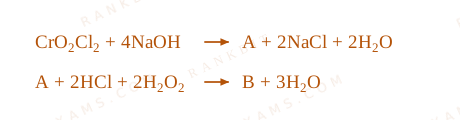
The number of valence electrons present in the metal among mathrmCr, mathrmCo, mathrmFe and mathrmNi which has the lowest enthalpy of atomisation is:

Solution & Explanation

### Core Logic Let's look at the enthalpy of atomisation values for the given 3d transition metals: - **Chromium (mathrmCr)**: 397 text kJ mol^-1 - **Iron (mathrmFe)**: 416 text kJ mol^-1 - **Cobalt (mathrmCo)**: 425 text kJ mol^-1 - **Nickel (mathrmNi)**: 430 text kJ mol^-1 Among the choices, **Chromium (mathrmCr)** has the lowest enthalpy of atomisation (397 text kJ mol^-1), due to a highly stable half-filled d-subshell configuration which leads to weaker metallic bonding relative to the other metals listed. The valence electronic configuration of mathrmCr is: mathrmCr = [mathrmAr] 3mathrmd^5 4mathrms^1 Total valence electrons = 5 + 1 = 6. ### Pattern Recognition In transition metals, manganese (Mn) has the absolute lowest enthalpy of atomisation in the 3d series because of its completely half-filled d^5 and completely filled s^2 stability. Since Mn is not in the list, Chromium ("Cr") is next, having 6 valence electrons. ### Evaluation Rubric / Model Answer null ### Chapter Mix Class 12 Chemistry: d- and f-Block Elements

Reference Study Guides

More d- and f-Block Elements Previous-Year Questions — Page 8

Q86 jee_main_2024_31_jan_evening Chromyl Chloride Test
In the reaction of potassium dichromate, potassium chloride and sulfuric acid (conc.), the oxidation state of the chromium in the product is (+) ________
Numerical Answer. Answer: 6 to 6

Solution

### Related Formula K_2Cr_2O_7(s) + 4KCl(s) + 6H_2SO_4(conc.) rightarrow 2CrO_2Cl_2(g) + 6KHSO_4 + 3H_2O ### Core Logic This reaction represents the Chromyl Chloride test used to detect the presence of chloride ions. When potassium dichromate is heated with a metal chloride in concentrated sulfuric acid, red vapors of chromyl chloride (CrO_2Cl_2) are evolved. ### Step 1: Oxidation State Calculation In chromyl chloride (CrO_2Cl_2): Let the oxidation state of Chromium be x. Oxygen is typically -2 and Chlorine is -1. x + 2(-2) + 2(-1) = 0 x - 4 - 2 = 0 x = +6 Thus, the oxidation state of Chromium in the product is 6. ### Evaluation Rubric / Model Answer null ### Chapter Mix Class 12 Chemistry: The d- and f-Block Elements Class 11 Chemistry: Practical Chemistry
Q71 jee_main_2024_31_jan_morning Potassium Dichromate and Permanganate
Identify correct statements from below: A. The chromate ion is square planar. B. Dichromates are generally prepared from chromates. C. The green manganate ion is diamagnetic. D. Dark green coloured K_2MnO_4 disproportionates in a neutral or acidic medium to give permanganate. E. With increasing oxidation number of transition metal, ionic character of the oxides decreases. Choose the correct answer from the options given below:
  • A. textB, C, D only
  • B. textA, D, E only
  • C. textA, B, C only
  • D. textB, D, E only

Solution

### Step 1: Statement A Analysis CrO_4^2- (chromate ion) is tetrahedral, not square planar. Statement A is incorrect. ### Step 2: Statement B Analysis 2Na_2CrO_4 + 2H^+ rightarrow Na_2Cr_2O_7 + 2Na^+ + H_2O. Dichromates are indeed prepared from chromates. Statement B is correct. ### Step 3: Statement C Analysis The green manganate ion (MnO_4^2-) has manganese in the +6 oxidation state (3d^1). Thus, it contains 1 unpaired electron and is paramagnetic, not diamagnetic. Statement C is incorrect. ### Step 4: Statement D Analysis Dark green coloured K_2MnO_4 undergoes disproportionation in neutral or acidic media to yield permanganate (MnO_4^-) and manganese dioxide (MnO_2). Statement D is correct. ### Step 5: Statement E Analysis Fajans' rule dictates that as the oxidation state increases, polarizing power increases, leading to a decrease in ionic character (increase in covalent character). Statement E is correct. ### Final Conclusion The correct statements are B, D, and E. ### Evaluation Rubric / Model Answer null ### Chapter Mix Class 12 Chemistry: The d- and f-Block Elements

More d- and f-Block Elements Questions — jee_main_2025_07_april_morning

Practice all d- and f-Block Elements previous-year questions →

Rankbit System
JEE Physics: Waves (+15.5%) | Electrostatics: Concentric Shells (-29.7%) | Modern Physics: Photoelectric Clones (+34.2%) | Mathematics: Definite Integrals (+18.1%) | Chemistry: Coordination Splitting (-11.4%) | JEE Physics: Waves (+15.5%) | Electrostatics: Concentric Shells (-29.7%) | Modern Physics: Photoelectric Clones (+34.2%) | Mathematics: Definite Integrals (+18.1%) | Chemistry: Coordination Splitting (-11.4%)