The number of valence electrons present in the metal among Cr$\mathrm{Cr}$, Co$\mathrm{Co}$, Fe$\mathrm{Fe}$ and Ni$\mathrm{Ni}$ which has the lowest enthalpy of atomisation is:
A.8
B.9
C.6
D.10
Solution & Explanation
Core Logic
Let's look at the enthalpy of atomisation values for the given 3d transition metals:
Among the choices, Chromium (Cr$\mathrm{Cr}$) has the lowest enthalpy of atomisation (397 kJ mol⁻¹$397 \text{ kJ mol}^{-1}$), due to a highly stable half-filled d-subshell configuration which leads to weaker metallic bonding relative to the other metals listed.
The valence electronic configuration of Cr$\mathrm{Cr}$ is:
In transition metals, manganese (Mn$Mn$) has the absolute lowest enthalpy of atomisation in the 3d series because of its completely half-filled d⁵$d^5$ and completely filled s²$s^2$ stability. Since Mn$Mn$ is not in the list, Chromium ("Cr"$"Cr"$) is next, having 6$6$ valence electrons.
The reaction yields sodium tetrahydroxoplumbate(II), [Pb(OH)₄]²⁻$[\text{Pb(OH)}_4]^{2-}$. The charge of the complex species is -2$-2$ (dianionic), and it binds 4 hydroxo coordination ligands, matching a coordination number of four.
Chapter Mix
Class 12 Chemistry: d-and f-Block Elements
Class 12 Chemistry: Coordination Compounds
Q78jee_main_2024_27_jan_morningChromyl Chloride Test
NaCl$\text{NaCl}$ reacts with conc. H₂SO₄$H_2SO_4$ and K₂Cr₂O₇$K_2Cr_2O_7$ to give reddish fumes (B), which react with NaOH$\text{NaOH}$ to give yellow solution (C). (B) and (C) respectively are;
The electronic configuration for Neodymium is:
[Atomic Number for Neodymium 60]
A.[Xe] 4f⁴ 6s²$\text{[Xe]} 4f^4 6s^2$
B.[Xe] 5f⁴ 7s²$\text{[Xe]} 5f^4 7s^2$
C.[Xe] 4f⁶ 6s²$\text{[Xe]} 4f^6 6s^2$
D.[Xe] 4f¹ 5d¹ 6s²$\text{[Xe]} 4f^1 5d^1 6s^2$
Solution
Core Logic
The noble gas configuration of Xenon (Z=54$Z=54$) provides the primary core layout. For Neodymium (Z=60$Z=60$), the 6 remaining valence electrons distribute into the inner 4f$4\text{f}$ orbital subshell rather than filling the 5d$5\text{d}$ subshell due to shielding effects. This results in an absolute atomic ground state electronic configuration of [Xe] 4f⁴ 6s²$\text{[Xe]} 4\text{f}^4 6\text{s}^2$.
Pattern Recognition
Lanthanide filling sequences generally bypass 5d$5d$ progression except for specific exceptions (La, Gd, Lu).
Potassium permanganate (KMnO₄$KMnO_4$) is a strong oxidizing agent. When heated to 513K$513\mathrm{K}$, it undergoes thermal decomposition to give potassium manganate (K₂MnO₄$K_2MnO_4$), manganese dioxide (MnO₂$MnO_2$), and oxygen gas (O₂$O_2$).
The products formed along with O₂$O_2$ are K₂MnO₄$K_2MnO_4$ (green) and MnO₂$MnO_2$ (black).
Chapter Mix
Class 12 Chemistry: d and f Block Elements
Q63jee_main_2024_29_jan_morningPotassium Dichromate and Chromyl Chloride Test
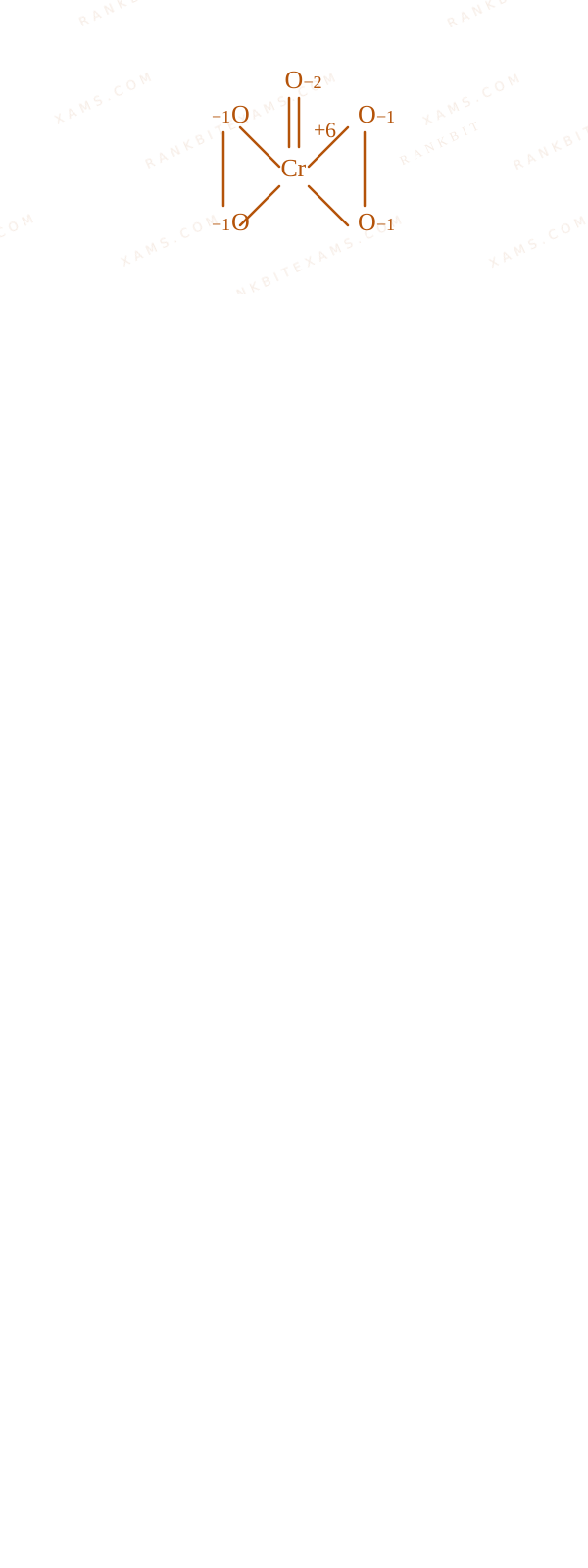
In chromyl chloride test for confirmation of Cl^-$Cl^-$ ion, a yellow solution is obtained. Acidification of the solution and addition of amyl alcohol and 10%$10\%$H₂O₂$H_2O_2$ turns organic layer blue indicating formation of chromium pentoxide. The oxidation state of chromium in that is
Acidification of the yellow CrO₄²⁻$CrO_4^{2-}$ solution followed by the addition of H₂O₂$H_2O_2$ and amyl alcohol yields a blue-colored organic layer due to the formation of chromium pentoxide (CrO₅$CrO_5$).
Potassium Dichromate and Chromyl Chloride Test diagram for Q63 - JEE Main 2024 Morning
The structure of chromium pentoxide (CrO₅$CrO_5$) features a distinctive "butterfly" arrangement. It contains one double-bonded oxide oxygen (O²⁻$O^{2-}$) and four peroxide oxygens (O₂²⁻$O_2^{2-}$). Therefore, there are 2 peroxo linkages.
Let the oxidation state of Chromium be x$x$.
x + 1(-2) + 4(-1) = 0$$x + 1(-2) + 4(-1) = 0$$
x - 2 - 4 = 0$x - 2 - 4 = 0$x = +6$x = +6$
Thus, the oxidation state of Cr in CrO₅$CrO_5$ is +6$+6$.
Pattern Recognition
A classic oxidation state trap. Calculating simply via formula CrO₅$CrO_5$ yields x - 10 = 0 x = +10$x - 10 = 0 \implies x = +10$, which is impossible for Chromium (max +6). Whenever calculation exceeds the maximum group valency, peroxide bonds are present.
Chapter Mix
Class 12 Chemistry: d and f Block Elements
Class 11 Chemistry: Redox Reactions
More d- and f-Block Elements Questions — jee_main_2025_07_april_morning
Practice past-year questions one chapter at a time. Pick an exam → subject → chapter and get every PYQ for that topic — pulled together from all past papers — with the chapter's key formulas alongside.