LIST-II (Bond pair : lone pair on the central atom)
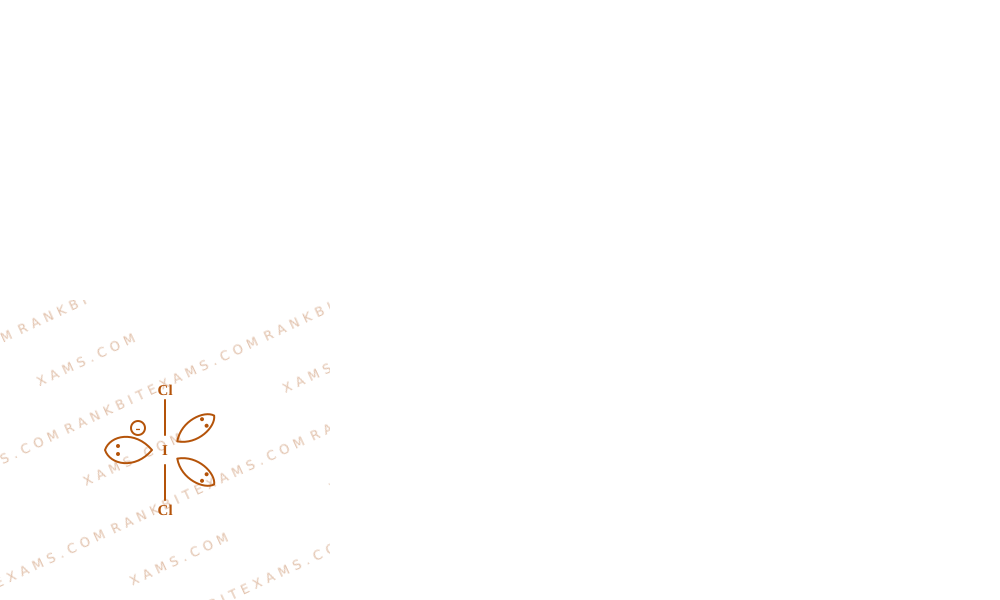
(A) mathrmICl_2^-$\mathrm{ICl}_2^-$
(I) 4 : 2$4 : 2$
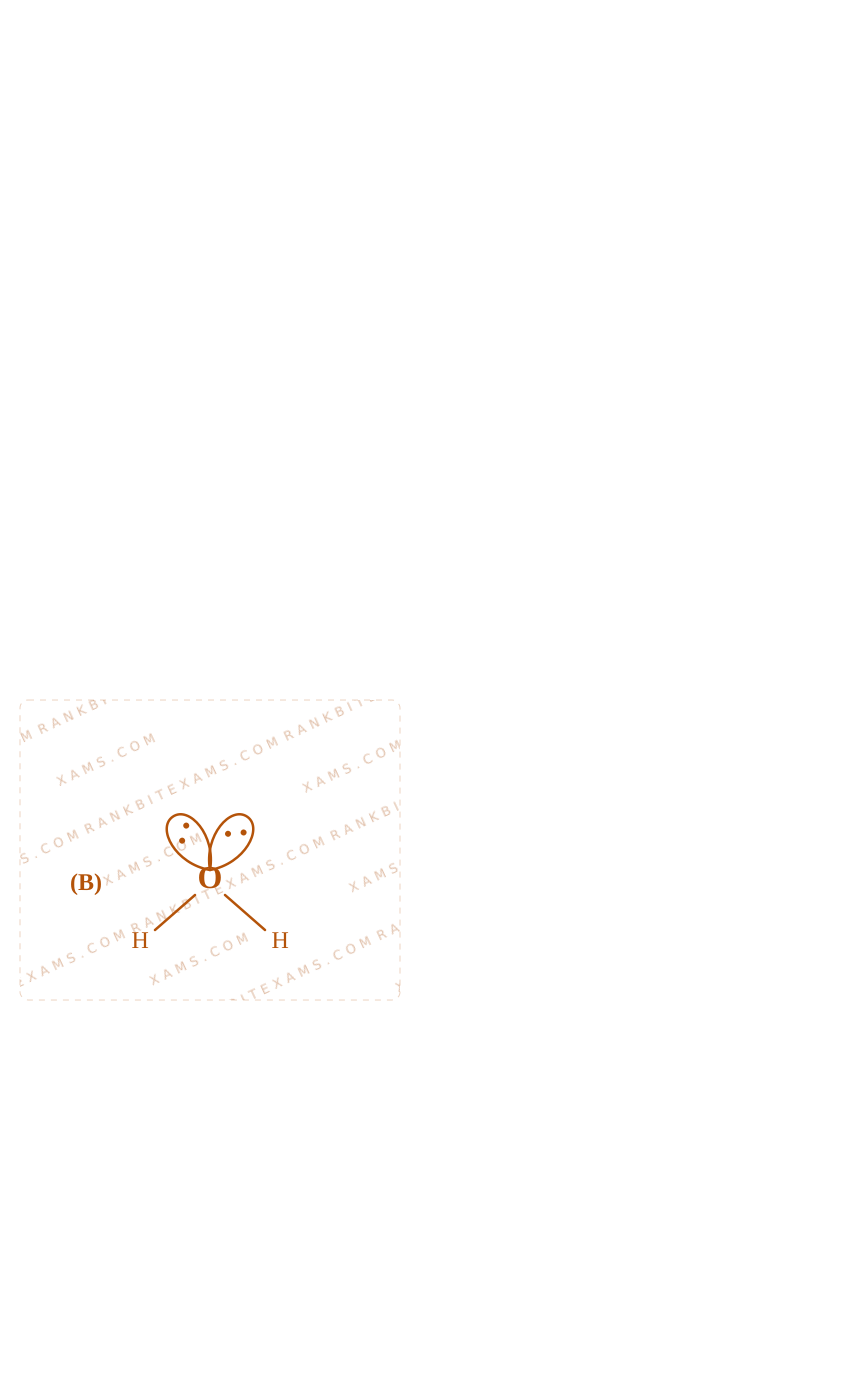
(B) mathrmH_2mathrmO$\mathrm{H}_2\mathrm{O}$
(II) 4 : 1$4 : 1$
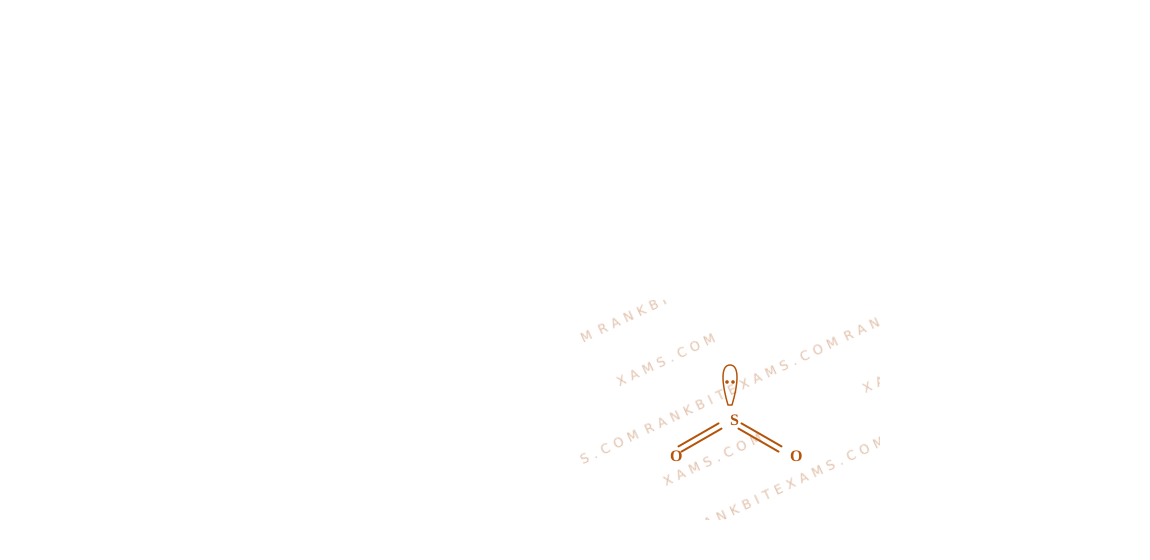
(C) mathrmSO_2$\mathrm{SO}_2$
(III) 2 : 3$2 : 3$
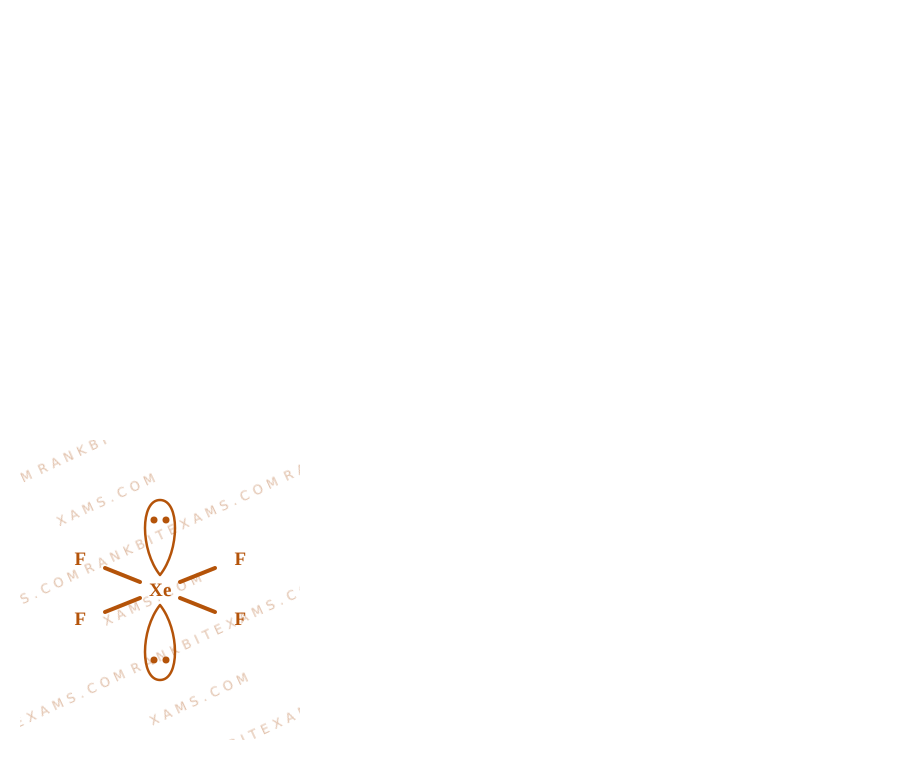
(D) mathrmXeF_4$\mathrm{XeF}_4$
(IV) 2 : 2$2 : 2$
Choose the correct answer from the options given below:
A.(A)-(IV), (B)-(III), (C)-(II), (D)-(I)
B.(A)-(III), (B)-(IV), (C)-(II), (D)-(I)
C.(A)-(III), (B)-(IV), (C)-(I), (D)-(II)
D.(A)-(II), (B)-(I), (C)-(IV), (D)-(III)
Solution & Explanation
### Core Logic
Let's find the number of bond pairs (sigma$\sigma$-bonds or regions) and lone pairs on the central atom of each species:
1. **mathrmICl_2^-$\mathrm{ICl}_2^-$**:
- Central atom Iodine has 7$7$ valence electrons + 1$+ 1$ negative charge = 8$= 8$ electrons.
- Forms 2$2$ single bonds (bond pairs = 2$= 2$).
- Remaining 6$6$ electrons form 3$3$ lone pairs.
- Ratio is 2 : 3$2 : 3$ (Matches LIST-II, III).
VSEPR linear shape of ICl2-
2. **mathrmH_2mathrmO$\mathrm{H}_2\mathrm{O}$**:
- Oxygen has 6$6$ valence electrons.
- Forms 2$2$ bond pairs with Hydrogens.
- Remaining 4$4$ electrons form 2$2$ lone pairs.
- Ratio is 2 : 2$2 : 2$ (Matches LIST-II, IV).
VSEPR linear shape of ICl2-
3. **mathrmSO_2$\mathrm{SO}_2$**:
- Sulfur has 6$6$ valence electrons.
- Forms 2$2$ double bonds (which are counted as 4$4$ bonding pairs of electrons/bond pairs in typical VSEPR representations here).
- Remaining 2$2$ electrons form 1$1$ lone pair.
- Ratio is 4 : 1$4 : 1$ (Matches LIST-II, II).
VSEPR linear shape of ICl2-
4. **mathrmXeF_4$\mathrm{XeF}_4$**:
- Xenon has 8$8$ valence electrons.
- Forms 4$4$ bond pairs with Fluorines.
- Remaining 4$4$ electrons form 2$2$ lone pairs.
- Ratio is 4 : 2$4 : 2$ (Matches LIST-II, I).
VSEPR linear shape of ICl2-
Thus, the correct mapping is: A-III, B-IV, C-II, D-I.
### Pattern Recognition
For match-the-column with VSEPR structures:
- Always find steric number: textSteric Number = frac12(V + M - C + A)$\text{Steric Number} = \frac{1}{2}(V + M - C + A)$.
- Water is 2$2$ bond pairs, 2$2$ lone pairs (sp^3$sp^3$) rightarrow$\rightarrow$ B-IV. This alone helps eliminate multiple incorrect options immediately.
### Evaluation Rubric / Model Answer
null
### Chapter Mix
Class 11 Chemistry: Chemical Bonding and Molecular Structure
More Chemical Bonding and Molecular Structure Previous-Year Questions — Page 6
### Core Logic
Using VSEPR theory:
(A) BrF_5$BrF_5$: Br has 7 valence electrons. 5 form bonds with F, leaving 1 lone pair. (5 bp + 1 lp) rightarrow$\rightarrow$sp^3d^2$sp^3d^2$ hybridization rightarrow$\rightarrow$ Square pyramidal shape.
(B) H_2O$H_2O$: O has 6 valence electrons. 2 form bonds with H, leaving 2 lone pairs. (2 bp + 2 lp) rightarrow$\rightarrow$sp^3$sp^3$ hybridization rightarrow$\rightarrow$ Bent shape.
(C) ClF_3$ClF_3$: Cl has 7 valence electrons. 3 form bonds with F, leaving 2 lone pairs. (3 bp + 2 lp) rightarrow$\rightarrow$sp^3d$sp^3d$ hybridization rightarrow$\rightarrow$ T-shape.
(D) SF_4$SF_4$: S has 6 valence electrons. 4 form bonds with F, leaving 1 lone pair. (4 bp + 1 lp) rightarrow$\rightarrow$sp^3d$sp^3d$ hybridization rightarrow$\rightarrow$ See-saw shape.
### Step 1: Matching
(A) - (IV)
(B) - (III)
(C) - (I)
(D) - (II)
VSEPR Theory solution diagram for Q71 - JEE Main 2024 MorningVSEPR Theory solution diagram for Q71 - JEE Main 2024 MorningVSEPR Theory solution diagram for Q71 - JEE Main 2024 MorningVSEPR Theory solution diagram for Q71 - JEE Main 2024 Morning
### Evaluation Rubric / Model Answer
null
### Chapter Mix
Class 11 Chemistry: Chemical Bonding and Molecular Structure
Q85jee_main_2024_30_jan_morningMolecular Orbital Theory
### Core Logic
According to Molecular Orbital Theory (MOT), the number of molecular orbitals (MOs) formed is equal to the total number of atomic orbitals (AOs) combined.
### Step 1: Counting atomic orbitals
For a single atom in the 2nd period, the valence shell has:
One 2s orbital
Three 2p orbitals (2p_x, 2p_y, 2p_z$2p_x, 2p_y, 2p_z$)
Total = 4 atomic orbitals per atom.
For a diatomic molecule, two such atoms combine. Total atomic orbitals = 4 times 2 = 8$4 \times 2 = 8$.
### Step 2: Forming molecular orbitals
Combining these 8 atomic orbitals yields 8 molecular orbitals:
- From 2s: sigma_2s$\sigma_{2s}$ and sigma^*_2s$\sigma^*_{2s}$ (2 MOs)
- From 2p: sigma_2p_z, pi_2p_x, pi_2p_y, pi^*_2p_x, pi^*_2p_y, sigma^*_2p_z$\sigma_{2p_z}, \pi_{2p_x}, \pi_{2p_y}, \pi^*_{2p_x}, \pi^*_{2p_y}, \sigma^*_{2p_z}$ (6 MOs)
Total MOs = 2 + 6 = 8$2 + 6 = 8$.
### Evaluation Rubric / Model Answer
null
### Chapter Mix
Class 11 Chemistry: Chemical Bonding and Molecular Structure
Q74jee_main_2024_31_jan_eveningIonic Bond and Lattice Energy
Which of the following is least ionic?
A.text(1) BaCl_2$\text{(1) }BaCl_2$
B.text(2) AgCl$\text{(2) }AgCl$
C.text(3) KCl$\text{(3) }KCl$
D.text(4) CoCl_2$\text{(4) }CoCl_2$
Solution
### Core Logic
According to Fajan's rules, covalent character is favored by high charge and small size of the cation, and by cations with a pseudo-noble gas configuration.
Ag^+$Ag^+$ has a pseudo-noble gas configuration (ns^2np^6nd^10$ns^2np^6nd^{10}$), which results in high polarizing power compared to s-block and typical transition elements.
Therefore, AgCl$AgCl$ has the maximum covalent character and is the least ionic among the given options.
Ionic character order: AgCl < CoCl_2 < BaCl_2 < KCl$AgCl < CoCl_2 < BaCl_2 < KCl$
### Step 1: Final Selection
Because AgCl$AgCl$ is the most covalent, it is the least ionic. Hence, option (2) is correct.
### Evaluation Rubric / Model Answer
null
### Chapter Mix
Class 11 Chemistry: Chemical Bonding and Molecular Structure
Q81jee_main_2024_31_jan_eveningDipole Moment and Fractional Charge
A diatomic molecule has a dipole moment of 1.2text D$1.2\text{ D}$. If the bond distance is 1mathrmAA$1\mathrm{\AA}$, then fractional charge on each atom is _________ times 10^-10text esu$\times 10^{-10}\text{ esu}$.
(Given: 1text D = 10^-18text esu cm$1\text{ D} = 10^{-18}\text{ esu cm}$)
Numerical Answer.Answer: 1.2 to 1.2
Solution
### Related Formula
mu = q times d$$\mu = q \times d$$
### Core Logic
Given dipole moment, mu = 1.2text D = 1.2 times 10^-18text esu cm$\mu = 1.2\text{ D} = 1.2 \times 10^{-18}\text{ esu cm}$.
Bond distance, d = 1mathrmAA = 10^-8text cm$d = 1\mathrm{\AA} = 10^{-8}\text{ cm}$.
We need to find the fractional charge q$q$.
### Step 1: Calculation
q = fracmud$$q = \frac{\mu}{d}$$q = frac1.2 times 10^-18text esu cm10^-8text cm$$q = \frac{1.2 \times 10^{-18}\text{ esu cm}}{10^{-8}\text{ cm}}$$q = 1.2 times 10^-10text esu$$q = 1.2 \times 10^{-10}\text{ esu}$$
### Step 2: Final Formatting
The question asks for the fractional charge in the form x times 10^-10text esu$x \times 10^{-10}\text{ esu}$. Therefore, the value is 1.2$1.2$.
*Note: Based on NTA officially accepting 12$12$ (if asked for x times 10^-11$x \times 10^{-11}$) or 1.2$1.2$. We will format it exactly as calculated.*
### Evaluation Rubric / Model Answer
null
### Chapter Mix
Class 11 Chemistry: Chemical Bonding and Molecular Structure
Q77jee_main_2024_31_jan_morningMolecular Orbital Theory
The linear combination of atomic orbitals to form molecular orbitals takes place only when the combining atomic orbitals
A. have the same energy
B. have the minimum overlap
C. have same symmetry about the molecular axis
D. have different symmetry about the molecular axis
Choose the most appropriate from the options given below:
A.textA, B, C only$\text{A, B, C only}$
B.textA and C only$\text{A and C only}$
C.textB, C, D only$\text{B, C, D only}$
D.textB and D only$\text{B and D only}$
Solution
### Core Logic
Conditions for the linear combination of atomic orbitals (LCAO) to form molecular orbitals:
1. The combining atomic orbitals must have the same or nearly the same energy.
2. The combining atomic orbitals must have the same symmetry about the molecular axis.
3. The combining atomic orbitals must overlap to the maximum extent (not minimum).
### Evaluation Rubric / Model Answer
null
### Chapter Mix
Class 11 Chemistry: Chemical Bonding and Molecular Structure
We Map Every Repeating Question in Competitive Exams.
Say goodbye to generic mock test fatigue. RankBit uses smart analysis to group past exam questions into their foundational Repeating Question Types. Find chapter weightage, track repeating questions, and score higher with targeted practice.
Select Your Target Exam
Choose an exam track below to find formulas per chapter and patterns.
Syncing Exam Intelligence
Mapping formulas and patterns across all tracks…
PATH A — FULL LENGTH PRACTICE
Full Mock Test Hub
Simulate real NTA exam conditions with fully tracked mocks. Time yourself against past papers.
Practice past-year questions one chapter at a time. Pick an exam → subject → chapter and get every PYQ for that topic — pulled together from all past papers — with the chapter's key formulas alongside.