
Match the LIST-I with LIST-II.
LIST-I (Molecule/ion)LIST-II (Bond pair : lone pair on the central atom)
(A) mathrmICl_2^-(I) 4 : 2
(B) mathrmH_2mathrmO(II) 4 : 1
(C) mathrmSO_2(III) 2 : 3
(D) mathrmXeF_4(IV) 2 : 2
Choose the correct answer from the options given below:

Solution & Explanation

### Core Logic Let's find the number of bond pairs (sigma-bonds or regions) and lone pairs on the central atom of each species: 1. **mathrmICl_2^-**: - Central atom Iodine has 7 valence electrons + 1 negative charge = 8 electrons. - Forms 2 single bonds (bond pairs = 2). - Remaining 6 electrons form 3 lone pairs. - Ratio is 2 : 3 (Matches LIST-II, III).
VSEPR linear shape of ICl2-
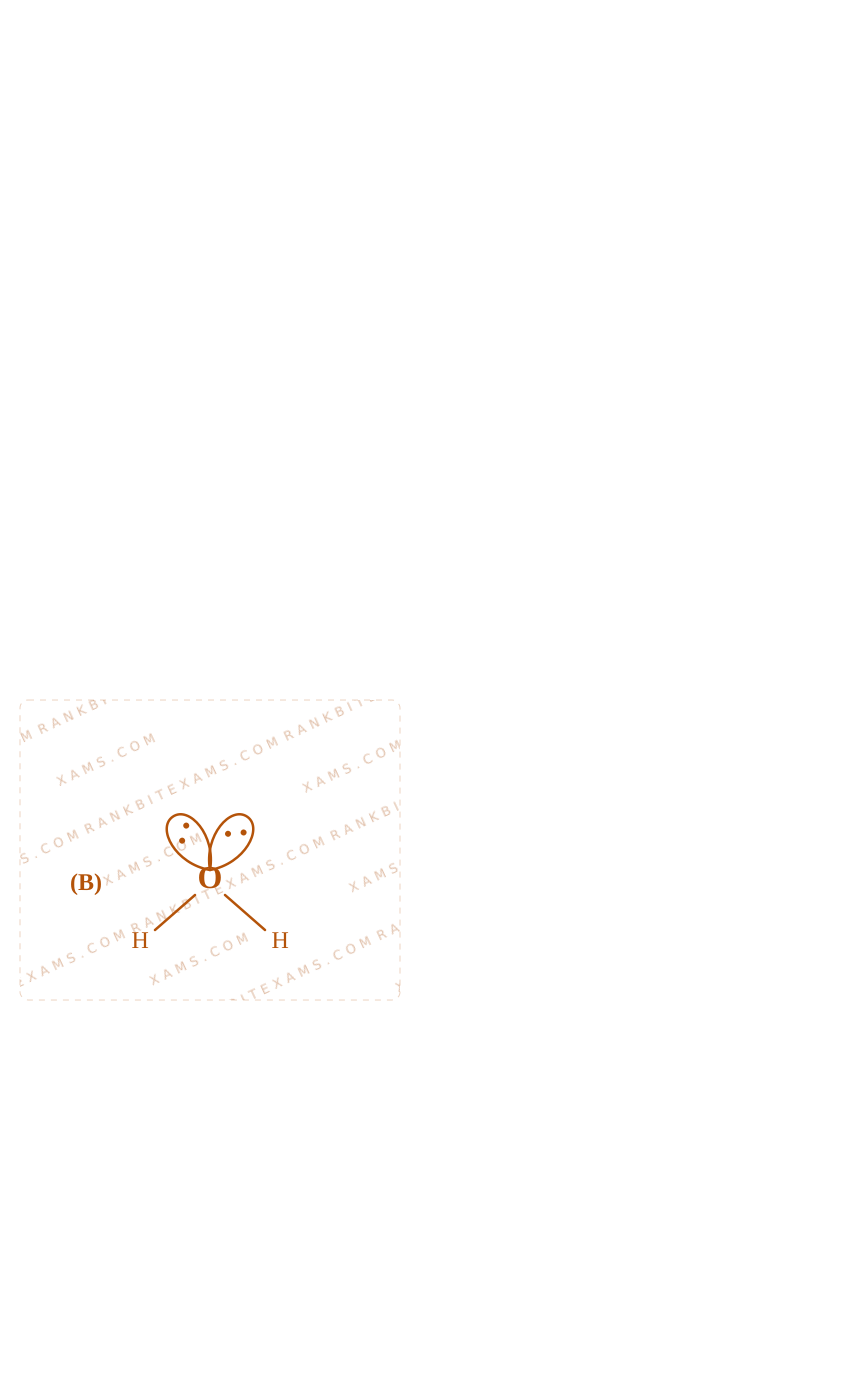
2. **mathrmH_2mathrmO**: - Oxygen has 6 valence electrons. - Forms 2 bond pairs with Hydrogens. - Remaining 4 electrons form 2 lone pairs. - Ratio is 2 : 2 (Matches LIST-II, IV).
VSEPR linear shape of ICl2-
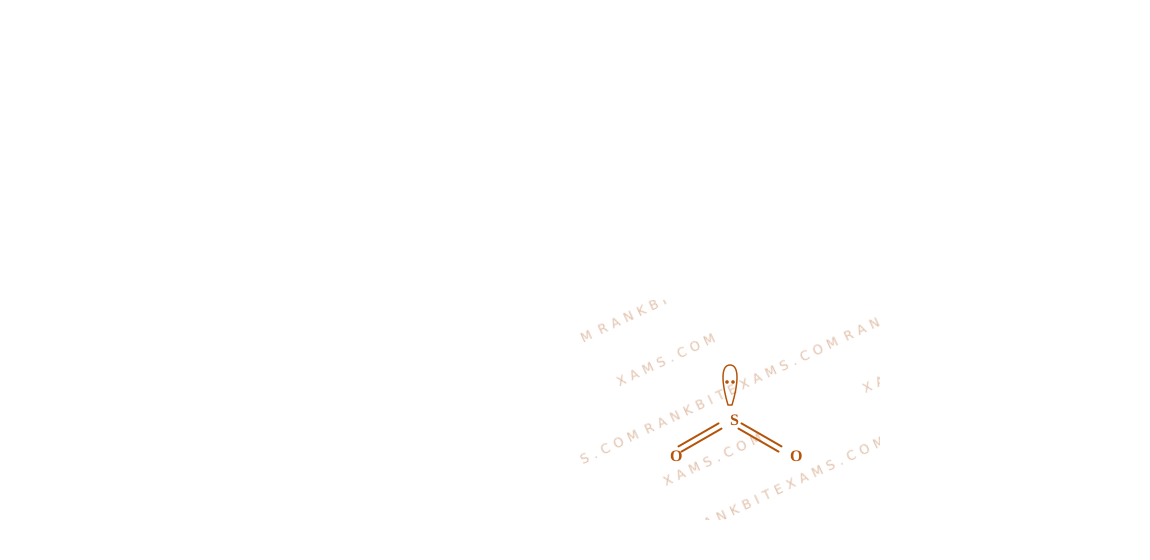
3. **mathrmSO_2**: - Sulfur has 6 valence electrons. - Forms 2 double bonds (which are counted as 4 bonding pairs of electrons/bond pairs in typical VSEPR representations here). - Remaining 2 electrons form 1 lone pair. - Ratio is 4 : 1 (Matches LIST-II, II).
VSEPR linear shape of ICl2-
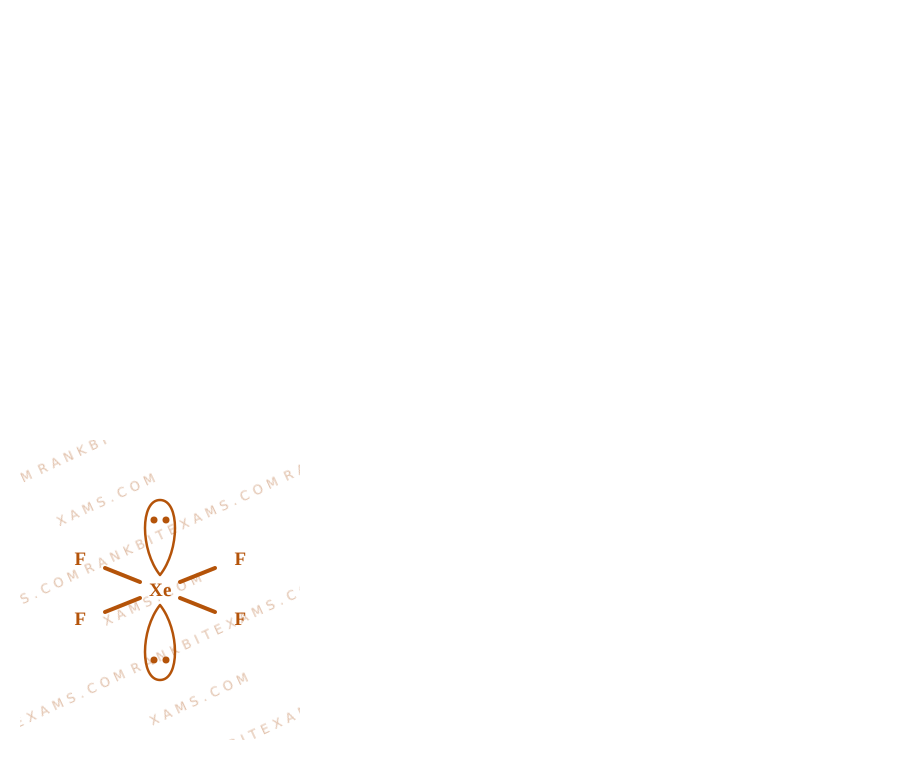
4. **mathrmXeF_4**: - Xenon has 8 valence electrons. - Forms 4 bond pairs with Fluorines. - Remaining 4 electrons form 2 lone pairs. - Ratio is 4 : 2 (Matches LIST-II, I).
VSEPR linear shape of ICl2-
Thus, the correct mapping is: A-III, B-IV, C-II, D-I. ### Pattern Recognition For match-the-column with VSEPR structures: - Always find steric number: textSteric Number = frac12(V + M - C + A). - Water is 2 bond pairs, 2 lone pairs (sp^3) rightarrow B-IV. This alone helps eliminate multiple incorrect options immediately. ### Evaluation Rubric / Model Answer null ### Chapter Mix Class 11 Chemistry: Chemical Bonding and Molecular Structure

More Chemical Bonding and Molecular Structure Previous-Year Questions — Page 4

Q74 jee_main_2024_01_february_morning Ionic Character
Arrange the bonds in order of increasing ionic character in the molecules. LiF, K_2O, N_2, SO_2 and ClF_3.
  • A. ClF_3 < N_2 < SO_2 < K_2O < LiF
  • B. LiF < K_2O < ClF_3 < SO_2 < N_2
  • C. N_2 < SO_2 < ClF_3 < K_2O < LiF
  • D. N_2 < ClF_3 < SO_2 < K_2O < LiF

Solution

### Core Logic The ionic character of a bond is directly proportional to the electronegativity difference (Delta EN) between the two bonded atoms. Larger Delta EN implies higher ionic character. ### Step 1: Assess Electronegativity Differences - N_2: Both atoms are Nitrogen. Delta EN = 0. Purely covalent. (Lowest ionic character) - SO_2: Bond between S and O. Moderate Delta EN. Covalent with some polarity. - ClF_3: Bond between Cl and F. Delta EN is higher than S-O as F is the most electronegative element. - K_2O: Bond between K (alkali metal, very low EN) and O. Very high Delta EN. Ionic. - LiF: Bond between Li (alkali metal) and F (highest EN). Maximum Delta EN possible among these options. Most ionic. ### Step 2: Order Derivation Increasing order of ionic character (or Delta EN): N_2 < SO_2 < ClF_3 < K_2O < LiF ### Pattern Recognition Homodiatomic (N_2) is always 0% ionic. Alkali metal + Halogen (LiF) represents the extreme of the ionic spectrum. Sorting non-metals by group distance yields the middle ranks. ### Evaluation Rubric / Model Answer null ### Chapter Mix Class 11 Chemistry: Chemical Bonding and Molecular Structure

Q85 jee_main_2024_01_february_morning VSEPR Theory
The number of molecules/ion/s having trigonal bipyramidal shape is .... PF_5, BrF_5, PCl_5, [PtCl_4]^2-, BF_3, Fe(CO)_5
Numerical Answer. Answer: 3 to 3

Solution

### Core Logic Using VSEPR theory to find the hybridization and shape: 1. PF_5: P has 5 valence electrons, forms 5 single bonds with F. Steric number = 5 (sp3d). 0 lone pairs. Shape = Trigonal bipyramidal. 2. BrF_5: Br has 7 valence electrons, forms 5 single bonds, 1 lone pair. Steric number = 6 (sp3d2). Shape = Square pyramidal. 3. PCl_5: P has 5 valence electrons, 5 bonds, 0 lone pairs. Steric number = 5 (sp3d). Shape = Trigonal bipyramidal. 4. [PtCl_4]^2-: Pt^2+ is a d^8 system. With Cl^- (but 4d/5d transition metals always form low spin square planar complexes), it's dsp^2 hybridized. Shape = Square planar. 5. BF_3: B has 3 valence electrons, 3 bonds, 0 lone pairs. Steric number = 3 (sp2). Shape = Trigonal planar. 6. Fe(CO)_5: Fe (d6s2 -> d8 under strong field CO). Carbonyls strongly prefer 5-coordinate trigonal bipyramidal geometry for d^8 (dsp^3 hybridization). Shape = Trigonal bipyramidal. ### Step 1: Count Trigonal Bipyramidal Molecules Molecules with trigonal bipyramidal shape: - PF_5 - PCl_5 - Fe(CO)_5 Total count = 3. ### Pattern Recognition Steric Number = 5 with 0 lone pairs ALWAYS yields Trigonal Bipyramidal geometry. Watch out for BrF_5 which has 5 bonds but 1 lone pair (SN = 6, Square Pyramidal). ### Evaluation Rubric / Model Answer null ### Chapter Mix Class 11 Chemistry: Chemical Bonding and Molecular Structure Class 12 Chemistry: Coordination Compounds
Q81 jee_main_2024_29_january_evening Molecular Orbital Theory
The total number of anti bonding molecular orbitals, formed from 2s and 2p atomic orbitals in a diatomic molecule is ________.
Numerical Answer. Answer: 4 to 4

Solution

### Related Formula textTotal Atomic Orbitals Combinations = textBonding MOs + textAntibonding MOs ### Core Logic When atomic orbitals combine, they form an equal number of molecular orbitals: * Two 2s atomic orbitals combine to form **1** bonding orbital (sigma_2s) and **1** antibonding orbital (sigma^*_2s). * Six 2p atomic orbitals combine to form **3** bonding orbitals (sigma_2p_z, pi_2p_x, pi_2p_y) and **3** antibonding orbitals (sigma^*_2p_z, pi^*_2p_x, pi^*_2p_y). ### Step 1: Total Summation Summing the antibonding orbitals from both subshells: textTotal Antibonding Molecular Orbitals = 1 text (from 2s) + 3 text (from 2p) = 4 ### Pattern Recognition The linear combination of N atomic orbitals always yields exactly fracN, 2 antibonding molecular orbitals. ### Evaluation Rubric / Model Answer null ### Chapter Mix Class 11 Chemistry: Chemical Bonding and Molecular Structure
Q90 jee_main_2024_29_january_evening Dipole Moment
The total number of molecules with zero dipole moment among mathrmCH_4, mathrmBF_3, mathrmH_2mathrmO, HF, mathrmNH_3, mathrmCO_2 and mathrmSO_2 is ________.
Numerical Answer. Answer: 3 to 3

Solution

### Related Formula vecmu_textnet = sum vecmu_i = 0 quad text(For perfectly symmetrical geometry configurations) ### Core Logic Analyze the molecular geometry and symmetry of each molecule: 1. textCH_4: Symmetrical tetrahedral geometry implies mu = 0. 2. textBF_3: Symmetrical trigonal planar geometry implies mu = 0. 3. textH_2textO: Bent shape due to lone pairs implies mu neq 0. 4. textHF: Linear asymmetric diatomic molecule implies mu neq 0. 5. textNH_3: Trigonal pyramidal shape due to a lone pair implies mu neq 0. 6. textCO_2: Symmetrical linear structure (O=C=O) where dipoles cancel out implies mu = 0. 7. textSO_2: Bent angular geometry due to a lone pair implies mu neq 0. ### Step 1: Final Counting The molecules with a net zero dipole moment are textCH_4, textBF_3, and textCO_2. This gives a total count of **3**. ### Pattern Recognition Molecules with a symmetrical arrangement of identical bonds and no lone pairs on the central atom (e.g., tetrahedral textCH_4, trigonal planar textBF_3, linear textCO_2) always have a net dipole moment of zero. ### Evaluation Rubric / Model Answer null ### Chapter Mix Class 11 Chemistry: Chemical Bonding and Molecular Structure
Q69 jee_main_2024_27_jan_morning Dipole Moment
Choose the polar molecule from the following:
  • A. CCl_4
  • B. CO_2
  • C. CH_2=CH_2
  • D. CHCl_3

Solution

### Core Logic CCl_4 rightarrow mu = 0 quad text(Symmetrical tetrahedral) CO_2 rightarrow mu = 0 quad text(Linear structure) CH_2=CH_2 rightarrow mu = 0 quad text(Planar symmetrical structure) For CHCl_3, the individual dipole vectors do not cancel due to differing electronegativities of H and Cl, leading to a permanent non-zero dipole moment (mu neq 0).
Dipole vectors structural cancellation schema for Q69 - JEE Main 2024 Morning
### Pattern Recognition Symmetry yields vector cancellation rightarrow mu=0. Asymmetry in CHCl_3 prevents cancellation rightarrow polar. ### Chapter Mix Class 11 Chemistry: Chemical Bonding and Molecular Structure
Rankbit System
JEE Physics: Waves (+15.5%) | Electrostatics: Concentric Shells (-29.7%) | Modern Physics: Photoelectric Clones (+34.2%) | Mathematics: Definite Integrals (+18.1%) | Chemistry: Coordination Splitting (-11.4%) | JEE Physics: Waves (+15.5%) | Electrostatics: Concentric Shells (-29.7%) | Modern Physics: Photoelectric Clones (+34.2%) | Mathematics: Definite Integrals (+18.1%) | Chemistry: Coordination Splitting (-11.4%)