LIST-II (Bond pair : lone pair on the central atom)
(A) mathrmICl_2^-$\mathrm{ICl}_2^-$
(I) 4 : 2$4 : 2$
(B) mathrmH_2mathrmO$\mathrm{H}_2\mathrm{O}$
(II) 4 : 1$4 : 1$
(C) mathrmSO_2$\mathrm{SO}_2$
(III) 2 : 3$2 : 3$
(D) mathrmXeF_4$\mathrm{XeF}_4$
(IV) 2 : 2$2 : 2$
Choose the correct answer from the options given below:
A.(A)-(IV), (B)-(III), (C)-(II), (D)-(I)
B.(A)-(III), (B)-(IV), (C)-(II), (D)-(I)
C.(A)-(III), (B)-(IV), (C)-(I), (D)-(II)
D.(A)-(II), (B)-(I), (C)-(IV), (D)-(III)
Solution & Explanation
### Core Logic
Let's find the number of bond pairs (sigma$\sigma$-bonds or regions) and lone pairs on the central atom of each species:
1. **mathrmICl_2^-$\mathrm{ICl}_2^-$**:
- Central atom Iodine has 7$7$ valence electrons + 1$+ 1$ negative charge = 8$= 8$ electrons.
- Forms 2$2$ single bonds (bond pairs = 2$= 2$).
- Remaining 6$6$ electrons form 3$3$ lone pairs.
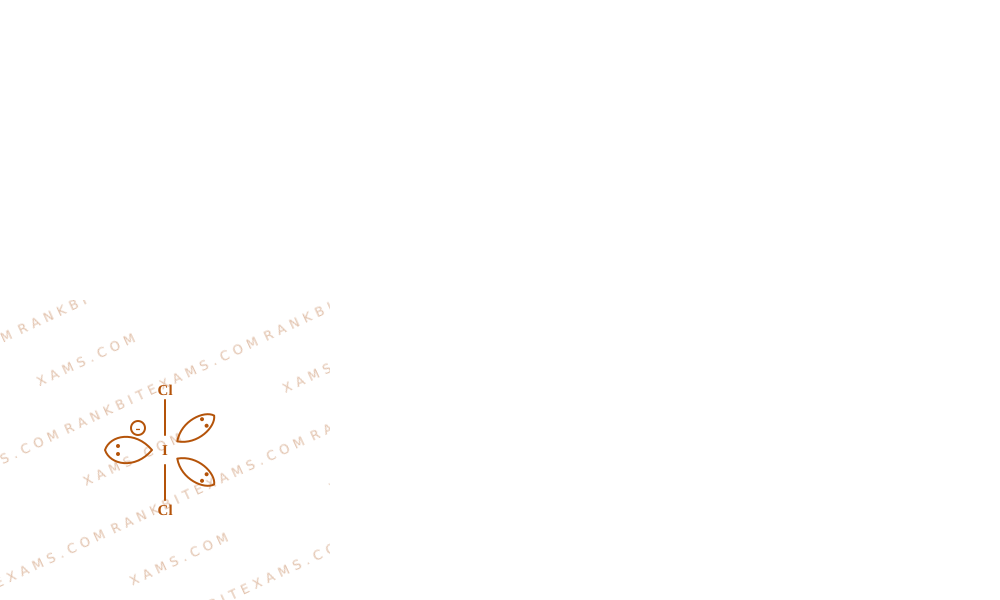
- Ratio is 2 : 3$2 : 3$ (Matches LIST-II, III).
VSEPR linear shape of ICl2-
2. **mathrmH_2mathrmO$\mathrm{H}_2\mathrm{O}$**:
- Oxygen has 6$6$ valence electrons.
- Forms 2$2$ bond pairs with Hydrogens.
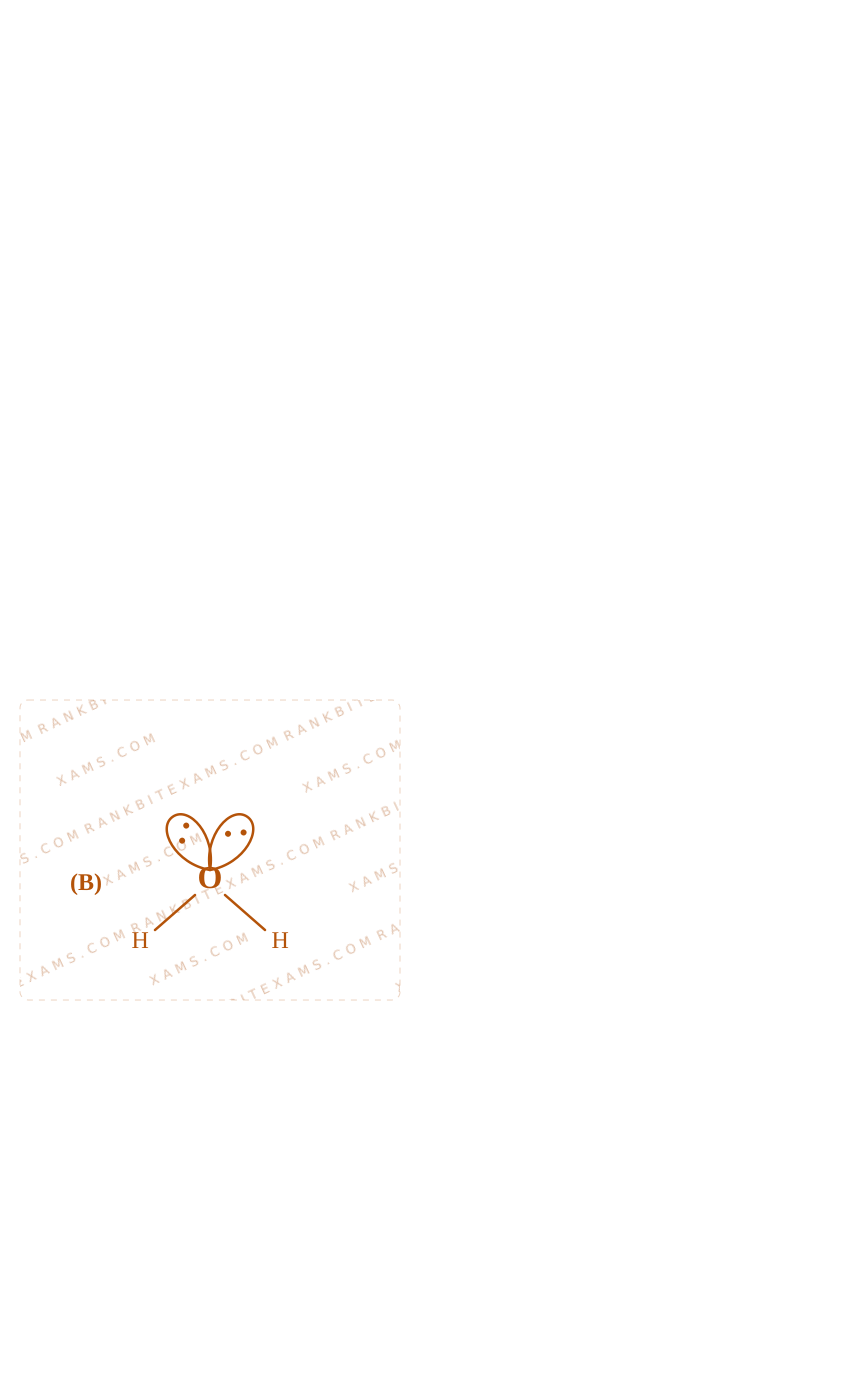
- Remaining 4$4$ electrons form 2$2$ lone pairs.
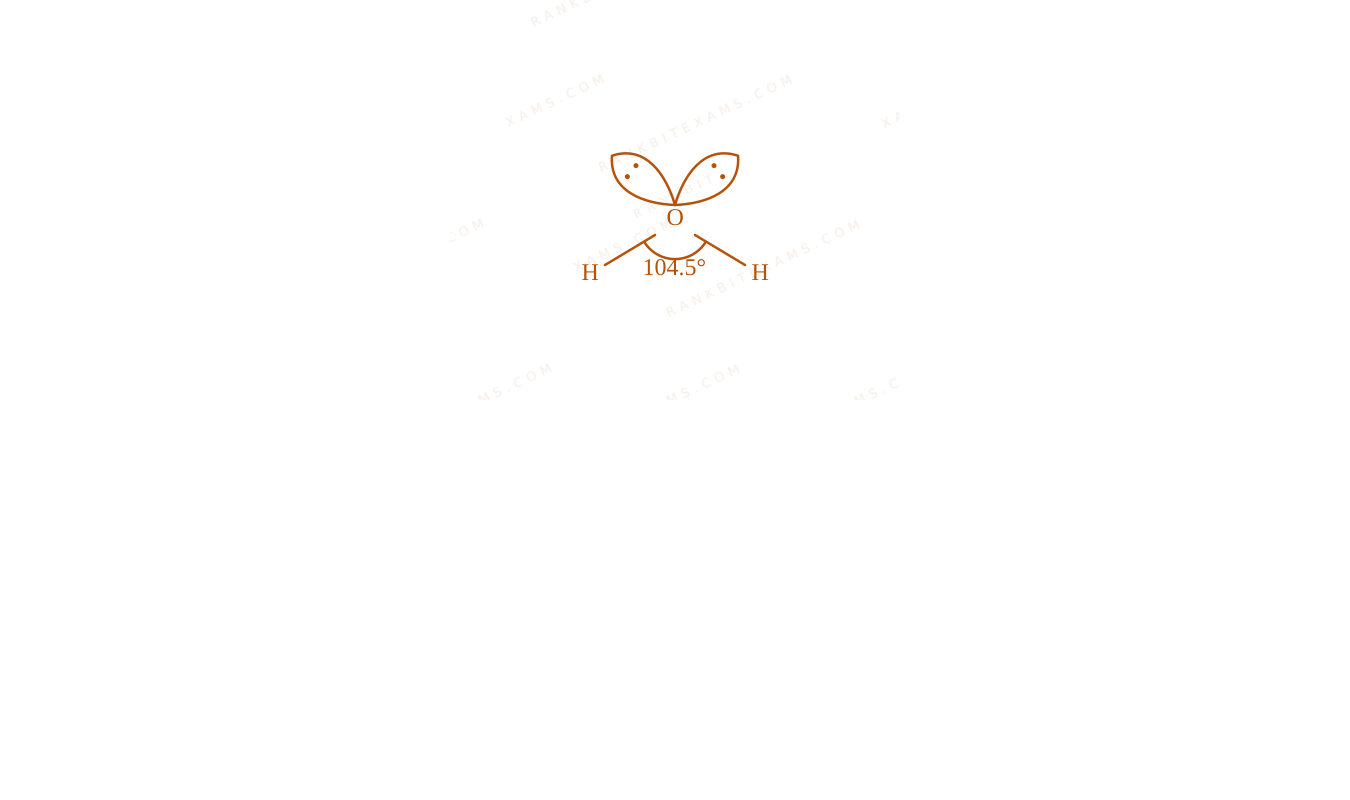
- Ratio is 2 : 2$2 : 2$ (Matches LIST-II, IV).
VSEPR linear shape of ICl2-
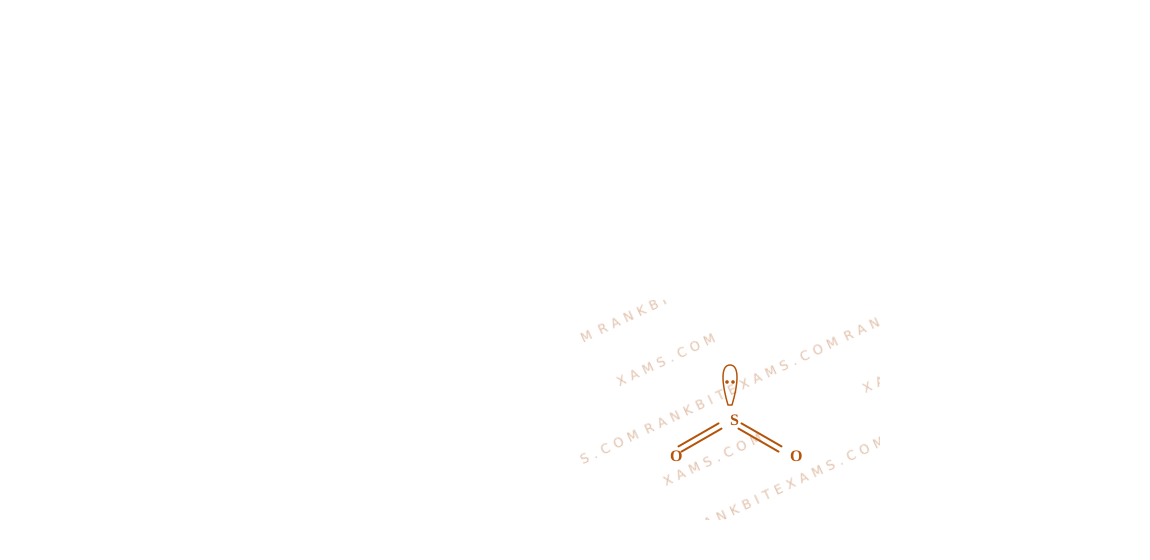
3. **mathrmSO_2$\mathrm{SO}_2$**:
- Sulfur has 6$6$ valence electrons.
- Forms 2$2$ double bonds (which are counted as 4$4$ bonding pairs of electrons/bond pairs in typical VSEPR representations here).
- Remaining 2$2$ electrons form 1$1$ lone pair.
- Ratio is 4 : 1$4 : 1$ (Matches LIST-II, II).
VSEPR linear shape of ICl2-
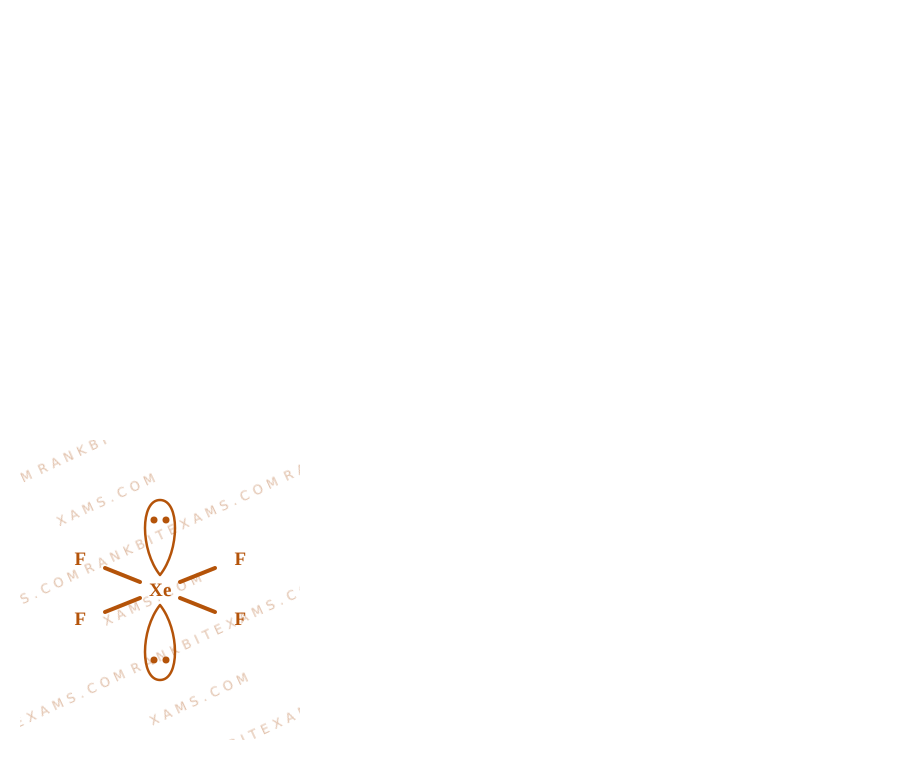
4. **mathrmXeF_4$\mathrm{XeF}_4$**:
- Xenon has 8$8$ valence electrons.
- Forms 4$4$ bond pairs with Fluorines.
- Remaining 4$4$ electrons form 2$2$ lone pairs.
- Ratio is 4 : 2$4 : 2$ (Matches LIST-II, I).
VSEPR linear shape of ICl2-
Thus, the correct mapping is: A-III, B-IV, C-II, D-I.
### Pattern Recognition
For match-the-column with VSEPR structures:
- Always find steric number: textSteric Number = frac12(V + M - C + A)$\text{Steric Number} = \frac{1}{2}(V + M - C + A)$.
- Water is 2$2$ bond pairs, 2$2$ lone pairs (sp^3$sp^3$) rightarrow$\rightarrow$ B-IV. This alone helps eliminate multiple incorrect options immediately.
### Evaluation Rubric / Model Answer
null
### Chapter Mix
Class 11 Chemistry: Chemical Bonding and Molecular Structure
More Chemical Bonding and Molecular Structure Previous-Year Questions — Page 3
Q28jee_main_2025_04_april_morningMolecular Orbital Theory
Which of the following molecules(s) show/s paramagnetic behavior?
(A) O_2$O_2$
(B) N_2$N_2$
(C) F_2$F_2$
(D) S_2$S_2$
(E) Cl_2$Cl_2$
Choose the correct answer from the options given below:
A.textB only$\text{B only}$
B.textA \& C only$\text{A \& C only}$
C.textA \& E only$\text{A \& E only}$
D.textA \& D only$\text{A \& D only}$
Solution
### Related Formula
Paramagnetism implies$\implies$ Presence of at least one unpaired electron in the molecular orbitals.
### Core Logic
According to Molecular Orbital Theory (MOT):
* O_2$O_2$ has 16 electrons. Its outer configuration contains two unpaired electrons in the anti-bonding orbitals: pi^*_2p_x = pi^*_2p_y$\pi^{*}_{2p_x} = \pi^{*}_{2p_y}$. Thus, it is paramagnetic.
* S_2$S_2$ belongs to the same oxygen family group and shares an analogous valence configuration with two unpaired electrons in its anti-bonding pi^*$\pi^*$ orbitals. Hence, it is also paramagnetic.
* N_2$N_2$ (14e-), F_2$F_2$ (18e-), and Cl_2$Cl_2$ (34e-) have completely paired electronic systems and behave diamagnetically.
### Pattern Recognition
Both O_2$O_2$ and S_2$S_2$ contain 2 unpaired electrons in their highest occupied molecular orbitals, making them classic examples of paramagnetic diatomic species.
### Evaluation Rubric / Model Answer
null
### Chapter Mix
Class 11 Chemistry: Chemical Bonding and Molecular Structure
Q39jee_main_2025_07_april_eveningHybridization
In textSO_2$\text{SO}_2$, textNO_2^-$\text{NO}_2^-$ and textN_3^-$\text{N}_3^-$ the hybridizations at the central atom are respectively:
A.sp^2text, sp^2 text and sp$sp^2\text{, } sp^2 \text{ and } sp$
B.sp^2text, sp text and sp$sp^2\text{, } sp \text{ and } sp$
C.sp^2text, sp^2 text and sp^2$sp^2\text{, } sp^2 \text{ and } sp^2$
D.sptext, sp^2 text and sp$sp\text{, } sp^2 \text{ and } sp$
Solution
### Related Formula
textSteric Number (Steric count) = textNumber of lone pairs on central atom + textNumber of sigmatext-bonds$$\text{Steric Number (Steric count)} = \text{Number of lone pairs on central atom} + \text{Number of } \sigma\text{-bonds}$$
### Core Logic
Let's perform steric calculations for each species:
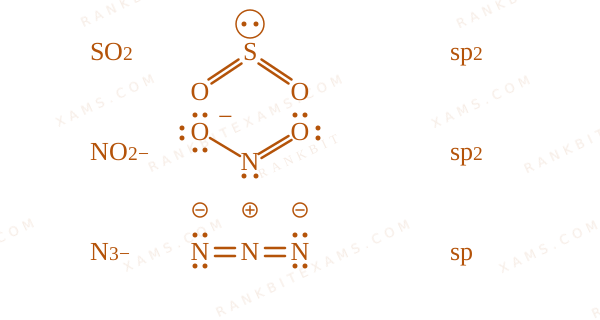
- textSO_2$\text{SO}_2$: Central sulfur atom has 6 valence electrons, forms 2\,sigma$2\,\sigma$-bonds (and 2\,pi$2\,\pi$-bonds) with oxygen, leaving 1 lone pair. Steric number = 2 + 1 = 3 implies sp^2$= 2 + 1 = 3 \implies sp^2$.
- textNO_2^-$\text{NO}_2^-$: Central nitrogen atom has 5 valence electrons + 1$+ 1$ from negative charge = 6$= 6$. It forms 2\,sigma$2\,\sigma$-bonds, leaving 1 lone pair. Steric number = 2 + 1 = 3 implies sp^2$= 2 + 1 = 3 \implies sp^2$.
- textN_3^-$\text{N}_3^-$ (Azide ion): Linear configuration structure can be drawn as:
overlinetextN=overset+textN=overlinetextN $$\overline{\text{N}}=\overset{+}{\text{N}}=\overline{\text{N}} $$
The central nitrogen has 2\,sigma$2\,\sigma$-bonds and 0 lone pairs. Steric number = 2 + 0 = 2 implies sp$= 2 + 0 = 2 \implies sp$.
### Step 1: Geometry Outlines
The individual orbital fields are represented visually:
Hybridization diagram for Q39 - JEE Main 2025 Evening
Hence, hybridizations follow the order: sp^2$sp^2$, sp^2$sp^2$, and sp$sp$.
### Pattern Recognition
Steric short tracking: Species with linear structures like textCO_2, textN_2O, textN_3^-$\text{CO}_2, \text{N}_2O, \text{N}_3^-$ possess central atoms that are always sp$sp$ hybridized due to the requirement of two opposing sigma$\sigma$-bonds.
### Evaluation Rubric / Model Answer
null
### Chapter Mix
Class 11 Chemistry: Chemical Bonding and Molecular Structure
Q32jee_main_2025_24_jan_eveningResonance and Bond Parameters
Given below are two statements:
Statement (I) : Experimentally determined oxygen-oxygen bond lengths in the mathrmO_3$\mathrm{O}_{3}$ are found to be same and the bond length is greater than that of a mathrmO=O$\mathrm{O=O}$ (double bond) but less than that of a single (mathrmO-O)$(\mathrm{O-O})$ bond.
Statement (II) : The strong lone pair-lone pair repulsion between oxygen atoms is solely responsible for the fact that the bond length in ozone is smaller than that of a double bond (mathrmO=O)$(\mathrm{O=O})$ but more than that of a single bond (mathrmO-O)$(\mathrm{O-O})$.
In the light of the above statements, choose the correct answer from the options given below:
A. \text{Statement I is true but Statement II is false}
B. \text{Both Statement I and Statement II are true}
C. \text{Both Statement I and Statement II are false}
D. \text{Statement I is false but Statement II is true}
Solution
### Core Logic
Analysis of Statement I:
Ozone (mathrmO_3$\mathrm{O}_3$) exhibits resonance. The two major canonical forms contribute equally to the resonance hybrid, meaning both oxygen-oxygen bonds are identical. Their bond order is 1.5$1.5$, making the bond length intermediate between a true single bond and a true double bond. Thus, Statement I is completely true.
Analysis of Statement II:
Statement II claims that lone pair-lone pair repulsion is solely responsible for this intermediate bond length. This is incorrect. The intermediate bond parameter is fundamentally a direct consequence of resonance delocalization, not lone-pair repulsions. Thus, Statement II is false.
### Pattern Recognition
Whenever a molecule has identical intermediate bond lengths instead of distinct single and double bonds, resonance delocalization is almost always the core underlying reason.
### Evaluation Rubric / Model Answer
null
### Chapter Mix
Class 11 Chemistry: Chemical Bonding and Molecular Structure
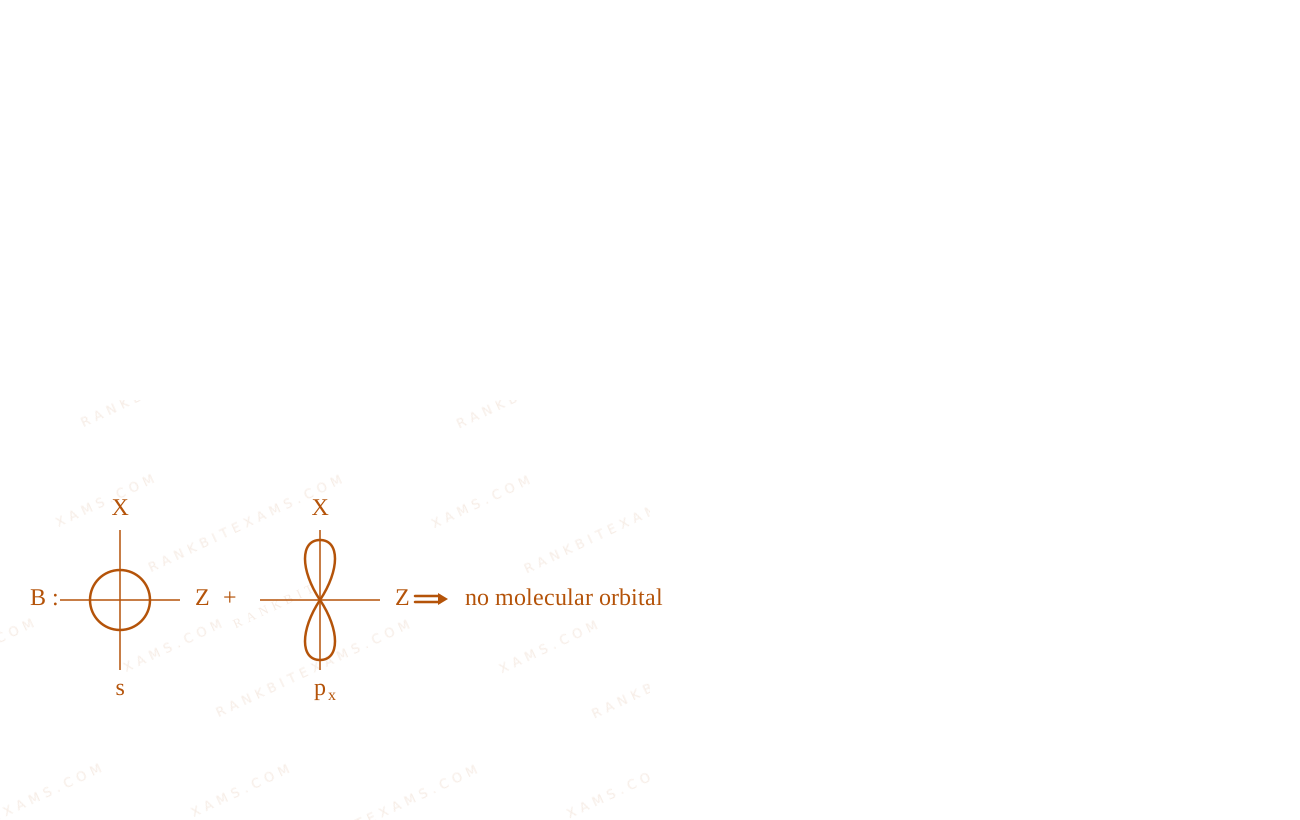
Q30jee_main_2025_24_jan_morningMolecular Orbital Theory
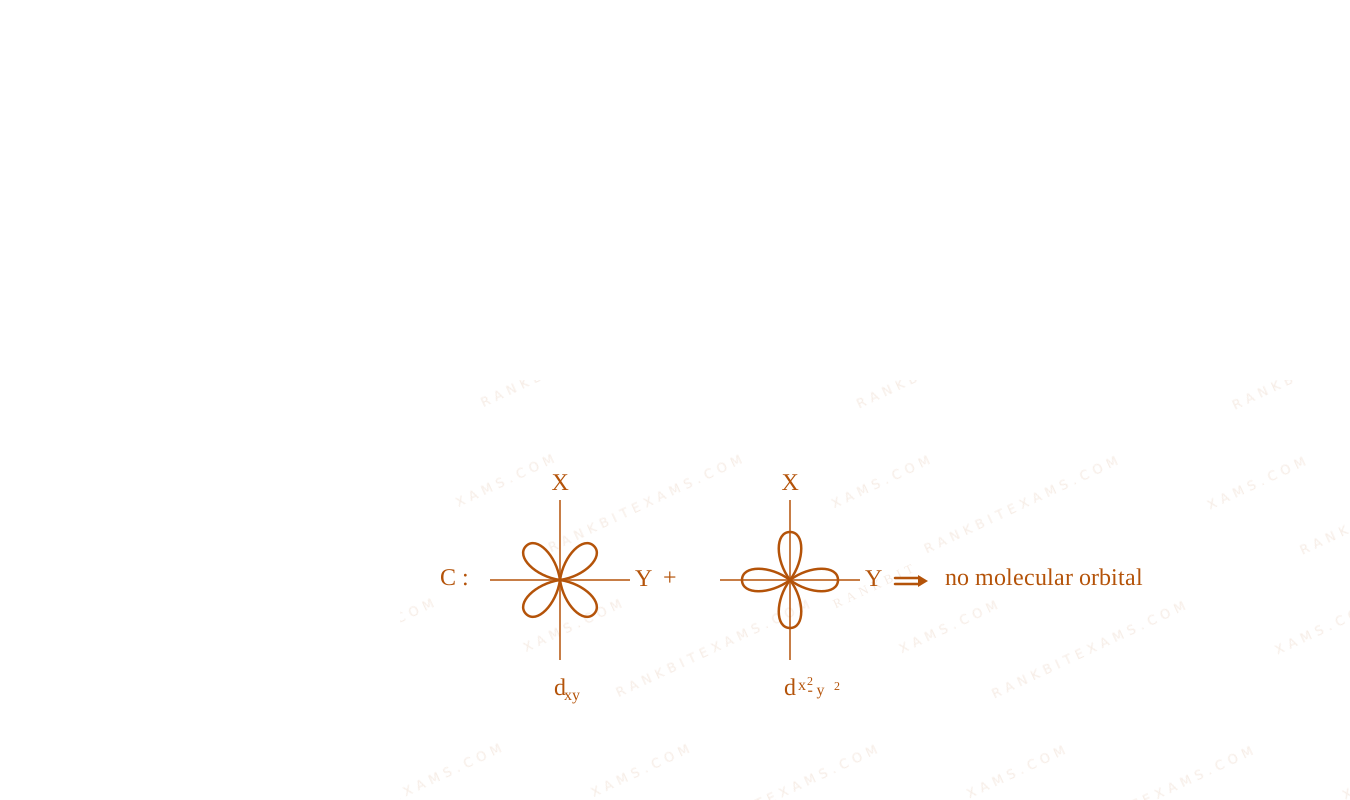
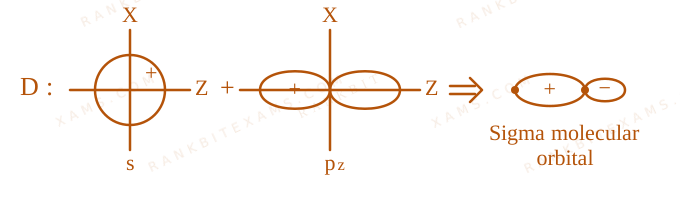
Which of the following linear combination of atomic orbitals will lead to formation of molecular orbitals in homonuclear diatomic molecules [internuclear axis in z-direction]?
A. 2p_z$2p_{z}$ and 2p_x$2p_{x}$
B. 2s and 2p_x$2p_{x}$
C. 3d_xy$3d_{xy}$ and 3d_x^2-y^2$3d_{x^{2}-y^{2}}$
D. 2s and 2p_z$2p_{z}$
E. 2p_z$2p_{z}$ and 3d_x^2-y^2$3d_{x^{2}-y^{2}}$
Choose the correct answer from the options given below:
A. E Only
B. A and B Only
C. D Only
D. C and D Only
Solution
### Core Logic
For atomic orbitals to successfully combine into molecular orbitals, they must share appropriate spatial symmetry relative to the internuclear axis (z$z$-axis).
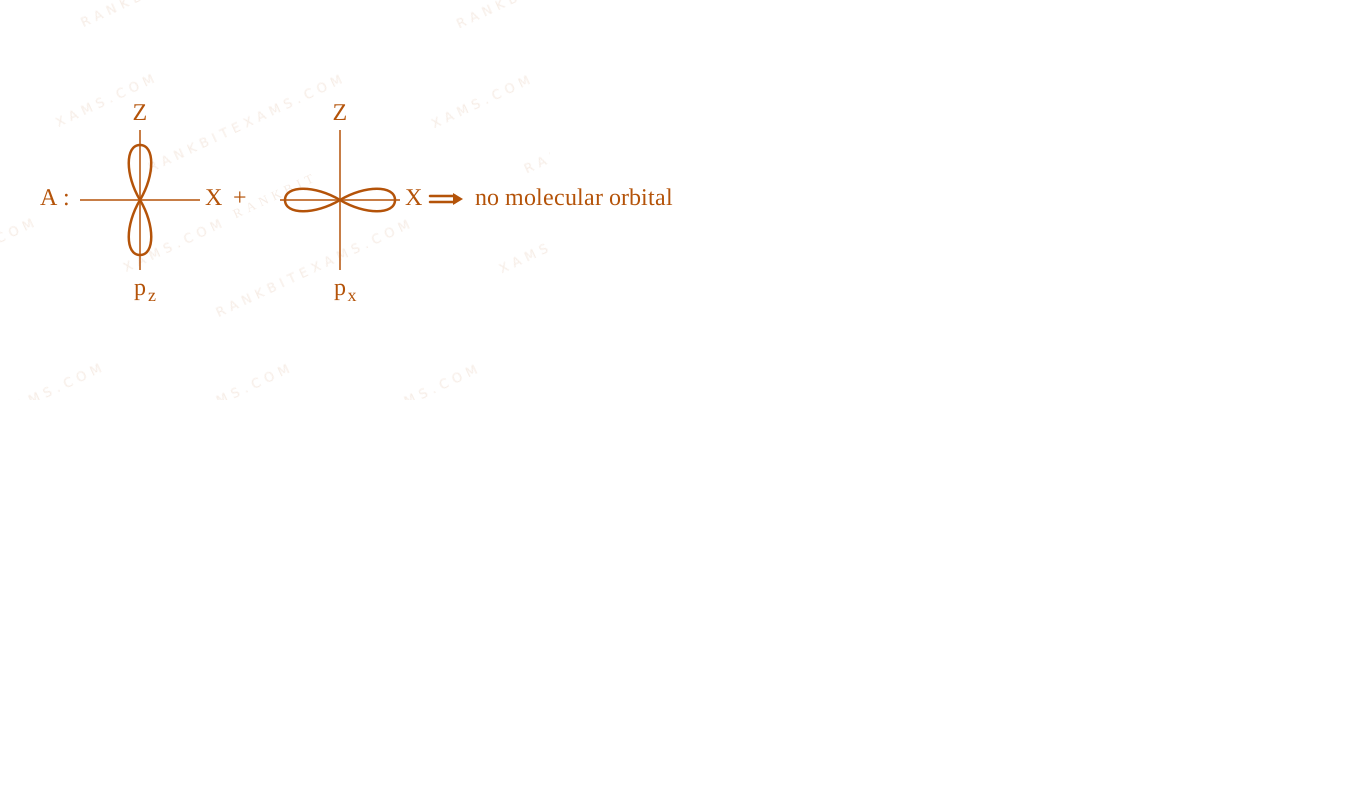
- Combination A, B, C, and E involve orbitals with mismatching symmetry planes, resulting in a net zero overlap integral.
- Combination D (2s$2s$ and 2p_z$2p_z$) preserves continuous spatial alignment along the z$z$-axis, allowing effective frontal overlap to synthesize a stable sigma molecular orbital.
Visual symmetry breakdowns:
- Molecular Orbital Theory diagram 1 for Q30 (Symmetry mismatch for A)
- Molecular Orbital Theory diagram 1 for Q30 (Symmetry mismatch for C)
- Molecular Orbital Theory diagram 1 for Q30 (Valid overlapping leading to Sigma molecular orbital for D)
- Molecular Orbital Theory diagram 1 for Q30 (Symmetry mismatch for E)
### Pattern Recognition
Verify orbital symmetry signs across the designated internuclear reference line. Mismatched symmetries cancel out completely (I_textoverlap = 0$I_{\text{overlap}} = 0$).
### Evaluation Rubric / Model Answer
null
### Chapter Mix
Class 11 Chemistry: Chemical Bonding and Molecular Structure
Q43jee_main_2025_24_jan_morningHybridization and Molecular Geometry
Which of the following statement is true with respect to mathrmH_2mathrmO, mathrmNH_3$\mathrm{H}_2\mathrm{O}, \mathrm{NH}_3$ and mathrmCH_4$\mathrm{CH}_4$ ?
A. The central atoms of all the molecules are mathfraksp^3$\mathfrak{sp}^3$ hybridized.
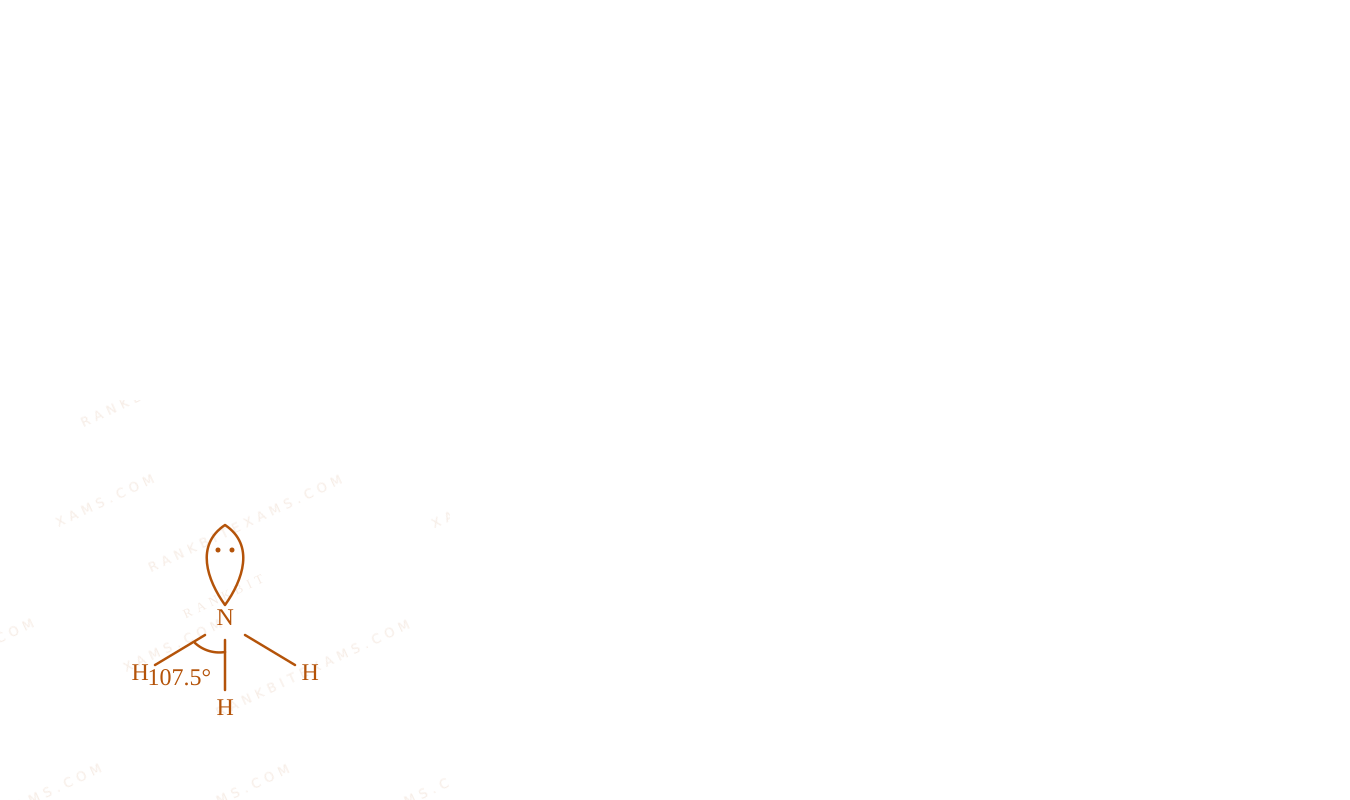
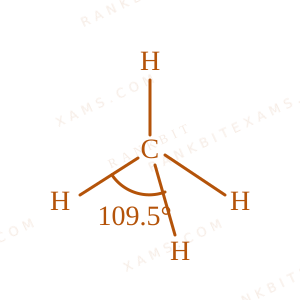
B. The H-O-H, H-N-H and H-C-H angles in the above molecules are 104.5^circ$104.5^{\circ}$ , 107.5^circ$107.5^{\circ}$ and 109.5^circ$109.5^{\circ}$ respectively.
C. The increasing order of dipole moment is mathrmCH_4 < mathrmNH_3 < mathrmH_2mathrmO$\mathrm{CH}_4 < \mathrm{NH}_3 < \mathrm{H}_2\mathrm{O}$ .
D. Both mathrmH_2mathrmO$\mathrm{H}_2\mathrm{O}$ and mathrmNH_3$\mathrm{NH}_3$ are Lewis acids and mathrmCH_4$\mathrm{CH}_4$ is a Lewis base
E. A solution of mathrmNH_3$\mathrm{NH}_3$ in mathrmH_2mathrmO$\mathrm{H}_2\mathrm{O}$ is basic. In this solution mathrmNH_3$\mathrm{NH}_3$ and mathrmH_2mathrmO$\mathrm{H}_2\mathrm{O}$ act as Lowry-Bronsted acid and base respectively.
Choose the correct answer from the options given below:
A. A, B and C only
B. C, D and E only
C. A, D and E only
D. A, B, C and E only
Solution
### Core Logic
Analyzing each statement individually:
- **Statement A is true**: The central atoms (O, N, C$O, N, C$) all possess an electron steric number equal to 4, indicating mathfraksp^3$\mathfrak{sp}^3$ hybridization state pathways.
- **Statement B is true**: Due to valence shell electron pair repulsions, the bond angles decrease from the ideal tetrahedral angle (109.5^circ$109.5^{\circ}$ in CH_4$CH_4$, Water molecule structural bond configuration shape representation) as lone pairs are added (107.5^circ$107.5^{\circ}$ in NH_3$NH_3$ with 1 lone pair, Water molecule structural bond configuration shape representation; 104.5^circ$104.5^{\circ}$ in H_2O$H_2O$ with 2 lone pairs, Water molecule structural bond configuration shape representation).
- **Statement C is true**: The dipole moment increases alongside central atom electronegativity and asymmetric lone pair configurations, following the sequence mathrmCH_4 (0text D) < mathrmNH_3 (1.47text D) < mathrmH_2mathrmO (1.85text D)$\mathrm{CH}_4 (0\text{ D}) < \mathrm{NH}_3 (1.47\text{ D}) < \mathrm{H}_2\mathrm{O} (1.85\text{ D})$.
### Pattern Recognition
Lone pairs repel bonding electron pairs more strongly than bonding pairs repel each other, systematically compressing adjacent bond angles.
### Evaluation Rubric / Model Answer
null
### Chapter Mix
Class 11 Chemistry: Chemical Bonding and Molecular Structure
We Map Every Repeating Question in Competitive Exams.
Say goodbye to generic mock test fatigue. RankBit uses smart analysis to group past exam questions into their foundational Repeating Question Types. Find chapter weightage, track repeating questions, and score higher with targeted practice.
Select Your Target Exam
Choose an exam track below to find formulas per chapter and patterns.
Syncing Exam Intelligence
Mapping formulas and patterns across all tracks…
PATH A — FULL LENGTH PRACTICE
Full Mock Test Hub
Simulate real NTA exam conditions with fully tracked mocks. Time yourself against past papers.
Practice past-year questions one chapter at a time. Pick an exam → subject → chapter and get every PYQ for that topic — pulled together from all past papers — with the chapter's key formulas alongside.