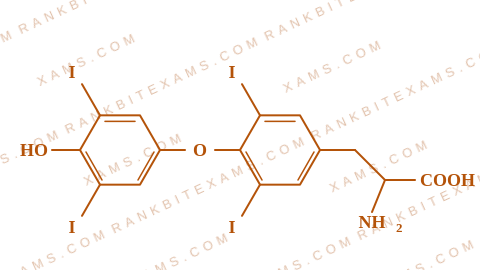
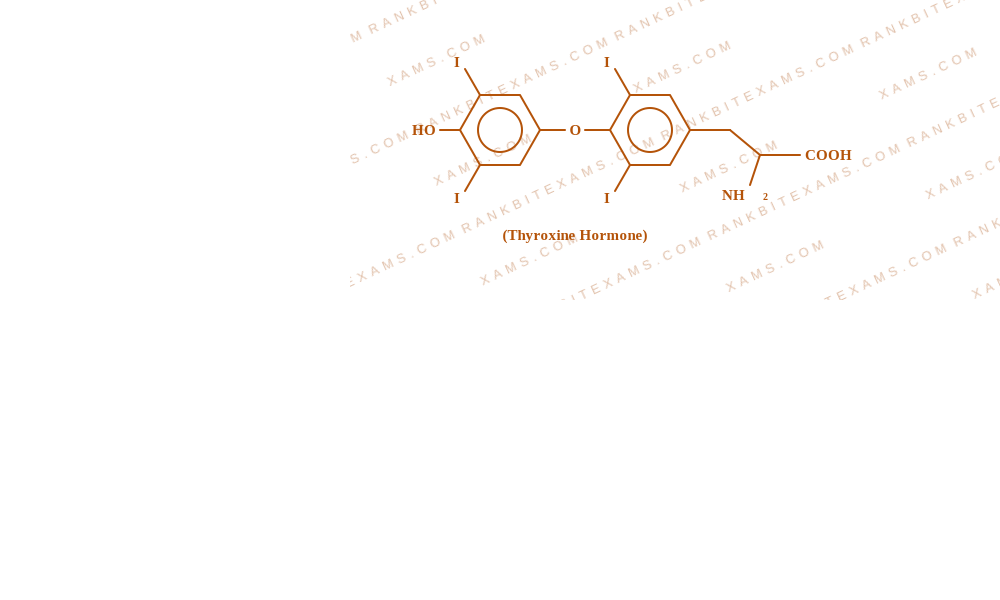
Thyroxine, the hormone has the structure given below:
The structural formula of Thyroxine shows four iodine atoms attached to the aromatic benzene rings.
The percentage of iodine in thyroxine is ______ %. (nearest integer)
(Given molar mass in g mol⁻¹$\mathrm{g\ mol}^{-1}$ of C: 12$\mathrm{C}: 12$, H: 1$\mathrm{H}: 1$, O: 16$\mathrm{O}: 16$, N: 14$\mathrm{N}: 14$, I: 127$\mathrm{I}: 127$)
Hence, the percentage of iodine in thyroxine is 65$65$.
Pattern Recognition
Thyroxine molecular mass (777$777$) is composed mostly of Iodine (508$508$), making up approximately 508/777 ≈ 65%$508/777 \approx 65\%$ of its entire mass. Always carefully account for the four phenyl-bound iodines.
Evaluation Rubric / Model Answer
Accurate molecular weight summation leading to 65%$65\%$ nearest integer Iodine composition.
Chapter Mix
Class 12 Chemistry: Biomolecules
Class 12 Chemistry: Organic Chemistry - Oxygen containing compounds
Keywords:#Thyroxine Structure#Iodine Percentage#Hormones#Molecular Mass Calculation
More Biomolecules Previous-Year Questions — Page 2
Q54jee_main_2026_23_january_eveningNucleic Acids
Both human DNA and RNA are chiral molecules. The chirality in DNA and RNA arises due to the presence of
Nucleic acids (DNA and RNA) are composed of three fundamental building blocks: nitrogenous bases, a pentose sugar, and phosphate groups.
The nitrogenous bases are planar and generally achiral. The phosphate groups are also achiral.
The chirality in both DNA and RNA originates strictly from their pentose sugar components, which have multiple chiral carbon centers.
Step 1: Identifying the specific sugar
DNA contains β$\beta$-D-2-deoxyribose, and RNA contains β$\beta$-D-ribose. Both of these are chiral D-sugar components.
Pattern Recognition
Any question asking about the source of chirality in nucleic acid backbones always points to the pentose sugar ring (D-sugar component).
Chapter Mix
Class 12 Chemistry: Biomolecules
Q53jee_main_2026_24_january_eveningProteins and Amino Acids
The number of possible tripeptides formed involving alanine (ala), glycine (gly) and valine (val), where no amino acid has been used more than once is:
A. 6
B. 3
C. 4
D. 8
Solution
Core Logic
Since we have 3 distinct amino acids and each must be used exactly once, the number of unique tripeptides corresponds to the number of permutations of these 3 items.
Possible sequences:
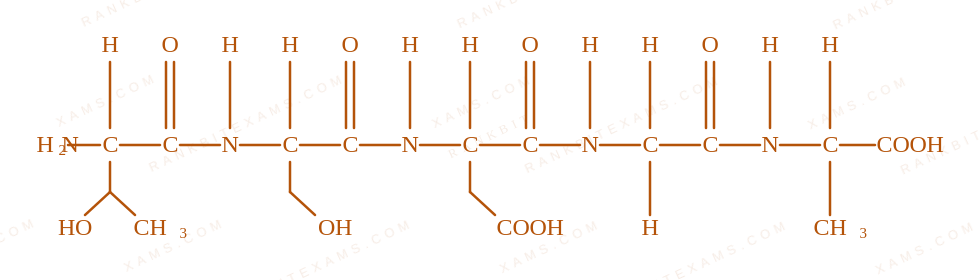
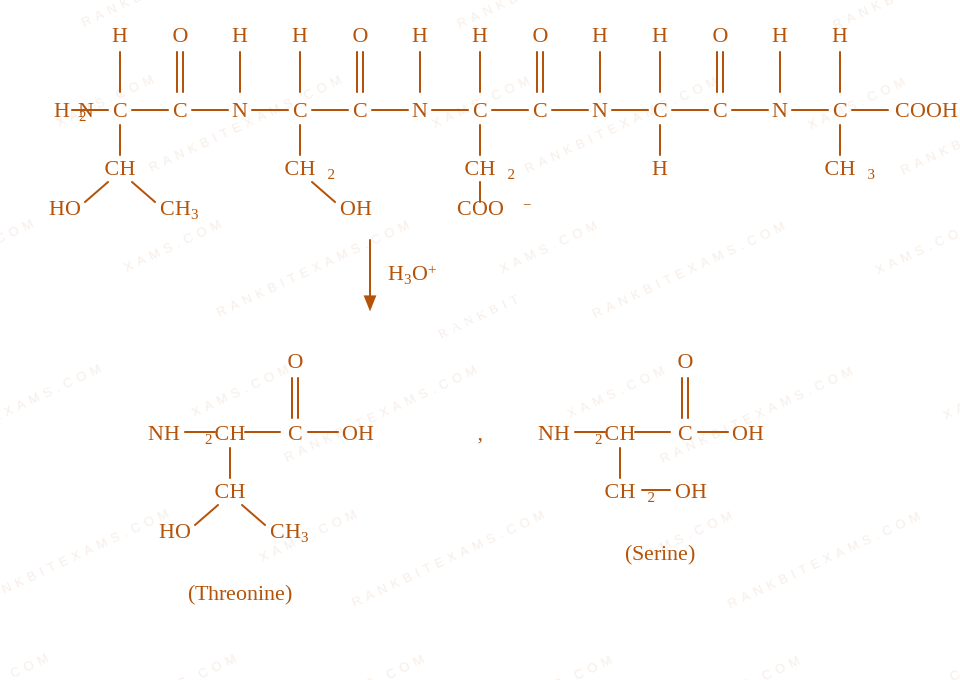
In the given pentapeptide, find out an essential amino acid (Y) and the sequence present in the pentapeptide:
Full structural formula of a polypeptide chain for sequence deduction.
Choose the correct answer from the options given below:
N-terminal reading is standard left-to-right. Memory aid for essential amino acids: 'PVT TIM HALL' (Threonine is the 'T').
Chapter Mix
Class 12 Chemistry: Biomolecules
Q61jee_main_2026_28_january_eveningReducing And Non Reducing Sugars
Structures of four disaccharides are given below. Among the given disaccharides, the non-reducing sugar is :
A.(1)$(1)$
B.(2)$(2)$
C.(3)$(3)$
D.(4)$(4)$
Solution
Core Logic
For a sugar to be non-reducing, it must NOT possess a free hemiacetal or hemiketal group. The linkage connecting the monosaccharide units must consume both anomeric carbons via an acetal/ketal linkage.
Structure (1) represents Sucrose, which has an α, β -1,2$\alpha, \beta -1,2$-glycosidic bond. Both anomeric carbons are locked in the glycosidic linkage Reducing And Non Reducing Sugars and Reducing And Non Reducing Sugars.
Structures (2), (3), and (4) are maltose or lactose-type structures containing a free anomeric -OH, thus acting as reducing sugars.
Step 1: Final Conclusion
Structure (1) is sucrose, which lacks a hemiacetal linkage, making it a non-reducing sugar.
Pattern Recognition
Whenever asked for a non-reducing sugar among standard disaccharides, look for Sucrose (linked at C1 of glucose and C2 of fructose). Both anomeric carbons are tied up.
Chapter Mix
Class 12 Chemistry: Biomolecules
Q44jee_main_2025_02_april_eveningProteins and Amino Acid Sequences
A tetrapeptide "x" on complete hydrolysis produced glycine (Gly), alanine (Ala), valine (Val), leucine (Leu) in equimolar proportion each. The number of tetrapeptides (sequences) possible involving each of these amino acids is
A. 16
B. 32
C. 8
D. 24
Solution
Related Formula
Number of unique sequences = n!$$\text{Number of unique sequences} = n!$$
Core Logic
A tetrapeptide is formed by connecting four amino acids through three peptide linkages.
Since the problem specifies that complete hydrolysis of the tetrapeptide produces Gly, Ala, Val, and Leu in equimolar proportions, the peptide must contain exactly one molecule of each of these four distinct amino acids.
Step 1: Calculate the Permutations
The number of unique peptide sequences corresponds to the number of ways we can arrange these 4 distinct amino acids:
Number of permutations = 4! = 4 × 3 × 2 × 1 = 24$$\text{Number of permutations} = 4! = 4 \times 3 \times 2 \times 1 = 24$$
Pattern Recognition
Combinatorics in Chemistry: If we have n$n$ unique, non-repeating amino acids, the number of linear isomeric peptides is n!$n!$. If repetition were permitted, the number of possible peptides would be nⁿ$n^n$ (which would be 4⁴ = 256$4^4 = 256$ in this case).
Practice past-year questions one chapter at a time. Pick an exam → subject → chapter and get every PYQ for that topic — pulled together from all past papers — with the chapter's key formulas alongside.
