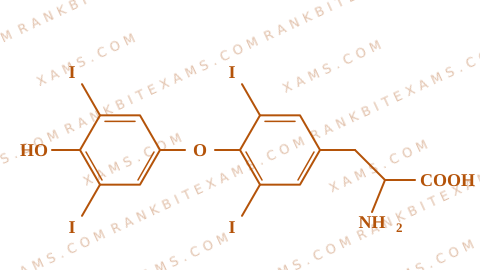
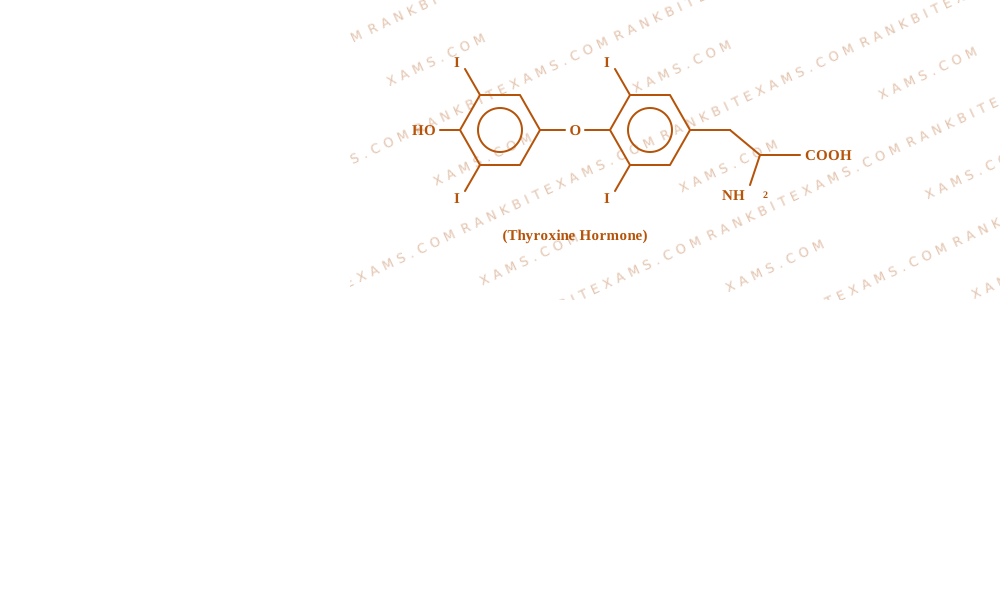
Thyroxine, the hormone has the structure given below:
Chemical skeletal structure of thyroxine hormone for Q47
The structural formula of Thyroxine shows four iodine atoms attached to the aromatic benzene rings.
The percentage of iodine in thyroxine is ______ %. (nearest integer) (Given molar mass in mathrmg\ mol^-1 of mathrmC: 12, mathrmH: 1, mathrmO: 16, mathrmN: 14, mathrmI: 127)

Numerical Answer Type:
Enter a numerical value Answer: 65 to 65 +4 marks

Solution & Explanation

### Related Formula \% mathrmI = frac4 times M_mathrmIM_textThyroxine times 100 ### Core Logic Let's first determine the molecular formula of Thyroxine from its structure shown in below :
Thyroxine molecular structure highlight for Q47
The structural formula of Thyroxine shows four iodine atoms attached to the aromatic benzene rings.
- Formula: mathrmC_15mathrmH_11mathrmO_4mathrmNmathrmI_4 Now, compute the molecular mass: - Carbon: 15 times 12 = 180 - Hydrogen: 11 times 1 = 11 - Oxygen: 4 times 16 = 64 - Nitrogen: 1 times 14 = 14 - Iodine: 4 times 127 = 508 textTotal Molecular Mass = 180 + 11 + 64 + 14 + 508 = 777 text g mol^-1 Now, calculate the percentage of Iodine: \% mathrmI = frac508777 times 100 approx 65.38 \% approx 65 \% Hence, the percentage of iodine in thyroxine is 65. ### Pattern Recognition Thyroxine molecular mass (777) is composed mostly of Iodine (508), making up approximately 508/777 approx 65\% of its entire mass. Always carefully account for the four phenyl-bound iodines. ### Evaluation Rubric / Model Answer Accurate molecular weight summation leading to 65\% nearest integer Iodine composition. ### Chapter Mix Class 12 Chemistry: Biomolecules Class 12 Chemistry: Organic Chemistry - Oxygen containing compounds

More Biomolecules Previous-Year Questions

Q67 jee_main_2026_21_jan_morning Amino Acids
Identify the correct statements. A. Arginine and Tryptophan are essential amino acids. B. Histidine does not contain heterocyclic ring in its structure. C. Proline is a six membered cyclic ring amino acid. D. Glycine does not have chiral centre. E. Cysteine has characteristic feature of side chain as mathrmMeS-CH_2-CH_2-. Choose the correct answer from the options given below:
  • A. textC and E Only
  • B. textB and E Only
  • C. textC and D Only
  • D. textA and D Only

Solution

### Core Logic A. Arginine and Tryptophan are indeed essential amino acids (cannot be synthesized by the human body). (Correct) B. Histidine contains an imidazole ring, which is a heterocyclic ring. So statement B is incorrect. C. Proline contains a pyrrolidine ring, which is a five-membered cyclic ring. So statement C is incorrect. D. Glycine is mathrmNH_2-CH_2-COOH. Because its alpha carbon has two identical hydrogen atoms attached, it lacks a chiral center. (Correct) E. Cysteine's side chain is a thiol group (-mathrmCH_2-SH), not a thioether (mathrmMeS-CH_2-CH_2- which belongs to Methionine). So statement E is incorrect. Correct statements: A and D. ### Evaluation Rubric / Model Answer null ### Chapter Mix Class 12 Chemistry: Biomolecules
Q44 jee_main_2025_02_april_evening Proteins and Amino Acid Sequences
A tetrapeptide "x" on complete hydrolysis produced glycine (Gly), alanine (Ala), valine (Val), leucine (Leu) in equimolar proportion each. The number of tetrapeptides (sequences) possible involving each of these amino acids is
  • A. 16
  • B. 32
  • C. 8
  • D. 24

Solution

### Related Formula textNumber of unique sequences = n! ### Core Logic A **tetrapeptide** is formed by connecting four amino acids through three peptide linkages. Since the problem specifies that complete hydrolysis of the tetrapeptide produces Gly, Ala, Val, and Leu in *equimolar proportions*, the peptide must contain exactly one molecule of each of these four distinct amino acids. ### Step 1: Calculate the Permutations The number of unique peptide sequences corresponds to the number of ways we can arrange these 4 distinct amino acids: textNumber of permutations = 4! = 4 times 3 times 2 times 1 = 24 ### Pattern Recognition Combinatorics in Chemistry: If we have n unique, non-repeating amino acids, the number of linear isomeric peptides is n!. If repetition were permitted, the number of possible peptides would be n^n (which would be 4^4 = 256 in this case). ### Evaluation Rubric / Model Answer null ### Chapter Mix Class 12 Chemistry: Biomolecules
Q jee_main_2025_02_april_morning Molar Mass Calculations
0.1mathrm~mol of the following given antiviral compound (P) will weigh times 10^-1mathrm~g
Antiviral nucleoside structural layout diagram for Q48
The diagram displays the full multi-cyclic skeletal structure of an antiviral nucleoside molecule featuring explicit iodine and fluorine atomic positions.
(Given : molar mass in mathrmg cdot mol^-1 H: 1, C: 12, N: 14, O: 16, F: 19, I: 127)
Numerical Answer. Answer: 372 to 372

Solution

### Related Formula Standard molecular weight calculation formula system: textMolar Mass = sum (textAtom Count times textAtomic Weight) textMass = textMoles times textMolar Mass ### Core Logic Let's tabulate and sum up the constituent atoms based on the verified structural formula layout : * Counting positions meticulously yields a molecular identity formula of mathrmC_9H_10FIN_2O_4. * Calculating the total molar mass: textMass = (9 times 12) + (10 times 1) + 19 + 127 + (2 times 14) + (4 times 16) textMass = 108 + 10 + 19 + 127 + 28 + 64 = 372mathrm~g/mol
Detailed skeletal atomic breakdown calculation diagram for Q48
The diagram displays the full multi-cyclic skeletal structure of an antiviral nucleoside molecule featuring explicit iodine and fluorine atomic positions.
### Step 1: Final Mass Scaling Find the mass of 0.1mathrm~mol of the sample: textWeight = 0.1 times 372 = 37.2mathrm~g = 372 times 10^-1mathrm~g Hence, the integer value for the blank box is 372. ### Pattern Recognition When counting atoms in nucleoside structures, remember that each vertex in the ribose sugar ring represents a fully saturated carbon component unless double bonds or heteroatoms are explicitly drawn. ### Evaluation Rubric / Model Answer null ### Chapter Mix Class 12 Chemistry: Biomolecules Class 11 Chemistry: Some Basic Concepts of Chemistry

Q37 jee_main_2025_02_april_morning Amino Acids Properties
Identify the correct statement among the following:
  • A. (1)\ textAll naturally occurring amino acids except glycine contain one chiral centre.
  • B. (2)\ textAll naturally occurring amino acids are optically active.
  • C. (3)\ textGlutamic acid is the only amino acid that contains a -COOH group at the side chain.
  • D. (4)\ textAmino acid, cysteine easily undergo dimerization due to the presence of free SH group.

Solution

### Related Formula Dimerization of thiol pairs yields a disulfide linkage via an oxidation mechanism: mathrm2R-SH xrightarrow[-H_2] R-S-S-R ### Core Logic Let's review each choice item factually layout-by-row: * Option 1 is inaccurate: Isoleucine and threonine contain two distinct chiral centers. * Option 2 is inaccurate: Glycine lacks a asymmetric center, rendering it optically inactive. * Option 3 is inaccurate: Aspartic acid similarly contains a carboxylic acid functional group along its side chain. * Option 4 is correct: Cysteine contains a highly active free functional -mathrmSH group that easily dimerizes to form Cystine through a disulfide loop matrix. ### Pattern Recognition Disulfide bridges formed by cysteine play a crucial role in maintaining the tertiary and quaternary structural configurations of complex protein folds. ### Evaluation Rubric / Model Answer null ### Chapter Mix Class 12 Chemistry: Biomolecules
Q28 jee_main_2025_03_april_evening Vitamins Classification
Fat soluble vitamins are: A. Vitamin mathrmB_1 B. Vitamin mathrmC C. Vitamin mathrmE D. Vitamin mathrmB_12 E. Vitamin mathrmK Choose the correct answer from the options given below :
  • A. C & D Only
  • B. A & B Only
  • C. B & C Only
  • D. C & E Only

Solution

### Related Formula Vitamins are classified into two categories based on solubility: - Water-soluble: Vitamin B-complex and Vitamin C. - Fat-soluble: Vitamins A, D, E, and K. ### Core Logic Categorize each given vitamin: - Vitamin mathrmB_1 (Thiamine) rightarrow Water-soluble - Vitamin mathrmC (Ascorbic acid) rightarrow Water-soluble - Vitamin mathrmE (Tocopherol) rightarrow Fat-soluble - Vitamin mathrmB_12 (Cobalamin) rightarrow Water-soluble - Vitamin mathrmK (Phylloquinone) rightarrow Fat-soluble ### Step 1: Select correct options Only C (Vitamin mathrmE) and E (Vitamin mathrmK) are fat-soluble. Thus, the correct option is (4). ### Pattern Recognition Use the mnemonic 'ADEK' to remember the fat-soluble vitamins. All other vitamins (mainly B-complex and C) are water-soluble. ### Evaluation Rubric / Model Answer null ### Chapter Mix Class 12 Chemistry: Biomolecules
Rankbit System
JEE Physics: Waves (+15.5%) | Electrostatics: Concentric Shells (-29.7%) | Modern Physics: Photoelectric Clones (+34.2%) | Mathematics: Definite Integrals (+18.1%) | Chemistry: Coordination Splitting (-11.4%) | JEE Physics: Waves (+15.5%) | Electrostatics: Concentric Shells (-29.7%) | Modern Physics: Photoelectric Clones (+34.2%) | Mathematics: Definite Integrals (+18.1%) | Chemistry: Coordination Splitting (-11.4%)
