JEE Main · Chemistry ↑ Rising

Amines appeared 39 times across 3 years — 4.5% of Chemistry. This question is from Carbylamine Reaction.

Year 2026 2025 2024 Total
Questions 16 14 9 39

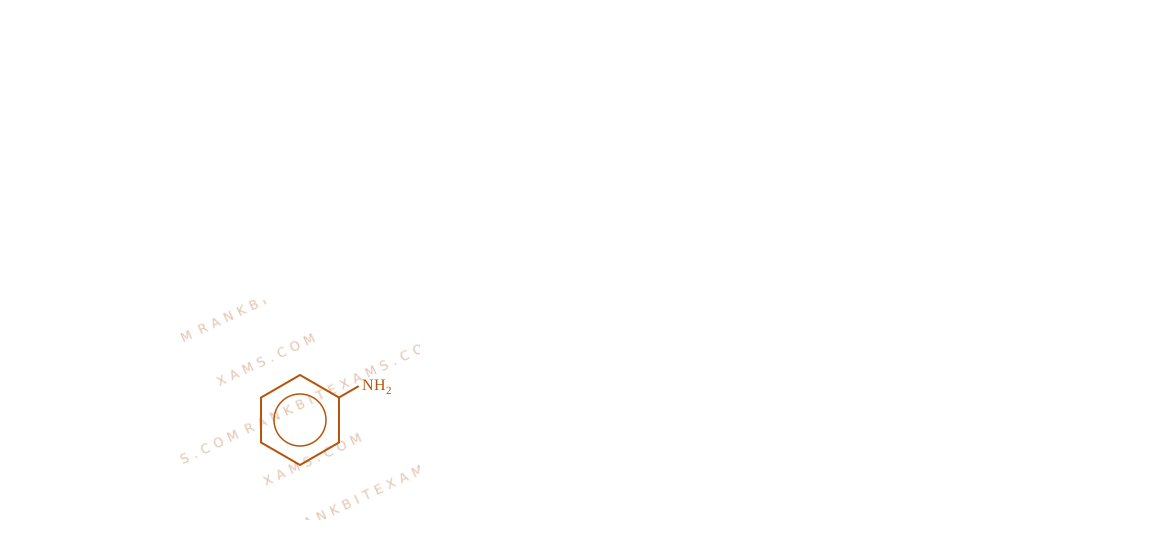
Which of the following amine(s) show(s) positive carbylamine test? A.
Carbylamine reactant aniline diagram for Q27 - JEE Main 2025
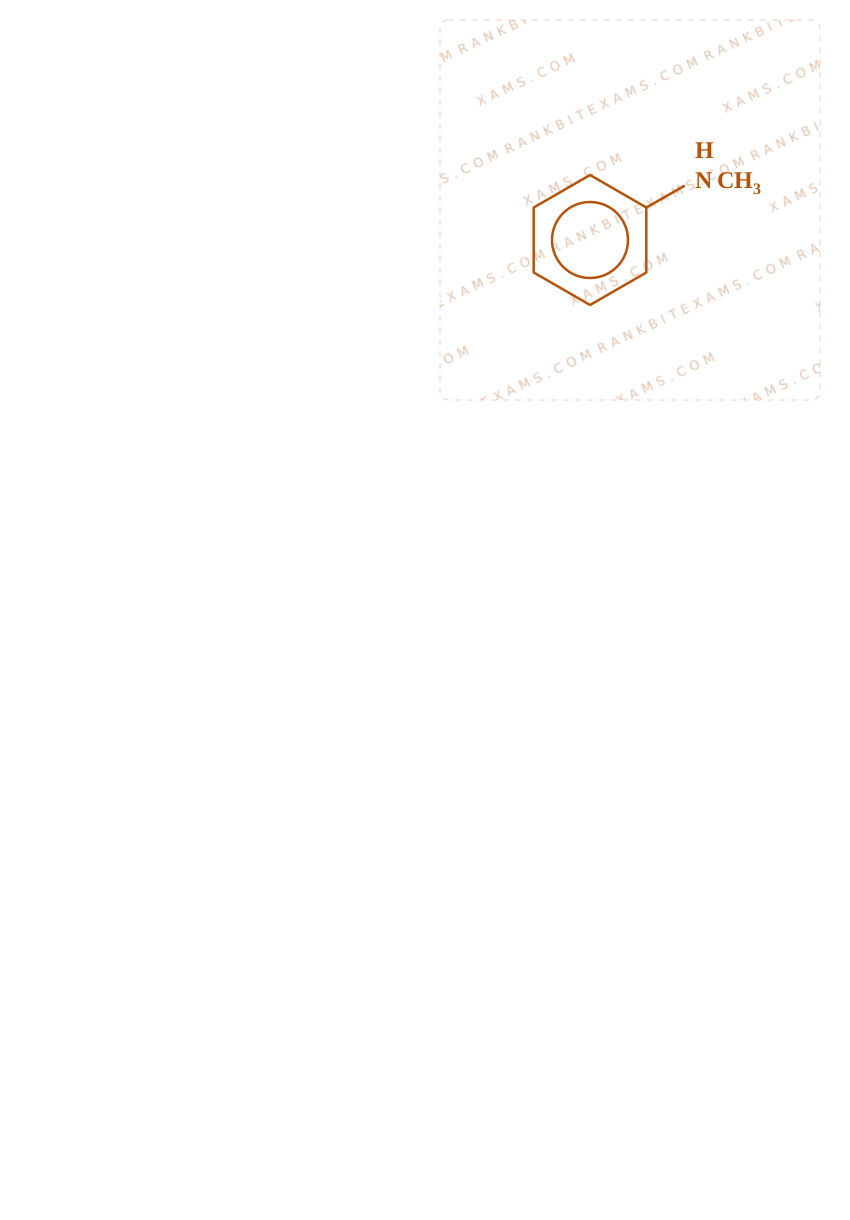
The structures depict Aniline (A) and N-Methylaniline (E) to distinguish primary and secondary aromatic amines.
B. (CH₃)₂NH C. CH₃NH₂ D. (CH₃)₃N E.
Carbylamine reactant aniline diagram for Q27 - JEE Main 2025
The structures depict Aniline (A) and N-Methylaniline (E) to distinguish primary and secondary aromatic amines.
Choose the correct answer from the options given below:

Solution & Explanation

Related Formula
R-NH₂ + CHCl₃ + 3KOH arrow R-NC + 3KCl + 3H₂O
Core Logic

Only primary (1^°) aliphatic and aromatic amines yield a positive carbylamine test (forming foul-smelling alkyl/aryl isocyanides).

  • A is Aniline (primary aromatic amine) arrow Positive
  • B is Dimethylamine (secondary aliphatic amine) arrow Negative
  • C is Methylamine (primary aliphatic amine) arrow Positive
  • D is Trimethylamine (tertiary aliphatic amine) arrow Negative
  • E is N-Methylaniline (secondary aromatic amine) arrow Negative
  • Thus, only A and C show a positive test.

Pattern Recognition

Shortcut: Look directly for any amine with a plain -NH₂ functional group. Secondary (-NH-) and tertiary (-N-) amines never react.

Chapter Mix

Class 12 Chemistry: Amines

More Amines Previous-Year Questions — Page 7

Q70 jee_main_2024_01_february_morning Nomenclature of Amines
Given below are two statements: Statement (I) : Aminobenzene and aniline are same organic compounds. Statement (II) : Aminobenzene and aniline are different organic compounds. In the light of the above statements, choose the most appropriate answer from the options given below:
  • A. Both Statement I and Statement II are correct
  • B. Statement I is correct but Statement II is incorrect
  • C. Statement I is incorrect but Statement II is correct
  • D. Both Statement I and Statement II are incorrect

Solution

Core Logic

Aniline is the common name for the simplest aromatic amine, which consists of a phenyl group attached to an amino group (C₆H₅NH₂). According to IUPAC nomenclature, the amino group attached to a benzene ring can also be called aminobenzene.

Step 1: Statement Validation

Statement I: True. Aminobenzene is just the systematic IUPAC name for aniline. Statement II: False. They refer to the exact same molecule.

Pattern Recognition

Common names for simple aromatic compounds are often accepted as IUPAC names. Aniline = Benzenamine = Aminobenzene.

Chapter Mix

Class 12 Chemistry: Amines
Q80 jee_main_2024_01_february_morning Electrophilic Substitution
Given below are two statements: Statement (I): The NH₂ group in Aniline is ortho and para directing and a powerful activating group. Statement (II): Aniline does not undergo Friedel-Craft's reaction (alkylation and acylation). In the light of the above statements, choose the most appropriate answer from the options given below:
  • A. Both Statement I and Statement II are correct
  • B. Both Statement I and Statement II are incorrect
  • C. Statement I is incorrect but Statement II is correct.
  • D. Statement I is correct but Statement II is incorrect

Solution

Core Logic

Statement (I): The -NH₂ group has a lone pair of electrons on nitrogen, which undergoes resonance with the benzene ring (strong +M effect). This strongly activates the ring towards electrophilic substitution and directs incoming electrophiles to the ortho and para positions.

Statement (II): Friedel-Crafts alkylation and acylation require a Lewis acid catalyst like anhydrous AlCl₃. Aniline is a Lewis base (due to the lone pair on N) and reacts with the Lewis acid AlCl₃ to form a stable salt/complex (C₆H₅ +NH₂-AlCl₃^-). This removes the lone pair from resonance and converts the -NH₂ group into a strongly deactivating group, thereby halting the Friedel-Crafts reaction.

Step 1: Evaluate Statements

Statement I is correct. Statement II is correct.

Pattern Recognition

Aniline NEVER undergoes Friedel-Crafts because the base (NH₂) reacts with the catalyst (AlCl₃) before the reaction can proceed.

Chapter Mix

Class 12 Chemistry: Amines
Q68 jee_main_2024_29_jan_morning Electrophilic Substitution in Amines
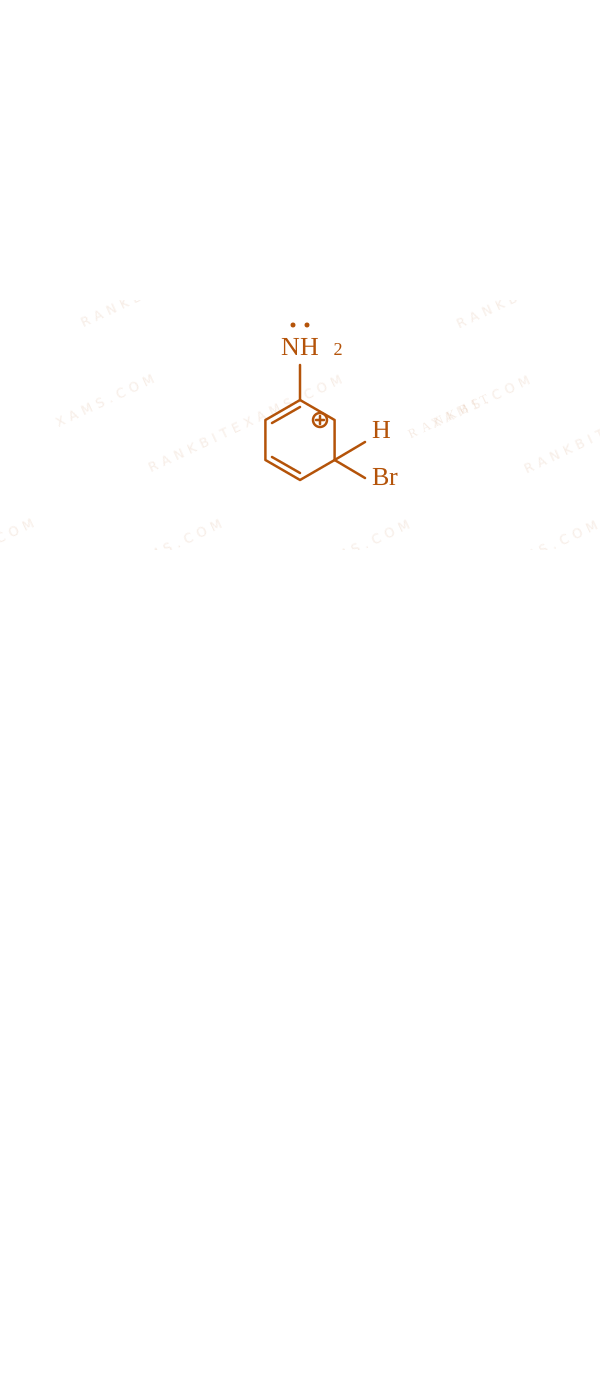
The arenium ion which is not involved in the bromination of Aniline is.
  • A. ""
  • B. ""
  • C. ""
  • D. ""

Solution

Core Logic

Aniline undergoes electrophilic aromatic substitution (like bromination). The -NH₂ group is a strongly activating group and directs incoming electrophiles to the ortho and para positions due to resonance electron donation (+M effect).

Step 1: Identifying Sigma Complexes (Arenium Ions)

When an electrophile (Br^+) attacks the ring, an intermediate arenium ion (sigma complex) is formed.

  • If attack occurs at the ortho or para position, the positive charge is delocalized onto the carbon atom bearing the -NH₂ group. The lone pair on nitrogen can then stabilize this positive charge via resonance, forming a highly stable resonance structure (an octet-complete intermediate).
  • If attack occurs at the meta position, the positive charge delocalizes only over the remaining ring carbons and never rests on the carbon bearing the -NH₂ group. Thus, it misses the extra stabilization provided by the nitrogen lone pair.
  • Because the meta attack intermediate is less stable compared to ortho/para attack, and the -NH₂ is strictly o/p directing, the meta-arenium ion is NOT a primary intermediate involved in standard bromination pathways of neutral aniline.

Step 2: Conclusion

Option 3 displays the arenium ion resulting from a meta-attack (positive charge skips the -NH₂ substituted carbon).

Electrophilic Substitution in Amines diagram for Q68 - JEE Main 2024 Morning

Since -NH₂ is ortho/para directing, the meta-arenium ion will not be formed.

Chapter Mix

Class 12 Chemistry: Amines

Q jee_main_2024_30_january_evening Diazonium Salts
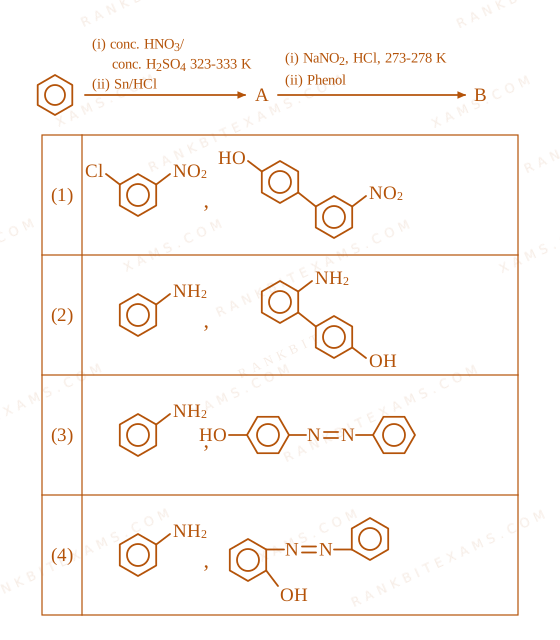
The products A and B formed in the following reaction scheme are respectively
Diazonium Salts diagram for Q68 - JEE Main 2024 Evening
The diagram shows a reaction pathway for synthesizing product A and B.
  • A.
  • B.
  • C.
  • D.

Solution

Core Logic

Step 1: Nitration of benzene using conc. HNO₃ and conc. H₂SO₄ gives nitrobenzene. Step 2: Reduction of nitrobenzene with Sn/HCl yields aniline. Step 3: Aniline reacts with NaNO₂/HCl at 0-5^° C to form benzene diazonium chloride (Product A). Step 4: Benzene diazonium chloride undergoes a coupling reaction with phenol (typically in a mildly alkaline medium) to form p-hydroxyazobenzene, an orange dye (Product B).

Reaction pathway for products A and B diagram for Q68 - JEE Main 2024 Evening
The diagram shows a reaction pathway for synthesizing product A and B.

Pattern Recognition

Nitration arrow Reduction arrow Diazotization arrow Coupling (Azo Dye Test).

Chapter Mix

Class 12 Chemistry: Amines
Q jee_main_2024_30_jan_morning Preparation of Amines
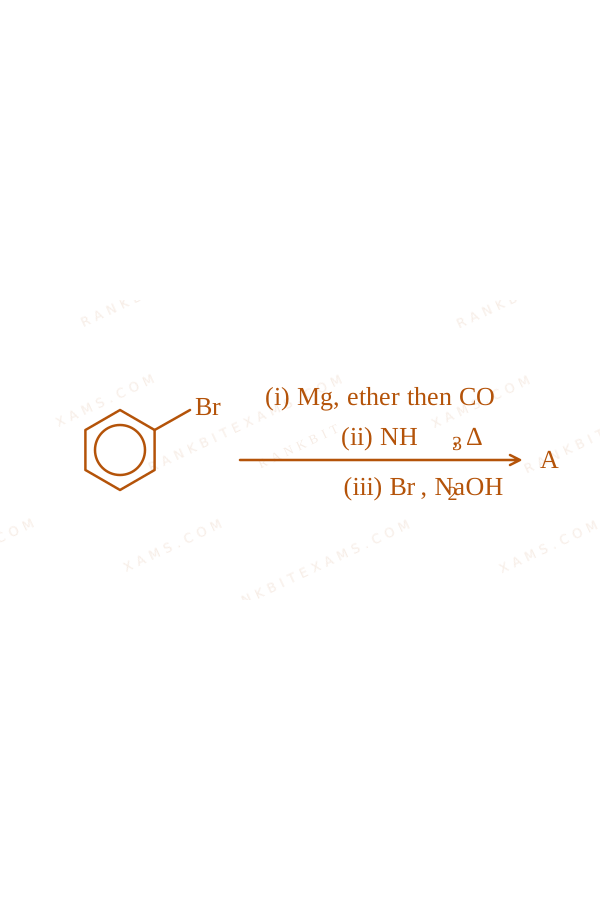
The final product A, formed in the following multistep reaction sequence is:
Preparation of Amines diagram for Q72 - JEE Main 2024 Morning
The image outlines a synthesis pathway converting bromobenzene through several steps finally using Hoffmann bromamide reaction.
  • A.
  • B.
  • C.
  • D.

Solution

Core Logic

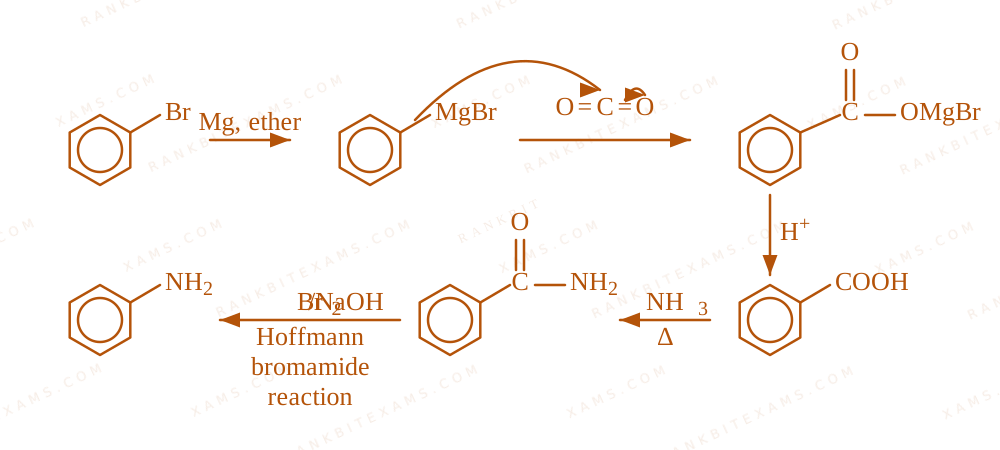
Step 1: Bromobenzene + Mg, ether arrow Phenylmagnesium bromide (Grignard reagent). Step 2: Grignard + CO₂ followed by H^+ arrow Benzoic acid (C₆H₅COOH). Step 3: Benzoic acid + NH₃, Δ arrow Benzamide (C₆H₅CONH₂). Step 4: Benzamide + Br₂/NaOH (Hoffmann bromamide degradation) arrow Aniline (C₆H₅NH₂).

Preparation of Amines solution diagram for Q72 - JEE Main 2024 Morning
The image outlines a synthesis pathway converting bromobenzene through several steps finally using Hoffmann bromamide reaction.

Step 1: Tracing the product

The final product 'A' is Aniline.

Chapter Mix

Class 12 Chemistry: Amines Class 12 Chemistry: Aldehydes, Ketones and Carboxylic Acids Class 12 Chemistry: Haloalkanes and Haloarenes
Rankbit System
JEE Physics: Waves (+15.5%) | Electrostatics: Concentric Shells (-29.7%) | Modern Physics: Photoelectric Clones (+34.2%) | Mathematics: Definite Integrals (+18.1%) | Chemistry: Coordination Splitting (-11.4%) | JEE Physics: Waves (+15.5%) | Electrostatics: Concentric Shells (-29.7%) | Modern Physics: Photoelectric Clones (+34.2%) | Mathematics: Definite Integrals (+18.1%) | Chemistry: Coordination Splitting (-11.4%)
