Which of the following amine(s) show(s) positive carbylamine test?
A.
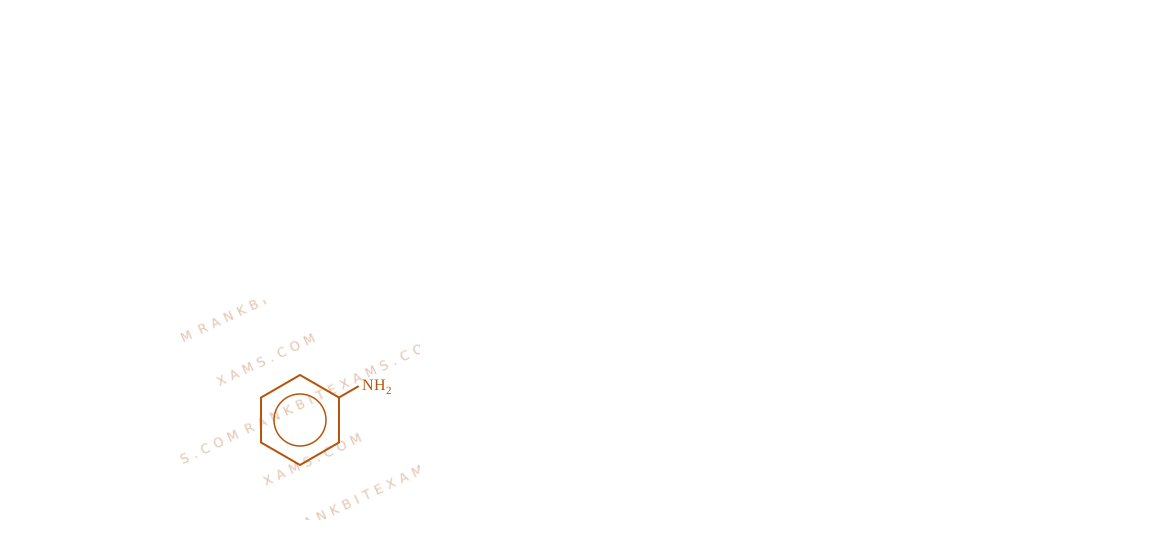
The structures depict Aniline (A) and N-Methylaniline (E) to distinguish primary and secondary aromatic amines.
B. (CH₃)₂NH$(CH_3)_2NH$
C. CH₃NH₂$CH_3NH_2$
D. (CH₃)₃N$(CH_3)_3N$
E.
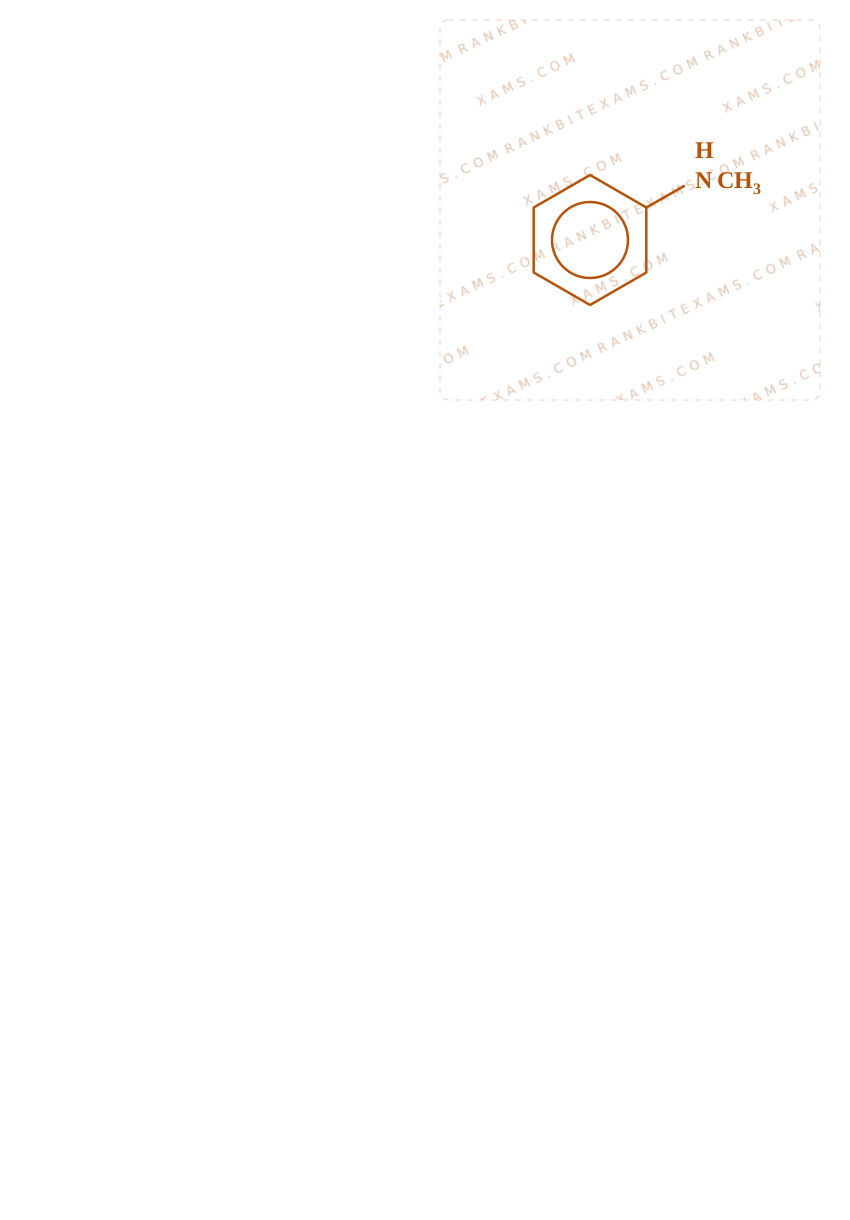
The structures depict Aniline (A) and N-Methylaniline (E) to distinguish primary and secondary aromatic amines.
Choose the correct answer from the options given below:
Only primary (1^°$1^\circ$) aliphatic and aromatic amines yield a positive carbylamine test (forming foul-smelling alkyl/aryl isocyanides).
A is Aniline (primary aromatic amine) arrow$\rightarrow$ Positive
B is Dimethylamine (secondary aliphatic amine) arrow$\rightarrow$ Negative
C is Methylamine (primary aliphatic amine) arrow$\rightarrow$ Positive
D is Trimethylamine (tertiary aliphatic amine) arrow$\rightarrow$ Negative
E is N-Methylaniline (secondary aromatic amine) arrow$\rightarrow$ Negative
Thus, only A and C show a positive test.
Pattern Recognition
Shortcut: Look directly for any amine with a plain -NH₂$-\text{NH}_2$ functional group. Secondary (-NH-$-\text{NH}-$) and tertiary (-N-$-\text{N}-$) amines never react.
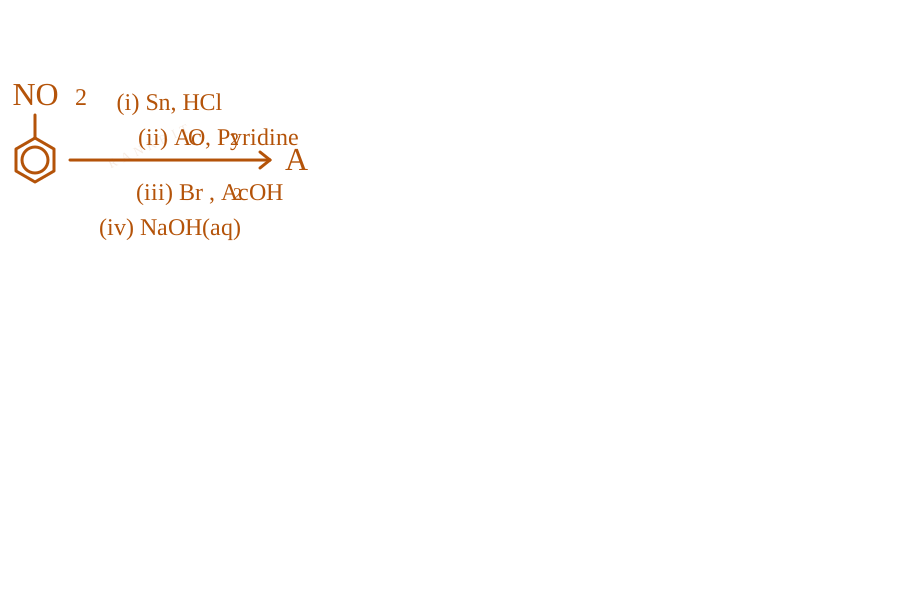
The major product (A) formed in the following reaction sequence is:
The flowchart traces the conversion of nitrobenzene using Sn/HCl, Ac2O/pyridine, Br2/AcOH, and aqueous NaOH.
A.
B.
C.
D.
Solution
Core Logic
Let's track the chemical transformations sequentially:
Step 1 (Sn + HCl$Sn + HCl$): Nitrobenzene is cleanly reduced to yield Aniline (C₆H₅NH₂$C_6H_5NH_2$).
Step 2 (Ac₂O + Pyridine$Ac_2O + \text{Pyridine}$): Protecting step. Aniline undergoes acetylation to form Acetanilide (C₆H₅NHCOCH₃$C_6H_5NHCOCH_3$). This tempers the highly activating -NH₂$-NH_2$ group to prevent poly-bromination.
Step 3 (Br₂ + AcOH$Br_2 + AcOH$): The -NHCOCH₃$-NHCOCH_3$ amide group safely directs electrophilic bromination to the less-hindered para position, yielding p-bromoacetanilide.
Step 4 (NaOH(aq)$NaOH_{(aq)}$): Basic hydrolysis removes the protecting acetyl group, restoring the free amine function to yield the final product: p-bromoaniline.
Pattern Recognition
Acetylation of aniline followed by halogenation and subsequent hydrolysis is the standard synthetic pathway to produce mono-substituted para-haloanilines.
Chapter Mix
Class 12 Chemistry: Amines
Q36jee_main_2025_07_april_eveningBasicity of Amines
The descending order of basicity of following amines is:
(A) Aniline
(B) p-Methoxyaniline
(C) p-Nitroaniline
(D) CH₃NH₂$\text{CH}_3\text{NH}_2$
(E) (CH₃)₂NH$(\text{CH}_3)_2\text{NH}$
Choose the correct answer from the options given below:
The images show structural configurations of the aromatic amines: aniline, p-methoxyaniline, and p-nitroaniline.The images show structural configurations of the aromatic amines: aniline, p-methoxyaniline, and p-nitroaniline.The images show structural configurations of the aromatic amines: aniline, p-methoxyaniline, and p-nitroaniline.The images show structural configurations of the aromatic amines: aniline, p-methoxyaniline, and p-nitroaniline.
A.B > E > D > A > C$\text{B} > \text{E} > \text{D} > \text{A} > \text{C}$
B.E > D > B > A > C$\text{E} > \text{D} > \text{B} > \text{A} > \text{C}$
C.E > D > A > B > C$\text{E} > \text{D} > \text{A} > \text{B} > \text{C}$
D.E > A > D > C > B$\text{E} > \text{A} > \text{D} > \text{C} > \text{B}$
Solution
Related Formula
Basicity ∝ Availability of lone pair of electrons on Nitrogen atom$$\text{Basicity} \propto \text{Availability of lone pair of electrons on Nitrogen atom}$$Basicity ∝ +I, +M groups Basicity ∝ 1-I, -M groups$$\text{Basicity} \propto +\text{I}, +\text{M groups} \quad \text{Basicity} \propto \frac{1}{-\text{I}, -\text{M groups}}$$
Core Logic
Aliphatic amines vs Aromatic amines: In aromatic amines (A, B, C), the lone pair on nitrogen is delocalized into the benzene ring via resonance, decreasing basicity compared to aliphatic amines (D, E) where electron pairs are localized.
Among aliphatic amines (aqueous standard configurations implicit): Secondary amine (CH₃)₂NH$(\text{CH}_3)_2\text{NH}$ is a stronger base than primary CH₃NH₂$\text{CH}_3\text{NH}_2$ due to combined inductive effect (+I$+\text{I}$) and solvation fields. Hence, E > D$\text{E} > \text{D}$.
Among substituted aromatic amines:
(B) p-Methoxyaniline: -OCH₃$-\text{OCH}_3$ exerts a strong electron-donating resonance effect (+M$+\text{M}$), maximizing ring density and electronic availability on N.
(A) Aniline: Baseline reference value with no extra substitutions.
(C) p-Nitroaniline: -NO₂$-\text{NO}_2$ acts as an intensive electron-withdrawing field (-M, -I$-\text{M}, -\text{I}$), pulling electron clouds heavily and quenching basicity.
Step 1: Consolidating Rankings
Combining both structural domains cleanly provides:
E > D > B > A > C$$\text{E} > \text{D} > \text{B} > \text{A} > \text{C} $$
Pattern Recognition
Basicity hierarchy shortcut: Aliphatic secondary >$>$ Aliphatic primary >$>$ Aromatic with EDG (+M$+\text{M}$) >$>$ Unsubstituted aniline >$>$ Aromatic with EWG (-M$-\text{M}$). This immediately gives E > D > B > A > C$\text{E} > \text{D} > \text{B} > \text{A} > \text{C}$ without deep arithmetic.
Chapter Mix
Class 12 Chemistry: Amines
Class 11 Chemistry: Organic Chemistry - Some Basic Principles and Techniques
Q28jee_main_2025_24_jan_eveningChemical Reactions of Aniline
For reaction
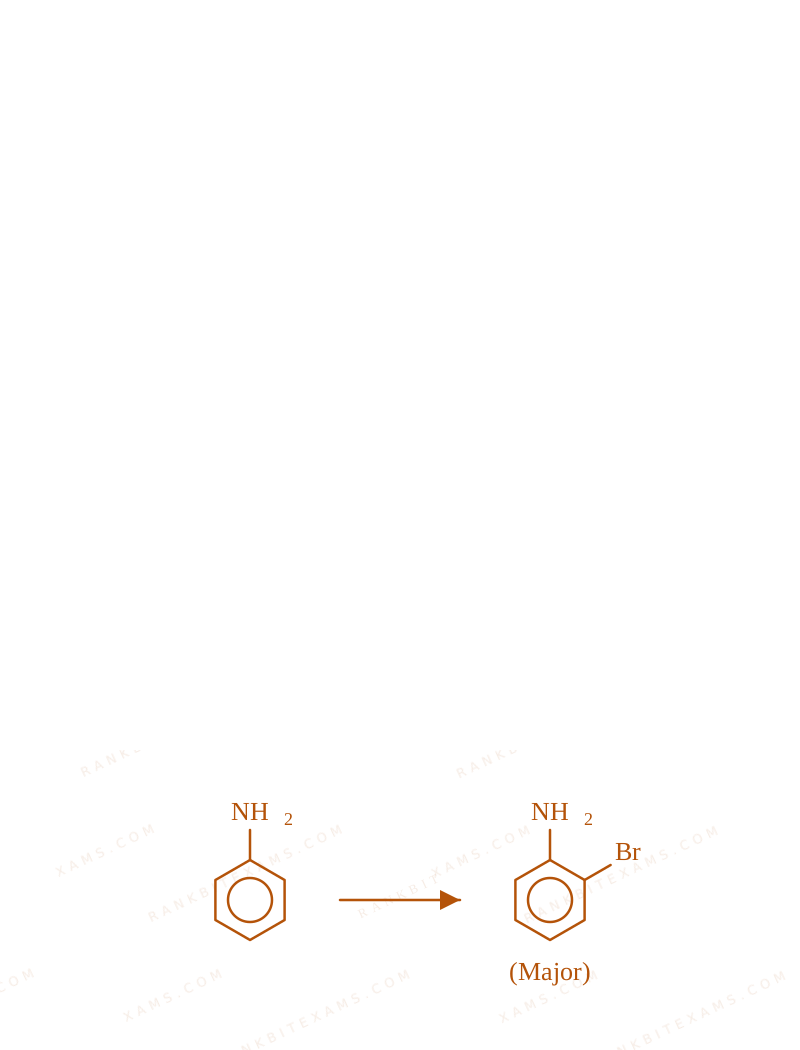
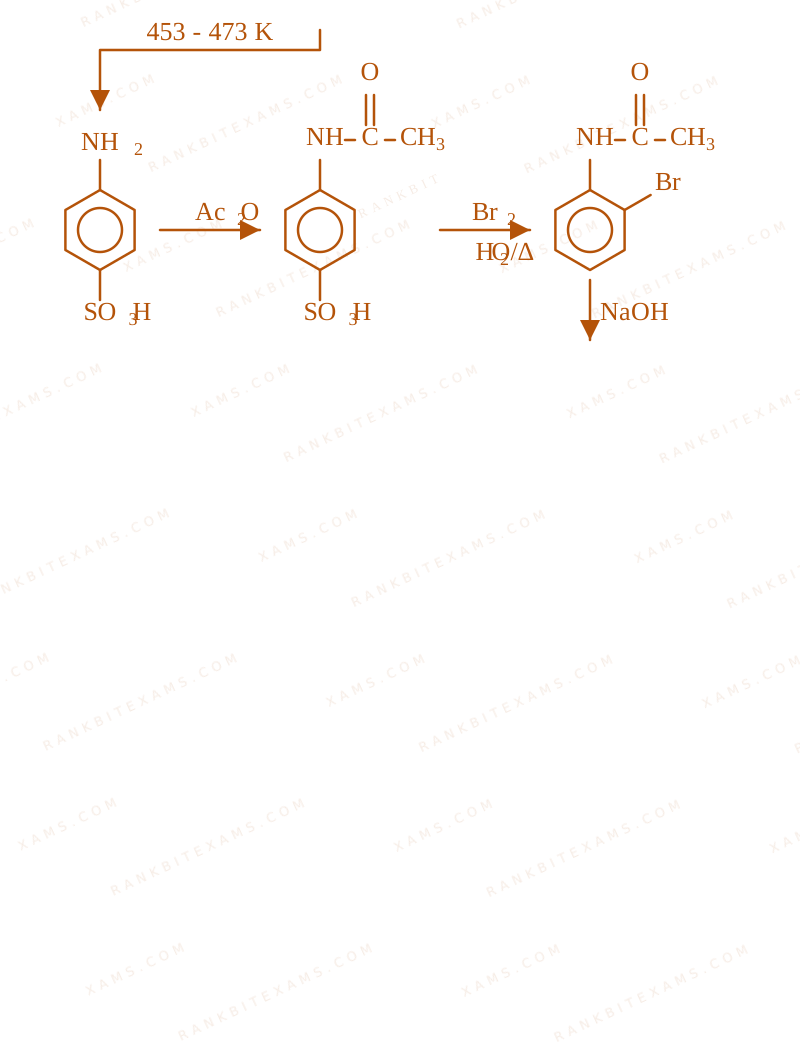
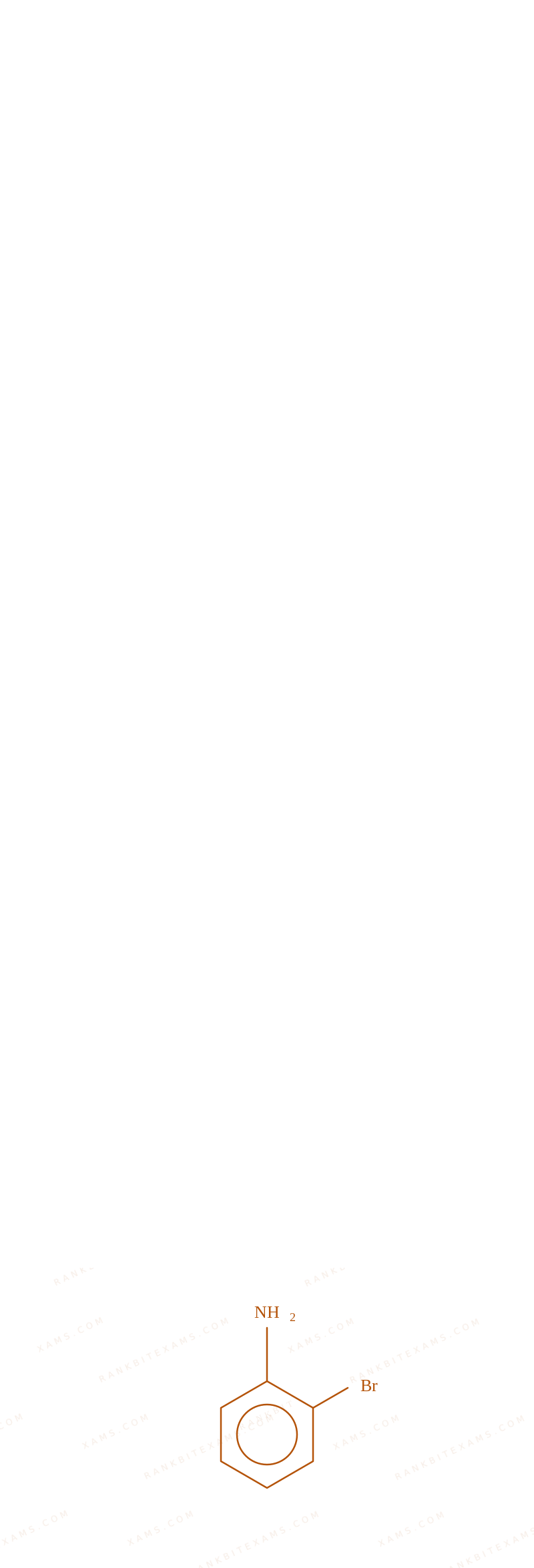
The image shows a multi-step organic conversion starting with sulfanilic acid intermediate structure mapping to a selectively brominated major product.
The correct order of set of reagents for the above conversion is :
To direct selective monobromination ortho to the amino functionality while utilizing the masking capability of the sulfonic acid group:
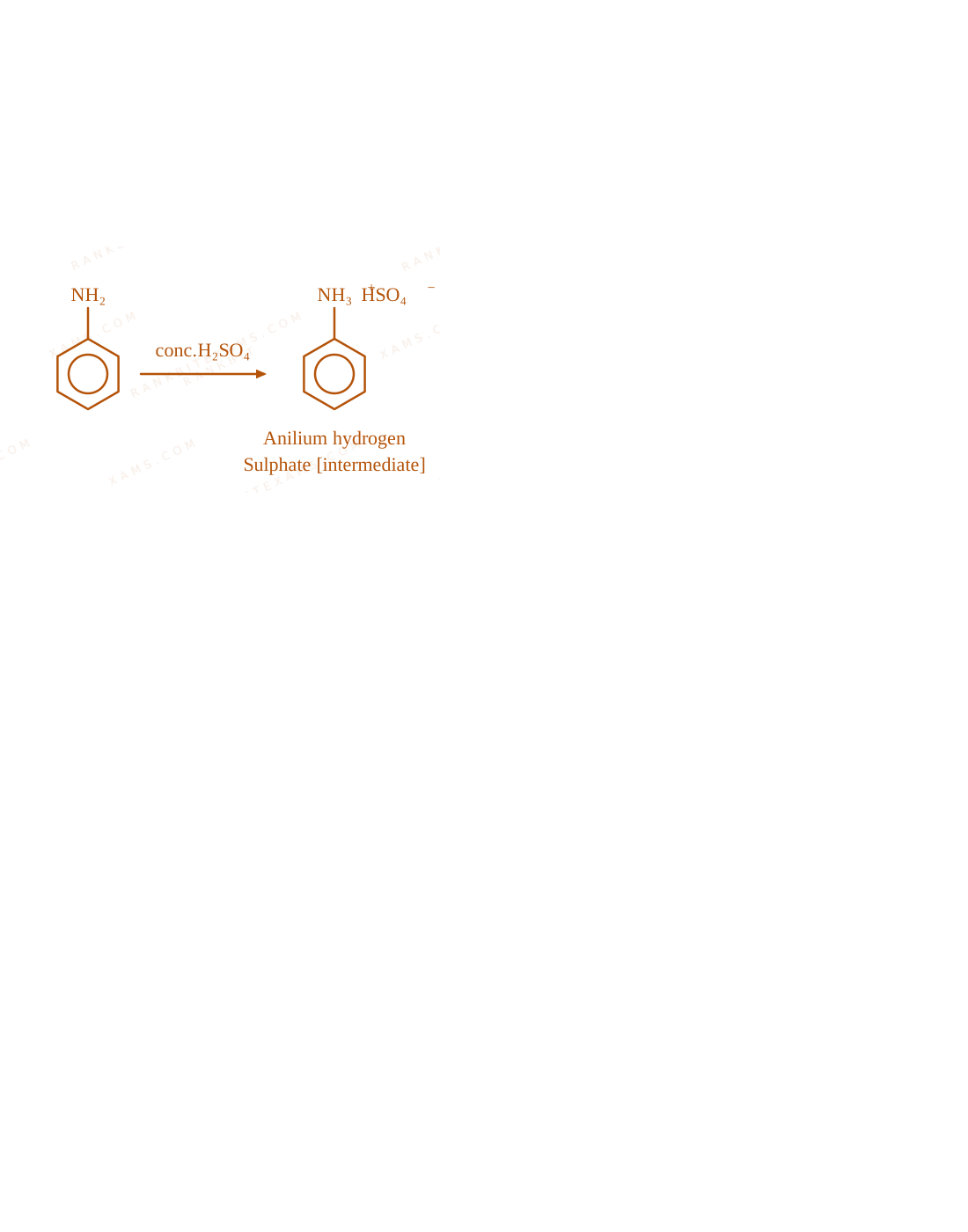
Treating Aniline with conc. H2SO₄$\mathrm{H}{2}SO_{4}$ at high temperature (453-473 K$453-473\text{ K}$) yields Sulfanilic acid due to para sulfonating preference.
Acetylation with Ac₂O$\mathrm{Ac}_{2}O$ protects the amine as an acetanilide functionality to moderate activation power and prevent over-bromination.
Electrophilic substitution using Br₂$\mathrm{Br}_{2}$ selectively places bromine at the position ortho to the protected acetamido group (the only available activated site since para is occupied).
Acidic/thermal desulfonation via H₂O(Δ)$\mathrm{H}_{2}O(\Delta)$ cleaves the para-sulfonic acid group.
Alkaline hydrolysis with NaOH$\mathrm{NaOH}$ removes the acetyl protecting group to regenerate the pristine primary amine structure yielding ortho-bromoaniline.
Step-by-Step Mechanism
The reaction mechanism progresses linearly through the designated strategic intermediates:
The image shows a multi-step organic conversion starting with sulfanilic acid intermediate structure mapping to a selectively brominated major product.The image shows a multi-step organic conversion starting with sulfanilic acid intermediate structure mapping to a selectively brominated major product.The image shows a multi-step organic conversion starting with sulfanilic acid intermediate structure mapping to a selectively brominated major product.
Pattern Recognition
When dealing with aniline conversions requiring blocked para positions followed by a removal step, look for the sequence tracking: Sulfonation arrow$\rightarrow$ Protection arrow$\rightarrow$ Halogenation arrow$\rightarrow$ Desulfonation arrow$\rightarrow$ Deprotection.
Chapter Mix
Class 12 Chemistry: Amines
Q43jee_main_2025_28_jan_eveningChemical Reactions of Amines
Identify correct statements:
(A) Primary amines do not give diazonium salts when treated with NaNO₃$NaNO_{3}$ in acidic condition.
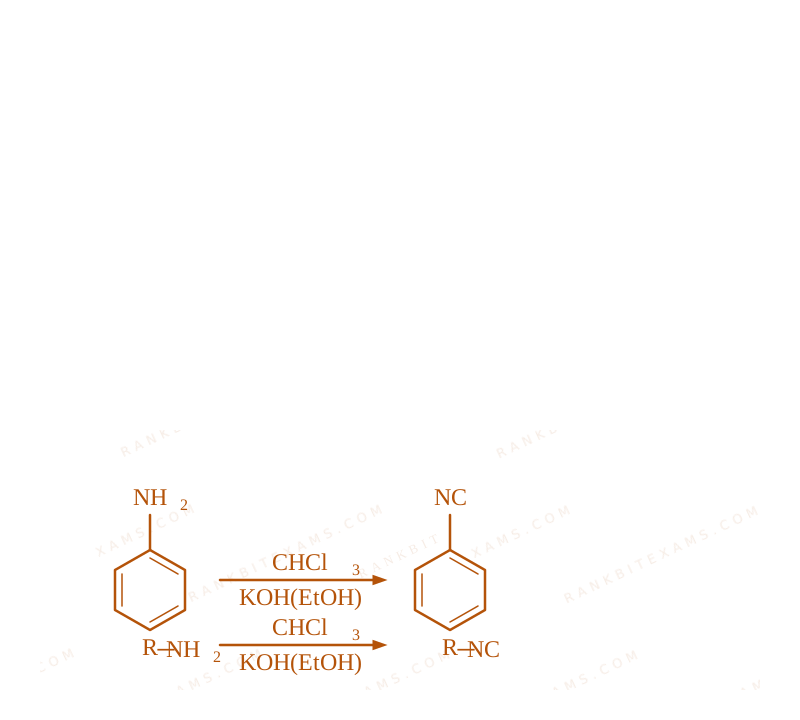
(B) Aliphatic and aromatic primary amines on heating with CHCl₃$CHCl_{3}$ and ethanolic KOH form carbylamines.
(C) Secondary and tertiary amines also give carbylamine test.
(D) Benzenesulfonyl chloride is known as Hinsberg's reagent.
(E) Tertiary amines reacts with benzenesulfonyl chloride very easily.
Choose the correct answer from the options given below :
A. (B) and (D) only
B. (A) and (B) only
C. (D) and (E) only
D. (B) and (C) only
Solution
Related Formula
The Carbylamine reaction is specific to primary amines:
(A) Primary aromatic amines form stable diazonium salts with NaNO₂/HCl$NaNO_2/HCl$ at low temperatures, making this statement false.
(B) Both aliphatic and aromatic primary amines undergo the carbylamine test to produce foul-smelling isocyanides. This is correct.
(C) Secondary and tertiary amines do not undergo the carbylamine reaction, making this statement false.
(D) Benzenesulfonyl chloride (C₆H₅SO₂Cl$C_6H_5SO_2Cl$) is the definition of Hinsberg's reagent. This is correct.
(E) Tertiary amines do not possess an acidic hydrogen on nitrogen and do not react with Hinsberg's reagent under standard analytical testing conditions, making this statement false.
Step 1: Selecting Correct Entries
Statements (B) and (D) are verified as true.
Reaction equations summary for primary amine classification
Pattern Recognition
Hinsberg's reagent and the carbylamine test are key analytical methods used to differentiate primary, secondary, and tertiary amines. The carbylamine test is strictly positive only for primary (1^°$1^\circ$) amine groups.
Chapter Mix
Class 12 Chemistry: Amines
Qjee_main_2025_29_jan_morningBasic Character of Amines
Given below are some nitrogen containing compounds.
Four amine candidates are indexed to find the optimal basic compound for reaction calculations.
Each of them is treated with HCl separately.
1.0 g of the most basic compound will consume ________ mg of HCl.
(Given molar mass in g mol ⁻¹$^{-1}$ C:12, H : 1, O : 16, Cl : 35.5)
Four amine candidates are indexed to find the optimal basic compound for reaction calculations.
Step 1: Identify the most basic amine
Benzylamine (C₆H₅CH₂NH₂$\mathrm{C}_6\mathrm{H}_5\mathrm{CH}_2\mathrm{NH}_2$) is the most basic compound here because its nitrogen lone pair is localized and not involved in aromatic resonance. This stands in contrast to aniline or amides, which delocalize their lone pairs into the ring or carbonyl group .
Since 1 mole of benzylamine reacts with 1 mole of HCl$\mathrm{HCl}$ :
Moles of HCl consumed = 0.009346 mol$$\text{Moles of HCl consumed} = 0.009346 \, \mathrm{mol}$$Mass of HCl = 0.009346 · 36.5 = 0.3411 g = 341.1 mg arrow 341$$\text{Mass of HCl} = 0.009346 \cdot 36.5 = 0.3411 \, \mathrm{g} = 341.1 \, \mathrm{mg} \rightarrow 341$$
Pattern Recognition
Aliphatic localized clusters (like the -CH₂NH₂$-\mathrm{CH}_2\mathrm{NH}_2$ segment in benzylamine) always show higher basicity than aromatic ring-conjugated arrays.
Practice past-year questions one chapter at a time. Pick an exam → subject → chapter and get every PYQ for that topic — pulled together from all past papers — with the chapter's key formulas alongside.
 "aniline, p-methoxyaniline, p-nitroaniline")
 "aniline, p-methoxyaniline, p-nitroaniline")
 "aniline, p-methoxyaniline, p-nitroaniline")

.svg "Amine Basicity, Neutralization Calculation, Molar Equivalence")
