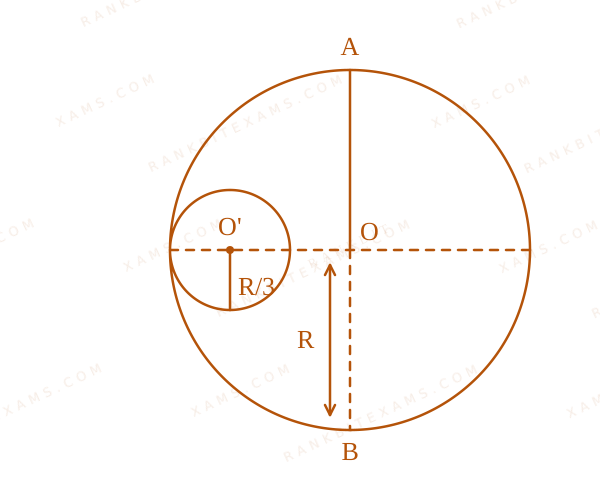
M and R be the mass and radius of a disc. A small disc of radius R/3 is removed from the bigger disc as shown in figure. The moment of inertia of remaining part of bigger disc about an axis AB passing through the centre O and perpendicular to the plane of disc is frac4mathrmxmathrmMR^2$\frac{4}{\mathrm{x}}\mathrm{MR}^2$ The value of x is
The graphic depicts a flat circular uniform disk of radius R with a smaller circular cut-out cavity of radius R/3 touching the perimeter. [cite: 197, 198, 199, 200, 208]
Numerical Answer Type:
Enter a numerical valueAnswer: 9 to 9+4 marks
Solution & Explanation
### Related Formula
I_textdisc = frac12 M R^2$$I_{\text{disc}} = \frac{1}{2} M R^2$$ [cite: 833]
I = I_textcm + M d^2 quad text(Parallel Axis Theorem)$$I = I_{\text{cm}} + M d^2 \quad \text{(Parallel Axis Theorem)}$$ [cite: 848]
### Core Logic
Let the original mass density per unit area be sigma$\sigma$. Without any cavity, the moment of inertia is: [cite: 198, 833]
I_1 = fracMR^22$$I_1 = \frac{MR^2}{2}$$ [cite: 833]
The mass of the removed small section scales directly with its cut-out area profile: [cite: 198, 834]
m = fracMpi R^2 times pi left(fracR3right)^2 = fracM9$$m = \frac{M}{\pi R^2} \times \pi \left(\frac{R}{3}\right)^2 = \frac{M}{9}$$ [cite: 198, 834, 844]
The center of mass of the removed disk sits at a distance d = R - fracR3 = frac2R3$d = R - \frac{R}{3} = \frac{2R}{3}$ away from the primary center O$O$[cite: 198, 205, 848]. Calculating its partial moment of inertia about O$O$ via the parallel axis theorem: [cite: 199, 848]
I_2 = fracm r^22 + m d^2 = fracfracM9left(fracR3right)^22 + fracM9left(frac2R3
ight)^2$$I_2 = \frac{m r^2}{2} + m d^2 = \frac{\frac{M}{9}\left(\frac{R}{3}\right)^2}{2} + \frac{M}{9}\left(\frac{2R}{3}
ight)^2$$ [cite: 848]
I_2 = fracMR^2162 + frac4MR^281 = fracMR^2 + 8MR^2162 = frac9MR^2162 = fracMR^218$$I_2 = \frac{MR^2}{162} + \frac{4MR^2}{81} = \frac{MR^2 + 8MR^2}{162} = \frac{9MR^2}{162} = \frac{MR^2}{18}$$ [cite: 848, 850]
Subtracting the removed component from the original configuration: [cite: 851]
I = I_1 - I_2 = fracMR^22 - fracMR^218 = frac9MR^2 - MR^218 = frac8MR^218 = frac49MR^2$$I = I_1 - I_2 = \frac{MR^2}{2} - \frac{MR^2}{18} = \frac{9MR^2 - MR^2}{18} = \frac{8MR^2}{18} = \frac{4}{9}MR^2$$ [cite: 851]
Matching this with frac4xMR^2$\frac{4}{x}MR^2$, we find x = 9$x = 9$[cite: 200, 208, 851, 853].
### Pattern Recognition
For uniform planar surfaces, mass always scales squarely with linear dimension changes (r rightarrow fracr3 implies m rightarrow fracm9$r \rightarrow \frac{r}{3} \implies m \rightarrow \frac{m}{9}$)[cite: 198, 834, 844]. Always apply the parallel axis theorem to bring the component values to a unified reference point before executing addition or subtraction[cite: 848, 851].
### Evaluation Rubric / Model Answer
null
### Chapter Mix
Class 11 Physics: System of Particles and Rotational Motion
Keywords:#moment of inertia disk cavity#JEE Main 2025 Evening Q25#parallel axis theorem mass reduction#rotational mechanics disk cut out#moment of inertia disc cavity#parallel axis theorem radius#removed mass fraction geometry#rotational mechanics axis center
More System of Particles and Rotational Motion Previous-Year Questions — Page 4
Q24jee_main_2025_28_jan_morningMoment of Inertia
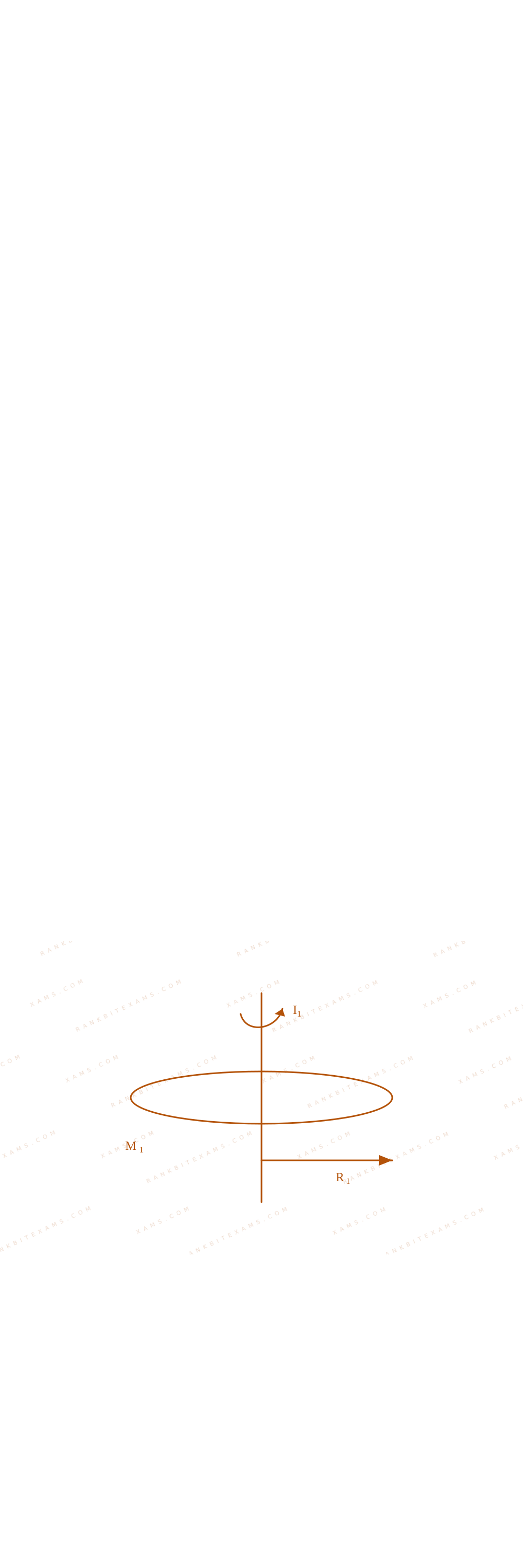
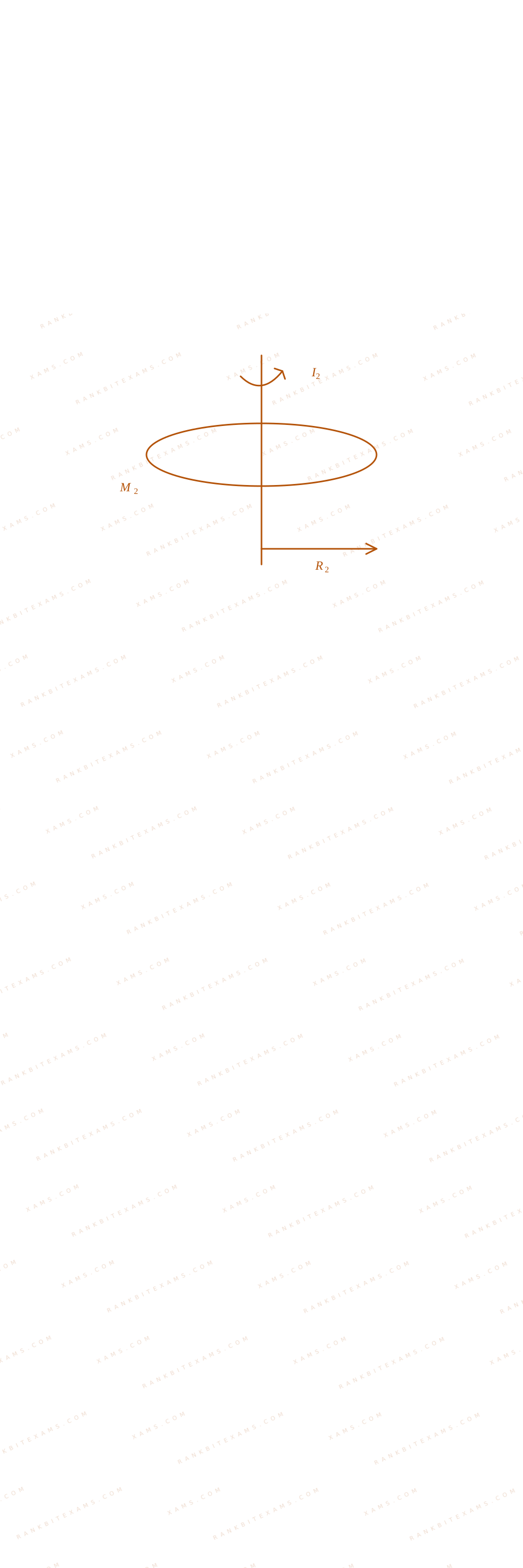
Two iron solid discs of negligible thickness have radii mathbfR_1$\mathbf{R}_1$ and mathbfR_2$\mathbf{R}_2$ and moment of inertia mathrmI_1$\mathrm{I}_1$ and mathrmI_2$\mathrm{I}_2$ , respectively. For mathrmR_2 = 2mathrmR_1$\mathrm{R}_2 = 2\mathrm{R}_1$ , the ratio of mathrmI_1$\mathrm{I}_1$ and mathrmI_2$\mathrm{I}_2$ would be 1 / mathrmx$1 / \mathrm{x}$ , where mathrmx =$\mathrm{x} =$
Numerical Answer.Answer: 16 to 16
Solution
### Core Logic
Since mass scales with the face surface area for discs of identical thickness and material composition:
mathrmM = sigma cdot pi mathrmR^2 implies mathrmM propto mathrmR^2$$\mathrm{M} = \sigma \cdot \pi \mathrm{R}^2 \implies \mathrm{M} \propto \mathrm{R}^2$$Disk mass allocation scaling profile diagram for Q24Disk mass allocation scaling profile diagram for Q24mathrmM_1 = mathrmM_0, quad mathrmM_2 = sigma pi (2mathrmR_1)^2 = 4mathrmM_0$$\mathrm{M}_1 = \mathrm{M}_0, \quad \mathrm{M}_2 = \sigma \pi (2\mathrm{R}_1)^2 = 4\mathrm{M}_0$$
The moment of inertia formula for a disc is:
mathrmI = frac12mathrmMmathrmR^2 implies mathrmI propto mathrmMmathrmR^2 propto mathrmR^4$$mathrm{I} = \frac{1}{2}\mathrm{M}\mathrm{R}^2 \implies \mathrm{I} \propto \mathrm{M}\mathrm{R}^2 \propto \mathrm{R}^4$$
Calculating the ratio for the given radii configuration:
fracmathrmI_1mathrmI_2 = fracmathrmM_1 mathrmR_1^2mathrmM_2 mathrmR_2^2 = fracmathrmM_0 cdot mathrmR_1^24mathrmM_0 cdot (2mathrmR_1)^2 = frac116$$\frac{\mathrm{I}_1}{\mathrm{I}_2} = \frac{\mathrm{M}_1 \mathrm{R}_1^2}{\mathrm{M}_2 \mathrm{R}_2^2} = \frac{\mathrm{M}_0 \cdot \mathrm{R}_1^2}{4\mathrm{M}_0 \cdot (2\mathrm{R}_1)^2} = \frac{1}{16}$$
### Step 1: Value Convergence
Comparing this fraction to 1/mathrmx$1/\mathrm{x}$ yields:
mathrmx = 16$\mathrm{x} = 16$
### Pattern Recognition
For 2D uniform laminar objects, scaling the radius changes both the mass factor (by mathrmR^2$\mathrm{R}^2$) and the distribution distance (by mathrmR^2$\mathrm{R}^2$), resulting in an overall mathrmR^4$\mathrm{R}^4$ dependency rule.
### Evaluation Rubric / Model Answer
null
### Chapter Mix
Class 11 Physics: System of Particles and Rotational Motion
Q10jee_main_2025_03_april_morningRolling Without Slipping
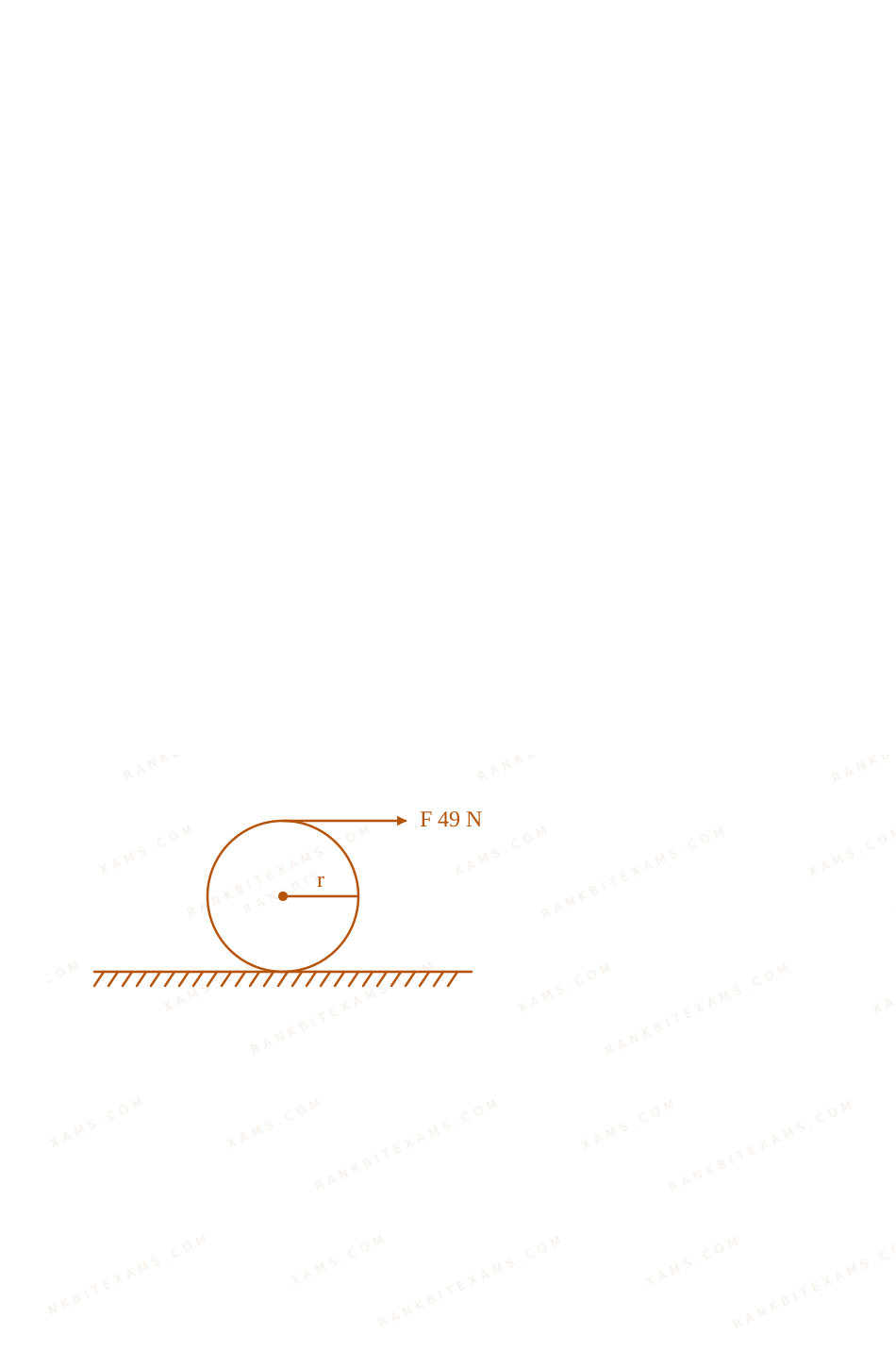
A force of 49mathrm~N$49\mathrm{~N}$ acts tangentially at the highest point of a sphere (solid) of mass 20mathrm~kg$20\mathrm{~kg}$, kept on a rough horizontal plane. If the sphere rolls without slipping, then the acceleration of the center of the sphere is:
A schematic of a solid sphere of mass m resting on a horizontal plane with a force F pointing horizontally to the right at the highest point.
A.3.5mathrm~m/s^2$3.5\mathrm{~m/s}^2$
B.0.35mathrm~m/s^2$0.35\mathrm{~m/s}^2$
C.2.5mathrm~m/s^2$2.5\mathrm{~m/s}^2$
D.0.25mathrm~m/s^2$0.25\mathrm{~m/s}^2$
Solution
### Related Formula
Torque equation about the instantaneous center of zero velocity (bottom contact point P$P$):
tau_P = I_P alpha$$\tau_P = I_P \alpha$$
For a solid sphere, the moment of inertia about the center is I_c = frac25MR^2$I_c = \frac{2}{5}MR^2$. By the parallel axis theorem:
I_P = I_c + MR^2 = frac75MR^2$$I_P = I_c + MR^2 = \frac{7}{5}MR^2$$
### Core Logic
Since the sphere rolls without slipping, we can conveniently write the torque equation about the lowest point of contact P$P$ because static friction passes through this point and exerts zero torque.
- Distance from point P$P$ to the top highest point is 2R$2R$.
- Tangential force F = 49mathrm~N$F = 49\mathrm{~N}$.
- Mass of solid sphere, M = 20mathrm~kg$M = 20\mathrm{~kg}$.
tau_P = F times 2R$$\tau_P = F \times 2R$$
Substitute tau_P$\tau_P$ and I_P$I_P$ into the torque equation:
F times 2R = left(frac75MR^2right) alpha$$F \times 2R = \left(\frac{7}{5}MR^2\right) \alpha$$
### Step 1: Solving for Linear Acceleration
For pure rolling, the acceleration of the center of mass a$a$ is related to angular acceleration alpha$\alpha$ by a = Ralpha$a = R\alpha$:
2F R = frac75MR^2 left(fracaRright)$$2F R = \frac{7}{5}MR^2 \left(\frac{a}{R}\right)$$2F = frac75 M a implies a = frac10F7M$$2F = \frac{7}{5} M a \implies a = \frac{10F}{7M}$$
Substitute the numerical values (F = 49mathrm~N$F = 49\mathrm{~N}$ and M = 20mathrm~kg$M = 20\mathrm{~kg}$):
a = frac10 times 497 times 20 = frac490140 = 3.5mathrm~m/s^2$$a = \frac{10 \times 49}{7 \times 20} = \frac{490}{140} = 3.5\mathrm{~m/s}^2$$
### Step 2: Analysis of Friction Force Direction
Let's write force equations to verify consistency:
F + f = M a$F + f = M a$49 + f = 20 times 3.5 = 70 implies f = 21mathrm~N$$49 + f = 20 \times 3.5 = 70 \implies f = 21\mathrm{~N}$$
Since f$f$ is positive, static friction acts in the forward direction. Rolling without slipping is fully maintained since the required static friction coefficient is well within realistic limits.
### Pattern Recognition
Calculating torque about the bottom contact point is a powerful shortcut for rolling-without-slipping questions! It completely bypasses having to guess or set up equations for the friction direction.
### Evaluation Rubric / Model Answer
null
### Chapter Mix
Class 11 Physics: System of Particles and Rotational Motion
Q12jee_main_2025_04_april_eveningRolling Motion
A wheel is rolling on a plane surface. The speed of a particle on the highest point of the rim is 8 m/s. The speed of the particle on the rim of the wheel at the same level as the centre of wheel, will be:
A.4sqrt2text m/s$4\sqrt{2}\text{ m/s}$
B.8text m/s$8\text{ m/s}$
C.4text m/s$4\text{ m/s}$
D.8sqrt2text m/s$8\sqrt{2}\text{ m/s}$
Solution
### Related Formula
Velocity of a point on a rolling wheel at angular position theta$\theta$ from the lowest point:
v = 2 v_textcm sinleft(fractheta2right)$$v = 2 v_{\text{cm}} \sin\left(\frac{\theta}{2}\right)$$
### Core Logic
At the highest point, theta = 180^circ$\theta = 180^\circ$, so:
v_texttop = 2v_textcm = 8text m/s implies v_textcm = 4text m/s$$v_{\text{top}} = 2v_{\text{cm}} = 8\text{ m/s} \implies v_{\text{cm}} = 4\text{ m/s}$$
For a particle on the rim at the same horizontal level as the center, the angle from the lowest point is theta = 90^circ$\theta = 90^\circ$.
### Step 1: Compute Speed at Mid-Height
Substituting theta = 90^circ$\theta = 90^\circ$ into our velocity relation:
v_textmid = 2v_textcm sin(45^circ) = 2 times 4 times frac1sqrt2 = 4sqrt2text m/s$$v_{\text{mid}} = 2v_{\text{cm}} \sin(45^\circ) = 2 \times 4 \times \frac{1}{\sqrt{2}} = 4\sqrt{2}\text{ m/s}$$Instantaneous center of rotation on rolling wheel
### Pattern Recognition
The contact point with the ground is the Instantaneous Center of Rotation (ICR). Distance to top point is 2R$2R$, distance to mid-level point is sqrtR^2+R^2 = sqrt2R$\sqrt{R^2+R^2} = \sqrt{2}R$. Velocity scales linearly with distance from ICR.
### Evaluation Rubric / Model Answer
null
### Chapter Mix
Class 11 Physics: Rotational Motion
Q22jee_main_2025_04_april_eveningConservation of Angular Momentum
A solid sphere with uniform density and radius R is rotating initially with constant angular velocity (omega_1)$(\omega_{1})$ about its diameter. After some time during the rotation its starts loosing mass at a uniform rate, with no change in its shape. The angular velocity of the sphere when its radius becomes R / 2$R / 2$ is xomega_1$x\omega_{1}$. The value of x is ________.
Numerical Answer.Answer: 32 to 32
Solution
### Related Formula
Conservation of Angular Momentum (since no external torque acts):
I_1 omega_1 = I_2 omega_2$$I_1 \omega_1 = I_2 \omega_2$$
For a solid sphere, moment of inertia is:
I = frac25MR^2$$I = \frac{2}{5}MR^2$$
Mass scales with volume:
M propto R^3$M \propto R^3$
### Core Logic
When the radius reduces to R_2 = fracR2$R_2 = \frac{R}{2}$, the mass scales cubically:
M_2 = M_1 left(fracR/2Rright)^3 = fracM_18$$M_2 = M_1 \left(\frac{R/2}{R}\right)^3 = \frac{M_1}{8}$$
Now, compute the new moment of inertia I_2$I_2$:
I_2 = frac25 M_2 R_2^2 = frac25 left(fracM_18right) left(fracR2right)^2 = frac25 M_1 R^2 times frac132 = fracI_132$$I_2 = \frac{2}{5} M_2 R_2^2 = \frac{2}{5} \left(\frac{M_1}{8}\right) \left(\frac{R}{2}\right)^2 = \frac{2}{5} M_1 R^2 \times \frac{1}{32} = \frac{I_1}{32}$$
### Step 1: Compute Final Angular Velocity
Using conservation of angular momentum:
I_1 omega_1 = left(fracI_132right) omega_2 implies omega_2 = 32 omega_1$$I_1 \omega_1 = \left(\frac{I_1}{32}\right) \omega_2 \implies \omega_2 = 32 \omega_1$$
Hence, the value of x$x$ is **32**.
### Pattern Recognition
Since inertia of a solid sphere scales with M R^2$M R^2$ and M propto R^3$M \propto R^3$, the net moment of inertia scales with R^5$R^5$. Shrinking the radius by half (1/2$1/2$) cuts down inertia by a factor of (1/2)^5 = 1/32$(1/2)^5 = 1/32$. Velocity must scale up by 32 to conserve momentum.
### Evaluation Rubric / Model Answer
null
### Chapter Mix
Class 11 Physics: Rotational Motion
Q4jee_main_2025_04_april_morningTorque and Angular Momentum
Which of the following are correct expression for torque acting on a body?
A. vectau=vecItimesvecL$\vec{\tau}=\vec{I}\timesvec{L}$
B. vectau=fracddt(vecrtimesvecp)$\vec{\tau}=\frac{d}{dt}(\vec{r}\timesvec{p})$
C. vectau=vecrtimesfracdvecpdt$\vec{\tau}=\vec{r}\times\frac{dvec{p}}{dt}$
D. vectau=Ivecalpha$\vec{\tau}=Ivec{\alpha}$
E. vectau=vecrtimesvecF$\vec{\tau}=\vec{r}\timesvec{F}$(vecr=$(\vec{r}=$ position vector; vecp=$\vec{p}=$ linear momentum; vecL=$\vec{L}=$ angular momentum; vecalpha=$\vec{\alpha}=$ angular acceleration; I=$I=$ moment of inertia; vecF=$\vec{F}=$ force; t=texttime)$t=\text{time})$
Choose the correct answer from the options given below:
A. B, D and E Only
B. C and D Only
C. B, C, D and E Only
D. A, B, D and E Only
Solution
### Related Formula
Fundamental mathematical definition of torque:
vectau = vecr times vecF
$$
vec{\tau} = \vec{r} \times \vec{F}
$$
Rotational analogue of Newton's second law:
vectau = fracdvecLdt = Ivecalpha
$$
vec{\tau} = \frac{dvec{L}}{dt} = Ivec{\alpha}
$$
Linear momentum relations:
vecL = vecr times vecp implies vectau = fracddt(vecr times vecp)
$$
vec{L} = \vec{r} \times \vec{p} implies \vec{\tau} = \frac{d}{dt}(\vec{r} \times \vec{p})
$$
### Core Logic
Let's check each expression sequentially:
* **A.** vectau=vecItimesvecL$\vec{\tau}=\vec{I}\timesvec{L}$ is dimensionally incorrect (Moment of inertia I$I$ is primarily treated as a tensor or scalar placeholder, not crossed directly like this).
* **B.** vectau=fracdvecLdt = fracddt(vecrtimesvecp)$\vec{\tau}=\frac{dvec{L}}{dt} = \frac{d}{dt}(\vec{r}\timesvec{p})$ is fundamentally correct.
* **C.** vectau=vecrtimesvecF = vecrtimesfracdvecpdt$\vec{\tau}=\vec{r}\timesvec{F} = \vec{r}\times\frac{dvec{p}}{dt}$ is correct since vecF = fracdvecpdt$\vec{F} = \frac{dvec{p}}{dt}$.
* **D.** vectau=Ivecalpha$\vec{\tau}=Ivec{\alpha}$ is the standard scalar component/fixed axis formulation.
* **E.** vectau=vecrtimesvecF$\vec{\tau}=\vec{r}\timesvec{F}$ is the true physical vector definition.
Thus, statements B, C, D, and E are universally correct representations.
### Pattern Recognition
Torque can be represented either through geometric structural parameters (position and force cross products) or via kinematic response properties (rate of change of angular momentum or product of rotational inertia and acceleration).
### Evaluation Rubric / Model Answer
null
### Chapter Mix
Class 11 Physics: System of Particles and Rotational Motion
More System of Particles and Rotational Motion Questions — jee_main_2025_07_april_evening
We Map Every Repeating Question in Competitive Exams.
Say goodbye to generic mock test fatigue. RankBit uses smart analysis to group past exam questions into their foundational Repeating Question Types. Find chapter weightage, track repeating questions, and score higher with targeted practice.
Select Your Target Exam
Choose an exam track below to find formulas per chapter and patterns.
Syncing Exam Intelligence
Mapping formulas and patterns across all tracks…
PATH A — FULL LENGTH PRACTICE
Full Mock Test Hub
Simulate real NTA exam conditions with fully tracked mocks. Time yourself against past papers.
Practice past-year questions one chapter at a time. Pick an exam → subject → chapter and get every PYQ for that topic — pulled together from all past papers — with the chapter's key formulas alongside.