Related Formula
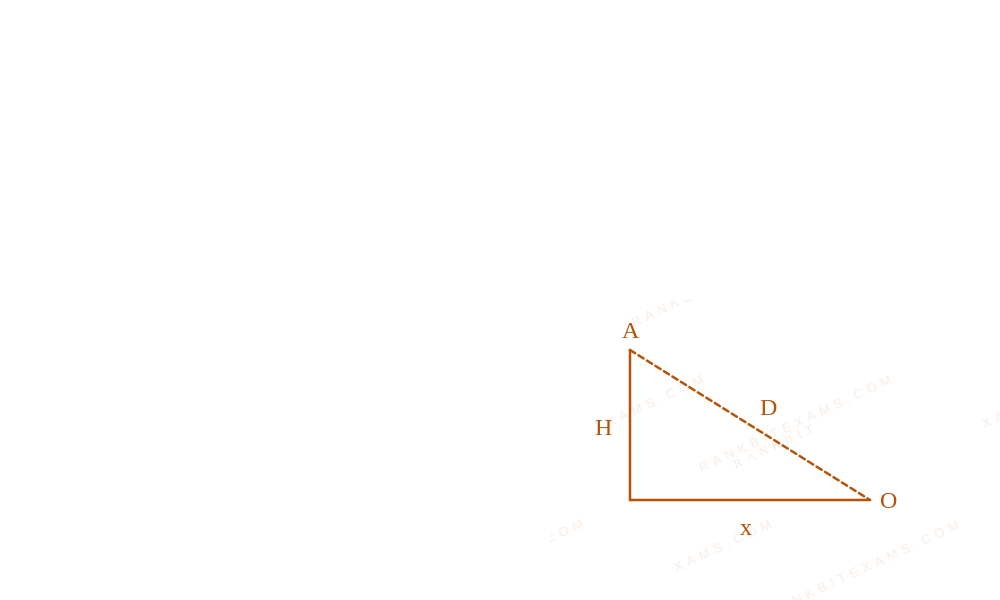
x = u · t$x = u \cdot t$ [cite: 763]
H = (1)/(2)gt²$$H = \frac{1}{2}gt^2$$ [cite: 764]
D = √(x² + H²)$$D = \sqrt{x^2 + H^2}$$ [cite: 774]
Core Logic
First, convert the horizontal velocity component to metric SI units: [cite: 157, 763]
u = 360 × (5)/(18) = 100 m/s$$u = 360 \times \frac{5}{18} = 100\ \text{m/s}$$ [cite: 157, 763]
Calculate the horizontal range distance x$x$ covered over t = 20 s$t = 20\ \text{s}$: [cite: 158, 763]
x = 100 × 20 = 2000 m = 2 km$$x = 100 \times 20 = 2000\ \text{m} = 2\ \text{km}$$ [cite: 158, 763]
The vertical displacement height H$H$ is explicitly given as 2 km = 2000 m$2\ \text{km} = 2000\ \text{m}$[cite: 157, 769]. Let's confirm with free-fall height calculation matching the solution template: [cite: 764]
H = (1)/(2) × 10 × (20)² = 5 × 400 = 2000 m = 2 km$$H = \frac{1}{2} \times 10 \times (20)^2 = 5 \times 400 = 2000\ \text{m} = 2\ \text{km}$$ [cite: 158, 769]
Now find the net spatial vector displacement D$D$ from the release coordinates: [cite: 774]
D = √(x² + H²) = √(2² + 2²) = √(8) = 2√(2) km$$D = \sqrt{x^2 + H^2} = \sqrt{2^2 + 2^2} = \sqrt{8} = 2\sqrt{2}\ \text{km}$$ [cite: 774]
Pattern Recognition
Be careful with the wording: the question asks for the displacement from the release coordinate position [cite: 159], which is the hypotenuse vector √(x² + H²)$\sqrt{x^2 + H^2}$[cite: 774]. Do not mistake it for the horizontal range distance alone.
Chapter Mix
Class 11 Physics: Motion in a Plane