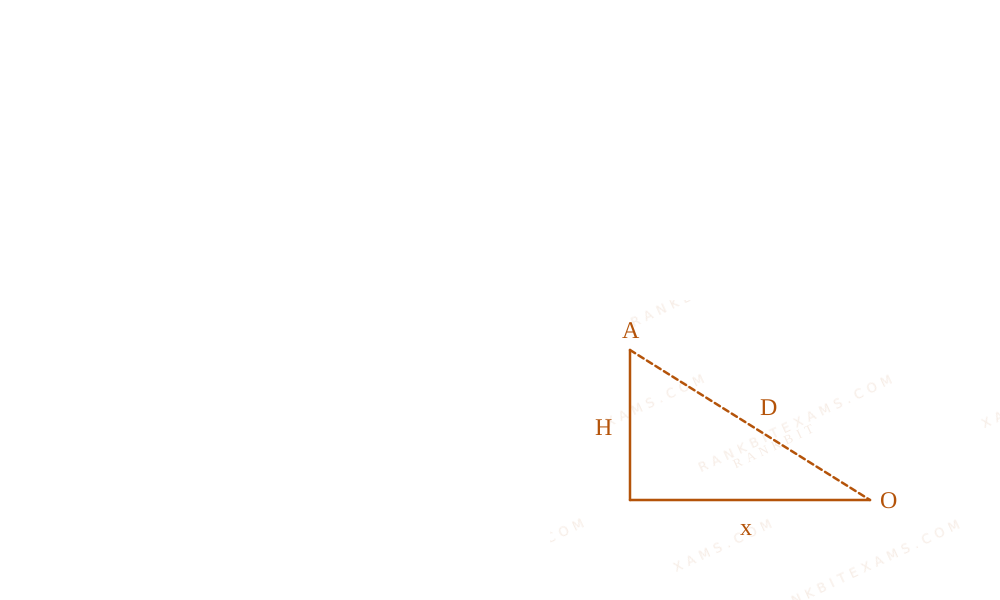
A helicopter flying horizontally with a speed of 360~km/h at an altitude of 2 km, drops an object at an instant. The object hits the ground at a point O, 20 s after it is dropped. Displacement of 'O' from the position of helicopter where the object was released is: (use acceleration due to gravity g=10~m/s^2 and neglect air resistance) [cite: 157, 158, 159, 160]

Solution & Explanation

### Related Formula x = u cdot t [cite: 763] H = frac12gt^2 [cite: 764] D = sqrtx^2 + H^2 [cite: 774] ### Core Logic First, convert the horizontal velocity component to metric SI units: [cite: 157, 763] u = 360 times frac518 = 100\ textm/s [cite: 157, 763] Calculate the horizontal range distance x covered over t = 20\ texts: [cite: 158, 763] x = 100 times 20 = 2000\ textm = 2\ textkm [cite: 158, 763] The vertical displacement height H is explicitly given as 2\ textkm = 2000\ textm[cite: 157, 769]. Let's confirm with free-fall height calculation matching the solution template: [cite: 764] H = frac12 times 10 times (20)^2 = 5 times 400 = 2000\ textm = 2\ textkm [cite: 158, 769] Now find the net spatial vector displacement D from the release coordinates: [cite: 774] D = sqrtx^2 + H^2 = sqrt2^2 + 2^2 = sqrt8 = 2sqrt2\ textkm [cite: 774] ### Pattern Recognition Be careful with the wording: the question asks for the displacement from the *release coordinate position* [cite: 159], which is the hypotenuse vector sqrtx^2 + H^2[cite: 774]. Do not mistake it for the horizontal range distance alone. ### Evaluation Rubric / Model Answer null ### Chapter Mix Class 11 Physics: Motion in a Plane
Projectile motion diagram for Q18 - JEE Main 2025 Evening

Reference Study Guides

More Motion in a Plane Previous-Year Questions — Page 3

Q55 jee_main_2024_30_january_evening Vector Operations
A vector has magnitude same as that of vecmathrmA = 3hatmathrmi + 4hatmathrmj and is parallel to vecmathrmB = 4hatmathrmi + 3hatmathrmj. The x and y components of this vector in first quadrant are x and 3 respectively where x = ________
Numerical Answer. Answer: 4 to 4

Solution

### Related Formula |vecA| = sqrtA_x^2 + A_y^2 vecN = |vecA| hatB ### Core Logic We need to find a new vector vecN that has the magnitude of vecA and the direction of vecB. Magnitude of vecA: |vecA| = sqrt3^2 + 4^2 = sqrt25 = 5. Unit vector in the direction of vecB: hatB = fracvecB|vecB| = frac4hati + 3hatjsqrt4^2 + 3^2 = frac4hati + 3hatj5. ### Step 1: Construct the Vector vecN = |vecA| hatB = 5 left( frac4hati + 3hatj5 right) vecN = 4hati + 3hatj ### Step 2: Match Components The x and y components are given as x and 3. From vecN = 4hati + 3hatj, we see the x-component is 4. Therefore, x = 4. ### Pattern Recognition Constructing a vector matching magnitude and direction is a simple scalar multiplication of the desired magnitude by the target direction's unit vector. ### Evaluation Rubric / Model Answer null ### Chapter Mix Class 11 Physics: Motion in a Plane

Q44 jee_main_2024_31_jan_evening Vector Algebra
If two vectors vecA and vecB having equal magnitude R are inclined at an angle theta, then
  • A. |vecA - vecB| = sqrt2R sin left(fractheta2right)
  • B. |vecA + vecB| = 2R sin left(fractheta2right)
  • C. |vecA + vecB| = 2R cos left(fractheta2right)
  • D. |vecA - vecB| = 2R cos left(fractheta2right)

Solution

### Related Formula The magnitude of the resultant vector is given by: |vecR_res| = sqrtA^2 + B^2 + 2AB cos theta ### Core Logic Let |vecA| = |vecB| = R. Then for vector addition: |vecA + vecB| = sqrtR^2 + R^2 + 2R^2 cos theta ### Step 1: Simplify Addition Form |vecA + vecB| = sqrt2R^2 (1 + cos theta) Using the trigonometric identity 1 + cos theta = 2 cos^2 left(fractheta2right): |vecA + vecB| = sqrt2R^2 times 2 cos^2 left(fractheta2right) = 2R cos left(fractheta2right) ### Step 2: Cross-check Subtraction Form For subtraction: |vecA - vecB| = sqrtR^2 + R^2 - 2R^2 cos theta |vecA - vecB| = sqrt2R^2 (1 - cos theta) = sqrt2R^2 times 2 sin^2 left(fractheta2right) = 2R sin left(fractheta2right) Checking options, only |vecA + vecB| = 2R cos left(fractheta2right) is correctly paired in the choice list. ### Pattern Recognition Standard geometry shortcut: Addition of two equal vectors yields a cosine half-angle dependency. Subtraction yields a sine half-angle dependency. (+ to cos), (- to sin). ### Evaluation Rubric / Model Answer null ### Chapter Mix Class 11 Physics: Motion in a Plane

More Motion in a Plane Questions — jee_main_2025_07_april_evening

Practice all Motion in a Plane previous-year questions →

Rankbit System
JEE Physics: Waves (+15.5%) | Electrostatics: Concentric Shells (-29.7%) | Modern Physics: Photoelectric Clones (+34.2%) | Mathematics: Definite Integrals (+18.1%) | Chemistry: Coordination Splitting (-11.4%) | JEE Physics: Waves (+15.5%) | Electrostatics: Concentric Shells (-29.7%) | Modern Physics: Photoelectric Clones (+34.2%) | Mathematics: Definite Integrals (+18.1%) | Chemistry: Coordination Splitting (-11.4%)