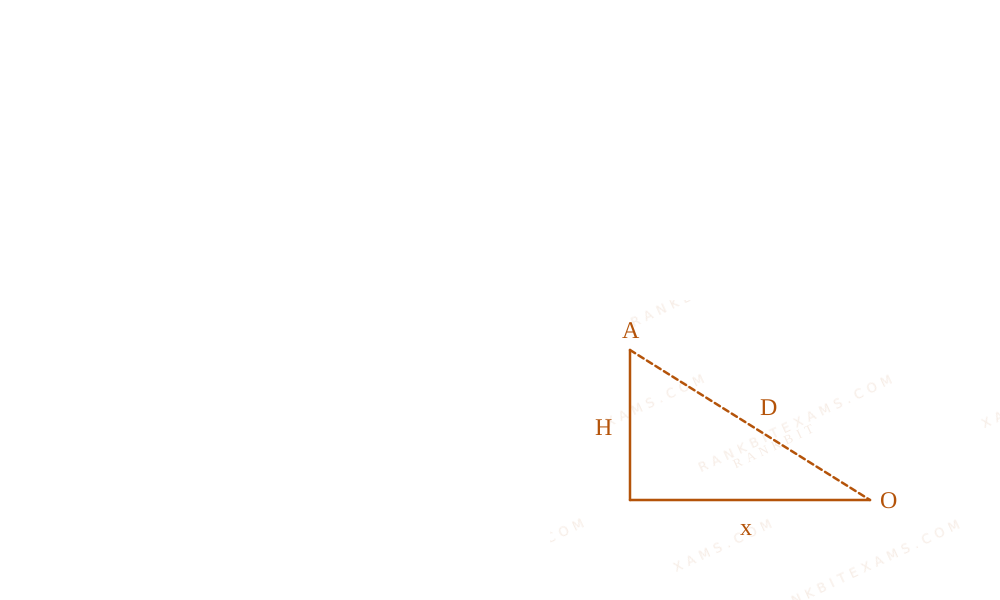
A helicopter flying horizontally with a speed of 360~km/h$360~km/h$ at an altitude of 2 km, drops an object at an instant. The object hits the ground at a point O, 20 s after it is dropped. Displacement of 'O' from the position of helicopter where the object was released is:
(use acceleration due to gravity g=10~m/s^2$g=10~m/s^{2}$ and neglect air resistance) [cite: 157, 158, 159, 160]
Keywords:#horizontal projection height mechanics#JEE Main 2025 Evening Q18#net displacement release point#velocity unit conversion horizontal
More Motion in a Plane Previous-Year Questions — Page 2
Qjee_main_2025_29_jan_morningRelative Motion
The maximum speed of a boat in still water is 27 \, textkm/h$27 \, \text{km/h}$ . Now this boat is moving downstream in a river flowing at 9 \, textkm/h$9 \, \text{km/h}$ . A man in the boat throws a ball vertically upwards with speed of 10 \, textm/s$10 \, \text{m/s}$ . Range of the ball as observed by an observer at rest on the river bank, is ________ cm. (Take g = 10 \, textm/s^2$g = 10 \, \text{m/s}^2$ )
Numerical Answer.Answer: 2000 to 2000
Solution
### Related Formula
T = frac2u_yg, quad R = v_x cdot T$$T = \frac{2u_y}{g}, \quad R = v_x \cdot T$$
### Core Logic
Relative range tracking frame vector
The total horizontal velocity components combine due to downstream motion addition
v_x = 27 + 9 = 36text km/h = 36 cdot frac518 = 10text m/s$$v_x = 27 + 9 = 36\text{ km/h} = 36 \cdot \frac{5}{18} = 10\text{ m/s}$$
The time of flight for the vertical launch tracking stands at :
T = frac2 cdot 1010 = 2text s$$T = \frac{2 \cdot 10}{10} = 2\text{ s}$$
Horizontal range measured along the river bank frame is :
Range = v_x cdot T = 10 cdot 2 = 20text m = 2000text cm$$Range = v_x \cdot T = 10 \cdot 2 = 20\text{ m} = 2000\text{ cm}$$
### Chapter Mix
Class 11 Physics: Motion in a Straight Line
Class 11 Physics: Motion in a Plane
A particle moving in a circle of radius R$R$ with uniform speed takes time T$T$ to complete one revolution. If this particle is projected with the same speed at an angle theta$\theta$ to the horizontal, the maximum height attained by it is equal to 4R$4R$. The angle of projection theta$\theta$ is then given by:
### Related Formula
The centripetal force (F$F$) acting on a particle of mass m$m$ moving with velocity v$v$ in a path of radius r$r$ is given by:
F = fracm v^2r$$F = \frac{m v^2}{r}$$
### Core Logic
Given that the two particles have the same mass (m_1 = m_2$m_1 = m_2$) and the ratio of their radii of curvature is:
fracr_1r_2 = frac34$$\frac{r_1}{r_2} = \frac{3}{4}$$
To maintain a constant (equal) centripetal force (F_1 = F_2$F_1 = F_2$):
### Step 1: Relate Velocity to Radius
fracm_1 v_1^2r_1 = fracm_2 v_2^2r_2$$\frac{m_1 v_1^2}{r_1} = \frac{m_2 v_2^2}{r_2}$$
Since m_1 = m_2$m_1 = m_2$, the equation simplifies to:
fracv_1^2r_1 = fracv_2^2r_2 implies fracv_1^2v_2^2 = fracr_1r_2$$\frac{v_1^2}{r_1} = \frac{v_2^2}{r_2} \implies \frac{v_1^2}{v_2^2} = \frac{r_1}{r_2}$$fracv_1v_2 = sqrtfracr_1r_2$$\frac{v_1}{v_2} = \sqrt{\frac{r_1}{r_2}}$$
### Step 2: Calculate the Ratio
Substituting the given ratio of radii:
fracv_1v_2 = sqrtfrac34 = fracsqrt32$$\frac{v_1}{v_2} = \sqrt{\frac{3}{4}} = \frac{\sqrt{3}}{2}$$
Therefore, the ratio of their velocities is sqrt3:2$\sqrt{3}:2$.
### Pattern Recognition
For problems involving steady values under constraint variations, establish the proportionality relation first. Here, F propto fracv^2r implies v propto sqrtr$F \propto \frac{v^2}{r} \implies v \propto \sqrt{r}$ when F$F$ and m$m$ are held constant.
### Evaluation Rubric / Model Answer
null
### Chapter Mix
Class 11 Physics: Motion in a Plane
Q52jee_main_2024_29_jan_morningProjectile Motion
A ball rolls off the top of a stairway with horizontal velocity u$u$. The steps are 0.1 mathrm~m$0.1 \mathrm{~m}$ high and 0.1 mathrm~m$0.1 \mathrm{~m}$ wide. The minimum velocity u$u$ with which that ball just hits the step 5 of the stairway will be sqrtx mathrm~ms^-1$\sqrt{x} \mathrm{~ms}^{-1}$ where x =$x =$ ________ [use g = 10 mathrm~m/s^2$g = 10 \mathrm{~m/s}^2$].
Numerical Answer.Answer: 2 to 2
Solution
### Related Formula
For a projectile fired horizontally from height h$h$ with speed u$u$:
textHorizontal Range R = u cdot t$$\text{Horizontal Range } R = u \cdot t$$textVertical Displacement h = frac12 g t^2$$\text{Vertical Displacement } h = \frac{1}{2} g t^2$$
### Core Logic
To just clear step 4 and land on the tread of step 5, the flight trajectory must pass beyond the outer corner boundary vertex of the 4^textth$4^{\text{th}}$ step.
Therefore, net horizontal distance required to cross 4 complete steps is:
R = 4 times 0.1 mathrm~m = 0.4 mathrm~m$$R = 4 \times 0.1 \mathrm{~m} = 0.4 \mathrm{~m}$$
Similarly, net vertical fall matching the top of the 4^textth$4^{\text{th}}$ step level is:
h = 4 times 0.1 mathrm~m = 0.4 mathrm~m$$h = 4 \times 0.1 \mathrm{~m} = 0.4 \mathrm{~m}$$Trajectory diagram of a ball clearing step corners on a staircase grid for Q52
### Step 1: Determine Time of Flight
Using the vertical kinematic equation:
0.4 = frac12 times 10 times t^2 implies 0.4 = 5 t^2$$0.4 = \frac{1}{2} \times 10 \times t^2 \implies 0.4 = 5 t^2$$t^2 = frac0.45 = 0.08 mathrm~s^2$$t^2 = \frac{0.4}{5} = 0.08 \mathrm{~s^2}$$
### Step 2: Determine Velocity
Using the horizontal path equation:
R = u cdot t implies R^2 = u^2 cdot t^2$$R = u \cdot t \implies R^2 = u^2 \cdot t^2$$
Substituting range and time values:
(0.4)^2 = u^2 times 0.08$$(0.4)^2 = u^2 \times 0.08$$0.16 = u^2 times 0.08$$0.16 = u^2 \times 0.08$$u^2 = frac0.160.08 = 2 implies u = sqrt2 mathrm~m/s$$u^2 = \frac{0.16}{0.08} = 2 \implies u = \sqrt{2} \mathrm{~m/s}$$
### Step 3: Extract x
Matching the parameter form u = sqrtx$u = \sqrt{x}$, we find:
x = 2$x = 2$
### Pattern Recognition
To clear the n$n$-th step, the projectile must safely pass the outer point of step (n-1)$(n-1)$. Treat the geometric coordinates of corners as bounding constraints (x = (n-1)w$x = (n-1)w$, y = (n-1)h$y = (n-1)h$) to configure kinematics instantaneously.
### Evaluation Rubric / Model Answer
null
### Chapter Mix
Class 11 Physics: Motion in a Plane
Q50jee_main_2024_30_january_eveningProjectile Motion from a Tower
Projectiles mathrmA$\mathrm{A}$ and mathrmB$\mathrm{B}$ are thrown at angles of 45^circ$45^{\circ}$ and 60^circ$60^{\circ}$ with vertical respectively from top of a 400 mathrm~m$400 \mathrm{~m}$ high tower. If their ranges and times of flight are same, the ratio of their speeds of projection mathrmv_A: mathrmv_B$\mathrm{v_A}: \mathrm{v_B}$ is:
A.1: sqrt3$1: \sqrt{3}$
B.sqrt2:1$\sqrt{2}:1$
C.1:2$1:2$
D.1:sqrt2$1:\sqrt{2}$
Solution
### Core Logic
Projectile Motion from a Tower diagram for Q50 - JEE Main 2024 Evening
For two projectiles launched from the same height to have the same time of flight (T$T$), their vertical components of velocity must be equal.
Since the angles given are with the *vertical*, the vertical components are v_A cos(45^circ)$v_A \cos(45^{\circ})$ and v_B cos(60^circ)$v_B \cos(60^{\circ})$.
If T_A = T_B$T_A = T_B$, then v_Ay = v_By$v_{Ay} = v_{By}$.
v_A cos(45^circ) = v_B cos(60^circ)$$v_A \cos(45^{\circ}) = v_B \cos(60^{\circ})$$v_A left(frac1sqrt2right) = v_B left(frac12right)$$v_A \left(\frac{1}{\sqrt{2}}\right) = v_B \left(\frac{1}{2}\right)$$fracv_Av_B = fracsqrt22 = frac1sqrt2$$\frac{v_A}{v_B} = \frac{\sqrt{2}}{2} = \frac{1}{\sqrt{2}}$$
### Step 1: Check Inconsistency
For the ranges to be the same while having the same time of flight, their horizontal components of velocity must also be equal: v_Ax = v_Bx$v_{Ax} = v_{Bx}$.
v_A sin(45^circ) = v_B sin(60^circ)$$v_A \sin(45^{\circ}) = v_B \sin(60^{\circ})$$v_A left(frac1sqrt2right) = v_B left(fracsqrt32right)$$v_A \left(\frac{1}{\sqrt{2}}\right) = v_B \left(\frac{\sqrt{3}}{2}\right)$$fracv_Av_B = sqrtfrac32$$\frac{v_A}{v_B} = \sqrt{\frac{3}{2}}$$
This yields a contradiction. It is impossible for both the ranges and the times of flight to be simultaneously equal for different angles of projection from a tower.
### Step 2: Conclusion
The question contains inconsistent data and is technically a Bonus question. However, if one arbitrarily equates only the time of flight (or if NTA intended a different scenario), the ratio fracv_Av_B = frac1sqrt2$\frac{v_A}{v_B} = \frac{1}{\sqrt{2}}$ matches option (4), which was the officially provided key before corrections.
### Pattern Recognition
Be wary of over-constrained physics problems. If a question specifies both range AND time of flight are identical for two different angles, check if the math yields a contradiction. NTA often accepts the result of one partial constraint.
### Evaluation Rubric / Model Answer
null
### Chapter Mix
Class 11 Physics: Motion in a Plane
More Motion in a Plane Questions — jee_main_2025_07_april_evening
We Map Every Repeating Question in Competitive Exams.
Say goodbye to generic mock test fatigue. RankBit uses smart analysis to group past exam questions into their foundational Repeating Question Types. Find chapter weightage, track repeating questions, and score higher with targeted practice.
Select Your Target Exam
Choose an exam track below to find formulas per chapter and patterns.
Syncing Exam Intelligence
Mapping formulas and patterns across all tracks…
PATH A — FULL LENGTH PRACTICE
Full Mock Test Hub
Simulate real NTA exam conditions with fully tracked mocks. Time yourself against past papers.
Practice past-year questions one chapter at a time. Pick an exam → subject → chapter and get every PYQ for that topic — pulled together from all past papers — with the chapter's key formulas alongside.
.svg)


