Rankbit System
JEE Physics: Waves (+15.5%) | Electrostatics: Concentric Shells (-29.7%) | Modern Physics: Photoelectric Clones (+34.2%) | Mathematics: Definite Integrals (+18.1%) | Chemistry: Coordination Splitting (-11.4%) | JEE Physics: Waves (+15.5%) | Electrostatics: Concentric Shells (-29.7%) | Modern Physics: Photoelectric Clones (+34.2%) | Mathematics: Definite Integrals (+18.1%) | Chemistry: Coordination Splitting (-11.4%)

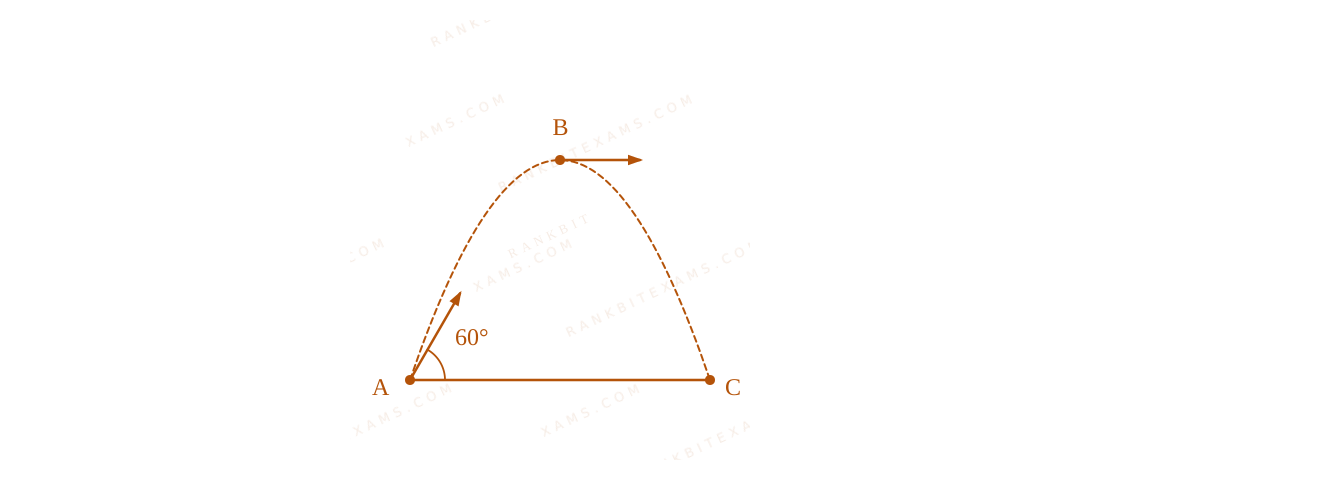
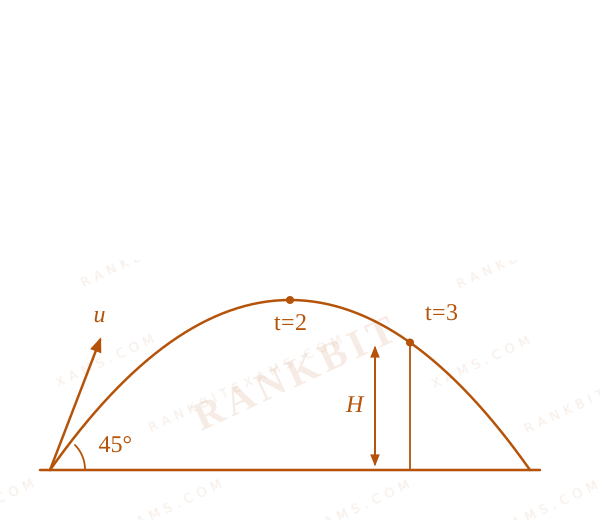
Two projectiles are fired with same initial speed from same point on ground at angles of (45^circ - alpha) and (45^circ + alpha) , respectively, with the horizontal direction. The ratio of their maximum heights attained is :

Solution & Explanation

### Related Formula H_max = fracu^2 sin^2 theta2g ### Core Logic Let theta_1 = 45^circ - alpha and theta_2 = 45^circ + alpha. The ratio of maximum heights is: fracH_1H_2 = fracsin^2(45^circ - alpha)sin^2(45^circ + alpha) ### Step 1: Simplify Trigonometric Terms sin(45^circ pm alpha) = frac1sqrt2cosalpha pm frac1sqrt2sinalpha fracH_1H_2 = frac(cosalpha - sinalpha)^2(cosalpha + sinalpha)^2 = fraccos^2alpha + sin^2alpha - 2sinalphacosalphacos^2alpha + sin^2alpha + 2sinalphacosalpha = frac1 - sin 2alpha1 + sin 2alpha [cite: 602, 603] ### Pattern Recognition For complementary angles shifted symmetric to 45^circ, ratios simplify cleanly via sin 2alpha identities[cite: 602, 603]. ### Chapter Mix Class 11 Physics: Motion in a Plane

Reference Study Guides

More Motion in a Plane Previous-Year Questions

Q11 2025 Projectile Motion
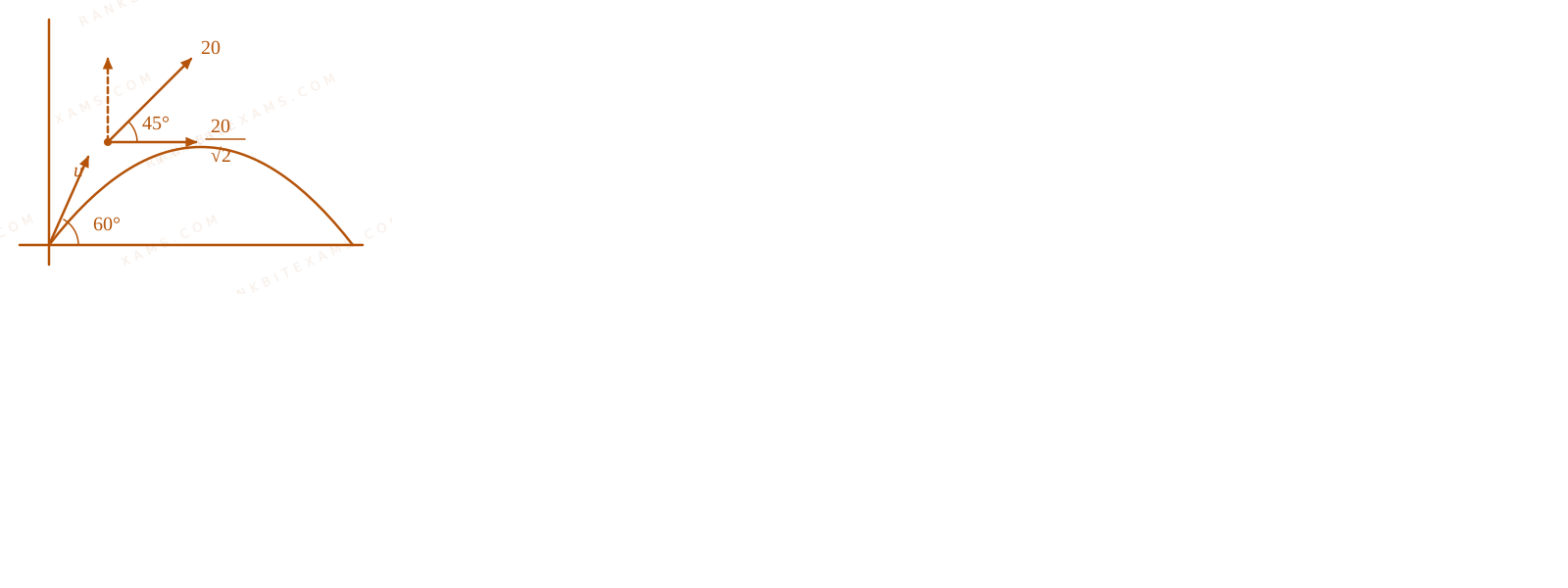
A particle is projected with velocity u so that its horizontal range is three times the maximum height attained by it. The horizontal range of the projectile is given as fracnu^225g , where value of n is: (Given ' g' is the acceleration due to gravity).
  • A. 6
  • B. 18
  • C. 12
  • D. 24

Solution

### Related Formula For a projectile with launch speed u and angle theta: - Horizontal Range: R = fracu^2 sin(2theta)g = frac2 u^2 sintheta costhetag - Maximum Height: H = fracu^2 sin^2theta2g The general ratio linking range and maximum height is: tantheta = frac4HR ### Core Logic Given state: R = 3H Rightarrow fracHR = frac13 ### Step 1: Determine the projection angle (theta) Substitute the ratio into the relation: tantheta = 4 left(fracHRright) = 4 left(frac13right) = frac43 This is a standard Pythagorean triangle angle: sintheta = frac45, quad costheta = frac35 ### Step 2: Compute the horizontal range (R) R = frac2 u^2 sintheta costhetag R = frac2 u^2 left(frac45right) left(frac35right)g = frac24 u^225 g Comparing this with the given format fracnu^225g: n = 24 ### Pattern Recognition The relation tantheta = 4H/R is an essential identity in projectile dynamics. Whenever R = k H, then tantheta = 4/k. Recognizing standard angles like tantheta = 4/3 or 3/4 directly yields trigonometric values immediately. ### Evaluation Rubric / Model Answer null ### Chapter Mix Class 11 Physics: Motion in a Plane
Q12 2025 Projectile Motion
Two projectiles are fired from ground with same initial speeds from same point at angles (45^circ + alpha) and (45^circ - alpha) with horizontal direction. The ratio of their times of flights is
  • A. 1
  • B. frac1 - tanalpha1 + tanalpha
  • C. frac1 + sin 2alpha1 - sin 2alpha
  • D. frac1 + tanalpha1 - tanalpha

Solution

### Related Formula The time of flight T of a projectile launched with speed u at an angle theta with the horizontal is: T = frac2u sinthetag ### Core Logic The launch angles of the two projectiles are: theta_1 = 45^circ + alpha theta_2 = 45^circ - alpha Since they have the same speed u: fracT_1T_2 = fracsin(45^circ + alpha)sin(45^circ - alpha) ### Step 1: Simplify Trigonometric Ratio Using the angle sum and difference formulas: fracT_1T_2 = fracsin 45^circ cos alpha + cos 45^circ sin alphasin 45^circ cos alpha - cos 45^circ sin alpha fracT_1T_2 = fracfrac1sqrt2cosalpha + frac1sqrt2sinalphafrac1sqrt2cosalpha - frac1sqrt2sinalpha = fraccosalpha + sinalphacosalpha - sinalpha Divide numerator and denominator by \cos\alpha: fracT_1T_2 = frac1 + tanalpha1 - tanalpha$ ### Pattern Recognition Sees: Projectile angles complementary to 45^\circ. Shortcut: Remember the identity \tan(45^\circ + \alpha) = \frac{1+\tan\alpha}{1-\tan\alpha}. Since complementary angles have sine ratios proportional to \sin(45^\circ + \alpha)/\sin(45^\circ - \alpha) = \tan(45^\circ + \alpha), the answer is directly \frac{1+\tan\alpha}{1-\tan\alpha}$. ### Evaluation Rubric / Model Answer null ### Chapter Mix Class 11 Physics: Motion in a Plane
Q18 2025 Projectile Motion
A helicopter flying horizontally with a speed of 360~km/h at an altitude of 2 km, drops an object at an instant. The object hits the ground at a point O, 20 s after it is dropped. Displacement of 'O' from the position of helicopter where the object was released is: (use acceleration due to gravity g=10~m/s^2 and neglect air resistance) [cite: 157, 158, 159, 160]
  • A. 2sqrt5~mathrmkm [cite: 161]
  • B. 4~mathrmkm [cite: 163]
  • C. 7.2~mathrmkm [cite: 162]
  • D. 2sqrt2~mathrmkm [cite: 163]

Solution

### Related Formula x = u cdot t [cite: 763] H = frac12gt^2 [cite: 764] D = sqrtx^2 + H^2 [cite: 774] ### Core Logic First, convert the horizontal velocity component to metric SI units: [cite: 157, 763] u = 360 times frac518 = 100\ textm/s [cite: 157, 763] Calculate the horizontal range distance x covered over t = 20\ texts: [cite: 158, 763] x = 100 times 20 = 2000\ textm = 2\ textkm [cite: 158, 763] The vertical displacement height H is explicitly given as 2\ textkm = 2000\ textm[cite: 157, 769]. Let's confirm with free-fall height calculation matching the solution template: [cite: 764] H = frac12 times 10 times (20)^2 = 5 times 400 = 2000\ textm = 2\ textkm [cite: 158, 769] Now find the net spatial vector displacement D from the release coordinates: [cite: 774] D = sqrtx^2 + H^2 = sqrt2^2 + 2^2 = sqrt8 = 2sqrt2\ textkm [cite: 774] ### Pattern Recognition Be careful with the wording: the question asks for the displacement from the *release coordinate position* [cite: 159], which is the hypotenuse vector sqrtx^2 + H^2[cite: 774]. Do not mistake it for the horizontal range distance alone. ### Evaluation Rubric / Model Answer null ### Chapter Mix Class 11 Physics: Motion in a Plane
Q8 2025 Velocity and Acceleration
The position vector of a moving body at any instant of time is given as vecmathrmr = (5mathrmt^2hatmathrmi - 5mathrmthatmathrmj)mathrmm. The magnitude and direction of velocity at t = 2s is,
  • A. 5sqrt15 m/s, making an angle of tan^-14 with -ve Y axis
  • B. 5sqrt15 m/s, making an angle of tan^-14 with +ve X axis
  • C. 5sqrt17 m/s, making an angle of tan^-14 with -ve Y axis
  • D. 5sqrt17 m/s, making an angle of tan^-14 with +ve X axis

Solution

### Related Formula vecv = fracdvecrdt ### Core Logic Given position vector: vecr = 5t^2hati - 5thatj Differentiating with respect to t: vecv = 10thati - 5hatj At t = 2\ mathrms: vecv = 20hati - 5hatj Magnitude of velocity: v = sqrt(20)^2 + (-5)^2 = sqrt400 + 25 = sqrt425 = 5sqrt17\ mathrmm/s Direction analysis:
Velocity vector components angle calculation Q8
v_x = 20 along +x axis, v_y = -5 along -y axis. Let theta be the angle made with the negative Y-axis: tan theta = left|fracv_xv_y ight| = frac205 = 4 implies theta = tan^-14 ### Pattern Recognition Always read the reference axis carefully in direction questions. Here, the angle is measured from the negative Y-axis, making tantheta = v_x / |v_y|. ### Evaluation Rubric / Model Answer null ### Chapter Mix Class 11 Physics: Motion in a Plane

More Motion in a Plane Questions — jee_main_2025_29_jan_morning

Practice all Motion in a Plane previous-year questions →

YOUR FIRST PREP STEP STARTS HERE

We Map Every Repeating Question in Competitive Exams.

Say goodbye to generic mock test fatigue. RankBit uses smart analysis to group past exam questions into their foundational Repeating Question Types. Find chapter weightage, track repeating questions, and score higher with targeted practice.

Select Your Target Exam

Choose an exam track below to find formulas per chapter and patterns.

Syncing Exam Intelligence

Mapping formulas and patterns across all tracks…

PATH A — FULL LENGTH PRACTICE

Full Mock Test Hub

Simulate real NTA exam conditions with fully tracked mocks. Time yourself against past papers.

Under Development
PATH B — TARGETED PRACTICE

Topic-wise Practice Hub

Practice past-year questions one chapter at a time. Pick an exam → subject → chapter and get every PYQ for that topic — pulled together from all past papers — with the chapter's key formulas alongside.

Loading Questions... Browse Topics
Latest from the Blog
View all →

Loading articles...