JEE Main · Physics ↓ Falling

Kinetic Theory of Gases appeared 26 times across 3 years — 3% of Physics. This question is from Kinetic Energy of Gas Molecules.

Year 2026 2025 2024 Total
Questions 6 11 9 26

The helium and argon are put in the flask at the same room temperature (300 K). The ratio of average kinetic energies (per molecule) of helium and argon is : (Give: Molar mass of helium = 4 g/mol, Molar mass of argon =40~g/mol) [cite: 74, 75, 76, 77]

Solution & Explanation

Related Formula

K.E. = (f)/(2) kB T [cite: 688]

Core Logic

The average kinetic energy per molecule depends only on the temperature T and the degrees of freedom f of the gas[cite: 75, 688]. Both Helium (He) and Argon (Ar) are monoatomic noble gases, meaning both share the same degrees of freedom (f = 3)[cite: 689]. Since they sit in the same flask at identical room temperature (T = 300 K), their translational kinetic energies per molecule are exactly equal [cite: 74, 688]:

K.E.HeK.E.Ar = (1)/(1) [cite: 688]

Pattern Recognition

Do not get distracted by the molar masses given in the question stem[cite: 76, 77]. Kinetic energy per molecule is purely temperature-dependent for an ideal gas, unlike the root-mean-square velocity (vrms) which explicitly includes molecular weight.

Chapter Mix

Class 11 Physics: Kinetic Theory of Gases

Reference Study Guides

More Kinetic Theory of Gases Previous-Year Questions — Page 3

Q jee_main_2025_28_jan_morning Rms Speed and Temperature
For a particular ideal gas which of the following graphs represents the variation of mean squared velocity of the gas molecules with temperature?
  • A.
  • B.
  • C. Graph (3)
  • D. Graph (4)

Solution

Related Formula
Vrms = 3RTM Vrms² = 3RMT
Core Logic

The parameter asked is the mean squared velocity, which corresponds directly to Vrms².

From the ideal gas kinematics relation, we observe:

Vrms² ∝ T

Comparing this format against standard geometric linear templates (y = mx), the curve must map as a clean straight line originating from absolute zero zero coordinates.

Step 1: Final Conclusion

This linear profile matches Graph (1), selecting option (1).

Pattern Recognition

Watch the vertical ordinate labels carefully: Root-mean-square velocity scales as a sub-linear curve (T), while mean squared metric trends linearly directly (y ∝ x).

Chapter Mix

Class 11 Physics: Kinetic Theory
Q8 jee_main_2025_04_april_evening Ideal Gas Equation
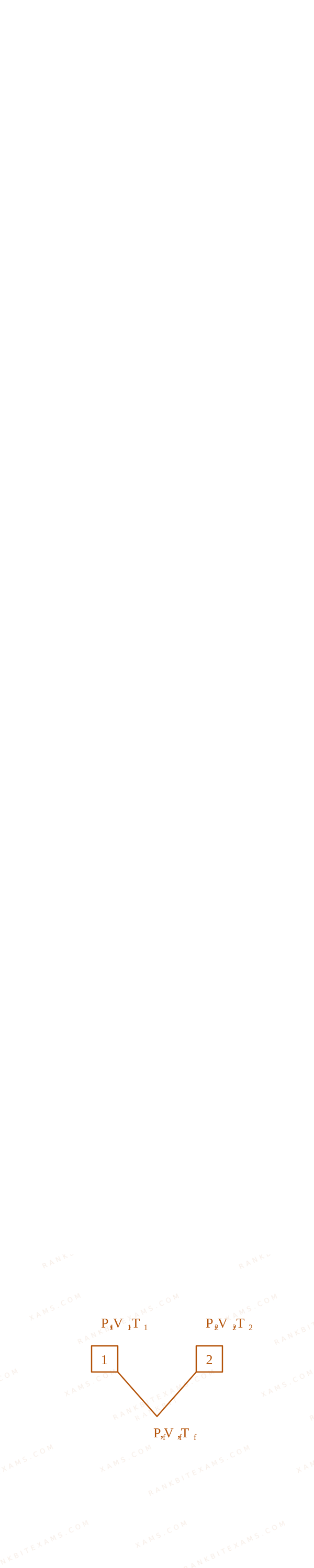
There are two vessels filled with an ideal gas where volume of one is double the volume of other. The large vessel contains the gas at 8 kPa at 1000 K while the smaller vessel contains the gas at 7 kPa at 500 K. If the vessels are connected to each other by a thin tube allowing the gas to flow and the temperature of both vessels is maintained at 600 K, at steady state the pressure in the vessels will be (in kPa).
  • A. 4.4
  • B. 6
  • C. 24
  • D. 18

Solution

Related Formula

Ideal Gas Law:

n = (PV)/(RT)

Conservation of moles: n₁ + n₂ = nf

Core Logic

Let the volume of the smaller vessel be V₁ = V, then the volume of the larger vessel is V₂ = 2V. Initial moles in large vessel:

n₂ = (8 × 2V)/(R × 1000) = (16V)/(1000R)

Initial moles in small vessel:

n₁ = (7 × V)/(R × 500) = (14V)/(1000R)

Total total initial moles:

ntotal = n₁ + n₂ = (30V)/(1000R)
Step 1: Connect Vessels to Dynamic Equilibrium

When connected, the total final volume is Vf = V + 2V = 3V. The final temperature is Tf = 600 K. Using mole conservation:

(30V)/(1000R) = (Pf (3V))/(R × 600) (30)/(1000) = (3Pf)/(600) (30)/(1000) = (Pf)/(200)

Pf = (30 × 200)/(1000) = 6 kPa

Dual vessel gas flow schema

Pattern Recognition

Connecting chambers preserves the net mass/moles (Σ nᵢ = constant). Keep everything relative to a common volume multiplier V to easily cancel terms.

Chapter Mix

Class 11 Physics: Kinetic Theory

Q1 jee_main_2025_04_april_morning Mean Free Path and Collision Frequency
The mean free path and the average speed of oxygen molecules at 300~K and 1~atm are 3 × 10⁻⁷~m and 600~m/s, respectively. Find the frequency of its collisions.
  • A. 2 × 10¹⁰/s
  • B. 9 × 10⁵/s
  • C. 2 × 10⁹/s
  • D. 5 × 10⁸/s

Solution

Related Formula
f = (1)/(T) = vavgλ

where:

  • f = frequency of collisions
  • vavg = average speed of the molecules
  • λ = mean free path
Core Logic

Given parameters:

  • Average speed, vavg = 600~m/s
  • Mean free path, λ = 3 × 10⁻⁷~m
Step 1: Calculate Frequency

Substitute the values into the formula:

f = 6003 × 10⁻⁷ = 2 × 10⁹~s⁻¹

Hence, the collision frequency is 2 × 10⁹/s.

Pattern Recognition

Collision frequency is simply distance covered per unit time (average velocity) divided by the average distance between consecutive collisions (mean free path).

Chapter Mix

Class 11 Physics: Kinetic Theory

Q4 jee_main_2025_28_jan_evening RMS Velocity
The ratio of vapour densities of two gases at the same temperature is (4)/(25) , then the ratio of r.m.s. velocities will be: [cite: 59-61]
  • A. (25)/(4)
  • B. (2)/(5)
  • C. (5)/(2)
  • D. (4)/(25)

Solution

Related Formula

The root-mean-square (r.m.s.) velocity of gas molecules is given by:

vrms = √((3RT)/(M))

Since molecular weight M is directly proportional to the vapour density (ρ), the r.m.s. velocity is inversely proportional to the square root of its vapour density:

vrms1vrms2 = √((ρ₂)/(ρ₁))
Core Logic

Given the ratio of vapour densities :

(ρ₁)/(ρ₂) = (4)/(25)

Therefore, the ratio of their r.m.s. velocities is:

vrms1vrms2 = √((25)/(4)) = (5)/(2)
Pattern Recognition

R.M.S. velocity changes inversely with the square root of mass or density. Whenever a density ratio is given, simply invert the fraction and take the square root to immediately find the velocity ratio.

Chapter Mix

Class 11 Physics: Kinetic Theory of Gases

More Kinetic Theory of Gases Questions — jee_main_2025_07_april_evening

Practice all Kinetic Theory of Gases previous-year questions →

Rankbit System
JEE Physics: Waves (+15.5%) | Electrostatics: Concentric Shells (-29.7%) | Modern Physics: Photoelectric Clones (+34.2%) | Mathematics: Definite Integrals (+18.1%) | Chemistry: Coordination Splitting (-11.4%) | JEE Physics: Waves (+15.5%) | Electrostatics: Concentric Shells (-29.7%) | Modern Physics: Photoelectric Clones (+34.2%) | Mathematics: Definite Integrals (+18.1%) | Chemistry: Coordination Splitting (-11.4%)