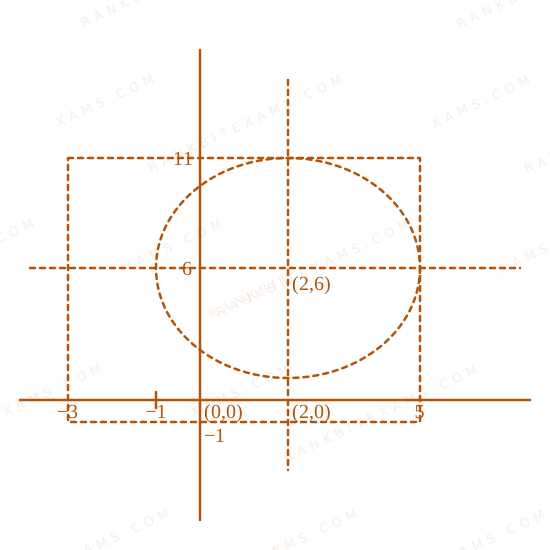
Let A = \(alpha ,beta)in mathbfRtimes mathbfR:|alpha -1|leq 4 text and |beta -5|leq 6\ and B = \(alpha , beta) in mathbfR times mathbfR: 16 (alpha - 2)^2 + 9 (beta - 6)^2 leq 144\. Then

Solution & Explanation

### Related Formula An ellipse equation is structured as: frac(x-h)^2a^2 + frac(y-k)^2b^2 leq 1 ### Core Logic Analyzing set A: |alpha - 1| le 4 implies -4 le alpha - 1 le 4 implies -3 le alpha le 5 |beta - 5| le 6 implies -6 le beta - 5 le 6 implies -1 le beta le 11 Thus, region A forms a rectangle bounded between x in [-3, 5] and y in [-1, 11]. Analyzing set B: 16(alpha - 2)^2 + 9(beta - 6)^2 le 144 Dividing by 144: frac(alpha - 2)^29 + frac(beta - 6)^216 le 1 This represents the interior and boundary of an ellipse centered at (2, 6) with semi-minor axis a = 3 and semi-major axis b = 4. ### Step 1: Spatial Inclusion Check Let's check the extreme horizontal and vertical extents of the ellipse B: Horizontal extent: x in [2 - 3, 2 + 3] = [-1, 5] Vertical extent: y in [6 - 4, 6 + 4] = [2, 10] Comparing with the boundaries of rectangle A (x in [-3, 5] and y in [-1, 11]): [-1, 5] subseteq [-3, 5] [2, 10] subseteq [-1, 11]
Set Inclusion and Regions diagram for Q53 - JEE Main 2025 Evening
Since all points of the ellipse lie perfectly inside the rectangular region, we conclusively find that B subset A. ### Pattern Recognition A bounding box check (finding h pm a and k pm b) for conics is the fastest analytical shortcut to verify set inclusion without plotting extensive coordinates. ### Evaluation Rubric / Model Answer null ### Chapter Mix Class 11 Mathematics: Sets, Relations and Functions Class 11 Mathematics: Conic Sections

Reference Study Guides

More Sets, Relations and Functions Previous-Year Questions — Page 10

Q6 jee_main_2024_31_jan_morning Composition of Functions
If f(x) = frac4x + 36x - 4, x neq frac23 and (fof)(x) = g(x), where g : mathbbR - left\frac23right\ to mathbbR - left\frac23right\, then (gogog)(4) is equal to
  • A. -frac1920
  • B. frac1920
  • C. -4
  • D. 4

Solution

### Core Logic f(x) = frac4x + 36x - 4 Compute g(x) = f(f(x)): g(x) = frac4left(frac4x + 36x - 4right) + 36left(frac4x + 36x - 4right) - 4 = frac16x + 12 + 18x - 1224x + 18 - 24x + 16 = frac34x34 = x ### Step 1: Composition Evaluation Since g(x) = x, g is the identity function. (gogog)(4) = g(g(g(4))) = 4 ### Evaluation Rubric / Model Answer null ### Chapter Mix Class 12 Maths: Relations and Functions

Q29 jee_main_2024_31_jan_morning Equivalence Relations
Let A = \1, 2, 3, 4\ and R = \(1, 2), (2, 3), (1, 4)\ be a relation on A. Let S be the equivalence relation on A such that R subset S and the number of elements in S is n. Then, the minimum value of n is
Numerical Answer. Answer: 16 to 16

Solution

### Core Logic S must be reflexive, symmetric, and transitive, containing (1,2), (2,3), and (1,4). Symmetric property forces (2,1), (3,2), (4,1) in S. Transitive property: (1,2) and (2,3) implies (1,3) in S. Symmetric implies (3,1) in S. (4,1) and (1,2) implies (4,2) in S. Symmetric implies (2,4) in S. (4,1) and (1,3) implies (4,3) in S. Symmetric implies (3,4) in S. ### Step 1: Universal Relation Since 1 is related to 2, 3, 4 and the relation is an equivalence relation (which creates partitions), all elements 1, 2, 3, and 4 must fall into the same single equivalence class. Thus, S must contain all possible ordered pairs in A times A. ### Step 2: Final Count Number of elements in A times A = 4 times 4 = 16. Minimum value of n is 16. ### Pattern Recognition If a relation connects all elements in a set to each other through a chain, its equivalence closure is the universal relation A times A. ### Evaluation Rubric / Model Answer null ### Chapter Mix Class 12 Maths: Relations and Functions

More Sets, Relations and Functions Questions — jee_main_2025_07_april_evening

Practice all Sets, Relations and Functions previous-year questions →

Rankbit System
JEE Physics: Waves (+15.5%) | Electrostatics: Concentric Shells (-29.7%) | Modern Physics: Photoelectric Clones (+34.2%) | Mathematics: Definite Integrals (+18.1%) | Chemistry: Coordination Splitting (-11.4%) | JEE Physics: Waves (+15.5%) | Electrostatics: Concentric Shells (-29.7%) | Modern Physics: Photoelectric Clones (+34.2%) | Mathematics: Definite Integrals (+18.1%) | Chemistry: Coordination Splitting (-11.4%)