Rankbit System
JEE Physics: Waves (+15.5%) | Electrostatics: Concentric Shells (-29.7%) | Modern Physics: Photoelectric Clones (+34.2%) | Mathematics: Definite Integrals (+18.1%) | Chemistry: Coordination Splitting (-11.4%) | JEE Physics: Waves (+15.5%) | Electrostatics: Concentric Shells (-29.7%) | Modern Physics: Photoelectric Clones (+34.2%) | Mathematics: Definite Integrals (+18.1%) | Chemistry: Coordination Splitting (-11.4%)

Let f, g: (1, infty) to mathbbR be defined as f(x) = frac2x + 35x + 2 and g(x) = frac2 - 3x1 - x. If the range of the function f(g(x)) on the interval [2, 4] is [alpha, beta], then frac1beta - alpha is equal to

Solution & Explanation

### Related Formula For a composite function f(g(x)): f(g(x)) = frac2g(x) + 35g(x) + 2 ### Core Logic Substitute g(x) = frac2 - 3x1 - x into f(x): f(g(x)) = frac2left(frac2 - 3x1 - xright) + 35left(frac2 - 3x1 - xright) + 2 = frac4 - 6x + 3 - 3x10 - 15x + 2 - 2x = frac7 - 9x12 - 17x For the domain interval [2, 4], calculate the boundary values since the function is monotonic: f(g(2)) = frac7 - 9(2)12 - 17(2) = frac-11-22 = frac12 f(g(4)) = frac7 - 9(4)12 - 17(4) = frac-29-56 = frac2956 Thus, the range [alpha, beta] = left[frac12, frac2956right]. ### Step 1: Calculate the Difference beta - alpha = frac2956 - frac12 = frac29 - 2856 = frac156 frac1beta - alpha = 56 ### Pattern Recognition When dealing with composite functions of linear fractions, simplify algebraically first. If the resulting function has no vertical asymptote in the specified interval, it is monotonic, and the extreme values occur exactly at the endpoints. ### Evaluation Rubric / Model Answer null ### Chapter Mix Class 11 Mathematics: Sets, Relations and Functions Class 12 Mathematics: Relations and Functions

Reference Study Guides

More Sets, Relations and Functions Previous-Year Questions

Q52 2025 Number of Functions
Consider the sets: A = \(x,y) in mathbbR times mathbbR : x^2 + y^2 = 25\ B = left\(x,y) in mathbbR times mathbbR : fracx^2144 + fracy^216 = 1right\ C = \(x,y) in mathbbZ times mathbbZ : x^2 + y^2 le 4\ and D = A cap B. The total number of one-one functions from the set D to the set C is:
  • A. 15120
  • B. 19320
  • C. 17160
  • D. 18290

Solution

### Related Formula The number of one-one (injective) functions from a set D with n(D) elements to a set C with n(C) elements is given by: ^n(C)mathrmP_n(D) = fracn(C)!(n(C) - n(D))! ### Core Logic Step 1: Find the number of elements in set D = A cap B. Solving the equations of circle A and ellipse B simultaneously: From A, y^2 = 25 - x^2. Substitute this into B: x^2 + 9(25 - x^2) = 144 implies -8x^2 = 144 - 225 = -81 implies x = pmfrac92sqrt2 Correspondingly, y = pmfracsqrt1192sqrt2. Thus, there are exactly 4 distinct intersection points, so n(D) = 4.
Number of Functions diagram for Q52 - JEE Main 2025 Morning
### Step 1: Count elements in Set C Set C consists of integral lattice points (x,y) inside or on the circle x^2 + y^2 le 4: Possible integer pairs are: (0,0), (pm1,0), (0,pm1), (pm2,0), (0,pm2), (pm1,pm1). Counting them yields n(C) = 13 elements. ### Step 2: Calculate Injective Functions The total number of one-one functions from D to C is: ^13mathrmP_4 = 13 times 12 times 11 times 10 = 17160 ### Pattern Recognition The intersection of a concentric circle and ellipse always yields 4 points if they cross completely. Break down the problem by counting the cardinality of domain and codomain independently before applying permutation formulas. ### Evaluation Rubric / Model Answer null ### Chapter Mix Class 11 Mathematics: Conic Sections Class 12 Mathematics: Relations and Functions
Q60 2025 Functional Equations and Series
Let f: mathbbR to mathbbR be a continuous function satisfying f(0) = 1 and f(2x) - f(x) = x for all x in mathbbR. If lim_n to infty left\ f(x) - fleft(fracx2^nright) right\ = G(x), then sum_r=1^10 G(r^2) is equal to
  • A. 540
  • B. 385
  • C. 420
  • D. 215

Solution

### Related Formula Sum of first n squares: sum_r=1^n r^2 = fracn(n+1)(2n+1)6 ### Core Logic From functional relation f(x) - fleft(fracx2right) = fracx2. Write a telescoping sequence by scaling variable down: fleft(fracx2right) - fleft(fracx4right) = fracx4 fleft(fracx4right) - fleft(fracx8right) = fracx8 dots fleft(fracx2^n-1right) - fleft(fracx2^nright) = fracx2^n ### Step 1: Evaluate the Limit Definition Summing all equations creates a telescoping sum on the left side: f(x) - fleft(fracx2^nright) = xleft(frac12 + frac14 + dots + frac12^nright) = xleft(1 - frac12^nright) Taking the limit as n to infty: G(x) = lim_n to infty xleft(1 - frac12^nright) = x ### Step 2: Final Sum Evaluation We need to compute sum_r=1^10 G(r^2) = sum_r=1^10 r^2: sum_r=1^10 r^2 = frac10 times 11 times 216 = 385 ### Pattern Recognition Linear iterative arguments of type f(2x)-f(x)=x naturally condense into geometric progression properties via geometric series limits. Always look for telescoping patterns in infinite limits of difference terms. ### Evaluation Rubric / Model Answer null ### Chapter Mix Class 11 Mathematics: Sequence and Series Class 12 Mathematics: Relations and Functions
Q53 2025 Set Inclusion and Regions
Let A = \(alpha ,beta)in mathbfRtimes mathbfR:|alpha -1|leq 4 text and |beta -5|leq 6\ and B = \(alpha , beta) in mathbfR times mathbfR: 16 (alpha - 2)^2 + 9 (beta - 6)^2 leq 144\. Then
  • A. B subset A
  • B. A cup B = \(x, y) : -4 leq x leq 4, -1 leq y leq 11\
  • C. neither A subset B nor B subset A
  • D. A subset B

Solution

### Related Formula An ellipse equation is structured as: frac(x-h)^2a^2 + frac(y-k)^2b^2 leq 1 ### Core Logic Analyzing set A: |alpha - 1| le 4 implies -4 le alpha - 1 le 4 implies -3 le alpha le 5 |beta - 5| le 6 implies -6 le beta - 5 le 6 implies -1 le beta le 11 Thus, region A forms a rectangle bounded between x in [-3, 5] and y in [-1, 11]. Analyzing set B: 16(alpha - 2)^2 + 9(beta - 6)^2 le 144 Dividing by 144: frac(alpha - 2)^29 + frac(beta - 6)^216 le 1 This represents the interior and boundary of an ellipse centered at (2, 6) with semi-minor axis a = 3 and semi-major axis b = 4. ### Step 1: Spatial Inclusion Check Let's check the extreme horizontal and vertical extents of the ellipse B: Horizontal extent: x in [2 - 3, 2 + 3] = [-1, 5] Vertical extent: y in [6 - 4, 6 + 4] = [2, 10] Comparing with the boundaries of rectangle A (x in [-3, 5] and y in [-1, 11]): [-1, 5] subseteq [-3, 5] [2, 10] subseteq [-1, 11]
Set Inclusion and Regions diagram for Q53 - JEE Main 2025 Evening
Since all points of the ellipse lie perfectly inside the rectangular region, we conclusively find that B subset A. ### Pattern Recognition A bounding box check (finding h pm a and k pm b) for conics is the fastest analytical shortcut to verify set inclusion without plotting extensive coordinates. ### Evaluation Rubric / Model Answer null ### Chapter Mix Class 11 Mathematics: Sets, Relations and Functions Class 11 Mathematics: Conic Sections
Q54 2025 Range of Rational Functions
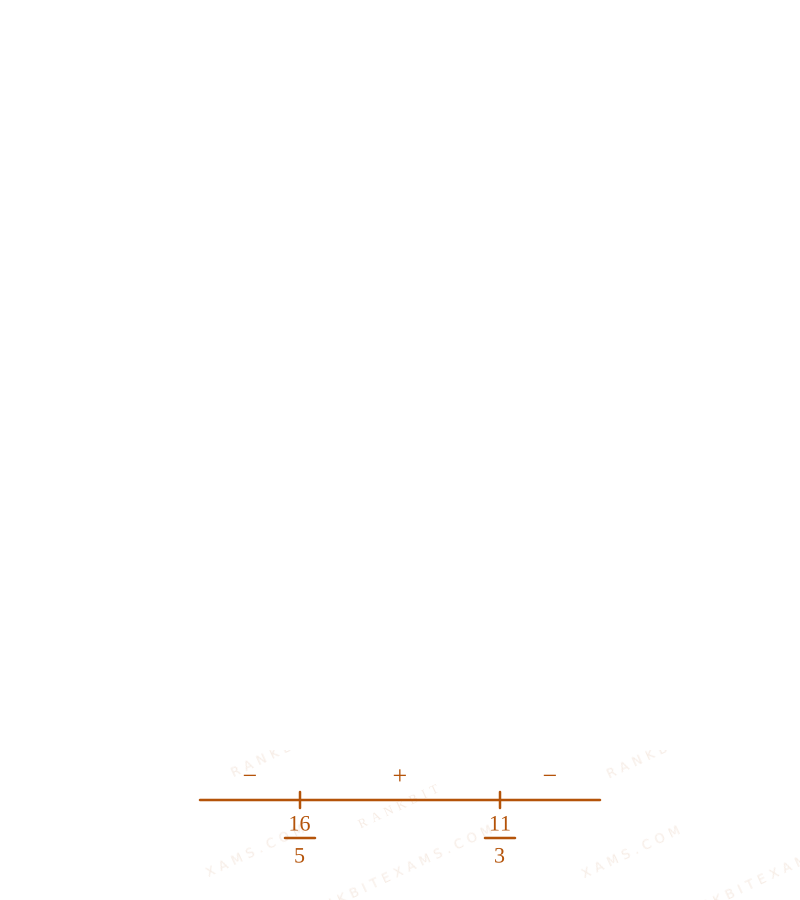
If the range of the function f(x) = frac5 - xx^2 - 3x + 2, x neq 1, 2, is (-infty , alpha ] cup [ beta , infty), then alpha^2 +beta^2 is equal to :
  • A. 190
  • B. 192
  • C. 188
  • D. 194

Solution

### Related Formula For a quadratic equation Ax^2 + Bx + C = 0 to yield real roots, its discriminant must satisfy: D = B^2 - 4AC ge 0 ### Core Logic Set y = frac5 - xx^2 - 3x + 2: y(x^2 - 3x + 2) = 5 - x yx^2 - 3xy + 2y + x - 5 = 0 Rearranging into a standard quadratic equation in terms of x: yx^2 + (1 - 3y)x + (2y - 5) = 0 ### Step 1: Discriminant Method Case I: If y = 0, the equation simplifies to x - 5 = 0 implies x = 5, which is a valid part of the domain. Thus, 0 belongs to the range. Case II: If y neq 0, for x to be real, D ge 0: (1 - 3y)^2 - 4(y)(2y - 5) ge 0 9y^2 + 1 - 6y - 8y^2 + 20y ge 0 y^2 + 14y + 1 ge 0 ### Step 2: Solving the Inequality Completing the square for y^2 + 14y + 1 ge 0: (y + 7)^2 - 48 ge 0 implies (y + 7)^2 ge (4sqrt3)^2 This gives: y le -7 - 4sqrt3 quad textor quad y ge -7 + 4sqrt3 Comparing with the interval (-infty , alpha ] cup [ beta , infty): alpha = -7 - 4sqrt3 beta = -7 + 4sqrt3 ### Step 3: Finding alpha^2 + beta^2 Using algebraic identities: alpha^2 + beta^2 = (-7 - 4sqrt3)^2 + (-7 + 4sqrt3)^2 = 2(7^2 + (4sqrt3)^2) = 2(49 + 48) = 2(97) = 194 ### Pattern Recognition For rational expressions of the form fractextLineartextQuadratic, converting to a quadratic in x and forcing D ge 0 establishes the range boundaries elegantly. ### Evaluation Rubric / Model Answer null ### Chapter Mix Class 11 Mathematics: Sets, Relations and Functions

More Sets, Relations and Functions Questions — jee_main_2025_04_april_morning

Practice all Sets, Relations and Functions previous-year questions →

YOUR FIRST PREP STEP STARTS HERE

We Map Every Repeating Question in Competitive Exams.

Say goodbye to generic mock test fatigue. RankBit uses smart analysis to group past exam questions into their foundational Repeating Question Types. Find chapter weightage, track repeating questions, and score higher with targeted practice.

Select Your Target Exam

Choose an exam track below to find formulas per chapter and patterns.

Syncing Exam Intelligence

Mapping formulas and patterns across all tracks…

PATH A — FULL LENGTH PRACTICE

Full Mock Test Hub

Simulate real NTA exam conditions with fully tracked mocks. Time yourself against past papers.

Under Development
PATH B — TARGETED PRACTICE

Topic-wise Practice Hub

Practice past-year questions one chapter at a time. Pick an exam → subject → chapter and get every PYQ for that topic — pulled together from all past papers — with the chapter's key formulas alongside.

Loading Questions... Browse Topics
Latest from the Blog
View all →

Loading articles...