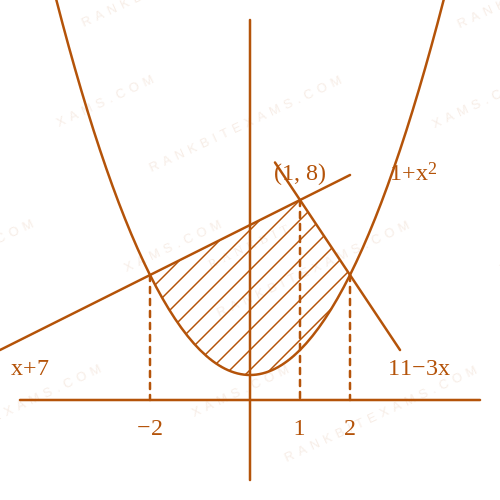
We need to find the intersection points of the curves to understand the x+7, 11-3x$\min\{x+7, 11-3x\}$ boundary transition:
x+7 = 11-3x 4x = 4 x = 1$x+7 = 11-3x \implies 4x = 4 \implies x = 1$.
Hence, the line switches behavior at x=1$x=1$.
Intersecting 1+x²$1+x^2$ with x+7$x+7$:
x² - x - 6 = 0 (x-3)(x+2) = 0 x = -2 or x = 3$$x^2 - x - 6 = 0 \implies (x-3)(x+2) = 0 \implies x = -2 \quad \text{or} \quad x = 3$$
Intersecting 1+x²$1+x^2$ with 11-3x$11-3x$:
x² + 3x - 10 = 0 (x+5)(x-2) = 0 x = 2 or x = -5$$x^2 + 3x - 10 = 0 \implies (x+5)(x-2) = 0 \implies x = 2 \quad \text{or} \quad x = -5$$
Area Under Curves diagram for Q57 - JEE Main 2025 Evening
Step 1: Set up Integrals
The transition points show that from x = -2$x = -2$ to 1$1$, the upper line is x+7$x+7$, and from x = 1$x = 1$ to 2$2$, the upper line is 11-3x$11-3x$.
When a boundary contains a $\min\{\}$ or $\max\{\}$ component, always solve for their internal intersection first to identify the exact splitting point of your definite integrals.
Keywords:#area of region minimum curve integral#JEE Main 2025 Evening Q57#Integral Calculus JEE Main 2025#Area Under Curves JEE Main 2025
More Integral Calculus Previous-Year Questions — Page 5
Q71jee_main_2025_02_april_morningDefinite Integration with GIF
Let [·]$[\cdot]$ denote the greatest integer function. If ∫₀^e³[ 1ex - 1]dx = α - ₑ2$\int_{0}^{e^{3}}\left[\frac{1}{e^{x - 1}}\right]\mathrm{d}x = \alpha -\log_{e}2$, then α³$\alpha^3$ is equal to ________.
Numerical Answer.Answer: 8 to 8
Solution
Related Formula
Greatest Integer Function boundaries:
[f(x)] = k for k ≤ f(x) < k+1, k in Z$$[f(x)] = k \quad \text{for} \quad k \le f(x) < k+1, \ k \in \mathbb{Z}$$
Core Logic
Analyze the value variations of f(x) = e1-x$f(x) = e^{1-x}$ across the integration limits [0, e³]$[0, e^3]$ to break down the integral into distinct piecewise continuous intervals.
Step 1: Determine Step Function Transition Points
Let y = e1-x$y = e^{1-x}$.
At x = 0 y = e¹ ≈ 2.718$x = 0 \implies y = e^1 \approx 2.718$
As x$x$ increases, e1-x$e^{1-x}$ decreases monotonically.
Find x$x$ where y = 2 e1-x = 2 1-x = ln 2 x = 1 - ln 2$y = 2 \implies e^{1-x} = 2 \implies 1-x = \ln 2 \implies x = 1 - \ln 2$.
Find x$x$ where y = 1 e1-x = 1 1-x = 0 x = 1$y = 1 \implies e^{1-x} = 1 \implies 1-x = 0 \implies x = 1$.
At the final boundary x = e³ y = e1-e³$x = e^3 \implies y = e^{1-e^3}$, which is a very small positive decimal strictly inside (0,1)$(0,1)$.
Step 2: Split the Definite Integral
Rewrite the integral based on the isolated interval blocks:
Always map the function values at the extreme boundary points first. Tracking the downward path from 2.71 arrow 2 arrow 1 arrow 0$2.71 \rightarrow 2 \rightarrow 1 \rightarrow 0$ reveals exactly where the integer thresholds are crossed.
The presence of a linear x$x$ factor in the numerator of a definite integral with symmetric trigonometric bounds is almost always eliminated using the a+b-x$a+b-x$ property. This reduces the integral to a standard substitution problem.
Chapter Mix
Class 12 Mathematics: Integrals

Q60jee_main_2025_07_april_morningProperties of Definite Integrals
The integral ∫₀^π ((x + 3) x)/(1 + 3 ²x) dx$\int_0^\pi \frac{(x + 3)\sin x}{1 + 3\cos^2x} dx$ is equal to:
Let t = √(3) x$t = \sqrt{3}\cos x$. Then dt = -√(3) x dx x dx = - dt√(3)$dt = -\sqrt{3}\sin x dx \implies \sin x dx = -\frac{dt}{\sqrt{3}}$.
Change in integration boundaries:
Whenever you encounter a linear x$x$ factor multiplying trigonometric components in a definite integral with symmetric limits like 0$0$ to π$\pi$, executing King's property first is almost guaranteed to cleanly wipe out that variable element.
Chapter Mix
Class 12 Mathematics: Definite Integrals
Q58jee_main_2025_08_april_eveningProperties of Definite Integrals
Let f(x)$f(x)$ be a a positive function and I₁ = ∫-(1)/(2)¹ 2xf(2x(1 - 2x)) dx$I_1 = \int_{-\frac{1}{2}}^{1} 2xf(2x(1 - 2x)) \, dx$ and I₂ = ∫₋₁² f(x(1 - x)) dx$I_2 = \int_{-1}^{2} f(x(1 - x)) \, dx$. Then the value of (I₂)/(I₁)$\frac{I_2}{I_1}$ is equal to
Perform variable substitution to match the arguments and limit bounds across both separate integral functions before invoking King's property.
Step 1: Perform Base Transformation Substitution
In I₁$I_1$, let 2x = t 2dx = dt$2x = t \implies 2dx = dt$.
Limits mapping: x = -1/2 t = -1$x = -1/2 \implies t = -1$; x = 1 t = 2$x = 1 \implies t = 2$.
I₁ = (1)/(2) ∫₋₁² t f(t(1-t)) dt 2I₁ = ∫₋₁² t f(t(1-t)) dt$$I_1 = \frac{1}{2} \int_{-1}^{2} t f(t(1-t)) \, dt \implies 2I_1 = \int_{-1}^{2} t f(t(1-t)) \, dt$$
Step 2: Invoke Integral Mirror Properties
Apply the identity using parameters (a+b-t) = (1-t)$(a+b-t) = (1-t)$:
Symmetric transformations highlighting factor expressions like x(1-x)$x(1-x)$ coupled with an external linear multiplier term x$x$ naturally simplify to half-weight area forms using reflection rules.
Chapter Mix
Class 12 Mathematics: Definite Integrals
Q61jee_main_2025_08_april_eveningIntegration of Absolute Value Functions
The integral ∫₋₁(3)/(2)(|π²x (π x)|) dx$\int_{-1}^{\frac{3}{2}}\left(\left|\pi^{2}\mathrm{x}\sin (\pi \mathrm{x})\right|\right) dx$ is equal to :
Products of two odd tracking metrics (like linear variable x$x$ matched with sinusoidal waves) yield overall even systems, enabling rapid evaluation over center-aligned domains.
Chapter Mix
Class 12 Mathematics: Definite Integrals
More Integral Calculus Questions — jee_main_2025_07_april_evening
Practice past-year questions one chapter at a time. Pick an exam → subject → chapter and get every PYQ for that topic — pulled together from all past papers — with the chapter's key formulas alongside.