The descending order of basicity of following amines is:
(A) Aniline
(B) p-Methoxyaniline
(C) p-Nitroaniline
(D) textCH_3textNH_2$\text{CH}_3\text{NH}_2$
(E) (textCH_3)_2textNH$(\text{CH}_3)_2\text{NH}$
Choose the correct answer from the options given below:
The images show structural configurations of the aromatic amines: aniline, p-methoxyaniline, and p-nitroaniline.The images show structural configurations of the aromatic amines: aniline, p-methoxyaniline, and p-nitroaniline.The images show structural configurations of the aromatic amines: aniline, p-methoxyaniline, and p-nitroaniline.
### Related Formula
textBasicity propto textAvailability of lone pair of electrons on Nitrogen atom$$\text{Basicity} \propto \text{Availability of lone pair of electrons on Nitrogen atom}$$textBasicity propto +textI, +textM groups quad textBasicity propto frac1-textI, -textM groups$$\text{Basicity} \propto +\text{I}, +\text{M groups} \quad \text{Basicity} \propto \frac{1}{-\text{I}, -\text{M groups}}$$
### Core Logic
1. Aliphatic amines vs Aromatic amines: In aromatic amines (A, B, C), the lone pair on nitrogen is delocalized into the benzene ring via resonance, decreasing basicity compared to aliphatic amines (D, E) where electron pairs are localized.
2. Among aliphatic amines (aqueous standard configurations implicit): Secondary amine (textCH_3)_2textNH$(\text{CH}_3)_2\text{NH}$ is a stronger base than primary textCH_3textNH_2$\text{CH}_3\text{NH}_2$ due to combined inductive effect (+textI$+\text{I}$) and solvation fields. Hence, textE > textD$\text{E} > \text{D}$.
3. Among substituted aromatic amines:
- **(B) p-Methoxyaniline**: -textOCH_3$-\text{OCH}_3$ exerts a strong electron-donating resonance effect (+textM$+\text{M}$), maximizing ring density and electronic availability on N.
- **(A) Aniline**: Baseline reference value with no extra substitutions.
- **(C) p-Nitroaniline**: -textNO_2$-\text{NO}_2$ acts as an intensive electron-withdrawing field (-textM, -textI$-\text{M}, -\text{I}$), pulling electron clouds heavily and quenching basicity.
### Step 1: Consolidating Rankings
Combining both structural domains cleanly provides:
textE > textD > textB > textA > textC $$\text{E} > \text{D} > \text{B} > \text{A} > \text{C} $$
### Pattern Recognition
Basicity hierarchy shortcut: Aliphatic secondary >$>$ Aliphatic primary >$>$ Aromatic with EDG (+textM$+\text{M}$) >$>$ Unsubstituted aniline >$>$ Aromatic with EWG (-textM$-\text{M}$). This immediately gives textE > textD > textB > textA > textC$\text{E} > \text{D} > \text{B} > \text{A} > \text{C}$ without deep arithmetic.
### Evaluation Rubric / Model Answer
null
### Chapter Mix
Class 12 Chemistry: Amines
Class 11 Chemistry: Organic Chemistry - Some Basic Principles and Techniques
Keywords:#basicity order of amines#JEE Main 2025 Evening Q36#aliphatic vs aromatic amines#resonance effect on aniline#aniline#p-methoxyaniline#p-nitroaniline
More Amines Previous-Year Questions — Page 5
Q72jee_main_2024_30_jan_morningPreparation of Amines
The final product A, formed in the following multistep reaction sequence is:
The image outlines a synthesis pathway converting bromobenzene through several steps finally using Hoffmann bromamide reaction.
A.The image outlines a synthesis pathway converting bromobenzene through several steps finally using Hoffmann bromamide reaction.
B.The image outlines a synthesis pathway converting bromobenzene through several steps finally using Hoffmann bromamide reaction.
C.The image outlines a synthesis pathway converting bromobenzene through several steps finally using Hoffmann bromamide reaction.
D.The image outlines a synthesis pathway converting bromobenzene through several steps finally using Hoffmann bromamide reaction.
Solution
### Core Logic
Step 1: Bromobenzene + Mg, ether rightarrow Phenylmagnesium bromide$Mg, ether \rightarrow Phenylmagnesium bromide$ (Grignard reagent).
Step 2: Grignard + CO_2$CO_2$ followed by H^+ rightarrow Benzoic acid$H^+ \rightarrow Benzoic acid$ (C_6H_5COOH$C_6H_5COOH$).
Step 3: Benzoic acid + NH_3, Delta rightarrow Benzamide$NH_3, \Delta \rightarrow Benzamide$ (C_6H_5CONH_2$C_6H_5CONH_2$).
Step 4: Benzamide + Br_2/NaOH$Br_2/NaOH$ (Hoffmann bromamide degradation) rightarrow Aniline$\rightarrow Aniline$ (C_6H_5NH_2$C_6H_5NH_2$).
The image outlines a synthesis pathway converting bromobenzene through several steps finally using Hoffmann bromamide reaction.
### Step 1: Tracing the product
The final product 'A' is Aniline.
### Evaluation Rubric / Model Answer
null
### Chapter Mix
Class 12 Chemistry: Amines
Class 12 Chemistry: Aldehydes, Ketones and Carboxylic Acids
Class 12 Chemistry: Haloalkanes and Haloarenes
Q78jee_main_2024_30_jan_morningChemical Reactions of Amines
Following is a confirmatory test for aromatic primary amines. Identify reagent (A) and (B)
Ph-NH_2 xrightarrowA Ph-N_2^+Cl^- xrightarrowB textScarlet red dye$Ph-NH_2 \xrightarrow{A} Ph-N_2^+Cl^- \xrightarrow{B} \text{Scarlet red dye}$
### Core Logic
The reaction sequence represents the classic dye test for aromatic primary amines.
Step 1 (Diazotization): Aniline (Ph-NH_2$Ph-NH_2$) reacts with nitrous acid (generated in situ from NaNO_2 + HCl$NaNO_2 + HCl$) at low temperature (0-5^circ C$0-5^\circ C$) to form benzene diazonium chloride (Ph-N_2^+Cl^-$Ph-N_2^+Cl^-$).
Thus, Reagent A is NaNO_2 + HCl$NaNO_2 + HCl$ at 0-5^circ C$0-5^\circ C$.
### Step 2: Coupling Reaction
Step 2: The diazonium salt undergoes an electrophilic substitution (coupling reaction) with an electron-rich aromatic ring to form an azo dye.
The formation of a 'scarlet red dye' is specifically the result of coupling benzene diazonium chloride with beta$\beta$-naphthol in a weakly basic medium (NaOH).
Chemical Reactions of Amines solution diagram for Q78 - JEE Main 2024 Morning
### Evaluation Rubric / Model Answer
null
### Chapter Mix
Class 12 Chemistry: Amines
Q69jee_main_2024_31_jan_eveningReactions of Diazonium Salts
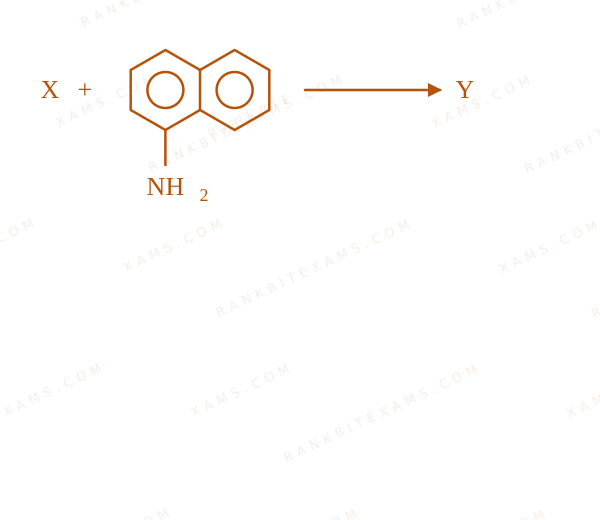
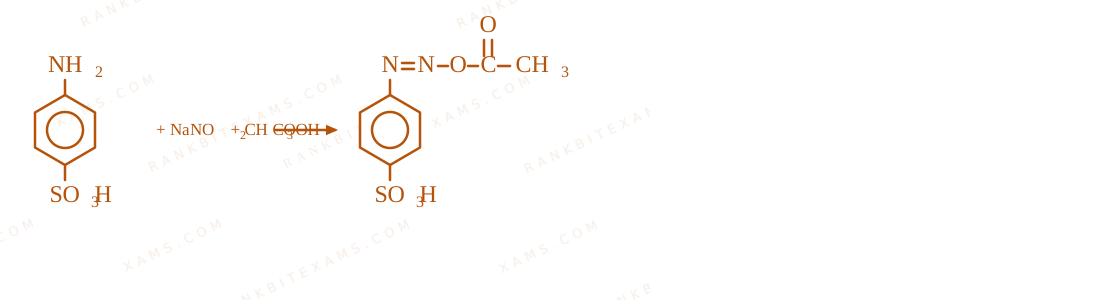
The azo-dye (Y) formed in the following reactions is
textSulphanilic acid + NaNO_2 + CH_3COOH rightarrow X$\text{Sulphanilic acid } + NaNO_2 + CH_3COOH \rightarrow X$The image shows the reaction of intermediate X with N,N-dimethylaniline to form an azo dye (Y).
### Core Logic
1) Sulphanilic acid reacts with NaNO_2$NaNO_2$ and CH_3COOH$CH_3COOH$ to form a diazonium salt (X).
2) The diazonium salt (X) then reacts with N,N-dimethylaniline (given in the coupling step image). The coupling takes place at the para position of the highly activated N,N-dimethylaniline ring.
3) This coupling yields Methyl Orange, an azo dye. Its structure is p$p$-dimethylaminoazobenzenesulphonic acid.
The image shows the reaction of intermediate X with N,N-dimethylaniline to form an azo dye (Y).
### Step 1: Final Identification
The final product (Y) matches option (4) structurally, containing the sulphonic acid group on one ring, the azo linkage, and the N,N-dimethylamine group on the para position of the other ring.
### Evaluation Rubric / Model Answer
null
### Chapter Mix
Class 12 Chemistry: Amines
Q70jee_main_2024_31_jan_eveningChemical Reactions of Amines
Given below are two statements:
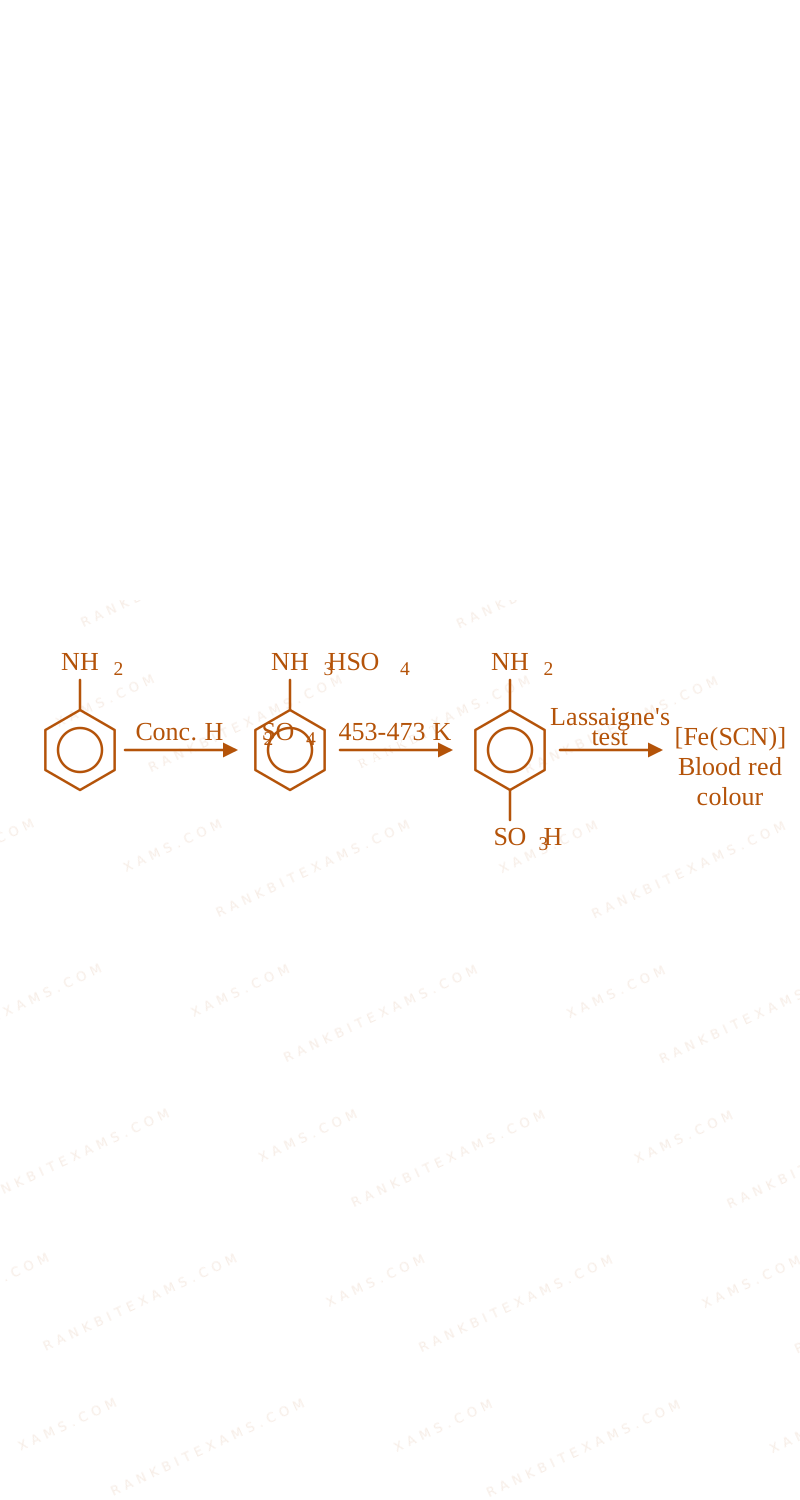
Statement I: Aniline reacts with con. H_2SO_4$H_2SO_4$ followed by heating at 453-473 K gives p-aminobenzene sulphonic acid, which gives blood red colour in the 'Lassaigne's test'.
Statement II: In Friedel-Crafts alkylation and acylation reactions, aniline forms salt with the AlCl_3$AlCl_3$ catalyst. Due to this, nitrogen of aniline acquires a positive charge and acts as deactivating group.
In the light of the above statements, choose the correct answer from the options given below:
A.text(1) Statement I is false but statement II is true$\text{(1) Statement I is false but statement II is true}$
B.text(2) Both statement I and statement II are false$\text{(2) Both statement I and statement II are false}$
C.text(3) Statement I is true but statement II is false$\text{(3) Statement I is true but statement II is false}$
D.text(4) Both statement I and statement II are true$\text{(4) Both statement I and statement II are true}$
Solution
### Core Logic
Statement I: Aniline reacting with concentrated H_2SO_4$H_2SO_4$ gives anilinium hydrogensulphate, which on heating at 453-473 K produces sulphanilic acid (p-aminobenzene sulphonic acid). Because sulphanilic acid contains both Nitrogen and Sulphur, it gives a blood-red colouration in Lassaigne's test due to the formation of thiocyanate ion SCN^-$SCN^-$ which reacts with Fe^3+$Fe^{3+}$ to form [Fe(SCN)]^2+$[Fe(SCN)]^{2+}$. Thus, Statement I is true.
Statement II: In Friedel-Crafts reactions, the Lewis acid catalyst AlCl_3$AlCl_3$ reacts with the lone pair on the nitrogen atom of aniline to form a salt. This generates a positive charge on the nitrogen, transforming the -NH_2$-NH_2$ group from a strong activating group into a strong deactivating group, thus preventing the Friedel-Crafts reaction from occurring. Thus, Statement II is true.
Chemical Reactions of Amines diagram for Q70 - JEE Main 2024 Evening
### Step 1: Final Conclusion
Both Statement I and Statement II are true. Option (4) is correct.
### Evaluation Rubric / Model Answer
null
### Chapter Mix
Class 12 Chemistry: Amines
Class 11 Chemistry: Organic Chemistry - Some Basic Principles and Techniques
Q83jee_main_2024_31_jan_eveningAcylation of Amines
A compound (x) with molar mass 108mathrm~g\,mol^-1$108\mathrm{~g\,mol^{-1}}$ undergoes acetylation to give product with molar mass 192mathrm~g\,mol^-1$192\mathrm{~g\,mol^{-1}}$. The number of amino groups in the compound (x) is ________.
Numerical Answer.Answer: 2 to 2
Solution
### Related Formula
R-NH_2 + CH_3COCl rightarrow R-NH-COCH_3 + HCl$$R-NH_2 + CH_3COCl \rightarrow R-NH-COCH_3 + HCl$$
### Core Logic
During the acetylation of an amino group, one hydrogen atom (mass = 1text g/mol$1\text{ g/mol}$) is replaced by an acetyl group (-COCH_3$-COCH_3$, mass = 43text g/mol$43\text{ g/mol}$).
Gain in molecular weight for every one -NH_2$-NH_2$ group acetylated = 43 - 1 = 42text g/mol$43 - 1 = 42\text{ g/mol}$.
### Step 1: Calculating Number of Groups
Total increase in molecular weight = Final mass - Initial mass = 192 - 108 = 84text g/mol$192 - 108 = 84\text{ g/mol}$.
textNumber of amino groups = fractextTotal mass increasetextMass increase per group = frac8442 = 2$$\text{Number of amino groups} = \frac{\text{Total mass increase}}{\text{Mass increase per group}} = \frac{84}{42} = 2$$
### Evaluation Rubric / Model Answer
null
### Chapter Mix
Class 12 Chemistry: Amines
More Amines Questions — jee_main_2025_07_april_evening
We Map Every Repeating Question in Competitive Exams.
Say goodbye to generic mock test fatigue. RankBit uses smart analysis to group past exam questions into their foundational Repeating Question Types. Find chapter weightage, track repeating questions, and score higher with targeted practice.
Select Your Target Exam
Choose an exam track below to find formulas per chapter and patterns.
Syncing Exam Intelligence
Mapping formulas and patterns across all tracks…
PATH A — FULL LENGTH PRACTICE
Full Mock Test Hub
Simulate real NTA exam conditions with fully tracked mocks. Time yourself against past papers.
Practice past-year questions one chapter at a time. Pick an exam → subject → chapter and get every PYQ for that topic — pulled together from all past papers — with the chapter's key formulas alongside.
 "aniline, p-methoxyaniline, p-nitroaniline")
 "aniline, p-methoxyaniline, p-nitroaniline")
 "aniline, p-methoxyaniline, p-nitroaniline")