When an object is placed 40~cm$40\mathrm{~cm}$ away from a spherical mirror an image of magnification (1)/(2)$\frac{1}{2}$ is produced. To obtain an image with magnification of (1)/(3)$\frac{1}{3}$, the object is to be moved:
A.40 cm away from the mirror.
B.80 cm away from the mirror.
C.20 cm towards the mirror.
D.20 cm away from the mirror.
Solution & Explanation
Related Formula
Magnification formula for a spherical mirror in terms of focal length f$f$ and object distance u$u$:
m = (f)/(f - u)$$m = \frac{f}{f - u}$$
Core Logic
Case 1: Given u₁ = -40~cm$u_1 = -40\mathrm{~cm}$ and m₁ = (1)/(2)$m_1 = \frac{1}{2}$:
(1)/(2) = (f)/(f - (-40)) f + 40 = 2f f = +40~cm$$\frac{1}{2} = \frac{f}{f - (-40)} \implies f + 40 = 2f \implies f = +40\mathrm{~cm}$$
Since f > 0$f > 0$, the optical element is a convex mirror forming a virtual, erect, and diminished image (0 < m < 1$0 < m < 1$).
Step 1: Calculate New Object Position
Case 2: To achieve a magnification of m₂ = (1)/(3)$m_2 = \frac{1}{3}$:
Final object position: u₂ = -80~cm$u_2 = -80\mathrm{~cm}$
Shift = |u₂| - |u₁| = 80 - 40 = 40~cm away from the mirror$$\text{Shift} = |u_2| - |u_1| = 80 - 40 = 40\mathrm{~cm}\text{ away from the mirror}$$
Pattern Recognition
For a convex mirror, images are always virtual, erect, and diminished. As the object is shifted farther away from the mirror (u → -∞$u \to -\infty$), the magnification decreases toward zero.
Chapter Mix
Class 12 Physics: Ray Optics and Optical Instruments
More Ray Optics and Optical Instruments Previous-Year Questions — Page 10
Qjee_main_2025_24_jan_morningSilvering of Lenses
A thin plano convex lens made of glass of refractive index 1.5 is immersed in a liquid of refractive index 1.2. When the plane side of the lens is silver coated for complete reflection, the lens immersed in the liquid behaves like a concave mirror of focal length 0.2 m. The radius of curvature of the curved surface of the lens is :-
A. 0.15 m
B. 0.10 m
C. 0.20 m
D. 0.25 m
Solution
Related Formula
The net focal power of a silvered tracking lens system is given by:
As shown in diagram Silvering of Lenses diagram for Q12 - JEE Main 2025 Morning, the plane flat side boundary interface has an infinite radius of curvature (R₂ = ∞$R_{2} = \infty$), meaning its mirror focal component is fM = ∞ PM = 0$f_{M} = \infty \implies P_{M} = 0$. The power depends entirely on the refraction step:
(1)/(f) = 2fL$$\frac{1}{f} = \frac{2}{f_{L}} $$
Step 1: Lens Maker Formulation
Find the focal expression of the immersed lens element [cite: 91, 679]:
Silvering a plano-flat back boundary means light traverses the initial curved face interface exactly twice, mapping to R = 2 · f · (μrel - 1)$R = 2 \cdot f \cdot (\mu_{\text{rel}} - 1)$.
Chapter Mix
Class 12 Physics: Ray Optics and Optical Instruments
Qjee_main_2025_24_jan_morningLens Maker's Formula
A plano-convex lens having radius of curvature of first surface 2 cm exhibits focal length of f₁$f_{1}$ in air. Another plano-convex lens with first surface radius of curvature 3 cm has focal length of f₂$f_{2}$ when it is immersed in a liquid of refractive index 1.2. If both the lenses are made of same glass of refractive index 1.5, the ratio of f₁$f_{1}$ and f₂$f_{2}$ will be :-
A. 3:5
B. 1:3
C. 1:2
D. 2:3
Solution
Related Formula
Lens Maker's Formula for a lens in a surrounding medium of refractive index μm$\mu_{m}$ is:
Always separate the refractive index multiplier from the geometric shape factor. This lets you calculate each change independently before taking the final ratio.
Chapter Mix
Class 12 Physics: Ray Optics and Optical Instruments
Q2jee_main_2025_24_jan_morningPower of a Lens
What is the relative decrease in focal length of a lens for an increase in optical power by 0.1 D from 2.5 D ? ['D' stands for dioptre]
A. 0.04
B. 0.40
C. 0.1
D. 0.01
Solution
Related Formula
The relationship between optical power P$P$ and focal length F$F$ is given by:
For a small change, we can approximate using differentiation: P = (1)/(F) dP = -(dF)/(F²) (dF)/(F) = -(dP)/(P)$P = \frac{1}{F} \implies dP = -\frac{dF}{F^2} \implies \frac{dF}{F} = -\frac{dP}{P}$. Thus, the relative change magnitude is (0.1)/(2.5) = (1)/(25) = 0.04$\frac{0.1}{2.5} = \frac{1}{25} = 0.04$.
Chapter Mix
Class 12 Physics: Ray Optics and Optical Instruments

Q6jee_main_2025_28_jan_eveningRefraction at Spherical Surfaces
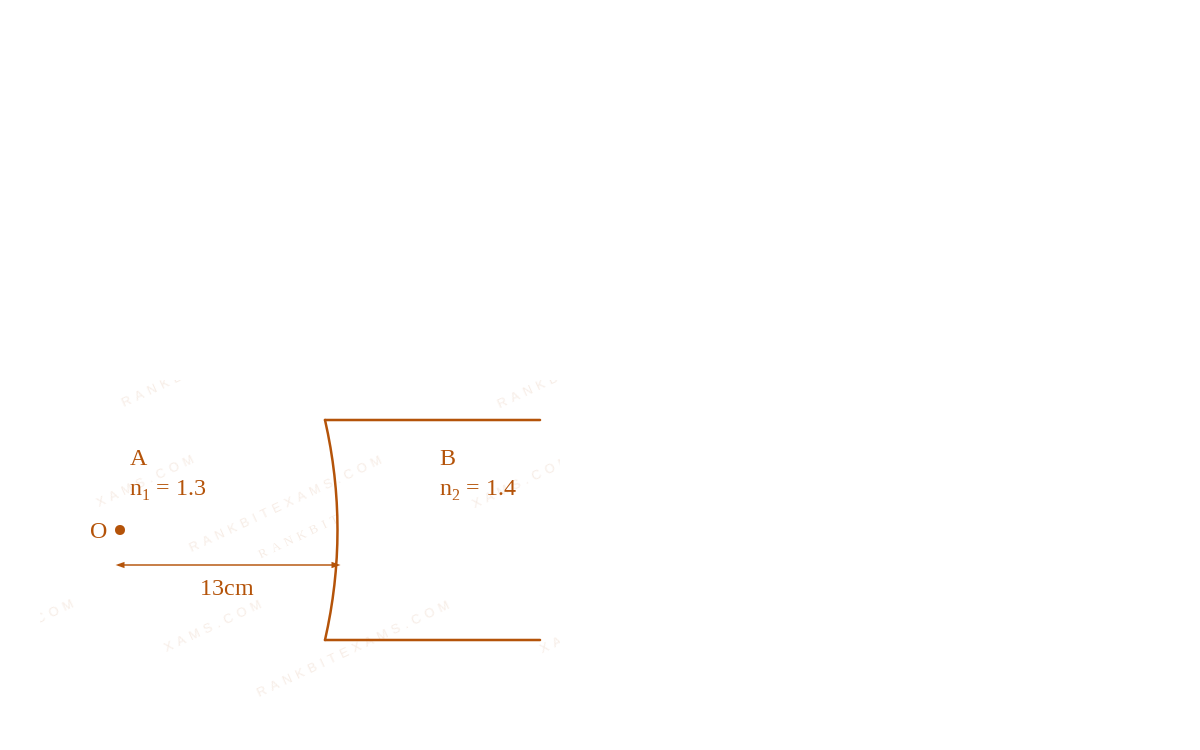
In a long glass tube, mixture of two liquids A and B with refractive indices 1.3 and 1.4 respectively, forms a convex refractive meniscus towards A. If an object placed at 13cm$13\mathrm{cm}$ from the vertex of the meniscus in A forms an image with a magnification of -2$-2$ then the radius of curvature of meniscus is :
A.1 cm$1 \, \text{cm}$
B.(1)/(3)cm$\frac{1}{3}\mathrm{cm}$
C.(2)/(3) ~cm$\frac{2}{3} \mathrm{~cm}$
D.(4)/(3) ~cm$\frac{4}{3} \mathrm{~cm}$
Solution
Related Formula
For refraction at a single spherical surface separating two mediums :
The visual system configuration of the refracting interface is tracked here:
Refraction at Spherical Surfaces diagram for Q6 - JEE Main 2025 Evening
Pattern Recognition
Keep precise track of sign conventions for single spherical surfaces. A convex meniscus towards A means the center of curvature lies inside medium B, meaning
$
Step 1: Visual Context
The visual system configuration of the refracting interface is tracked here:
Refraction at Spherical Surfaces diagram for Q6 - JEE Main 2025 Evening
Pattern Recognition
Keep precise track of sign conventions for single spherical surfaces. A convex meniscus towards A means the center of curvature lies inside medium B, meaning $
R$ will mathematically return as a positive parameter.
Chapter Mix
Class 12 Physics: Ray Optics
Q13jee_main_2025_28_jan_eveningReflection by Spherical Mirrors
A concave mirror produces an image of an object such that the distance between the object and image is 20 cm$20 \, \text{cm}$. If the magnification of the image is -3'$-3'$ , then the magnitude of the radius of curvature of the mirror is:
A.3.75cm$3.75\mathrm{cm}$
B.30cm$30\mathrm{cm}$
C.7.5cm$7.5\mathrm{cm}$
D.15cm$15\mathrm{cm}$
Solution
Related Formula
Magnification m$m$ of a mirror is given by:
m = -(v)/(u)$$m = -\frac{v}{u}$$
The mirror equation relates focal length to distance positions:
(1)/(f) = (1)/(v) + (1)/(u) f = (uv)/(u+v)$$\frac{1}{f} = \frac{1}{v} + \frac{1}{u} \implies f = \frac{uv}{u+v}$$
Radius of curvature R = 2f$R = 2f$.
Core Logic
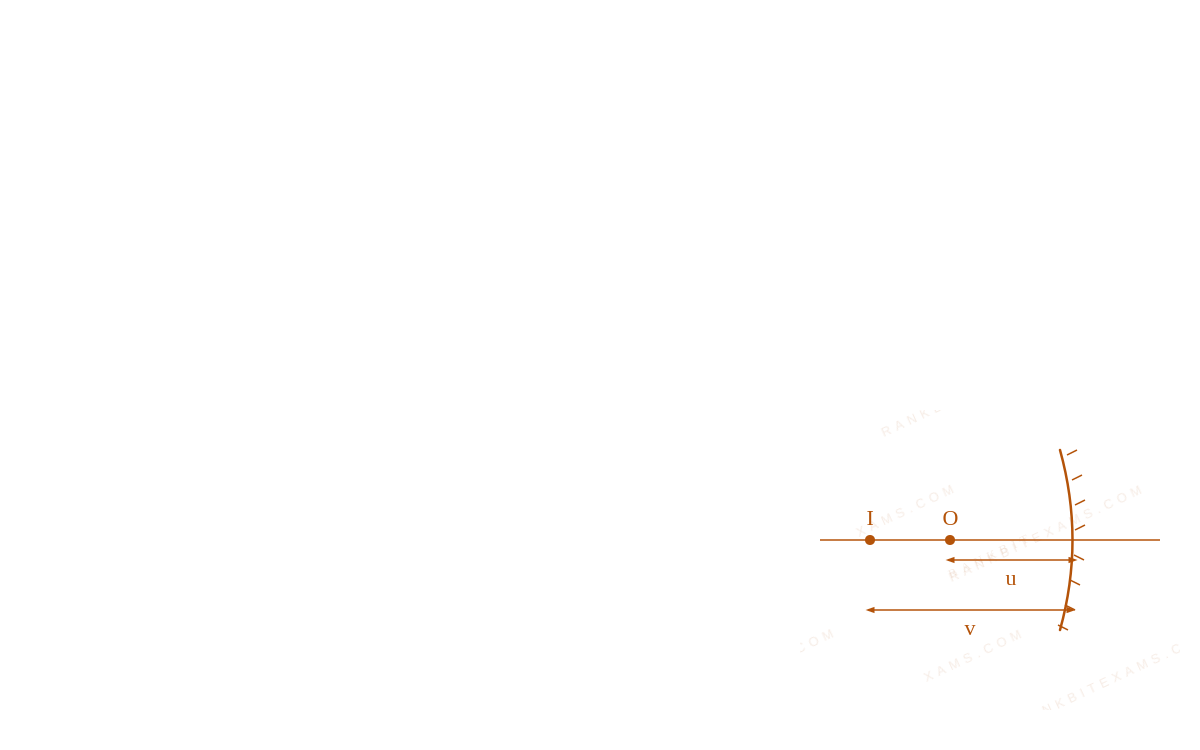
Given, magnification m = -3$m = -3$. This tells us the image is real and inverted[cite: 131, 757]:
-3 = -(v)/(u) v = 3u$$-3 = -\frac{v}{u} \implies v = 3u$$
Since both real objects and real images lie on the same side in front of a concave mirror, u$u$ and v$v$ are both negative fields. The physical distance separation between them is:
The visual positioning profile tracking focal path boundaries is given below:
Reflection by Spherical Mirrors diagram for Q13 - JEE Main 2025 Evening
Pattern Recognition
A magnification of -3$-3$ tells you immediately that the object lies between the Focus (F$F$) and Center of Curvature (C$C$), while the image forms beyond C$C$. This geometric layout instantly verifies that the radius value must exceed 10 cm$10\text{ cm}$.
Chapter Mix
Class 12 Physics: Ray Optics
More Ray Optics and Optical Instruments Questions — jee_main_2025_04_april_morning
Practice past-year questions one chapter at a time. Pick an exam → subject → chapter and get every PYQ for that topic — pulled together from all past papers — with the chapter's key formulas alongside.