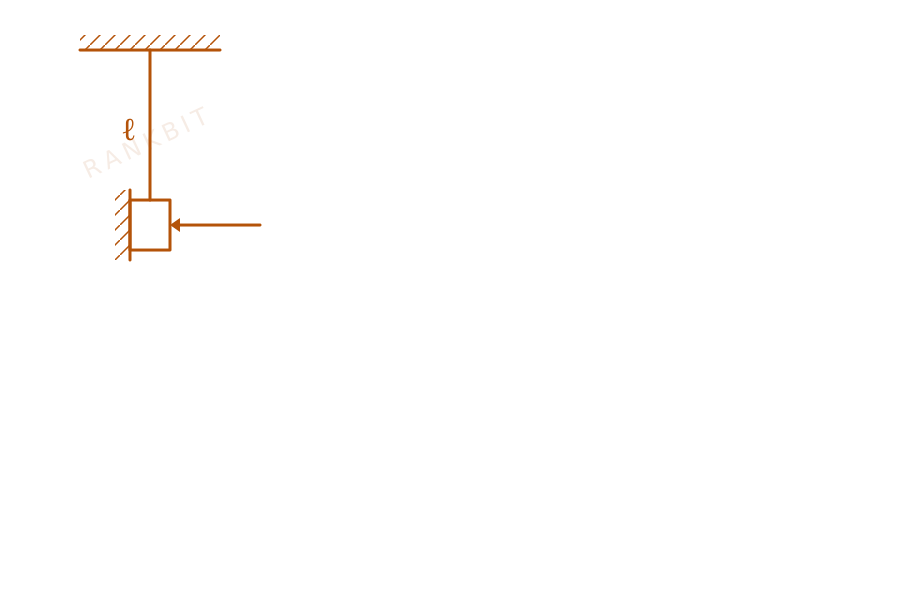
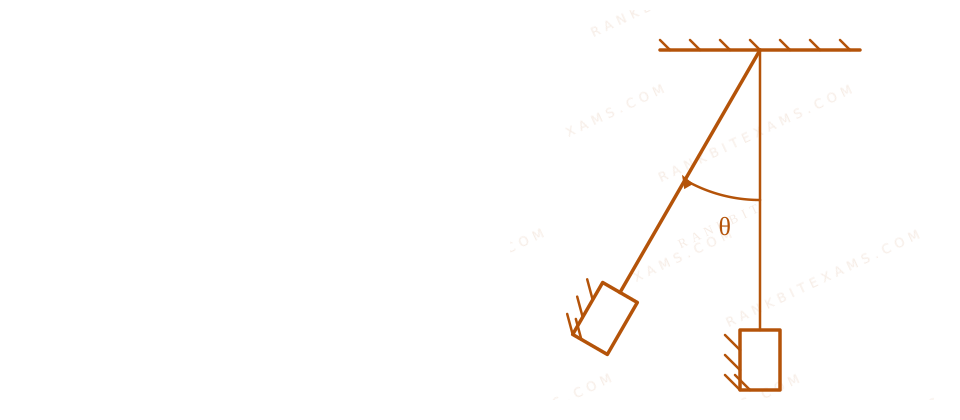
A small mirror of mass m$m$ is suspended by a massless thread of length l$l$. Then the small angle through which the thread will be deflected when a short pulse of laser of energy E$E$ falls normal on the mirror (c =$c = $ speed of light in vacuum and g =$g = $ acceleration due to gravity)
For small angles (θ)/(2) ≈ (θ)/(2)$\sin\frac{\theta}{2} \approx \frac{\theta}{2}$.
Core Logic
Assuming perfect normal reflection from the mirror surface, the pulse imparts a momentum impulse of (2E)/(c)$\frac{2E}{c}$ to the mass. This provides an initial velocity v$v$ to the mirror. The mirror then swings up to a maximum angle θ$\theta$ where kinetic energy converts entirely to gravitational potential energy.
Deflection of suspended mirror via laser pulse diagram for Q2 - JEE Main 2025 Morning
Step 1: Calculate Initial Velocity
From momentum change:
m(v - 0) = (2E)/(c) v = (2E)/(mc)$$m(v - 0) = \frac{2E}{c} \implies v = \frac{2E}{mc}$$
Deflection of suspended mirror via laser pulse diagram for Q2 - JEE Main 2025 Morning
This is a standard ballistic pendulum problem where the impulse is delivered by radiation pressure. Perfect reflection means momentum transfer is double the incident momentum (2· (E)/(c))$\left(2\cdot \frac{E}{c}\right)$.
Chapter Mix
Class 12 Physics: Dual Nature of Radiation and Matter
Class 11 Physics: System of Particles and Rotational Motion
More Dual Nature of Radiation and Matter Previous-Year Questions — Page 2
The ratio of de Broglie wavelength of a deutron with kinetic energy E to that of an alpha particle with kinetic energy 2E, is n : 1$n : 1$. The value of n is ____.
(Assume mass of proton = mass of neutron)
Set up the ratio of wavelengths for the deuteron and the alpha particle based on their given kinetic energies and masses. Let mass of proton/neutron be m$m$. Deuteron mass is 2m$2m$, Alpha particle mass is 4m$4m$.
So, the ratio is 2 : 1$2 : 1$. Therefore, n = 2$n = 2$.
Pattern Recognition
Memorize mass ratios for common particles: proton (m$m$), deuteron (2m$2m$), alpha (4m$4m$). Substitute directly into inverse-sqrt formula for λ$\lambda$.
Chapter Mix
Class 12 Physics: Dual Nature of Radiation and Matter
Q36jee_main_2026_28_january_eveningPhoton Energy
Number of photons of equal energy emitted per second by a 6 mW$6 \text{ mW}$ laser source operating at 663 nm$663 \text{ nm}$ is ____.
(Given: h = 6.63 × 10⁻³⁴ J.s$h = 6.63 \times 10^{-34} \text{ J.s}$ and c = 3 × 10⁸ m/s$c = 3 \times 10^{8} \text{ m/s}$)
A.5 × 10¹⁶$5 \times 10^{16}$
B.5 × 10¹⁵$5 \times 10^{15}$
C.10 × 10¹⁵$10 \times 10^{15}$
D.2 × 10¹⁶$2 \times 10^{16}$
Solution
Related Formula
P = n (hc)/(λ)$$P = n \frac{hc}{\lambda}$$
where:
P$P$ = Power of the laser
n$n$ = number of photons emitted per second
h$h$ = Planck's constant
c$c$ = speed of light
λ$\lambda$ = wavelength
An electron with mass m$m$ with an initial velocity (t = 0)$(t = 0)$v = v₀ i$\vec{v} = v_0\hat{i}$ (v₀ > 0$v_0 > 0$) enters a magnetic field B = B₀ j$\vec{B} = B_0\hat{j}$ . If the initial de-Broglie wavelength at t = 0$t = 0$ is λ₀$\lambda_0$ then its value after time t$t$ would be:
where p$p$ is the magnitude of momentum and v$v$ is the speed.
Core Logic
Since the magnetic force F$\vec{F}$ is always perpendicular to the velocity v$\vec{v}$ of the electron at any instant:
W = ∫ F · d r = 0$$W = \int \vec{F} \cdot d\vec{r} = 0$$
By the work-energy theorem, since work done by the magnetic field is zero, the kinetic energy (and thus the speed v$v$) of the electron remains constant throughout its motion.
Since speed v = v₀$v = v_0$ (constant), the magnitude of momentum p = m v$p = m v$ remains constant over time.
Therefore, the de-Broglie wavelength remains unchanged:
λ(t) = λ₀$$\lambda(t) = \lambda_0$$
Pattern Recognition
Sees: Charge entering purely magnetic field.
Trap: Resolving helical trajectories or cross products mathematically. Do not waste time computing components!
Shortcut: A magnetic field can ONLY change the direction of velocity, NEVER the magnitude (speed). Since de-Broglie wavelength depends solely on the magnitude of momentum (p = mv$p = mv$), it must remain constant.
Chapter Mix
Class 12 Physics: Dual Nature of Radiation and Matter
Class 12 Physics: Moving Charges and Magnetism
A monochromatic light is incident on a metallic plate having work function φ$\phi$. An electron, emitted normally to the plate from a point A with maximum kinetic energy, enters a constant magnetic field, perpendicular to the initial velocity of electron. The electron passes through a curve and hits back the plate at a point B. The distance between A and B is:
(Given: The magnitude of charge of an electron is e$e$ and mass is m$m$, h$h$ is Planck's constant and c$c$ is velocity of light. Take the magnetic field exists throughout the path of electron)
According to Einstein's photoelectric equation, the maximum kinetic energy of the emitted photoelectron is:
K = (hc)/(λ) - φ$$K_{\max} = \frac{hc}{\lambda} - \phi$$
The momentum p$p$ corresponding to this kinetic energy is:
p = 2m K = √(2m ((hc)/(λ) - φ))$$p = \sqrt{2m K_{\max}} = \sqrt{2m \left(\frac{hc}{\lambda} - \phi\right)}$$
The electron is emitted normally to the plate and enters a perpendicular constant magnetic field B$B$. It describes a circular arc (semicircle) and hits back the plate at point B. The distance between A and B is the diameter of this circular trajectory:
When a particle is launched perpendicularly from a flat boundary into a perpendicular magnetic field, it describes a semicircle and exits/re-hits the boundary at a distance equal to the diameter
$.
Pattern Recognition
When a particle is launched perpendicularly from a flat boundary into a perpendicular magnetic field, it describes a semicircle and exits/re-hits the boundary at a distance equal to the diameter $
An electron is released from rest near an infinite non-conducting sheet of uniform charge density -σ$-\sigma^{\prime}$. The rate of change of de-Broglie wavelength associated with the electron varies inversely as nth$n^{\text{th}}$ power of time. The numerical value of n$n$ is
Numerical Answer.Answer: 2 to 2
Solution
Related Formula
λ = (h)/(p)$$\lambda = \frac{h}{p}$$p = m v = m (at)$$p = m v = m (at)$$a = (e E)/(m) = e σ2mε₀$$a = \frac{e E}{m} = \frac{e \sigma^{\prime}}{2m\varepsilon_0}$$
where,
λ$\lambda$ = de-Broglie wavelength
p$p$ = linear momentum
a$a$ = acceleration of the electron in the uniform electric field E$E$t$t$ = time elapsed since release
Core Logic
Since the electron starts from rest (u = 0$u = 0$), its velocity v$v$ at any time t$t$ is:
v = at$v = at$
Thus, the momentum is p = m v = m a t$p = m v = m a t$.
Substitute this into the de-Broglie wavelength equation:
λ(t) = (h)/(m a t)$$\lambda(t) = \frac{h}{m a t}$$
Now, compute the rate of change of wavelength with respect to time:
Practice past-year questions one chapter at a time. Pick an exam → subject → chapter and get every PYQ for that topic — pulled together from all past papers — with the chapter's key formulas alongside.