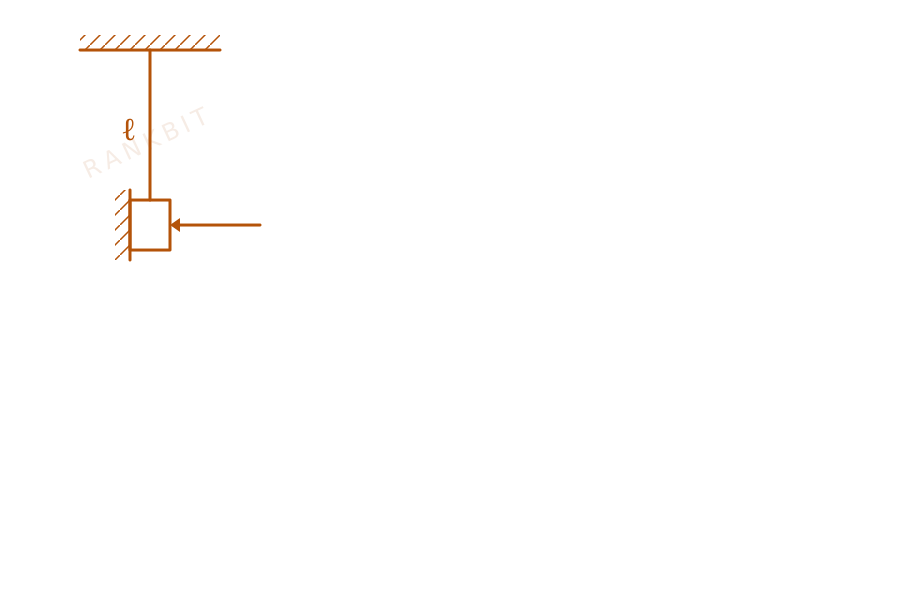
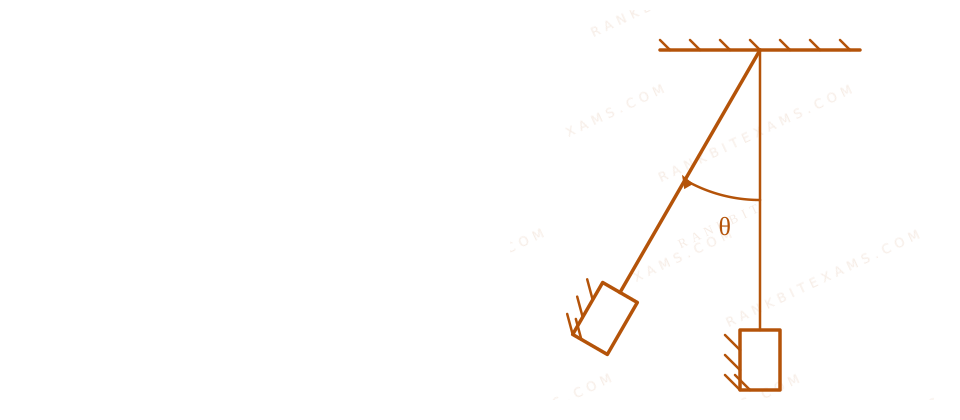
A small mirror of mass m$m$ is suspended by a massless thread of length l$l$. Then the small angle through which the thread will be deflected when a short pulse of laser of energy E$E$ falls normal on the mirror (c =$c = $ speed of light in vacuum and g =$g = $ acceleration due to gravity)
For small angles (θ)/(2) ≈ (θ)/(2)$\sin\frac{\theta}{2} \approx \frac{\theta}{2}$.
Core Logic
Assuming perfect normal reflection from the mirror surface, the pulse imparts a momentum impulse of (2E)/(c)$\frac{2E}{c}$ to the mass. This provides an initial velocity v$v$ to the mirror. The mirror then swings up to a maximum angle θ$\theta$ where kinetic energy converts entirely to gravitational potential energy.
Deflection of suspended mirror via laser pulse diagram for Q2 - JEE Main 2025 Morning
Step 1: Calculate Initial Velocity
From momentum change:
m(v - 0) = (2E)/(c) v = (2E)/(mc)$$m(v - 0) = \frac{2E}{c} \implies v = \frac{2E}{mc}$$
Deflection of suspended mirror via laser pulse diagram for Q2 - JEE Main 2025 Morning
This is a standard ballistic pendulum problem where the impulse is delivered by radiation pressure. Perfect reflection means momentum transfer is double the incident momentum (2· (E)/(c))$\left(2\cdot \frac{E}{c}\right)$.
Chapter Mix
Class 12 Physics: Dual Nature of Radiation and Matter
Class 11 Physics: System of Particles and Rotational Motion
More Dual Nature of Radiation and Matter Previous-Year Questions
A light wave described byE = 60[ (3 × 10¹⁵t) + (12 × 10¹⁵t)]$E = 60[\sin(3 \times 10^{15}t) + \sin(12 \times 10^{15}t)]$ (in SI units) falls on a metal surface of work function 2.8 eV. The maximum kinetic energy of ejected photoelectron is (approximately) ____ eV. (h = 6.6 × 10⁻³⁴ J⋯$h = 6.6 \times 10^{-34}\text{ J}\cdot\text{s}$. and e = 1.6 × 10⁻¹⁹C$e = 1.6 \times 10^{-19}\text{C}$)
The light wave consists of two frequencies governed by ω₁$\omega_1$ and ω₂$\omega_2$.
ω₁ = 3 × 10¹⁵ rad/s$\omega_1 = 3 \times 10^{15}\text{ rad/s}$ω₂ = 12 × 10¹⁵ rad/s$\omega_2 = 12 \times 10^{15}\text{ rad/s}$
The maximum kinetic energy of ejected photoelectrons will be determined by the highest frequency photon, which corresponds to ω₂ = 12 × 10¹⁵ rad/s$\omega_2 = 12 \times 10^{15}\text{ rad/s}$.
When a wave has multiple frequency components (E = E₁ ω₁ t + E₂ ω₂ t$E = E_1\sin\omega_1 t + E_2\sin\omega_2 t$), the Kmax$K_{\text{max}}$ is always strictly determined by the highest frequency (highest energy) component. Ignore the lower frequency terms.
Chapter Mix
Class 12 Physics: Dual Nature of Radiation and Matter
A particle having electric charge 3 × 10⁻¹⁹ C$3 \times 10^{-19} \text{ C}$ and mass 6 × 10⁻²⁷ kg$6 \times 10^{-27} \text{ kg}$ is accelerated by applying an electric potential of 1.21 V$1.21 \text{ V}$. Wavelength of the matter wave associated with the particle is α × 10⁻¹² m$\alpha \times 10^{-12} \text{ m}$. The value of α$\alpha$ is ________.
(Take Planck's constant = 6.6 × 10⁻³⁴ J⋯$= 6.6 \times 10^{-34} \text{ J}\cdot\text{s}$)
The expression inside the radical always evaluates cleanly in JEE. 2 × 6 × 3 = 36$2 \times 6 \times 3 = 36$ and 1.21 = (1.1)²$1.21 = (1.1)^2$ are engineered to perfectly cancel the 6.6$6.6$ in the numerator.
Chapter Mix
Class 12 Physics: Dual Nature of Radiation and Matter

Q44jee_main_2026_22_january_eveningPhotoelectric Effect and Threshold Frequency
Light is incident on a metallic plate having work function 110 × 10⁻²⁰$110 \times 10^{-20}$ J. If the produced photoelectrons have zero kinetic energy then the angular frequency of the incident light is ____ rad/s. (h = 6.63 × 10⁻³⁴$h = 6.63 \times 10^{-34}$ J.s)
A.1.04 × 10¹⁶$1.04 \times 10^{16}$
B.1.04 × 10¹³$1.04 \times 10^{13}$
C.1.66 × 10¹⁶$1.66 \times 10^{16}$
D.1.66 × 10¹⁵$1.66 \times 10^{15}$
Solution
Related Formula
φ = h v$\phi = h v$
ω = 2π v = (2π φ)/(h)$$\omega = 2\pi v = \frac{2\pi \phi}{h}$$
Core Logic
Since kinetic energy of photoelectrons is zero (Kmax = 0$K_{\text{max}} = 0$), incident photon energy equals work function φ$\phi$:
h v = φ v = (φ)/(h)$$h v = \phi \implies v = \frac{\phi}{h}$$
The de Broglie wavelength of an oxygen molecule at 27°C$27^{\circ}C$ is x × 10⁻¹²$x \times 10^{-12}$ m. The value of x is (take Planck's constant = 6.63 × 10⁻³⁴ J.s$6.63 \times 10^{-34}\text{ J.s}$, Boltzmann constant = 1.38 × 10⁻²³ J/K$1.38 \times 10^{-23}\text{ J/K}$, mass of oxygen. Molecule = 5.31 × 10⁻²⁶ kg$5.31 \times 10^{-26}\text{ kg}$).
Sees: "de Broglie wavelength" + "gas molecule" + "temperature" → Immediately use λ = h/√(3mkT)$\lambda = h/\sqrt{3mkT}$. Watch for temperature conversion to Kelvin.
Chapter Mix
Class 12 Physics: Dual Nature of Radiation and Matter
Class 11 Physics: Kinetic Theory
When a light of a given wavelength falls on a metallic surface the stopping potential for photoelectrons is 3.2 V. If a second light having wavelength twice of first light is used, the stopping potential drops to 0.7 V. The wavelength of first light is ____ m.
(h = 6.63× 10⁻³⁴J.s,e = 1.6× 10⁻¹⁹C,c = 3× 10⁸m / s)$(\mathrm{h} = 6.63\times 10^{-34}\mathrm{J.s},\mathrm{e} = 1.6\times 10^{-19}\mathrm{C},\mathrm{c} = 3\times 10^{8}\mathrm{m / s})$
When you have two states of photoelectric effect for the same metal, subtracting the two stopping potential equations instantly eliminates the work function φ$\phi$. Convert hc/e$hc/e$ directly to 12400 eV·AA$12400 \text{ eV}\cdot\text{\AA}$ to expedite calculation.
Chapter Mix
Class 12 Physics: Dual Nature of Radiation and Matter
More Dual Nature of Radiation and Matter Questions — jee_main_2025_04_april_morning
Practice past-year questions one chapter at a time. Pick an exam → subject → chapter and get every PYQ for that topic — pulled together from all past papers — with the chapter's key formulas alongside.