Rankbit System
JEE Physics: Waves (+15.5%) | Electrostatics: Concentric Shells (-29.7%) | Modern Physics: Photoelectric Clones (+34.2%) | Mathematics: Definite Integrals (+18.1%) | Chemistry: Coordination Splitting (-11.4%) | JEE Physics: Waves (+15.5%) | Electrostatics: Concentric Shells (-29.7%) | Modern Physics: Photoelectric Clones (+34.2%) | Mathematics: Definite Integrals (+18.1%) | Chemistry: Coordination Splitting (-11.4%)

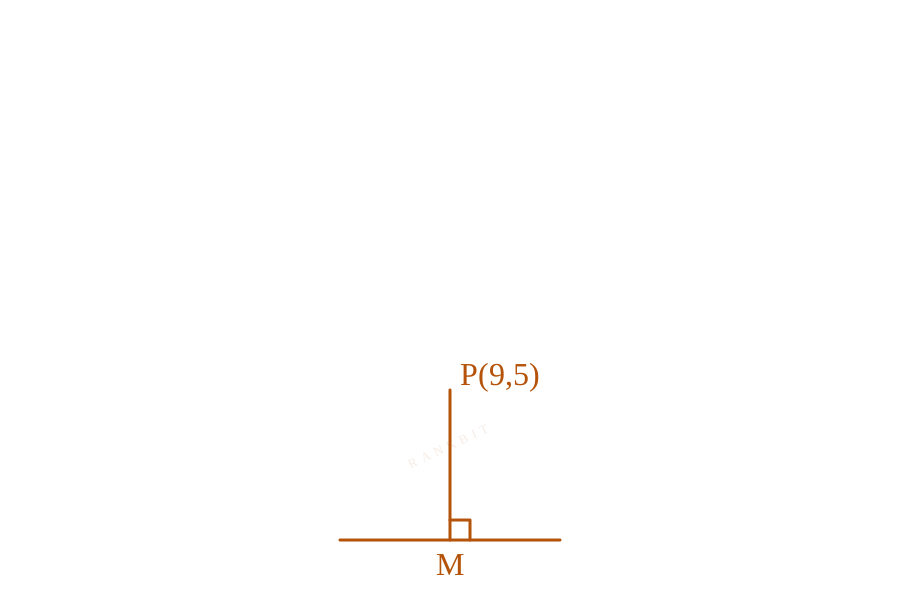
For an integer n ge 2, if the arithmetic mean of all coefficients in the binomial expansion of (x + y)^2n - 3 is 16, then the distance of the point P(2n - 1, n^2 - 4n) from the line x + y = 8 is:

Solution & Explanation

### Related Formula Sum of binomial coefficients for (x+y)^m is 2^m. Total number of terms is m + 1. Perpendicular distance formula from (x_0, y_0) to ax + by + c = 0: d = frac|ax_0 + by_0 + c|sqrta^2 + b^2 ### Core Logic The power is m = 2n - 3. Sum of coefficients = 2^2n - 3. Total terms = 2n - 2. Given Arithmetic Mean: frac2^2n - 32n - 2 = 16 implies frac2^2n - 32(n - 1) = 16 implies 2^2n - 4 = 16(n - 1) Testing integer values, n = 5 satisfies the equation perfectly since 2^6 = 64 and 16(5 - 1) = 64. ### Step 1: Determine Coordinates of Point P Substitute n = 5 into P(2n - 1, n^2 - 4n): x_0 = 2(5) - 1 = 9 y_0 = 5^2 - 4(5) = 5 Thus, P = (9, 5).
Properties of Binomial Coefficients diagram for Q54 - JEE Main 2025 Morning
### Step 2: Calculate Perpendicular Distance Find the distance from (9,5) to the line x + y - 8 = 0: d = left|frac9 + 5 - 8sqrt1^2 + 1^2right| = frac6sqrt2 = 3sqrt2 ### Pattern Recognition Binomial coefficient logic tightly constrains n to small integers. Use inspection quickly when polynomial-exponential configurations arise. ### Evaluation Rubric / Model Answer null ### Chapter Mix Class 11 Mathematics: Binomial Theorem Class 11 Mathematics: Straight Lines

Reference Study Guides

More Binomial Theorem Previous-Year Questions — Page 2

Q74 2025 Last Two Digits of a Number
The product of the last two digits of (1919)^1919 is
Numerical Answer. Answer: 63 to 63

Solution

### Related Formula (10k - 1)^n = dots + binomnn-1(10k)(-1)^n-1 + (-1)^n ### Core Logic Break the base parameter into a multiple of 10 form (1920 - 1) and use binomial expansions to decouple high factor blocks from final terminal digits. ### Step 1: Set Up Binomial Expansion (1919)^1919 = (1920 - 1)^1919 = binom19190(1920)^1919 - dots + binom19191918(1920)^1 - binom19191919 ### Step 2: Isolate Low Factor Coefficients All higher structural tracks sitting above index points present factors multiple loops over 100. Isolate trailing values: = 100lambda + 1919 times 1920 - 1 ### Step 3: Deduce Final Trailing Quotient Product 1919 times 1920 - 1 = 3684480 - 1 = 3684479 Trailing structural indicators: 79. Product calculation response: 7 times 9 = 63 ### Pattern Recognition Using expansions around tens bases shifts focus entirely to the last two expansion expressions to find digit answers rapidly. ### Evaluation Rubric / Model Answer null ### Chapter Mix Class 11 Mathematics: Binomial Theorem
Q67 2025 Remainder Problems
The remainder, when 7^103 is divided by 23, is equal to:
  • A. 14
  • B. 9
  • C. 17
  • D. 6

Solution

### Related Formula Modular arithmetic congruence rules: A equiv B pmodm implies A^n equiv B^n pmodm ### Core Logic We need to compute 7^103 pmod23. Let's break the exponent down into manageable powers: 7^103 = 7 cdot (7^2)^51 = 7 cdot (49)^51 Since 49 equiv 3 pmod23: 7^103 equiv 7 cdot 3^51 pmod23 ### Step 1: Simplify Higher Power Components Break down 3^51 using 3^3 = 27 equiv 4 pmod23: 3^51 = (3^3)^17 = 27^17 equiv 4^17 pmod23 So the expression becomes: 7 cdot 4^17 = 7 cdot 4 cdot (4^2)^8 = 28 cdot 16^8 Since 28 equiv 5 pmod23 and 16 equiv -7 pmod23: equiv 5 cdot (-7)^8 = 5 cdot 7^8 pmod23 ### Step 2: Final Remainder Evaluation Now compute 7^8 using 7^2 = 49 equiv 3 pmod23: 7^8 = (7^2)^4 equiv 3^4 = 81 pmod23 Since 81 equiv 12 pmod23: textExpression equiv 5 cdot 12 = 60 pmod23 Dividing 60 by 23 (23 times 2 = 46) yields a remainder of: 60 - 46 = 14 ### Pattern Recognition Using negative remainders (like 16 equiv -7) reduces large multiplication outputs instantly during binary power modular loops. ### Evaluation Rubric / Model Answer null ### Chapter Mix Class 11 Mathematics: Binomial Theorem

Q54 2025 Rational Terms in Expansion
The sum of all rational terms in the expansion of (2 + sqrt3)^8 is[cite: 540, 542]:
  • A. 16923
  • B. 3763
  • C. 33845
  • D. 18817

Solution

### Related Formula General term in the binomial expansion of (a+b)^n: T_r+1 = ^nC_r cdot a^n-r cdot b^r ### Core Logic For a term to be rational in (2+sqrt3)^8, the power of sqrt3 must be an even integer[cite: 1218]. Thus, r can only take even values from 0 to 8 [cite: 1219, 1220]: r in \0, 2, 4, 6, 8\ [cite: 1219, 1220] ### Step 1: Calculating individual rational terms Sum up terms explicitly for all valid values of r [cite: 1219, 1220]: textSum = ^8C_0(2)^8 + ^8C_2(2)^6(sqrt3)^2 + ^8C_4(2)^4(sqrt3)^4 + ^8C_6(2)^2(sqrt3)^6 + ^8C_8(sqrt3)^8 [cite: 1219, 1220] Compute the individual numeric values [cite: 1221]: - r=0: 1 cdot 256 = 256 - r=2: 28 cdot 64 cdot 3 = 5376 - r=4: 70 cdot 16 cdot 9 = 10080 - r=28 cdot 4 cdot 27 = 3024 - r=8: 1 cdot 1 cdot 81 = 81 textTotal Sum = 256 + 5376 + 10080 + 3024 + 81 = 18817 [cite: 1221, 1222] ### Pattern Recognition Notice that the sum of all rational terms can also be viewed as the rational part of the expanded configuration, equivalent to frac(2+sqrt3)^8 + (2-sqrt3)^82. ### Evaluation Rubric / Model Answer null ### Chapter Mix Class 11 Mathematics: Binomial Theorem
Q59 2025 Binomial Coefficients Series
If sum_r=1^9left(fracr + 32^rright)cdot^9mathrmC_r = alpha left(frac32right)^9 - beta [cite: 596], where alpha, beta in mathbbN [cite: 596], then (alpha + beta)^2 is equal to[cite: 608]:
  • A. 27
  • B. 9
  • C. 81
  • D. 18

Solution

### Related Formula 1. sum_r=1^n r cdot ^nC_r x^r = nx(1+x)^n-1 2. Binomial Theorem expansion: sum_r=0^n ^nC_r x^r = (1+x)^n ### Core Logic Split the given series summation into two independent parts [cite: 1316]: textSum = sum_r=1^9 fracr2^r cdot ^9C_r + 3sum_r=1^9 frac12^r cdot ^9C_r [cite: 1316] Simplify the first sub-sum using the index relation r cdot ^9C_r = 9 cdot ^8C_r-1 [cite: 1316]: sum_r=1^9 frac92^r cdot ^8C_r-1 = frac92sum_r=1^9 ^8C_r-1left(frac12right)^r-1 = frac92left(1 + frac12right)^8 = frac92left(frac32right)^8 [cite: 1316] Simplify the second sub-sum by including missing index r=0 [cite: 1316]: 3left[sum_r=0^9 ^9C_rleft(frac12right)^r - 1right] = 3left[left(1 + frac12right)^9 - 1right] = 3left(frac32right)^9 - 3 [cite: 1316] ### Step 1: Combining the components Combine both evaluations to fit into requested representation shape [cite: 1316]: textTotal Sum = frac92left(frac32right)^8 + 3left(frac32right)^9 - 3 [cite: 1316] Convert the fractional leading term [cite: 1316]: frac92left(frac32right)^8 = 3 cdot frac32left(frac32right)^8 = 3left(frac32right)^9 [cite: 1316] textTotal Sum = 3left(frac32right)^9 + 3left(frac32right)^9 - 3 = 6left(frac32right)^9 - 3 [cite: 1316] Matching coefficients gives [cite: 1317]: alpha = 6, quad beta = 3 [cite: 1317] Evaluate the required squared value [cite: 1317]: (alpha + beta)^2 = (6 + 3)^2 = 81 [cite: 1317] ### Pattern Recognition Splitting variable factors into standard combinatoric property fractions simplifies coefficient conversions with geometric series denominators. ### Evaluation Rubric / Model Answer null ### Chapter Mix Class 11 Mathematics: Binomial Theorem
Q63 2025 Properties of Binomial Coefficients
If 1^2 cdot left( ^15 mathrmC_1 right) + 2^2 cdot left( ^15 mathrmC_2 right) + 3^2 cdot left( ^15 mathrmC_3 right) + dots + 15^2 cdot left( ^15 mathrmC_15 right) = 2^mathrmm cdot 3^mathrmn cdot 5^mathrmk, where m, n, k ∈ N, then m + n + k is equal to :-
  • A. 19
  • B. 21
  • C. 18
  • D. 20

Solution

### Related Formula The general property linking indices to binomial coefficients is: r cdot binomnr = n cdot binomn-1r-1 ### Core Logic The given series can be structured using summation notation: S = sum_r=1^15 r^2 cdot binom15r Apply the identity r cdot binom15r = 15 cdot binom14r-1 to reduce one factor of r: S = sum_r=1^15 r cdot left[ 15 cdot binom14r-1 right] = 15 sum_r=1^15 r cdot binom14r-1 ### Step 1: Splitting the linear term Rewrite the index variable r as (r - 1) + 1 to align with the binomial lower index: S = 15 sum_r=1^15 big((r - 1) + 1big) cdot binom14r-1 S = 15 sum_r=1^15 (r - 1) cdot binom14r-1 + 15 sum_r=1^15 binom14r-1 Applying the property again to the first summation term: (r-1)binom14r-1 = 14binom13r-2: S = 15 cdot 14 sum_r=2^15 binom13r-2 + 15 sum_r=1^15 binom14r-1 ### Step 2: Evaluating the Sums and Prime Factorization Using the standard total sum of binomial coefficients sum_k=0^n binomnk = 2^n: S = 15 cdot 14 cdot 2^13 + 15 cdot 2^14 Factor out 15 cdot 2^13 from the expression: S = 15 cdot 2^13 (14 + 2) = 15 cdot 2^13 (16) = 15 cdot 2^13 cdot 2^4 S = 15 cdot 2^17 = (3^1 cdot 5^1) cdot 2^17 Matching this with the given format 2^m cdot 3^n cdot 5^k, we identify: m = 17, n = 1, and k = 1. ### Step 3: Calculating the sum of exponents Evaluating the targeted summation: m + n + k = 17 + 1 + 1 = 19 ### Pattern Recognition For a series of the type sum r^2 binomnr, remember the standard identity shortcut: n(n-1)2^n-2 + n2^n-1. Plugging in n=15 instantly outputs 15(14)2^13 + 15(2^14), bypasses matching terms manually. ### Evaluation Rubric / Model Answer null ### Chapter Mix Class 11 Mathematics: Binomial Theorem

More Binomial Theorem Questions — jee_main_2025_04_april_morning

Practice all Binomial Theorem previous-year questions →

YOUR FIRST PREP STEP STARTS HERE

We Map Every Repeating Question in Competitive Exams.

Say goodbye to generic mock test fatigue. RankBit uses smart analysis to group past exam questions into their foundational Repeating Question Types. Find chapter weightage, track repeating questions, and score higher with targeted practice.

Select Your Target Exam

Choose an exam track below to find formulas per chapter and patterns.

Syncing Exam Intelligence

Mapping formulas and patterns across all tracks…

PATH A — FULL LENGTH PRACTICE

Full Mock Test Hub

Simulate real NTA exam conditions with fully tracked mocks. Time yourself against past papers.

Under Development
PATH B — TARGETED PRACTICE

Topic-wise Practice Hub

Practice past-year questions one chapter at a time. Pick an exam → subject → chapter and get every PYQ for that topic — pulled together from all past papers — with the chapter's key formulas alongside.

Loading Questions... Browse Topics
Latest from the Blog
View all →

Loading articles...