JEE Main · Chemistry ↑ Rising

p-Block Elements appeared 42 times across 3 years — 4.9% of Chemistry. This question is from Group 15 Elements.

Year 2026 2025 2024 Total
Questions 16 13 13 42

Given below are two statements: Statement I: Nitrogen forms oxides with +1 to +5 oxidation states due to the formation of pπ - pπ bond with oxygen. Statement II: Nitrogen does not form halides with +5 oxidation state due to the absence of d-orbital in it. In the light of given statements, choose the correct answer from the options given below:

Solution & Explanation

Core Logic
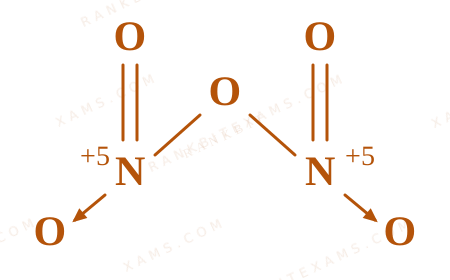
  • Statement I is true: Nitrogen has a small atomic size and high electronegativity, allowing it to form strong multiple pπ - pπ bonds with oxygen atoms. This enables stable oxide forms across a wide range of oxidation numbers spanning +1 to +5 (e.g., N₂O₅).
  • Statement II is true: Nitrogen is a second-period element with a valence shell configuration of 2s² 2p³. It completely lacks vacant 2d orbitals. As a result, it cannot expand its octet beyond a covalency of 4, preventing the synthesis of pentahalides like NX₅.
Pattern Recognition

Second-period elements are structurally bounded by a maximum covalency of 4 due to the complete absence of d-orbitals. This explains why NF₅ is unstable/non-existent while PF₅ is easily synthesized.

Chapter Mix

Class 12 Chemistry: The p-Block Elements

Nitrogen oxide bonding structure diagram for Q37

Reference Study Guides

More The p-Block Elements Previous-Year Questions — Page 9

Q61 jee_main_2024_31_jan_morning Group 18 Elements
Give below are two statements: Statement-I: Noble gases have very high boiling points. Statement-II: Noble gases are monoatomic gases. They are held together by strong dispersion forces. Because of this they are liquefied at very low temperature. Hence, they have very high boiling points. In the light of the above statements, choose the correct answer from the options given below:
  • A. Statement I is false but Statement II is true.
  • B. Both Statement I and Statement II are true.
  • C. Statement I is true but Statement II is false.
  • D. Both Statement I and Statement II are false.

Solution

Core Logic

Statement I and II are False.

Noble gases have low boiling points. Noble gases are held together by weak dispersion forces.

Pattern Recognition

Noble gases are characterized by extremely weak intermolecular forces (London dispersion forces) because they are monoatomic and non-polar, which directly results in very low boiling and melting points.

Chapter Mix

Class 12 Chemistry: The p-Block Elements

Q79 jee_main_2024_31_jan_morning Group 14 Elements
Consider the oxides of group 14 elements SiO₂, GeO₂, SnO₂, PbO₂, CO and GeO. The amphoteric oxides are
  • A. GeO, GeO₂
  • B. SiO₂, GeO₂
  • C. SnO₂, PbO₂
  • D. SnO₂, CO

Solution

Core Logic

In Group 14 elements, the nature of oxides varies down the group: CO is neutral. CO₂ and SiO₂ are acidic. GeO₂ is distinctly acidic. SnO₂ and PbO₂ are amphoteric.

Pattern Recognition

Tin (Sn) and Lead (Pb) mostly form amphoteric oxides (e.g., SnO, SnO₂, PbO, PbO₂), distinguishing them from the acidic oxides of Carbon and Silicon.

Chapter Mix

Class 11 Chemistry: The p-Block Elements

More The p-Block Elements Questions — jee_main_2025_04_april_morning

Practice all The p-Block Elements previous-year questions →

Rankbit System
JEE Physics: Waves (+15.5%) | Electrostatics: Concentric Shells (-29.7%) | Modern Physics: Photoelectric Clones (+34.2%) | Mathematics: Definite Integrals (+18.1%) | Chemistry: Coordination Splitting (-11.4%) | JEE Physics: Waves (+15.5%) | Electrostatics: Concentric Shells (-29.7%) | Modern Physics: Photoelectric Clones (+34.2%) | Mathematics: Definite Integrals (+18.1%) | Chemistry: Coordination Splitting (-11.4%)