JEE Main · Chemistry ↑ Rising

Hydrocarbons appeared 35 times across 3 years — 4.1% of Chemistry. This question is from Free Radical Bromination.

Year 2026 2025 2024 Total
Questions 14 12 9 35

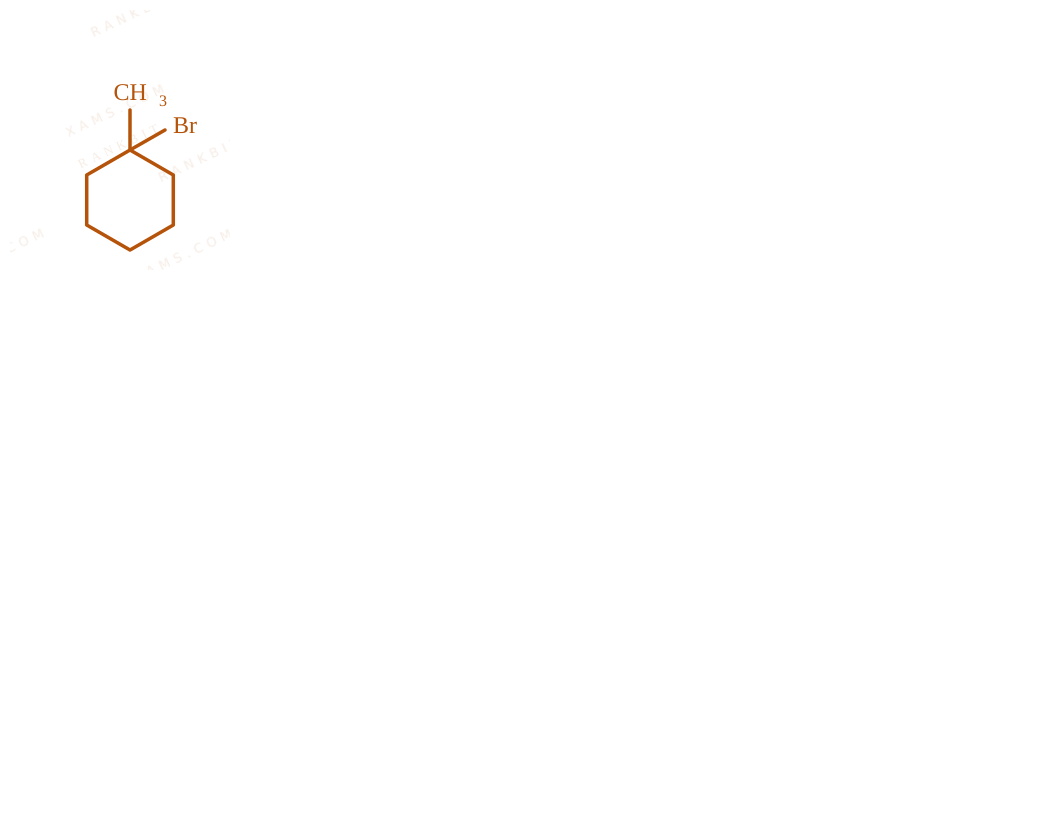
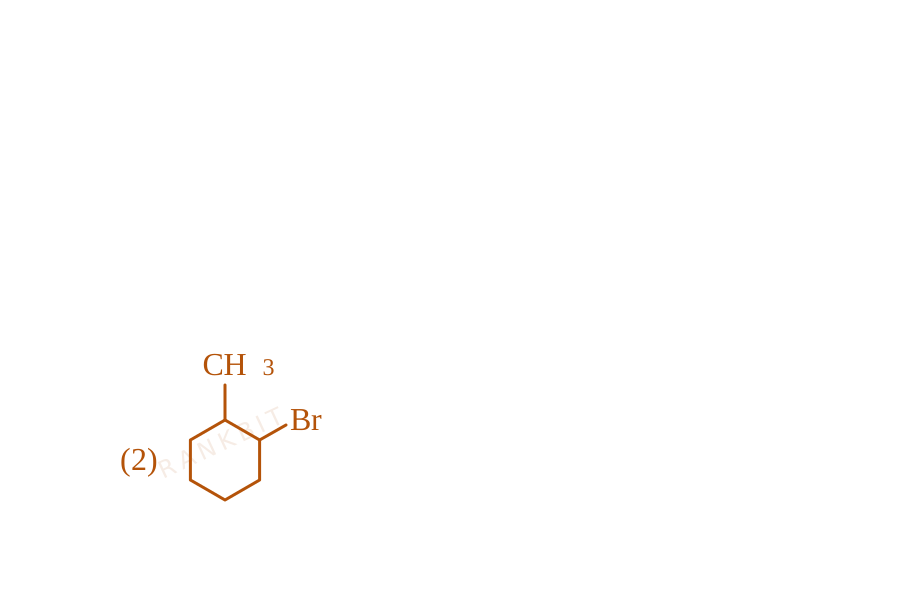
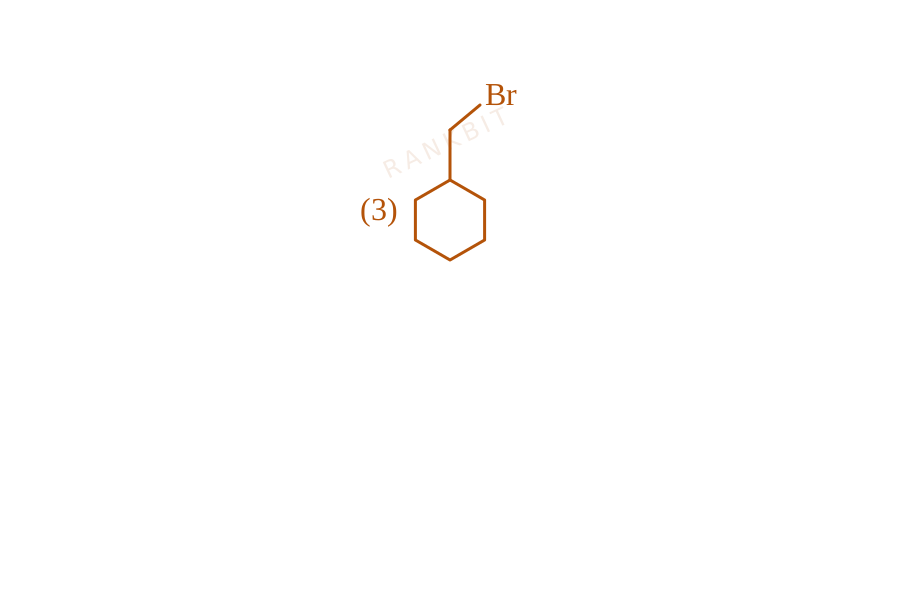
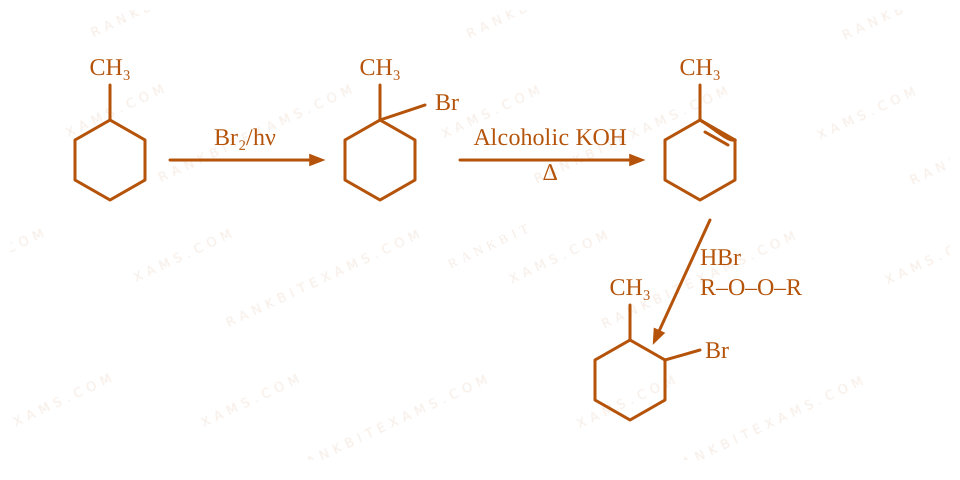
Predict the major product of the following reaction sequence:
Alkyl radical halogenation flowchart matrix for Q42 - JEE Main 2025 Morning
The sequence pathways specify Br2/hv free radical substitution, alcoholic KOH elimination, and HBr/peroxide addition.

Solution & Explanation

Core Logic

Let's analyze the steps of the reaction sequence:

  • Step 1 (Br₂ / hν): Light-induced free radical substitution targeted at the most stable tertiary position, producing 1-bromo-1-methylcyclohexane.
  • Step 2 (Alcoholic KOH, Δ): Dehydrohalogenation occurs via an E2 mechanism. Following Saytzeff's rule, elimination favors the formation of the more highly substituted, stable alkene: 1-methylcyclohexene.
  • Step 3 (HBr / R-O-O-R, hν): Radical hydrobromination across the unsymmetrical alkene. The presence of peroxide shifts addition toward the Anti-Markovnikov path, placing the bromine atom cleanly at the less-substituted secondary carbon to yield 1-bromo-2-methylcyclohexane.
Pattern Recognition

Combining Saytzeff elimination with a peroxide-promoted HBr addition allows you to reposition functional groups from highly substituted tertiary carbons to adjacent secondary positions.

Chapter Mix

Class 11 Chemistry: Hydrocarbons Class 12 Chemistry: Haloalkanes and Haloarenes

Detailed mechanism scheme tracing intermediates for Q42
The sequence pathways specify Br2/hv free radical substitution, alcoholic KOH elimination, and HBr/peroxide addition.

More Hydrocarbons Previous-Year Questions — Page 4

Q jee_main_2025_03_april_evening Electrophilic Aromatic Substitution
In the following series of reactions identify the major products A & B respectively:
Electrophilic Aromatic Substitution
  • A.
  • B.
  • C.
  • D.

Solution

Related Formula

Orienting effects in electrophilic aromatic substitution:

  • Bromine (-Br) is ortho/para-directing (para-dominated due to steric hindrance).
  • Sulfonic acid group (-SO₃H) is a strong deactivating, meta-directing group.
  • Electrophilic Aromatic Substitution
    Electrophilic Aromatic Substitution

Core Logic

Analyzing the first step:

  • Sulfonation of bromobenzene with SO₃/H₂SO₄ yields 4-bromobenzenesulfonic acid as the major product (A) due to steric hindrance at the ortho-position.
Step 1: Determine orientation for the second step

In 4-bromobenzenesulfonic acid, we have two substituents:

  • -Br (ortho/para director)
  • -SO₃H (meta director)
  • The positions meta to the deactivating -SO₃H group correspond to the positions ortho to the -Br group. Both directing effects align on the same position (carbon-3/carbon-5). Since -Br is activating relative to -SO₃H, it controls the orientation.

Step 2: Identify Product B

Halogenation with Br₂/Fe introduces a bromine atom ortho to the existing bromine atom (meta to -SO₃H):

Product B = 3,4-dibromobenzenesulfonic acid

This matches Option (2).

Pattern Recognition

When an activating group (-Br) and a deactivating group (-SO₃H) compete on a benzene ring, the orienting influence of the activating group wins. Position ortho to the bromine atom is favored over meta positions of the sulfonic acid group.

Chapter Mix

Class 11 Chemistry: Hydrocarbons Class 12 Chemistry: Haloalkanes and Haloarenes
Q26 jee_main_2025_07_april_morning Ozonolysis of Alkenes
Given below are two statements: Statement I: Ozonolysis followed by treatment with Zn, H₂O of cis-2-butene gives ethanal. Statement II: The product obtained by ozonolysis followed by treatment with Zn, H₂O of 3,6-dimethyloct-4-ene has no chiral carbon atom. In the light of the above statements, choose the correct answer from the options given below:
  • A. Both Statement I and Statement II are true
  • B. Statement I is false but Statement II is true
  • C. Statement I is true but Statement II is false
  • D. Both Statement I and Statement II are false

Solution

Related Formula
R₁-CH=CH-R₂ [(ii) Zn, H₂O](i) O₃ R₁-CHO + R₂-CHO
Core Logic

Statement I: Cis-2-butene (CH₃-CH=CH-CH₃) undergoes reductive ozonolysis to cleave the double bond and yield two molecules of acetaldehyde (ethanal, CH₃CHO). This statement is true.

Statement II: 3,6-dimethyloct-4-ene (CH₃-CH₂-CH(CH₃)-CH=CH-CH(CH₃)-CH₂-CH₃) undergoes reductive ozonolysis to yield 2-methylbutanal (CH₃-CH₂-CH(CH₃)-CHO). This product contains a chiral carbon atom (the C2 carbon bonded to -H, -CH₃, -CHO, and -C₂H₅). Thus, the statement that it has no chiral carbon atom is false.

Pattern Recognition

To check chirality after ozonolysis, draw the cleaved fragment structure first. Any carbon with four different groups is chiral. 2-methylbutanal has four unique groups attached to C2, making Statement II clearly false.

Chapter Mix

Class 11 Chemistry: Hydrocarbons Class 12 Chemistry: Organic Chemistry - Some Basic Principles and Techniques

Q33 jee_main_2025_29_jan_evening Aromatic Electrophilic Substitution
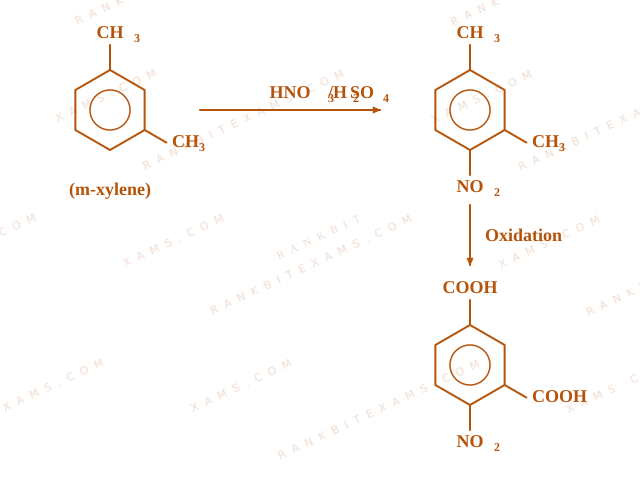
Given below are two statements : Statement (I): On nitration of m-xylene with HNO₃, H₂SO₄ followed by oxidation, 4-nitrobenzene-1, 3-dicarboxylic acid is obtained as the major product. Statement (II) : CH₃ group is o/p-directing while -NO₂ group is m-directing group. In the light of the above statements, choose the correct answer from the options given below :
  • A. Both Statement I and Statement II are false
  • B. Statement I is false but Statement II is true
  • C. Both Statement I and Statement II are true
  • D. Statement I is true but Statement II is false

Solution

Core Logic

Statement I is true: In m-xylene, both methyl groups direct incoming electrophiles to position 4 (synergistic ortho/para effect). Nitration gives 4-nitro-m-xylene. Subsequent strong oxidation of both -CH₃ groups yields 4-nitrobenzene-1,3-dicarboxylic acid.

Aromatic Electrophilic Substitution diagram for Q33 - JEE Main 2025 Evening

Statement II is true: Alkyl groups (-CH₃) act as ortho/para directors via hyperconjugation, whereas nitro groups (-NO₂) are strongly deactivating meta directors.

Pattern Recognition

When evaluating multi-substituted benzenes, identify whether directors reinforce the same positions. In m-xylene, position 4 is ortho to one methyl and para to the other.

Chapter Mix

Class 11 Chemistry: Hydrocarbons

Q47 jee_main_2025_29_jan_evening Aromatic Hydrocarbons and Isomerism
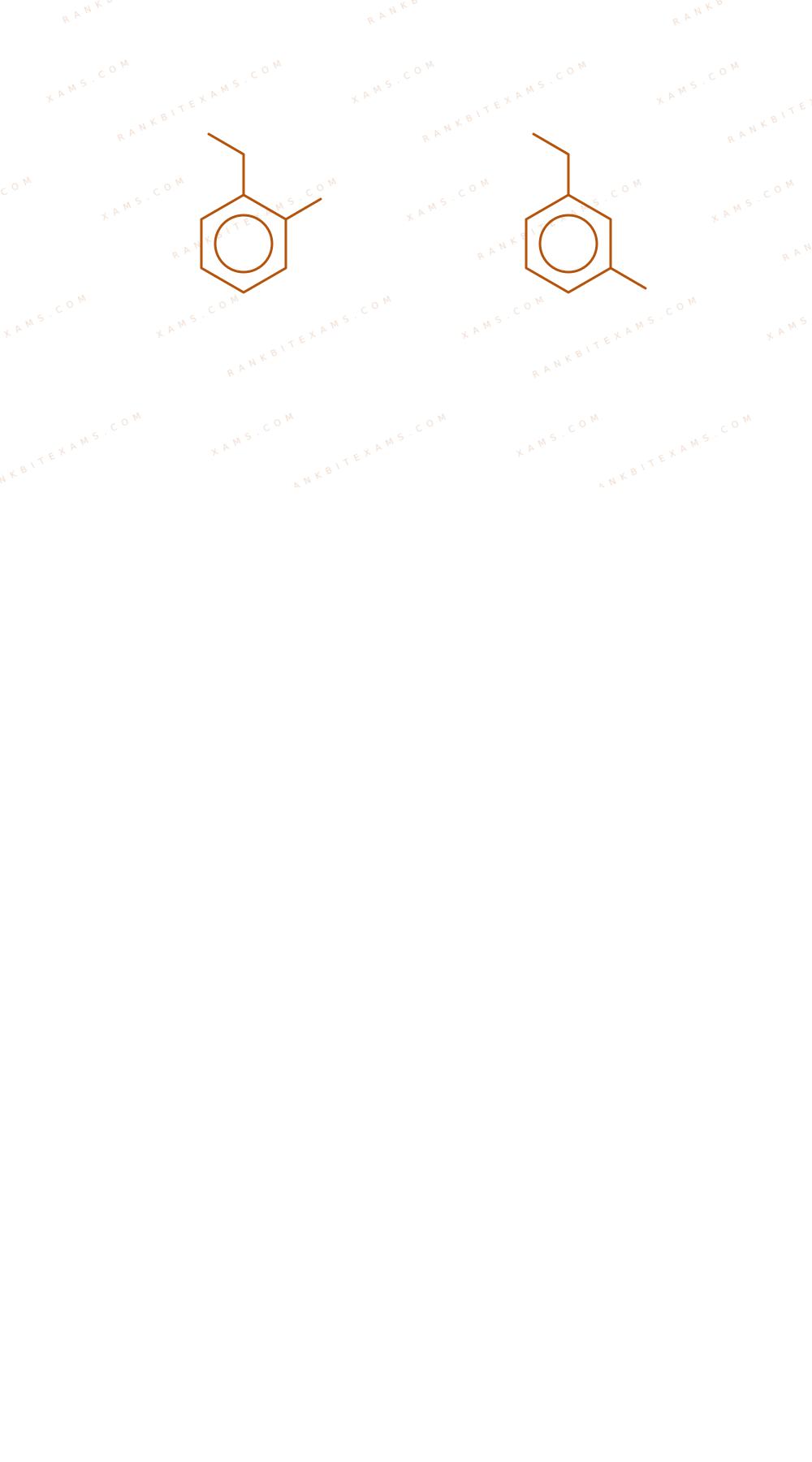
Isomeric hydrocarbons giving negative Baeyer's test have the molecular formula C₉H₁₂. The total number of isomers from above with exactly four different non-aliphatic substitution sites is ________.
Numerical Answer. Answer: 2 to 2

Solution

Core Logic

A negative Baeyer's test confirms that the hydrocarbon structural isomers contain no aliphatic alkene or alkyne unsaturations, establishing that they are purely aromatic benzene derivatives with side alkyl chains.

Aromatic Hydrocarbons and Isomerism diagram for Q47 - JEE Main 2025 Evening

To find structures possessing four distinct ring positions available for electrophilic substitution, we examine the symmetries of specific tri-substituted configurations. There are exactly 2 such structural isomers satisfying these spatial conditions.

Pattern Recognition

Negative test = aromatic ring constraint. Calculate positional substitution patterns meticulously to ensure ring symmetry matches the required counts.

Chapter Mix

Class 11 Chemistry: Hydrocarbons

Q jee_main_2025_03_april_morning Ozonolysis of Alkenes
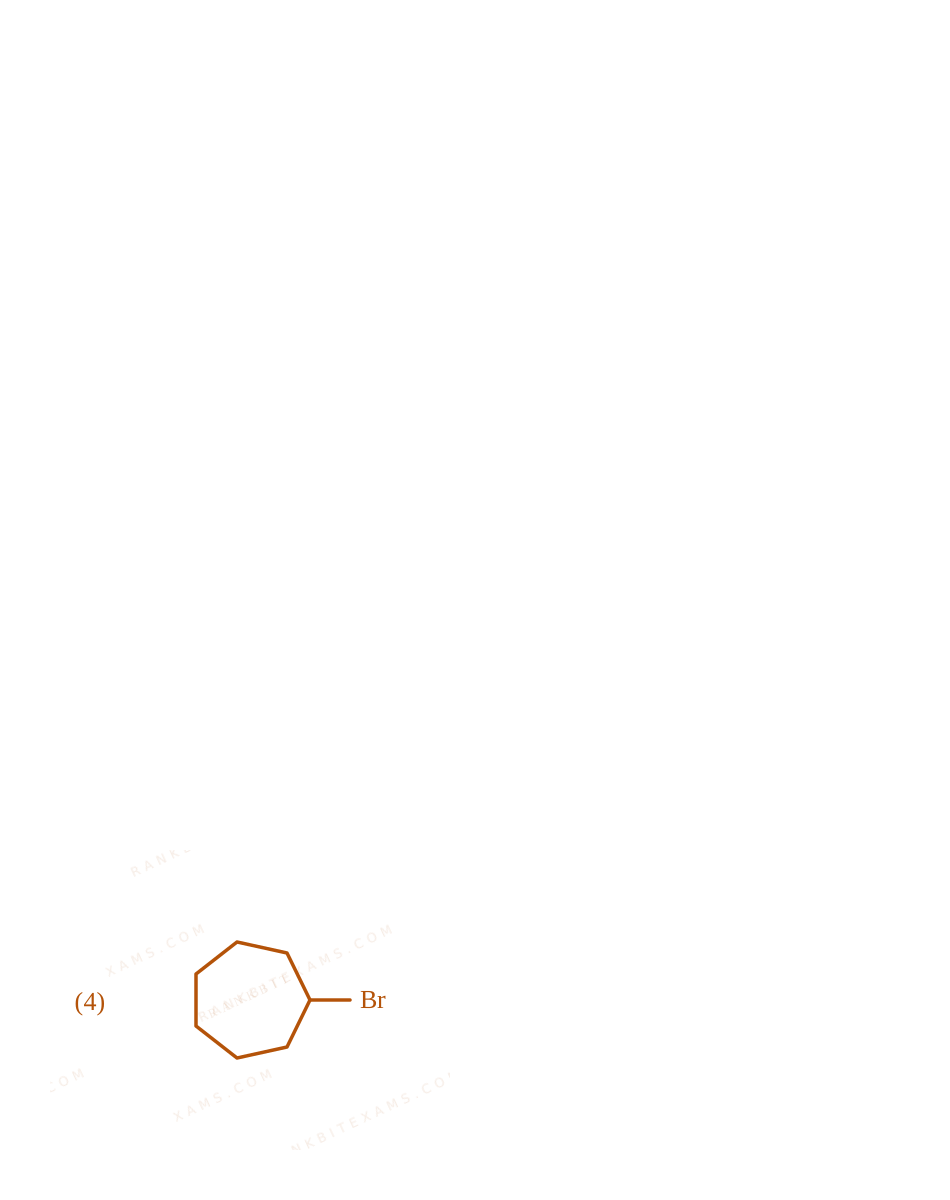
Which compound would give 3-methyl-6-oxoheptanal upon ozonolysis ?
  • A. Structure (1)
  • B. Structure (2)
  • C. Structure (3)
  • D. Structure (4)

Solution

Core Logic

Let us reconstruct the original alkene from the given ozonolysis product fragments. Write down the line-structure formula for 3-methyl-6-oxoheptanal:

O=CH-CH₂-CH(CH₃)-CH₂-CH₂-C(=O)-CH₃

Remove both carbonyl oxygen atoms and link carbon-1 directly to carbon-6 with a double bond. This cyclizes into a 6-membered ring structure: 1,4-dimethylcyclohexene.

Alkene cyclization path for Q42 - JEE Main 2025 Morning

Step 1: Ozonolysis Verification

Performing reductive ozonolysis (O₃ / Zn, H₂O) cleaves the internal endocyclic double bond of 1,4-dimethylcyclohexene, perfectly regenerating the acyclic keto-aldehyde compound.

Pattern Recognition

Shortcut: Count the carbons in the main chain product (7 carbons in main chain, 8 total). Ozonolysis of structure (2) creates an open chain containing a terminal aldehyde group on one end and a methyl ketone group on the other.

Evaluation Rubric / Model Answer

Option (B)

Chapter Mix

Class 11 Chemistry: Hydrocarbons

Rankbit System
JEE Physics: Waves (+15.5%) | Electrostatics: Concentric Shells (-29.7%) | Modern Physics: Photoelectric Clones (+34.2%) | Mathematics: Definite Integrals (+18.1%) | Chemistry: Coordination Splitting (-11.4%) | JEE Physics: Waves (+15.5%) | Electrostatics: Concentric Shells (-29.7%) | Modern Physics: Photoelectric Clones (+34.2%) | Mathematics: Definite Integrals (+18.1%) | Chemistry: Coordination Splitting (-11.4%)