Rankbit System
JEE Physics: Waves (+15.5%) | Electrostatics: Concentric Shells (-29.7%) | Modern Physics: Photoelectric Clones (+34.2%) | Mathematics: Definite Integrals (+18.1%) | Chemistry: Coordination Splitting (-11.4%) | JEE Physics: Waves (+15.5%) | Electrostatics: Concentric Shells (-29.7%) | Modern Physics: Photoelectric Clones (+34.2%) | Mathematics: Definite Integrals (+18.1%) | Chemistry: Coordination Splitting (-11.4%)

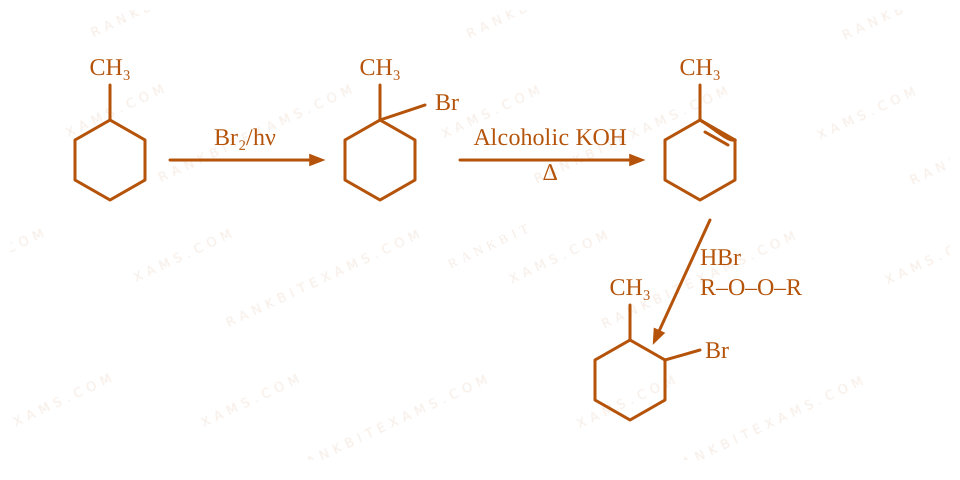
Predict the major product of the following reaction sequence:
Alkyl radical halogenation flowchart matrix for Q42 - JEE Main 2025 Morning
The sequence pathways specify Br2/hv free radical substitution, alcoholic KOH elimination, and HBr/peroxide addition.

Solution & Explanation

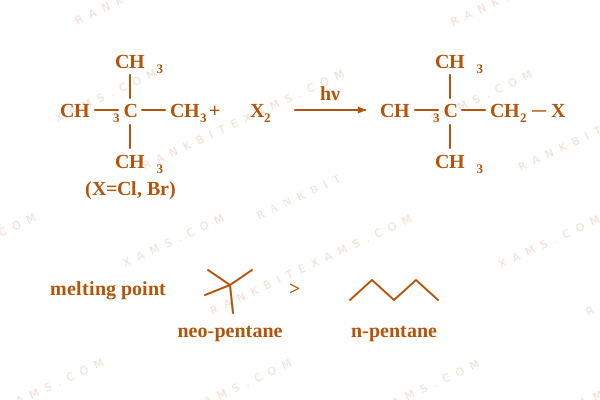
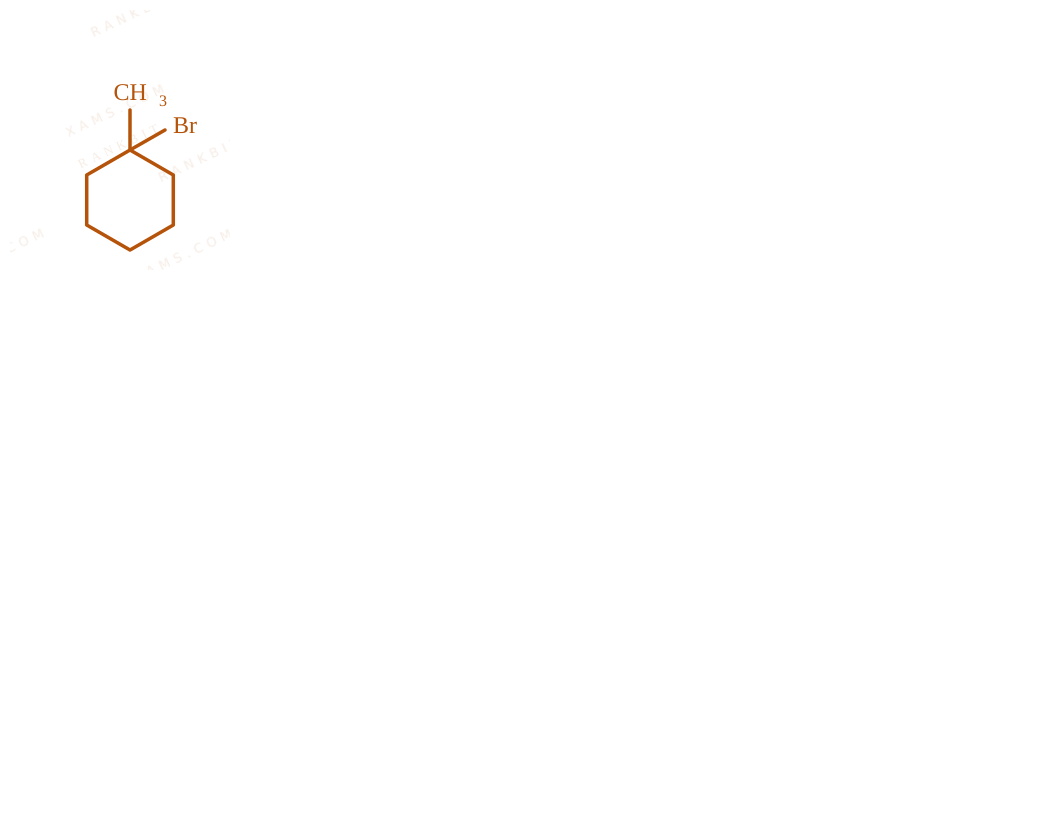
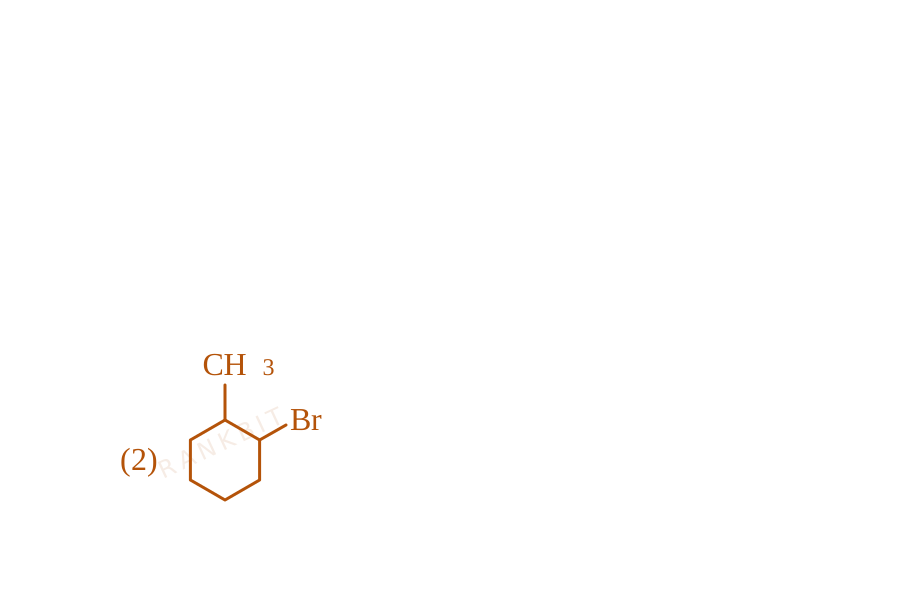
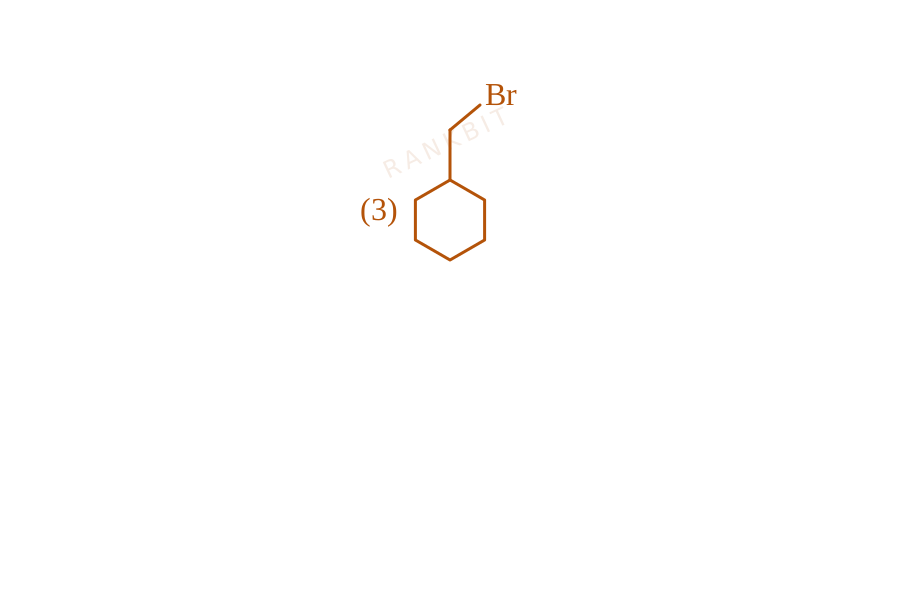
### Core Logic Let's analyze the steps of the reaction sequence: 1. **Step 1 (Br_2 / hnu):** Light-induced free radical substitution targeted at the most stable tertiary position, producing 1-bromo-1-methylcyclohexane. 2. **Step 2 (Alcoholic KOH, Delta):** Dehydrohalogenation occurs via an E2 mechanism. Following Saytzeff's rule, elimination favors the formation of the more highly substituted, stable alkene: 1-methylcyclohexene. 3. **Step 3 (HBr / R-O-O-R, hnu):** Radical hydrobromination across the unsymmetrical alkene. The presence of peroxide shifts addition toward the **Anti-Markovnikov** path, placing the bromine atom cleanly at the less-substituted secondary carbon to yield **1-bromo-2-methylcyclohexane**. ### Pattern Recognition Combining Saytzeff elimination with a peroxide-promoted HBr addition allows you to reposition functional groups from highly substituted tertiary carbons to adjacent secondary positions. ### Evaluation Rubric / Model Answer null ### Chapter Mix Class 11 Chemistry: Hydrocarbons Class 12 Chemistry: Haloalkanes and Haloarenes
Detailed mechanism scheme tracing intermediates for Q42
The sequence pathways specify Br2/hv free radical substitution, alcoholic KOH elimination, and HBr/peroxide addition.

Reference Study Guides

More Hydrocarbons Previous-Year Questions — Page 3

Q27 2025 Electrophilic Addition to Alkenes
Following are the four molecules "P", "Q", "R" and "S":
Electrophilic Addition to Alkenes diagram for Q27 - JEE Main 2025 Morning
The image shows four cyclic and acyclic alkene molecules labelled P, Q, R, and S.
Which one among the four molecules will react with H-Br(aq) at the fastest rate?
  • A. S
  • B. Q
  • C. R
  • D. P

Solution

### Related Formula textRate of Electrophilic Addition propto textStability of Intermediate Carbocation ### Core Logic Addition of H-Br(aq) follows an electrophilic addition pathway where a carbocation intermediate is formed in the rate-determining step. Among the given structures, compound Q forms a resonance-stabilized allylic/benzylic carbocation, rendering it highly stable compared to the others.
Electrophilic Addition to Alkenes solution diagram for Q27 - JEE Main 2025 Morning
The image shows four cyclic and acyclic alkene molecules labelled P, Q, R, and S.
### Pattern Recognition Look for conjugated or allylic systems that stabilize the positive charge dynamically via resonance. ### Evaluation Rubric / Model Answer null ### Chapter Mix Class 11 Chemistry: Hydrocarbons
Q29 2025 Alkyne Reactions and Ozonolysis
Identify product [A], [B] and [C] in the following reaction sequence : CH_3-Cequiv CHfracPd/CH_2rightarrow[A]frac(i)O_3(ii)Zn,H_2Orightarrow[B]+[C]
  • A. [A]:CH_3-CH=CH_2,\ [B]: CH_3CHO,\ [C]: HCHO
  • B. [A]: CH_2=CH_2,\ [B]: H_3C-CO-CH_3,\ [C]: HCHO
  • C. [A]:CH_3-CH=CH_2,\ [B]: CH_3CHO,\ [C]: CH_3CH_2OH
  • D. [A]: CH_3CH_2CH_3,\ [B]: CH_3CHO,\ [C]: HCHO

Solution

### Related Formula Partial hydrogenation of alkynes using Pd/C yields alkenes: R-Cequiv CH + H_2 xrightarrowPd/C R-CH=CH_2 Ozonolysis cleaves the double bond to form carbonyls: R-CH=CH_2 xrightarrow(i)O_3, (ii)Zn/H_2O R-CHO + HCHO ### Core Logic Step 1: Controlled reduction of propyne gives propene: CH_3-Cequiv CH xrightarrowPd/C, H_2 CH_3-CH=CH_2 quad [A] Step 2: Reductive ozonolysis of propene ([A]) splits the alkene at the C=C bond, creating ethanal ([B]) and methanal ([C]): CH_3-CH=CH_2 xrightarrowO_3, text then Zn/H_2O CH_3CHO\ [B] + HCHO\ [C] ### Step 1: Final Identification Hence, [A] = CH_3-CH=CH_2 [B] = CH_3CHO [C] = HCHO ### Pattern Recognition Whenever an alkyne undergoes partial hydrogenation with regular catalysts, count the carbons to trace the matching alkene framework. Cleaving a terminal alkene like propene always results in formaldehyde (HCHO) as one of the fragment products. ### Evaluation Rubric / Model Answer null ### Chapter Mix Class 11 Chemistry: Hydrocarbons

More Hydrocarbons Questions — jee_main_2025_04_april_morning

Practice all Hydrocarbons previous-year questions →

YOUR FIRST PREP STEP STARTS HERE

We Map Every Repeating Question in Competitive Exams.

Say goodbye to generic mock test fatigue. RankBit uses smart analysis to group past exam questions into their foundational Repeating Question Types. Find chapter weightage, track repeating questions, and score higher with targeted practice.

Select Your Target Exam

Choose an exam track below to find formulas per chapter and patterns.

Syncing Exam Intelligence

Mapping formulas and patterns across all tracks…

PATH A — FULL LENGTH PRACTICE

Full Mock Test Hub

Simulate real NTA exam conditions with fully tracked mocks. Time yourself against past papers.

Under Development
PATH B — TARGETED PRACTICE

Topic-wise Practice Hub

Practice past-year questions one chapter at a time. Pick an exam → subject → chapter and get every PYQ for that topic — pulled together from all past papers — with the chapter's key formulas alongside.

Loading Questions... Browse Topics
Latest from the Blog
View all →

Loading articles...