In a Young's double slit experiment, two slits are located 1.5 mm apart. The distance of screen from slits is 2 m and the wavelength of the source is 400 nm. If the 20 maxima of the double slit pattern are contained within the centre maximum of the single slit diffraction pattern, then the width of each slit is x × 10⁻³ cm$\mathrm{x} \times 10^{-3}\text{ cm}$, where x-value is ________.
Numerical Answer Type:
Enter a numerical valueAnswer: 15 to 15+4 marks
Solution & Explanation
Related Formula
Width of central maximum in single-slit diffraction:
Comparing with x × 10⁻³ cm$x \times 10^{-3}\text{ cm}$, the value of x$x$ is 15.
Pattern Recognition
Envelope matching conditions rely strictly on the geometric ratio of slit separation (d$d$) to individual slit width (a$a$). Wavelength (λ$\lambda$) and screen distance (D$D$) cancel out completely.
Keywords:#Young's double slit experiment two slits located 1.5 mm#JEE Main 2025 Evening Q24#Wave Optics JEE Main 2025#Diffraction and Interference JEE Main 2025
In a Young's double slit experiment, the slits are separated by 0.2~mm$0.2\mathrm{~mm}$. If the slits separation is increased to 0.4~mm$0.4\mathrm{~mm}$, the percentage change of the fringe width is:
Young's double slit interference apparatus is immersed in a liquid of refractive index 1.44$1.44$. It has slit separation of 1.5 mm$1.5\ \mathrm{mm}$. The slits are illuminated by a parallel beam of light whose wavelength in air is 690 nm$690\ \mathrm{nm}$. The fringe-width on a screen placed behind the plane of slits at a distance of 0.72 m$0.72\ \mathrm{m}$, will be:
When a YDSE apparatus is immersed in a medium of refractive index μ$\mu$, the fringe width decreases by a factor of μ$\mu$, i.e., β' = (β)/(μ)$\beta' = \frac{\beta}{\mu}$.
Chapter Mix
Class 12 Physics: Wave Optics
Q20jee_main_2025_24_jan_eveningPolarization
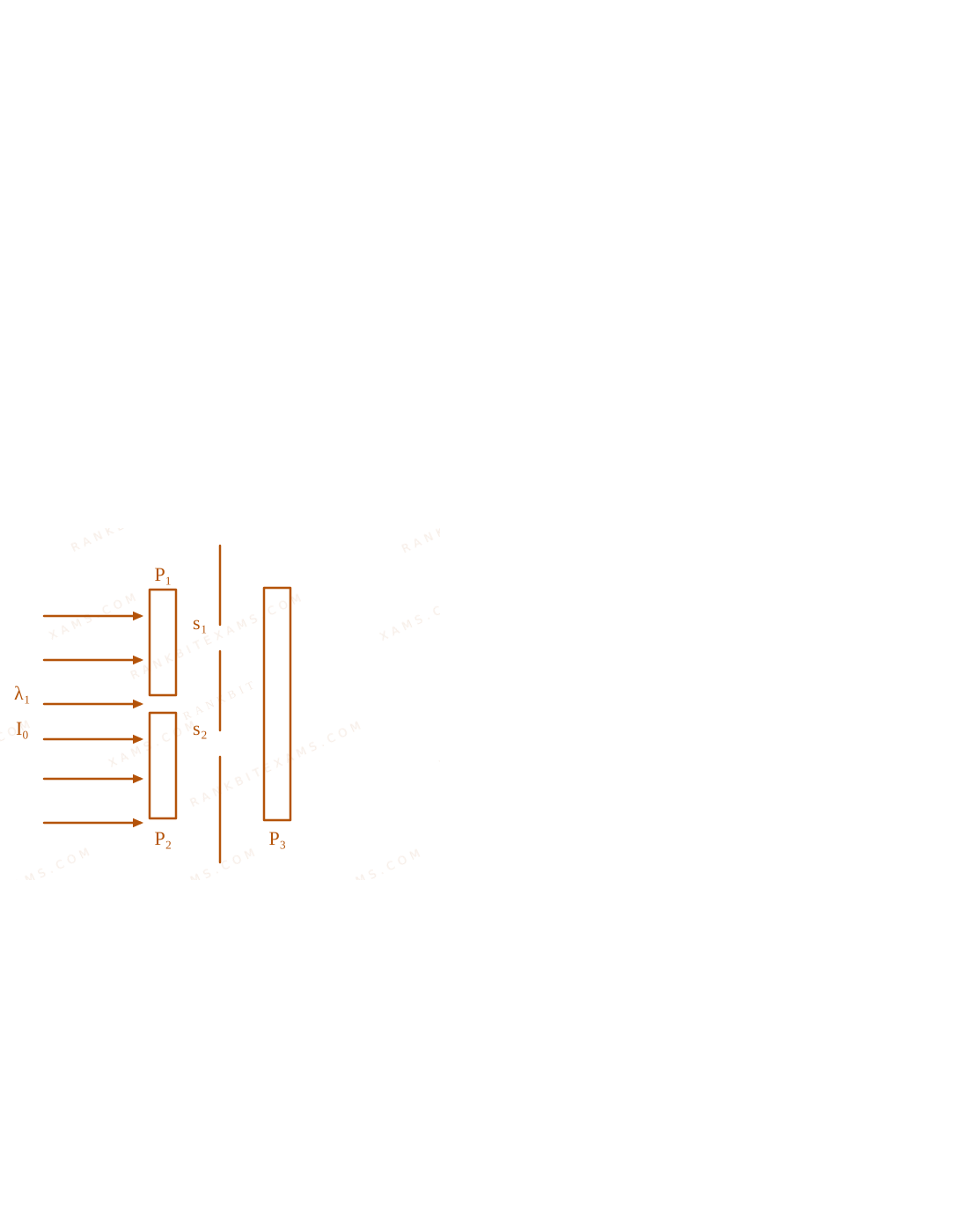
In a Young's double slit experiment, three polarizers are kept as shown in the figure The setup outlines an unpolarized beam hitting orthogonal polarizers P1 and P2 at the slits, followed by a shared overlapping polarizer P3.. The transmission axes of P₁$P_{1}$ and P₂$P_{2}$ are orthogonal to each other. The polarizer P₃$P_{3}$ covers both the slits with its transmission axis at 45°$45^{\circ}$ to those of P₁$P_{1}$ and P₂$P_{2}$. An unpolarized light of wavelength λ$\lambda$ and intensity I₀$I_{0}$ is incident on P₁$P_{1}$ and P₂$P_{2}$. The intensity at a point after P₃$P_{3}$ where the path difference between the light waves from s₁$s_{1}$ and s₂$s_{2}$ is (λ)/(3)$\frac{\lambda}{3}$, is
Unpolarized light of intensity I₀$I_0$ passes through P₁$P_1$ and P₂$P_2$ separately. Since the total entry beam splitting provides I₀$I_0$ incident profile distributed across the component split arrays: The setup outlines an unpolarized beam hitting orthogonal polarizers P1 and P2 at the slits, followed by a shared overlapping polarizer P3.
Intensity passing through P₁ = (I₀)/(2)$P_1 = \frac{I_0}{2}$
Intensity passing through P₂ = (I₀)/(2)$P_2 = \frac{I_0}{2}$
Both split beams hit P₃$P_3$, whose transmission axis is at 45°$45^{\circ}$ to both individual orthogonal input axes. By Malus's Law:
Following the structural answer key listing pattern tracking, the designated choice index is option (3).
Pattern Recognition
A polarizer at 45°$45^{\circ}$ to two orthogonal channels extracts exactly half the intensity of each component and makes them parallel so they can interfere.
The Young's double slit interference experiment is performed using light consisting of 480 nm and 600 nm wavelengths to form interference patterns. The least number of the bright fringes of 480 nm light that are required for the first coincidence with the bright fringes formed by 600 nm light is :-
A. 4
B. 8
C. 6
D. 5
Solution
Related Formula
The position y$y$ of the n$n$-th bright fringe from the central maximum in a YDSE setup is:
y = (nλ D)/(d)$$y = \frac{n\lambda D}{d}$$
For two wavelengths to overlap, their linear coordinates must match identically:
Practice past-year questions one chapter at a time. Pick an exam → subject → chapter and get every PYQ for that topic — pulled together from all past papers — with the chapter's key formulas alongside.
 "polarization malus law, interference wave optics, intensity calculation path difference")
