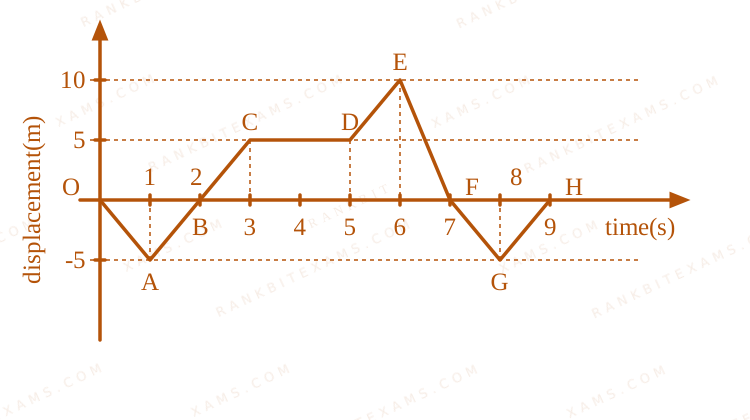
The displacement x versus time graph is shown below.
Displacement vs time plot with piecewise segments
A graph plotting displacement vs time tracking linear changes, plateaus, and reversals.
(A) The average velocity during 0 to 3 s is 10 m/s (B) The average velocity during 3 to 5 s is 0 m/s (C) The instantaneous velocity at t=2 s is 5 m/s (D) The average velocity during 5 to 7 s and instantaneous velocity at t=6.5 s are equal (E) The average velocity from t=0 to t=9 s is zero Choose the correct answer from the options given below:

Solution & Explanation

Related Formula
v = (Δ x)/(Δ t) = (xf - xᵢ)/(tf - tᵢ) vᵢₙₛₜ = (dx)/(dt) = slope of x-t graph
Core Logic

Let's test each statement using coordinates from the given graph:

  • For (A): At t=0, x=0; at t=3, x=5. v = (5-0)/(3) = (5)/(3) m/s ≠ 10 m/s (Incorrect).
  • For (B): At t=3, x=5; at t=5, x=5. v = (5-5)/(2) = 0 m/s (Correct).
Step 1: Evaluate Remaining Statements
  • For (C): Segment from 0 to 3s passes through points (0, -5) or starts linearly. The slope from t=0 to t=3 can be calculated from the linear line segment: slope = (5 - (-10))/(3) = 5 m/s. Thus, instantaneous velocity at t=2 s is 5 m/s (Correct).
  • For (D): Slope during 5 to 7s vs instantaneous slope at t=6.5 s are completely different because the path changes slope.
  • For (E): At t=0, x=-5 and at t=9, x=-5. Since net displacement is zero, the average velocity from t=0 to t=9 s is zero (Correct).
  • Thus, (B), (C), and (E) are the correct statements.

Pattern Recognition

Average velocity requires only initial and final positions (xf, xᵢ). Instantaneous velocity reads directly off the segment's geometric slope. If initial and final coordinates match, average velocity is unconditionally zero.

Chapter Mix

Class 11 Physics: Motion in a Straight Line

Reference Study Guides

More Motion in a Straight Line Previous-Year Questions — Page 8

Q44 jee_main_2024_31_jan_evening Vector Algebra
If two vectors A and B having equal magnitude R are inclined at an angle θ, then
  • A. | A - B| = √(2)R ((θ)/(2))
  • B. | A + B| = 2R ((θ)/(2))
  • C. | A + B| = 2R ((θ)/(2))
  • D. | A - B| = 2R ((θ)/(2))

Solution

Related Formula

The magnitude of the resultant vector is given by:

| Rᵣₑₛ| = √(A² + B² + 2AB θ)
Core Logic

Let | A| = | B| = R. Then for vector addition:

| A + B| = √(R² + R² + 2R² θ)
Step 1: Simplify Addition Form
| A + B| = √(2R² (1 + θ))

Using the trigonometric identity 1 + θ = 2 ² ((θ)/(2)):

| A + B| = √(2R² × 2 ² ((θ)/(2))) = 2R ((θ)/(2))
Step 2: Cross-check Subtraction Form

For subtraction:

| A - B| = √(R² + R² - 2R² θ) | A - B| = √(2R² (1 - θ)) = √(2R² × 2 ² ((θ)/(2))) = 2R ((θ)/(2))

Checking options, only | A + B| = 2R ((θ)/(2)) is correctly paired in the choice list.

Pattern Recognition

Standard geometry shortcut: Addition of two equal vectors yields a cosine half-angle dependency. Subtraction yields a sine half-angle dependency. (+ → ), (- → ).

Chapter Mix

Class 11 Physics: Motion in a Plane
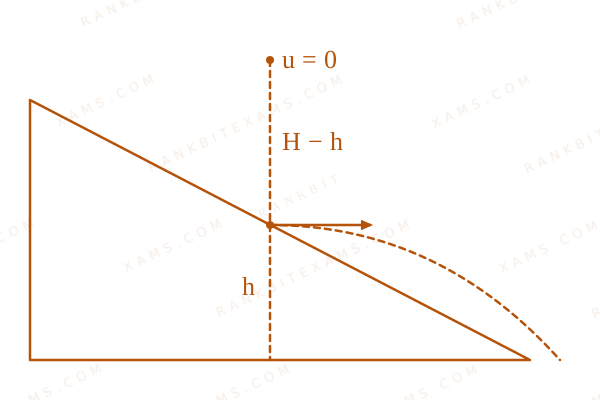
Q jee_main_2024_31_jan_morning Projectile Motion
A body starts falling freely from height H hits an inclined plane in its path at height h. As a result of this perfectly elastic impact, the direction of the velocity of the body becomes horizontal. The value of (H)/(h) for which the body will take the maximum time to reach the ground is
Numerical Answer. Answer: 2 to 2

Solution

Related Formula
t = √((2d)/(g))
Core Logic

Projectile Motion diagram for Q55 - JEE Main 2024 Morning

The body falls freely from height H to height h. The distance fallen is (H - h). Time taken to fall this distance:

t₁ = √((2(H - h))/(g))

After elastic impact, the vertical velocity becomes zero (the entire velocity is directed horizontally). From height h, it now acts as a horizontal projectile. The time taken to reach the ground vertically from height h is:

t₂ = √((2h)/(g))

Total time of flight T = t₁ + t₂:

T = √((2(H - h))/(g)) + √((2h)/(g))
Step 2: Maximizing Time

To find the maximum time T, differentiate T with respect to h and equate to zero:

(dT)/(dh) = √((2)/(g)) ( -12√(H - h) + 12√(h) ) = 0 12√(h) = 12√(H - h) √(H - h) = √(h)

Squaring both sides: H - h = h H = 2h

(H)/(h) = 2
Chapter Mix

Class 11 Physics: Kinematics

Q33 jee_main_2024_31_jan_morning Differentiation In Kinematics
The relation between time 't' and distance 'x' is t = α x² + β x, where α and β are constants. The relation between acceleration (a) and velocity (v) is:
  • A. a = -2α v³
  • B. a = -5α v⁵
  • C. a = -3α v²
  • D. a = -4α v⁴

Solution

Related Formula
v = (dx)/(dt) a = (dv)/(dt) = v(dv)/(dx)
Step 1: Differentiate with respect to time

Given the equation:

t = α x² + β x

Differentiating with respect to time t:

(dt)/(dt) = (d)/(dt)(α x² + β x) 1 = 2α x (dx)/(dt) + β (dx)/(dt) 1 = (2α x + β) v v = (2α x + β)⁻¹
Step 2: Calculate Acceleration

Now, acceleration a = (dv)/(dt). Differentiating v with respect to time t:

a = (d)/(dt) [ (2α x + β)⁻¹ ] a = -1(2α x + β)⁻² · (d)/(dt)(2α x + β) a = -(2α x + β)⁻² · (2α) (dx)/(dt)

Substitute v and (2α x + β)⁻² = v²:

a = -(v²) · (2α) · v a = -2α v³
Pattern Recognition

Standard kinematic shortcut: Whenever t = Ax² + Bx, v = (2Ax+B)⁻¹ and a = -2A v³. Memorizing this directly saves derivation time during the exam.

Chapter Mix

Class 11 Physics: Kinematics

More Motion in a Straight Line Questions — jee_main_2025_04_april_evening

Practice all Motion in a Straight Line previous-year questions →

Rankbit System
JEE Physics: Waves (+15.5%) | Electrostatics: Concentric Shells (-29.7%) | Modern Physics: Photoelectric Clones (+34.2%) | Mathematics: Definite Integrals (+18.1%) | Chemistry: Coordination Splitting (-11.4%) | JEE Physics: Waves (+15.5%) | Electrostatics: Concentric Shells (-29.7%) | Modern Physics: Photoelectric Clones (+34.2%) | Mathematics: Definite Integrals (+18.1%) | Chemistry: Coordination Splitting (-11.4%)
