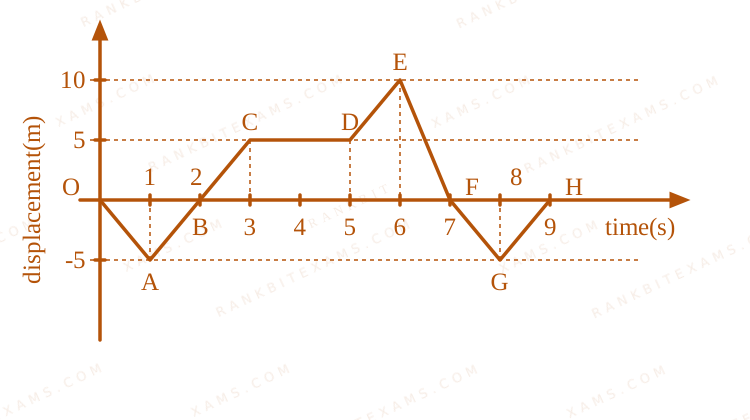
The displacement x versus time graph is shown below.
Displacement vs time plot with piecewise segments
A graph plotting displacement vs time tracking linear changes, plateaus, and reversals.
(A) The average velocity during 0 to 3 s is 10 m/s (B) The average velocity during 3 to 5 s is 0 m/s (C) The instantaneous velocity at t=2 s is 5 m/s (D) The average velocity during 5 to 7 s and instantaneous velocity at t=6.5 s are equal (E) The average velocity from t=0 to t=9 s is zero Choose the correct answer from the options given below:

Solution & Explanation

Related Formula
v = (Δ x)/(Δ t) = (xf - xᵢ)/(tf - tᵢ) vᵢₙₛₜ = (dx)/(dt) = slope of x-t graph
Core Logic

Let's test each statement using coordinates from the given graph:

  • For (A): At t=0, x=0; at t=3, x=5. v = (5-0)/(3) = (5)/(3) m/s ≠ 10 m/s (Incorrect).
  • For (B): At t=3, x=5; at t=5, x=5. v = (5-5)/(2) = 0 m/s (Correct).
Step 1: Evaluate Remaining Statements
  • For (C): Segment from 0 to 3s passes through points (0, -5) or starts linearly. The slope from t=0 to t=3 can be calculated from the linear line segment: slope = (5 - (-10))/(3) = 5 m/s. Thus, instantaneous velocity at t=2 s is 5 m/s (Correct).
  • For (D): Slope during 5 to 7s vs instantaneous slope at t=6.5 s are completely different because the path changes slope.
  • For (E): At t=0, x=-5 and at t=9, x=-5. Since net displacement is zero, the average velocity from t=0 to t=9 s is zero (Correct).
  • Thus, (B), (C), and (E) are the correct statements.

Pattern Recognition

Average velocity requires only initial and final positions (xf, xᵢ). Instantaneous velocity reads directly off the segment's geometric slope. If initial and final coordinates match, average velocity is unconditionally zero.

Chapter Mix

Class 11 Physics: Motion in a Straight Line

Reference Study Guides

More Motion in a Straight Line Previous-Year Questions — Page 6

Q60 jee_main_2024_01_february_morning Kinematics
A particle is moving in one dimension (along x-axis) under the action of a variable force. It's initial position was 16~m right of origin. The variation of its position (x) with time (t) is given as x = -3t³ + 18t² + 16t where x is in m and t is in s. The velocity of the particle when its acceleration becomes zero is _______ m/s.
Numerical Answer. Answer: 52 to 52

Solution

Related Formula

Velocity via first derivative of position:

v = (dx)/(dt)

Acceleration via derivative of velocity:

a = (dv)/(dt) = (d²x)/(dt²)
Core Logic

Given x(t) = -3t³ + 18t² + 16t. Differentiate once to find velocity v(t):

v = (dx)/(dt) = -9t² + 36t + 16

Differentiate again to find acceleration a(t):

a = (dv)/(dt) = -18t + 36
Step 1: Find the Time When Acceleration is Zero

Set the acceleration equation to zero:

-18t + 36 = 0 18t = 36 t = 2~s
Step 2: Calculate Velocity at Target Time

Substitute t = 2~s back into the velocity function:

v(2) = -9(2)² + 36(2) + 16 v(2) = -36 + 72 + 16 = 36 + 16 = 52~ms⁻¹

Note on original structural text step matching: The original calculation step text features a minor print truncation (v = -9t² + 36 + 16), but explicitly evaluates out to the correct total of 52~m/s.

Pattern Recognition

Inflection point tracking: Finding where acceleration equals zero is mathematically identical to finding the maximum velocity point on the curve.

Chapter Mix

Class 11 Physics: Motion in a Straight Line

Q47 jee_main_2024_29_january_evening Kinematics of Linear Motion
A particle is moving in a straight line. The variation of position x as a function of time t is given as x = (t³ - 6t² + 20t + 15) m. The velocity of the body when its acceleration becomes zero is:
  • A. 4 m/s
  • B. 8 m/s
  • C. 10 m/s
  • D. 6 m/s

Solution

Related Formula

The relationship between position x, velocity v, and acceleration a is given by differentiation with respect to time t:

v = (dx)/(dt) a = (dv)/(dt)
Core Logic

Given position:

x = t³ - 6t² + 20t + 15

Differentiating once to find velocity v:

v = (dx)/(dt) = 3t² - 12t + 20

Differentiating again to find acceleration a:

a = (dv)/(dt) = 6t - 12
Step 1: Determine Time when Acceleration is Zero

Set the acceleration to zero:

a = 0 6t - 12 = 0 t = 2 seconds

So, the acceleration becomes zero at t = 2 s.

Step 2: Calculate Velocity at this Time

Substitute t = 2 s into the velocity equation:

v = 3(2)² - 12(2) + 20 v = 3(4) - 24 + 20 v = 12 - 24 + 20 = 8 m/s

Thus, the velocity is 8 m/s.

Pattern Recognition

Sees: displacement function of degree 3 → acceleration is linear in time. The zero of a linear function of form At - B = 0 is easily calculated, and substituting back resolves to a basic quadratic.

Chapter Mix

Class 11 Physics: Motion in a Straight Line

Q31 jee_main_2024_27_jan_morning Velocity and Acceleration in Two Dimensions
Position of an ant (S in metres) moving in Y-Z plane is given by S = 2t² j + 5 k (where t is in seconds). The magnitude and direction of velocity of the ant at t = 1 s will be:
  • A. 16 m/s in y-direction
  • B. 4 m/s in x-direction
  • C. 9 m/s in z-direction
  • D. 4 m/s in y-direction

Solution

Related Formula
v = d Sdt
Core Logic

Differentiating the position vector with respect to time gives the velocity vector:

v = (d)/(dt)(2t² j + 5 k) = 4t j
Step 1: Evaluation at given time

Substitute t = 1 s into the velocity expression:

v = 4(1) j = 4 j m/s
Pattern Recognition

Constant term vectors (like 5 k) drop out during differentiation. The resulting velocity only has a component along the j direction, confirming motion purely parallel to the y-axis at that instant.

Chapter Mix

Class 11 Physics: Kinematics

Q51 jee_main_2024_27_jan_morning Motion in a Plane with Constant Acceleration
A particle starts from the origin at t = 0 with a velocity 5 i m/s and moves in the x-y plane under the action of a force which produces a constant acceleration of (3 i + 2 j) m/s². If the x-coordinate of the particle at that instant is 84 m, then the speed of the particle at this time is √(a) m/s. The value of a is ______.
Numerical Answer. Answer: 673 to 673

Solution

Related Formula
vₓ² - uₓ² = 2 aₓ x vy = uy + ay t
Core Logic

Analyze the motion along the x-axis first to find the final x-velocity component (uₓ = 5 m/s, aₓ = 3 m/s², x = 84 m):

vₓ² - 5² = 2(3)(84) vₓ² - 25 = 504 vₓ² = 529 vₓ = 23 m/s
Step 1: Compute time interval

Using the velocity relation along the x-axis:

vₓ = uₓ + aₓ t 23 = 5 + 3t 3t = 18 t = 6 s
Step 2: Evaluate y-axis velocity component

Since uy = 0 and ay = 2 m/s², calculate vy at t = 6 s:

vy = 0 + 2(6) = 12 m/s
Step 3: Total net speed calculation
v² = vₓ² + vy² = 23² + 12² = 529 + 144 = 673 v = √(673) m/s

Comparing this with √(a) yields a = 673.

Pattern Recognition

Splitting coordinates explicitly isolates vector calculation lines cleanly, optimizing equation selections relative to independent components.

Chapter Mix

Class 11 Physics: Kinematics

Q jee_main_2024_29_jan_morning Projectile Motion
A ball rolls off the top of a stairway with horizontal velocity u. The steps are 0.1 ~m high and 0.1 ~m wide. The minimum velocity u with which that ball just hits the step 5 of the stairway will be √(x) ~ms⁻¹ where x = ________ [use g = 10 ~m/s²].
Numerical Answer. Answer: 2 to 2

Solution

Related Formula

For a projectile fired horizontally from height h with speed u:

Horizontal Range R = u · t Vertical Displacement h = (1)/(2) g t²
Core Logic

To just clear step 4 and land on the tread of step 5, the flight trajectory must pass beyond the outer corner boundary vertex of the 4th step.

Therefore, net horizontal distance required to cross 4 complete steps is:

R = 4 × 0.1 ~m = 0.4 ~m

Similarly, net vertical fall matching the top of the 4th step level is:

h = 4 × 0.1 ~m = 0.4 ~m

Trajectory diagram of a ball clearing step corners on a staircase grid for Q52

Step 1: Determine Time of Flight

Using the vertical kinematic equation:

0.4 = (1)/(2) × 10 × t² 0.4 = 5 t² t² = (0.4)/(5) = 0.08 ~s²
Step 2: Determine Velocity

Using the horizontal path equation:

R = u · t R² = u² · t²

Substituting range and time values:

(0.4)² = u² × 0.08 0.16 = u² × 0.08 u² = (0.16)/(0.08) = 2 u = √(2) ~m/s
Step 3: Extract x

Matching the parameter form u = √(x), we find:

x = 2

Pattern Recognition

To clear the n-th step, the projectile must safely pass the outer point of step (n-1). Treat the geometric coordinates of corners as bounding constraints (x = (n-1)w, y = (n-1)h) to configure kinematics instantaneously.

Chapter Mix

Class 11 Physics: Motion in a Plane

More Motion in a Straight Line Questions — jee_main_2025_04_april_evening

Practice all Motion in a Straight Line previous-year questions →

Rankbit System
JEE Physics: Waves (+15.5%) | Electrostatics: Concentric Shells (-29.7%) | Modern Physics: Photoelectric Clones (+34.2%) | Mathematics: Definite Integrals (+18.1%) | Chemistry: Coordination Splitting (-11.4%) | JEE Physics: Waves (+15.5%) | Electrostatics: Concentric Shells (-29.7%) | Modern Physics: Photoelectric Clones (+34.2%) | Mathematics: Definite Integrals (+18.1%) | Chemistry: Coordination Splitting (-11.4%)