JEE Main · Physics ↓ Falling

Mechanical Properties of Solids appeared 21 times across 3 years — 2.4% of Physics. This question is from Elastic Moduli.

Year 2026 2025 2024 Total
Questions 4 9 8 21

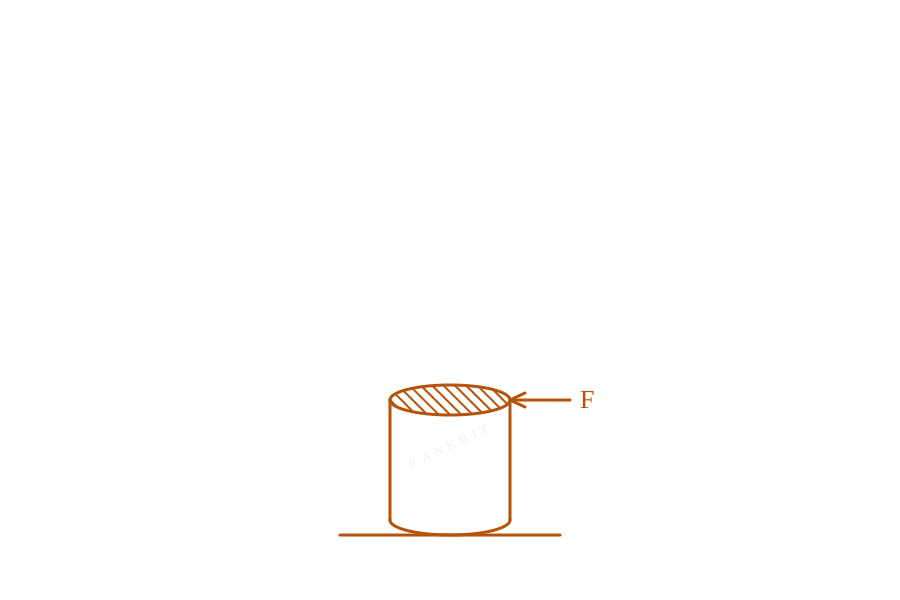
A cylindrical rod of length 1 m and radius 4 cm is mounted vertically. It is subjected to a shear force of 10⁵ N at the top. Considering infinitesimally small displacement in the upper edge, the angular displacement θ of the rod axis from its original position would be : (shear moduli, G=10¹⁰ N/m²)

Solution & Explanation

Related Formula
G = σshearθ = (F)/(A · θ)

where A = π r² is the cross-sectional area.

Core Logic

Rearranging the formula for θ:

θ = (F)/(A · G) = (F)/(π r² · G)

Substituting the values:

F = 10⁵ N r = 4 cm = 4 × 10⁻² m G = 10¹⁰ N/m²
Step 1: Calculate Angular Displacement
θ = 10⁵π × (4 × 10⁻²)² × 10¹⁰ θ = 10⁵π × 16 × 10⁻⁴ × 10¹⁰ = (10⁵)/(16π × 10⁶) θ = (1)/(160π) radians
Pattern Recognition

Shear strain definition is straightforwardly matching the geometry angle of shift. Avoid radius-to-diameter or unit mismatches.

Chapter Mix

Class 11 Physics: Mechanical Properties of Solids

Shear stress configuration on vertical rod

Reference Study Guides

More Mechanical Properties of Solids Previous-Year Questions — Page 3

Q24 jee_main_2025_24_jan_evening Bulk Modulus
The increase in pressure required to decrease the volume of a water sample by 0.2% is P × 10⁵ Nm ⁻² . Bulk modulus of water is 2.15 × 10⁹ Nm ⁻² . The value of P is ____.
Numerical Answer. Answer: 43 to 43

Solution

Related Formula

Bulk Modulus formula:

B = - (Δ P)/((Δ V)/(V)) Δ P = B ( (-Δ V)/(V) )
Core Logic

Given specifications:

  • Fractional volume drop, (-Δ V)/(V) = 0.2% = (0.2)/(100) = 2 × 10⁻³
  • Bulk modulus value, B = 2.15 × 10⁹ N/m²
  • Calculating excess pressure:

Δ P = 2.15 × 10⁹ × 2 × 10⁻³ Δ P = 4.3 × 10⁶ N/m² = 43 × 10⁵ N/m²

Comparing with P × 10⁵, we get P = 43.

Pattern Recognition

Bulk modulus measures a fluid's resistance to compression. A tiny percentage reduction in volume requires a massive amount of pressure due to water's near-incompressibility.

Chapter Mix

Class 11 Physics: Mechanical Properties of Solids

Q23 jee_main_2025_28_jan_evening Bulk Modulus
The volume contraction of a solid copper cube of edge length 10cm , when subjected to a hydraulic pressure of 7 × 10⁶Pa , would be ____________ mm³ . (Given bulk modulus of copper = 1.4 × 10¹¹ Nm⁻² )
Numerical Answer. Answer: 50

Solution

Related Formula

Bulk modulus B measures a material's resistance to uniform compression and is defined as the ratio of hydraulic pressure to volumetric strain:

B = (Δ P)/(((Δ V)/(V))) Δ V = (Δ P · V)/(B)
Core Logic

Given parameters [cite: 192, 193]:

  • Edge length of the cube, a = 10 cm = 0.1 m
  • Initial volume, V = a³ = (0.1)³ = 10⁻³ m³ = 10⁶ mm³
  • Hydraulic pressure increase, Δ P = 7 × 10⁶ Pa
  • Bulk Modulus, B = 1.4 × 10¹¹ N/m²
  • Substitute these values into the volume change equation :

Δ V = 7 × 10⁶ × 10⁻³1.4 × 10¹¹ Δ V = 7 × 10³1.4 × 10¹¹ = 5 × 10⁻⁷ m³

Convert the volume contraction into mm³:

Δ V = 5 × 10⁻⁷ × (10³)³ mm³ = 5 × 10⁻⁷ × 10⁹ mm³ = 50 mm³
Pattern Recognition

Always perform unit conversions carefully at the final step to avoid handling complex decimals during calculations. Converting 1 m³ = 10⁹ mm³ ensures a clean, error-free conversion.

Chapter Mix

Class 11 Physics: Mechanical Properties of Solids

Q jee_main_2025_29_jan_morning Elasticity
The fractional compression ( V) of water at the depth of 2.5km below the sea level is % Given, the Bulk modulus of water = 2× 10⁹Nm⁻² , density of water = 10³kgm⁻³ , acceleration due to gravity = g = 10ms⁻² .
  • A. 1.75
  • B. 1.0
  • C. 1.5
  • D. 1.25

Solution

Related Formula
B = (Δ P)/(((Δ V)/(V))) = (ρ g h)/(((Δ V)/(V)))
Core Logic

Calculate the hydrostatic pressure change at depth h = 2.5 km = 2500 m :

Δ P = ρ g h = 10³ · 10 · 2500 = 2.5 × 10⁷ ~N· m⁻²

Now compute the percentage fractional compression :

(Δ V)/(V) × 100 = (Δ P)/(B) × 100 = (2.5 × 10⁷)/(2 × 10⁹) × 100% = 1.25%
Chapter Mix

Class 11 Physics: Mechanical Properties of Solids Class 11 Physics: Mechanical Properties of Fluids

Q jee_main_2024_01_february_morning Elastic Moduli
With rise in temperature, the Young's modulus of elasticity:
  • A. changes erratically
  • B. decreases
  • C. increases
  • D. remains unchanged

Solution

Related Formula

Intermolecular forces weaken as thermal agitation increases:

Y = StressStrain
Core Logic

When temperature rises, the mean separation between atoms or molecules increases due to thermal expansion. This weakens the intermolecular binding forces, making the material easier to deform for the same amount of applied stress. Consequently, the value of Young's modulus decreases with a rise in temperature.

Step 1: Final Conclusion

Thus, Young's modulus of elasticity decreases with the increase in temperature.

Pattern Recognition

Temperature up arrow Thermal expansion up arrow Intermolecular bonds weaken arrow Modulus of elasticity down.

Chapter Mix

Class 11 Physics: Mechanical Properties of Solids

Q43 jee_main_2024_29_january_evening Hooke's Law and Young's Modulus
A wire of length L and radius r is clamped at one end. If its other end is pulled by a force F, its length increases by l. If the radius of the wire and the applied force both are reduced to half of their original values keeping original length constant, the increase in length will become:
  • A. 3 times
  • B. (3)/(2) times
  • C. 4 times
  • D. 2 times

Solution

Related Formula

Young's modulus Y is defined as:

Y = StressStrain = (F / A)/(l / L) = (F L)/(A l)

Solving for the extension l:

l = (F L)/(A Y) = (F L)/(π r² Y)

Since the material does not change, Y remains constant.

Core Logic

Let the original parameters be F, r, L, l. The extension is:

l = (F L)/(π r² Y) (i)

When the force and radius are both halved, keeping original length L and Young's Modulus Y constant:

  • New Force, F' = (F)/(2)
  • New Radius, r' = (r)/(2)
  • The new extension l' is:

l' = (F' L)/(π (r')² Y) = ((F/2) L)/(π (r/2)² Y) l' = (F L / 2)/(π r² Y / 4) = 2 ( (F L)/(π r² Y) )
Step 1: Calculate Final Extension

Comparing this with equation (i):

l' = 2l

Thus, the increase in length becomes 2 times its original value.

Pattern Recognition

From the formula l ∝ (F)/(r²), if F is scaled by (1)/(2) and r by (1)/(2), the scaling factor for l is (1/2)/((1/2)²) = 2 directly.

Chapter Mix

Class 11 Physics: Mechanical Properties of Solids

More Mechanical Properties of Solids Questions — jee_main_2025_04_april_evening

Practice all Mechanical Properties of Solids previous-year questions →

Rankbit System
JEE Physics: Waves (+15.5%) | Electrostatics: Concentric Shells (-29.7%) | Modern Physics: Photoelectric Clones (+34.2%) | Mathematics: Definite Integrals (+18.1%) | Chemistry: Coordination Splitting (-11.4%) | JEE Physics: Waves (+15.5%) | Electrostatics: Concentric Shells (-29.7%) | Modern Physics: Photoelectric Clones (+34.2%) | Mathematics: Definite Integrals (+18.1%) | Chemistry: Coordination Splitting (-11.4%)