The speed of a longitudinal wave in a metallic bar is 400 text m/s$400 \text{ m/s}$. If the density and Young's modulus of the bar material are increased by 0.5% and 1% respectively then the speed of the wave is changed approximately to ____ m/s.
A.399$399$
B.398$398$
C.402$402$
D.401$401$
Solution & Explanation
### Related Formula
V_textsound = sqrtfracYrho$$V_{\text{sound}} = \sqrt{\frac{Y}{\rho}}$$
where Y$Y$ is Young's modulus and rho$\rho$ is density.
### Core Logic
Taking natural logarithm on both sides:
ln V = frac12 ln Y - frac12 ln rho$$\ln V = \frac{1}{2} \ln Y - \frac{1}{2} \ln \rho$$
Differentiating to find fractional errors/changes:
fracDelta VV = frac12 fracDelta YY - frac12 fracDelta rhorho$$\frac{\Delta V}{V} = \frac{1}{2} \frac{\Delta Y}{Y} - \frac{1}{2} \frac{\Delta \rho}{\rho}$$
### Step 1: Calculate Percentage Change
Multiply by 100 to get percentages:
fracDelta VV times 100 = frac12 left( fracDelta YY times 100 right) - frac12 left( fracDelta rhorho times 100 right)$$\frac{\Delta V}{V} \times 100 = \frac{1}{2} \left( \frac{\Delta Y}{Y} \times 100 \right) - \frac{1}{2} \left( \frac{\Delta \rho}{\rho} \times 100 \right)$$
Given fracDelta YY times 100 = 1\%$\frac{\Delta Y}{Y} \times 100 = 1\%$ and fracDelta rhorho times 100 = 0.5\%$\frac{\Delta \rho}{\rho} \times 100 = 0.5\%$.
fracDelta VV times 100 = frac12(1\%) - frac12(0.5\%) = 0.5\% - 0.25\% = 0.25\%$$\frac{\Delta V}{V} \times 100 = \frac{1}{2}(1\%) - \frac{1}{2}(0.5\%) = 0.5\% - 0.25\% = 0.25\%$$
### Step 2: Calculate New Speed
fracDelta VV = frac0.25100 = frac1400$$\frac{\Delta V}{V} = \frac{0.25}{100} = \frac{1}{400}$$Delta V = frac1400 times 400 = 1 text m/s$$\Delta V = \frac{1}{400} \times 400 = 1 \text{ m/s}$$
The final speed is:
V_textfinal = V + Delta V = 400 + 1 = 401 text m/s$$V_{\text{final}} = V + \Delta V = 400 + 1 = 401 \text{ m/s}$$
### Pattern Recognition
For products and quotients of the form A^a / B^b$A^a / B^b$, the small percentage change is pm a(\%Delta A) mp b(\%Delta B)$\pm a(\%\Delta A) \mp b(\%\Delta B)$. Here, velocity scales with Y^1/2 rho^-1/2$Y^{1/2} \rho^{-1/2}$, so change is frac12(\%Delta Y) - frac12(\%Delta rho)$\frac{1}{2}(\%\Delta Y) - \frac{1}{2}(\%\Delta \rho)$.
### Evaluation Rubric / Model Answer
null
### Chapter Mix
Class 11 Physics: Mechanical Properties of Solids
Class 11 Physics: Waves
Keywords:#speed of a longitudinal wave in a metallic bar#JEE Main 2026 Evening Q34#Mechanical Properties of Solids JEE Main 2026#Speed of Longitudinal Wave JEE Main 2026
More Mechanical Properties of Solids Previous-Year Questions
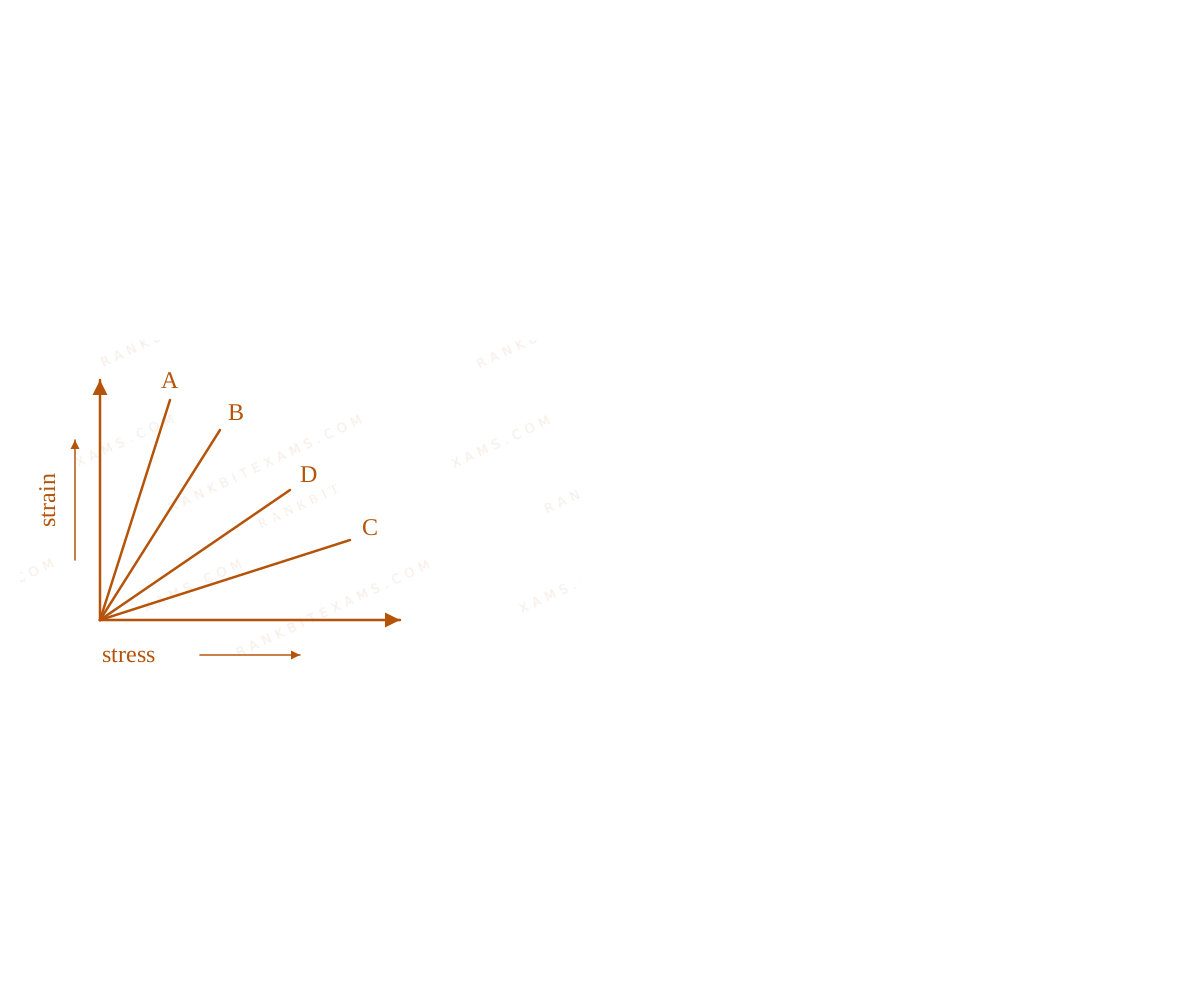
The strain-stress plot for materials A, B, C and D is shown in the figure. Which material has the largest Young's modulus?
A graph plotting Strain on the y-axis vs Stress on the x-axis for four materials.
A. C
B. D
C. A
D. B
Solution
### Related Formula
Y = fractextStresstextStrain$$Y = \frac{\text{Stress}}{\text{Strain}}$$
### Core Logic
In a plot where Strain is on the y-axis and Stress is on the x-axis, the slope of the line equals Strain/Stress.
Slope = fractextStraintextStress = frac1Y$$Slope = \frac{\text{Strain}}{\text{Stress}} = \frac{1}{Y}$$
Since Y = frac1Slope$Y = \frac{1}{Slope}$, the material with the largest Young's modulusY$Y$ will correspond to the line with the minimum slope (least steep line).
### Step 1: Final Conclusion
From the given graph, curve C is closest to the x-axis, meaning it has the smallest slope. Therefore, material C has the largest Young's modulus.
### Pattern Recognition
Sees: "strain-stress plot" instead of standard "stress-strain plot" → The axes are swapped! Always double check axis labels. Strain on Y means Slope = 1/Y.
### Evaluation Rubric / Model Answer
null
### Chapter Mix
Class 11 Physics: Mechanical Properties of Solids
Q39jee_main_2026_24_january_morningThermal Stress
A brass wire of length 2m and radius 1mm at 27^circ$27^{\circ}$ C is held taut between two rigid supports. Initially it was cooled to a temperature of -43^circ$-43^{\circ}$ C creating a tension T in the wire. The temperature to which the wire has to be cooled in order to increase the tension in it to 1.4T, is ____^circ$^{\circ}$C
A.-86$-86$
B.-71$-71$
C.-65$-65$
D.-80$-80$
Solution
### Related Formula
textThermal Tension, T = Y A alpha Delta theta$$\text{Thermal Tension, } T = Y A \alpha \Delta \theta$$
### Core Logic
For the first cooling, the tension T$T$ generated is:
T = Y A alpha Delta theta_1$$T = Y A \alpha \Delta \theta_1$$T = Y A alpha (27 - (-43))$$T = Y A \alpha (27 - (-43))$$T = Y A alpha (70) quad dots text(i)$$T = Y A \alpha (70) \quad \dots \text{(i)}$$
Let theta$\theta$ be the final temperature required for a tension of 1.4T$1.4T$.
1.4T = Y A alpha (27 - theta) quad dots text(ii)$$1.4T = Y A \alpha (27 - \theta) \quad \dots \text{(ii)}$$
### Step 1: Ratio of Tensions
Dividing equation (ii) by equation (i):
frac1.4TT = frac27 - theta70$$\frac{1.4T}{T} = \frac{27 - \theta}{70}$$1.4 = frac27 - theta70$$1.4 = \frac{27 - \theta}{70}$$27 - theta = 1.4 times 70 = 98$$27 - \theta = 1.4 \times 70 = 98$$theta = 27 - 98 = -71^circ textC$$\theta = 27 - 98 = -71^{\circ} \text{C}$$
### Pattern Recognition
Thermal tension strictly scales with the absolute difference in temperature from the unstressed state, Delta theta$\Delta \theta$. Multiplying tension by a factor simply scales Delta theta$\Delta \theta$ by that identical factor.
### Evaluation Rubric / Model Answer
null
### Chapter Mix
Class 11 Physics: Mechanical Properties of Solids
Class 11 Physics: Thermal Properties of Matter
Two wires A and B made of different materials of length 6.0 cm and 5.4 cm, respectively and area of cross sections 3.0 times 10^-5 mathrm~m^2$3.0 \times 10^{-5} \mathrm{~m}^{2}$ and 4.5 times 10^-5 mathrm~m^2$4.5 \times 10^{-5} \mathrm{~m}^{2}$ , respectively are stretched by the same magnitude under a given load. The ratio of the Young's modulus of A to that of B is x : 3$x : 3$. The value of x is ____.
A.1$1$
B.4$4$
C.2$2$
D.5$5$
Solution
### Related Formula
Y = fractextStresstextStrain = fracF / ADelta ell / ell = fracF ellA Delta ell$$Y = \frac{\text{Stress}}{\text{Strain}} = \frac{F / A}{\Delta \ell / \ell} = \frac{F \ell}{A \Delta \ell}$$
### Core Logic
Since the wires are stretched by the same magnitude (Delta ell_A = Delta ell_B$\Delta \ell_A = \Delta \ell_B$) under the same load (F_A = F_B$F_A = F_B$), the Young's Modulus Y$Y$ is proportional to fracellA$\frac{\ell}{A}$.
### Step 1: Setting up the Ratio
fracY_AY_B = left(fracell_Aell_Bright) left(fracA_BA_Aright)$$\frac{Y_A}{Y_B} = \left(\frac{\ell_A}{\ell_B}\right) \left(\frac{A_B}{A_A}\right)$$
Substitute the given values:
ell_A = 6.0 mathrm~cm$\ell_A = 6.0 \mathrm{~cm}$ell_B = 5.4 mathrm~cm$\ell_B = 5.4 \mathrm{~cm}$A_A = 3.0 times 10^-5 mathrm~m^2$A_A = 3.0 \times 10^{-5} \mathrm{~m}^2$A_B = 4.5 times 10^-5 mathrm~m^2$A_B = 4.5 \times 10^{-5} \mathrm{~m}^2$
### Step 2: Calculation
fracY_AY_B = left(frac6.05.4right) left(frac4.5 times 10^-53.0 times 10^-5right)$$\frac{Y_A}{Y_B} = \left(\frac{6.0}{5.4}\right) \left(\frac{4.5 \times 10^{-5}}{3.0 \times 10^{-5}}\right)$$= left(frac6054right) left(frac4.53.0right)$$= \left(\frac{60}{54}\right) \left(\frac{4.5}{3.0}\right)$$= left(frac109right) left(frac1.51right) = frac159 = frac53$$= \left(\frac{10}{9}\right) \left(\frac{1.5}{1}\right) = \frac{15}{9} = \frac{5}{3}$$
### Step 3: Finding x
Given ratio is x : 3$x : 3$.
fracx3 = frac53 Rightarrow x = 5$$\frac{x}{3} = \frac{5}{3} \Rightarrow x = 5$$
### Pattern Recognition
Whenever "stretched by same magnitude under same load" appears, strip out F$F$ and Delta ell$\Delta \ell$ to leave Y propto ell / A$Y \propto \ell / A$.
### Evaluation Rubric / Model Answer
null
### Chapter Mix
Class 11 Physics: Mechanical Properties of Solids
Q24jee_main_2025_02_april_eveningHooke's Law and Elongation of String
The length of a light string is 1.4mathrmm$1.4\mathrm{m}$ when the tension on it is 5mathrmN$5\mathrm{N}$ . If the tension increases to 7mathrmN$7\mathrm{N}$ , the length of the string is 1.56mathrmm$1.56\mathrm{m}$ . The original length of the string is ______ mathrmm$\mathrm{m}$ .
Numerical Answer.Answer: 1 to 1
Solution
### Related Formula
By Hooke's Law, the tension (T$T$) in a stretched elastic string is proportional to its change in length:
T = k cdot Delta L = k(L - L_0)$$T = k \cdot \Delta L = k(L - L_0)$$
where:
k$k$ = spring constant of the string
L$L$ = current stretched length
L_0$L_0$ = natural original length
### Core Logic
We can set up two algebraic equations using the given conditions:
1. **Case 1:** Tension T_1 = 5 \ mathrmN$T_1 = 5 \ \mathrm{N}$ produces stretched length L_1 = 1.4 \ mathrmm$L_1 = 1.4 \ \mathrm{m}$:
5 = k(1.4 - L_0) quad dots (1)$$5 = k(1.4 - L_0) \quad \dots (1)$$
2. **Case 2:** Tension T_2 = 7 \ mathrmN$T_2 = 7 \ \mathrm{N}$ produces stretched length L_2 = 1.56 \ mathrmm$L_2 = 1.56 \ \mathrm{m}$:
7 = k(1.56 - L_0) quad dots (2)$$7 = k(1.56 - L_0) \quad \dots (2)$$
### Step 1: Solve for natural length
Divide equation (1) by equation (2) to eliminate the spring constant k$k$:
frac57 = frac1.4 - L_01.56 - L_0$$\frac{5}{7} = \frac{1.4 - L_0}{1.56 - L_0}$$
Cross-multiply and solve for L_0$L_0$:
5(1.56 - L_0) = 7(1.4 - L_0)$$5(1.56 - L_0) = 7(1.4 - L_0)$$7.8 - 5 L_0 = 9.8 - 7 L_0$$7.8 - 5 L_0 = 9.8 - 7 L_0$$
Rearrange to isolate the variable:
2 L_0 = 9.8 - 7.8 = 2$$2 L_0 = 9.8 - 7.8 = 2$$L_0 = 1 \ mathrmm$$L_0 = 1 \ \mathrm{m}$$
Thus, the original length of the string is 1 mathrm~m$1 \mathrm{~m}$.
### Pattern Recognition
Sees: Elastic stretching of a string/wire under variable load.
Trap: Attempting to resolve details like Young's modulus or cross-sectional area. Taking ratios allows the spring constant k$k$ to cancel cleanly, saving computational effort.
Shortcut: Use the ratio equation fracT_1T_2 = fracL_1 - L_0L_2 - L_0$\frac{T_1}{T_2} = \frac{L_1 - L_0}{L_2 - L_0}$ directly. Solving the linear equation yields L_0 = 1text m$L_0 = 1\text{ m}$.
### Evaluation Rubric / Model Answer
null
### Chapter Mix
Class 11 Physics: Mechanical Properties of Solids
More Mechanical Properties of Solids Questions — jee_main_2026_28_january_evening
We Map Every Repeating Question in Competitive Exams.
Say goodbye to generic mock test fatigue. RankBit uses smart analysis to group past exam questions into their foundational Repeating Question Types. Find chapter weightage, track repeating questions, and score higher with targeted practice.
Select Your Target Exam
Choose an exam track below to find formulas per chapter and patterns.
Syncing Exam Intelligence
Mapping formulas and patterns across all tracks…
PATH A — FULL LENGTH PRACTICE
Full Mock Test Hub
Simulate real NTA exam conditions with fully tracked mocks. Time yourself against past papers.
Practice past-year questions one chapter at a time. Pick an exam → subject → chapter and get every PYQ for that topic — pulled together from all past papers — with the chapter's key formulas alongside.