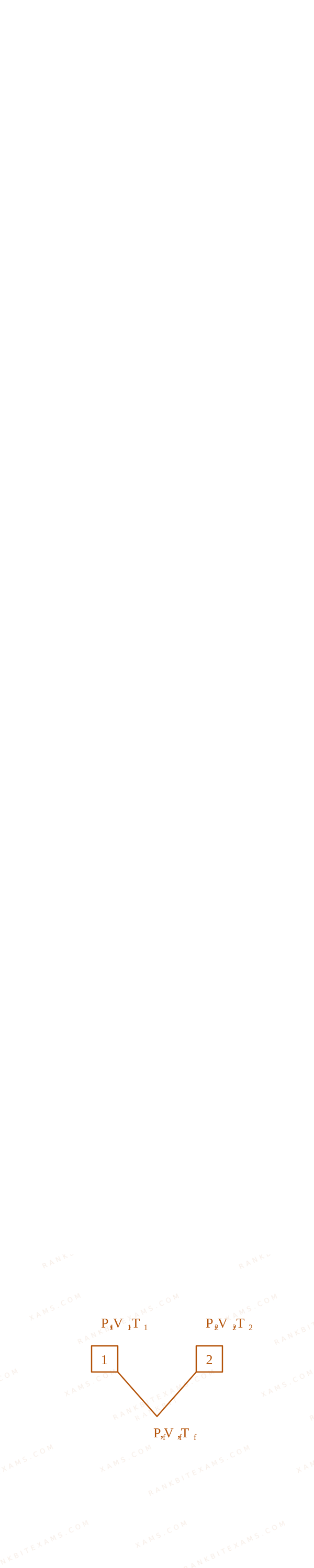
There are two vessels filled with an ideal gas where volume of one is double the volume of other. The large vessel contains the gas at 8 kPa at 1000 K while the smaller vessel contains the gas at 7 kPa at 500 K. If the vessels are connected to each other by a thin tube allowing the gas to flow and the temperature of both vessels is maintained at 600 K, at steady state the pressure in the vessels will be (in kPa).

Solution & Explanation

Related Formula

Ideal Gas Law:

n = (PV)/(RT)

Conservation of moles: n₁ + n₂ = nf

Core Logic

Let the volume of the smaller vessel be V₁ = V, then the volume of the larger vessel is V₂ = 2V. Initial moles in large vessel:

n₂ = (8 × 2V)/(R × 1000) = (16V)/(1000R)

Initial moles in small vessel:

n₁ = (7 × V)/(R × 500) = (14V)/(1000R)

Total total initial moles:

ntotal = n₁ + n₂ = (30V)/(1000R)
Step 1: Connect Vessels to Dynamic Equilibrium

When connected, the total final volume is Vf = V + 2V = 3V. The final temperature is Tf = 600 K. Using mole conservation:

(30V)/(1000R) = (Pf (3V))/(R × 600) (30)/(1000) = (3Pf)/(600) (30)/(1000) = (Pf)/(200)

Pf = (30 × 200)/(1000) = 6 kPa

Dual vessel gas flow schema

Pattern Recognition

Connecting chambers preserves the net mass/moles (Σ nᵢ = constant). Keep everything relative to a common volume multiplier V to easily cancel terms.

Chapter Mix

Class 11 Physics: Kinetic Theory

Reference Study Guides

More Kinetic Theory Previous-Year Questions — Page 5

Q50 jee_main_2024_27_jan_morning Kinetic Energy and Temperature
The average kinetic energy of a monatomic molecule is 0.414 eV at temperature:
  • A. 3000 K
  • B. 3200 K
  • C. 1600 K
  • D. 1500 K

Solution

Related Formula
Kavg = (3)/(2) kB T
Core Logic

Given energy is in electron-volts (1 eV = 1.6 × 10⁻¹⁹ J), we isolate T:

T = 2 Kavg3 kB

Substitute constants (kB = 1.38 × 10⁻²³ J/K):

Step 1: Compute value
T = 2 × 0.414 × 1.6 × 10⁻¹⁹3 × 1.38 × 10⁻²³ T = 1.3248 × 10⁻¹⁹4.14 × 10⁻²³ = 0.32 × 10⁴ = 3200 K
Pattern Recognition

Converting eV energy properties straight to structural SI standard Joules reveals highly cleanly simplified scalar components when paired with Boltzmann values.

Chapter Mix

Class 11 Physics: Kinetic Theory of Gases

Q50 jee_main_2024_29_jan_morning Ideal Gas Equation
Two vessels A and B are of the same size and are at same temperature. A contains 1 ~g of hydrogen and B contains 1 ~g of oxygen. PA and PB are the pressures of the gases in A and B respectively, then (PA)/(PB) is:
  • A. 16
  • B. 8
  • C. 4
  • D. 32

Solution

Related Formula

From the Ideal Gas Law equation:

P V = n R T P = (n R T)/(V)
Core Logic

Given that both vessels possess the same volume (VA = VB) and identical temperature states (TA = TB), the ratio of pressure reduces directly to:

(PA)/(PB) = (nA)/(nB)

where nA and nB are the number of moles of Hydrogen and Oxygen respectively.

Step 1: Calculate the Number of Moles

For Hydrogen (H₂, molar mass = 2 ~g/mol):

nA = (1)/(2)

For Oxygen (O₂, molar mass = 32 ~g/mol):

nB = (1)/(32)
Step 2: Find the Pressure Ratio

Substituting mole counts into the direct ratio:

(PA)/(PB) = (1/2)/(1/32) = (32)/(2) = 16

Therefore, the pressure ratio (PA)/(PB) is 16.

Pattern Recognition

For gas mixtures or vessel comparisons under constant volume and temperature, pressure matches the molar abundance directly (P ∝ n). Remember that standard elementary gases (H₂, O₂, N₂) exist as diatomic configurations when defining molar values.

Chapter Mix

Class 11 Physics: Kinetic Theory of Gases

Q46 jee_main_2024_30_january_evening Mixture of Gases
If three moles of monoatomic gas (γ = (5)/(3)) is mixed with two moles of a diatomic gas (γ = (7)/(5)), the value of adiabatic exponent γ for the mixture is:
  • A. 1.75
  • B. 1.40
  • C. 1.52
  • D. 1.35

Solution

Related Formula
fmixture = (n₁ f₁ + n₂ f₂)/(n₁ + n₂) γmixture = 1 + 2fmixture
Core Logic

For a monoatomic gas, degrees of freedom f₁ = 3. Moles n₁ = 3. For a diatomic gas, degrees of freedom f₂ = 5. Moles n₂ = 2. We can compute the equivalent degrees of freedom for the mixture using a weighted average.

Step 1: Calculate Equivalent Degrees of Freedom
fmixture = (n₁ f₁ + n₂ f₂)/(n₁ + n₂) fmixture = (3(3) + 2(5))/(3 + 2) = (9 + 10)/(5) = (19)/(5)
Step 2: Calculate Adiabatic Exponent
γmixture = 1 + 2fmixture γmixture = 1 + (2)/((19)/(5)) = 1 + (10)/(19) = (29)/(19) ≈ 1.52
Pattern Recognition

Alternatively, you can compute Cv and Cₚ for the mixture: Cv,mix = n₁ Cv1 + n₂ Cv2n₁ + n₂, and γmix = Cp,mixCv,mix. Both methods yield identical results rapidly.

Chapter Mix

Class 11 Physics: Kinetic Theory of Gases Class 11 Physics: Thermodynamics

Q49 jee_main_2024_30_jan_morning RMS Velocity of Gases
At which temperature the r.m.s. velocity of a hydrogen molecule equal to that of an oxygen molecule at 47°C?
  • A. 80 ~K
  • B. -73 ~K
  • C. 4 ~K
  • D. 20 ~K

Solution

Related Formula
vrms = √((3RT)/(M))
Core Logic

For the RMS velocities to be equal, the ratio of temperature to molar mass (T/M) must be identical for both gases.

Step 1: Set Up Equivalency
3RTH₂MH₂ = 3RTO₂MO₂ TH₂MH₂ = TO₂MO₂
Step 2: Substitute Values

TO₂ = 47^ = 47 + 273 = 320 ~K MH₂ = 2 ~g/mol MO₂ = 32 ~g/mol

TH₂2 = (320)/(32) TH₂ = 2 × 10 = 20 ~K
Pattern Recognition

vrms scales strictly as √(T/M). Remember to always convert Celsius to Kelvin before substituting.

Chapter Mix

Class 11 Physics: Kinetic Theory of Gases

Q38 jee_main_2024_31_jan_evening Internal Energy of a Gas Mixture
A gas mixture consists of 8 moles of argon and 6 moles of oxygen at temperature T. Neglecting all vibrational modes, the total internal energy of the system is
  • A. 29 RT
  • B. 20 RT
  • C. 27 RT
  • D. 21 RT

Solution

Related Formula

U = n Cv T where Cv = (f)/(2) R and f is the degree of freedom.

Core Logic

Argon (Ar) is monatomic f₁ = 3 Cv₁ = (3R)/(2). Oxygen (O₂) is diatomic f₂ = 5 (neglecting vibrational modes) Cv₂ = (5R)/(2). Total internal energy U = U₁ + U₂ = n₁ Cv₁ T + n₂ Cv₂ T.

Step 1: Compute Total Energy
U = 8 × ((3R)/(2)) T + 6 × ((5R)/(2)) T U = 4(3RT) + 3(5RT)

U = 12RT + 15RT U = 27 RT

Pattern Recognition

Internal energy is strictly additive. Immediately map Monatomic → 3/2 and Diatomic → 5/2. Plug linearly: 8(1.5) + 6(2.5) = 12 + 15 = 27.

Chapter Mix

Class 11 Physics: Kinetic Theory of Gases Class 11 Physics: Thermodynamics

More Kinetic Theory Questions — jee_main_2025_04_april_evening

Practice all Kinetic Theory previous-year questions →

Rankbit System
JEE Physics: Waves (+15.5%) | Electrostatics: Concentric Shells (-29.7%) | Modern Physics: Photoelectric Clones (+34.2%) | Mathematics: Definite Integrals (+18.1%) | Chemistry: Coordination Splitting (-11.4%) | JEE Physics: Waves (+15.5%) | Electrostatics: Concentric Shells (-29.7%) | Modern Physics: Photoelectric Clones (+34.2%) | Mathematics: Definite Integrals (+18.1%) | Chemistry: Coordination Splitting (-11.4%)