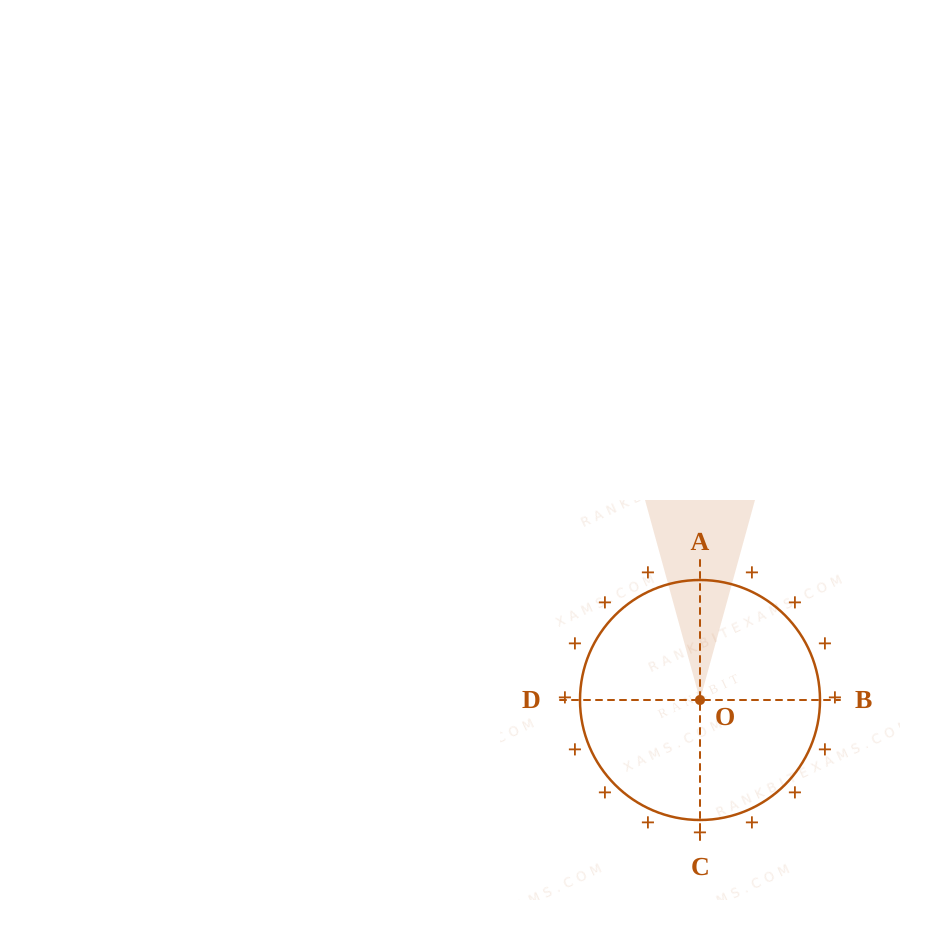

A metallic ring is uniformly charged as shown in figure. AC and BD are two mutually perpendicular diameters. Electric field due to arc AB to 'O' is 'E' is magnitude. What would be the magnitude of electric field at 'O' due to arc ABC?
Uniformly charged ring with perpendicular diameters
A circle showing perpendicular axes AC and BD dividing it into quadrants.

Solution & Explanation

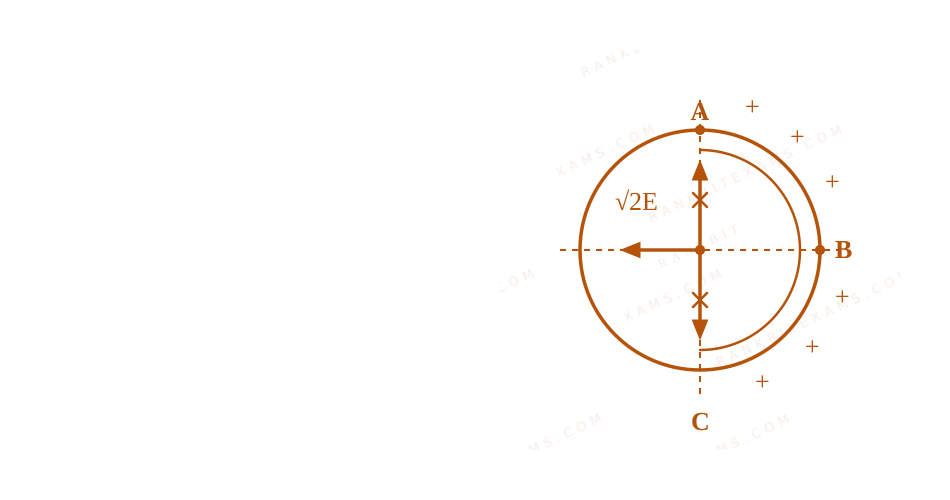
### Related Formula The electric field due to a circular arc subtending an angle phi at the center is given by: E_textarc = frac2klambdaR sinleft(fracphi2right) ### Core Logic Arc AB subtends 90^circ (one quadrant) at the center. The electric field due to it is given as E. Arc ABC consists of two independent quadrants: arc AB and arc BC. Each quadrant independently creates an electric field of magnitude E pointing along the bisector of that specific quadrant. ### Step 1: Vector Addition The electric field vecE_AB is directed at 45^circ away from both axes into the third quadrant. The electric field vecE_BC is directed at 45^circ towards the matching opposite quadrant. Since vecE_AB and vecE_BC are perpendicular to each other, their resultant magnitude is: E_textnet = sqrtE^2 + E^2 = sqrt2E
Vector field components due to charged arcs
A circle showing perpendicular axes AC and BD dividing it into quadrants.
Vector field components due to charged arcs
A circle showing perpendicular axes AC and BD dividing it into quadrants.
### Pattern Recognition Symmetric components of a ring create orthogonal vector fields. Each 90^circ arc produces a field of magnitude E directed along its angular bisector. Two adjacent quadrants have bisectors separated by 90^circ, hence use orthogonal vector addition. ### Evaluation Rubric / Model Answer null ### Chapter Mix Class 12 Physics: Electrostatics

Reference Study Guides

More Electrostatics Previous-Year Questions — Page 6

Q1 jee_main_2025_24_jan_morning Energy Stored in a Capacitor
Consider a parallel plate capacitor of area A (of each plate) and separation 'd' between the plates. If E is the electric field and epsilon_0 is the permittivity of free space between the plates, then potential energy stored in the capacitor is :-
  • A. frac12epsilon_0E^2Ad
  • B. frac34epsilon_0E^2Ad
  • C. frac14epsilon_0E^2Ad
  • D. epsilon_0E^2Ad

Solution

### Related Formula The electrostatic energy density u stored in an electric field E is given by: u = frac12epsilon_0E^2 The total potential energy U stored in a volume V is: U = u cdot V ### Core Logic For a parallel plate capacitor, the volume between the plates where the electric field exists is the product of the plate area A and the plate separation d: V = Ad ### Step 1: Calculating Stored Energy Substitute the volume expression into the total energy equation: U = left(frac12epsilon_0E^2 ight)(Ad) U = frac12epsilon_0E^2Ad ### Pattern Recognition Energy density times volume is a universal relation for field fields. Remember that volume is simply cross-sectional area multiplied by distance (Ad). ### Evaluation Rubric / Model Answer null ### Chapter Mix Class 12 Physics: Electrostatics
Q18 jee_main_2025_24_jan_morning Capacitance of a Parallel Plate Capacitor
A parallel plate capacitor was made with two rectangular plates, each with a length of l = 3 cm and breath of b = 1 cm. The distance between the plates is 3mu m Out of the following, which are the ways to increase the capacitance by a factor of 10? A. l = 30 cm, b = 1 cm, d=1mu m B. l = 3 cm, b=1 cm, d=30~mu m C. l = 6 cm, b=5 cm, d=3~mu m D. l = 1 cm, b=1textcm, d=10~mu m E. l = 5text cm, b=2 cm, d=1mu m Choose the correct answer from the options given below :
  • A. C and E only
  • B. B and D only
  • C. A only
  • D. C only

Solution

### Related Formula The capacitance of a parallel plate system is given by : C = fracepsilon_0Ad = fracepsilon_0lbd where l is length, b is breadth, and d is separation distance. ### Core Logic Evaluate the initial capacitance base scaling parameter : C_0 = fracepsilon_0 times 3text cm times 1text cm3mutextm = 1 times epsilon_0text units We want to increase this initial baseline capacitance value by a factor of 10, meaning our target capacitance is 10epsilon_0. ### Step 1: Audit Options Let's check the capacitance for options C and E : * Option C: l=6text cm, b=5text cm, d=3mutextm . C_C = fracepsilon_0 times 6 times 53 = 10epsilon_0text units (Correct) * Option E: l=5text cm, b=2text cm, d=1mutextm . C_E = fracepsilon_0 times 5 times 21 = 10epsilon_0text units (Correct) ### Pattern Recognition Capacitance scales matching the geometric factor fracl cdot bd. Look for options where this ratio scales up to exactly 10 times the initial baseline value. ### Evaluation Rubric / Model Answer null ### Chapter Mix Class 12 Physics: Electrostatics
Q21 jee_main_2025_24_jan_morning Gauss's Law and Electric Flux
A square loop of sides a = 1 m is held normally in front of a point charge q = 1C The flux of the electric field through the shaded region is frac5p times frac1varepsilon_0 fracNm^2C , where the value of p is .
Gauss's Law and Electric Flux diagram for Q21 - JEE Main 2025 Morning
The diagram illustrates a square loop divided into 8 symmetric parts with a point charge positioned in front of its center.
Numerical Answer. Answer: 48 to 48

Solution

### Related Formula By Gauss's Law, the total flux emitted by a point charge q through a completely enclosing symmetric cube container surface is: Phitexttotal = fracqepsilon0 ### Core Logic Assuming the charge resides at a symmetric center distance fraca2 relative to the loop face [cite: 784, 786], this square loop represents one of the six identical faces of an enclosing cube system. Thus, the flux passing through the entire square loop face is[cite: 775, 776]: Phitextsquare = frac16 Phitexttotal = fracq6epsilon0 ### Step 1: Symmetric Partitioning As shown in the solution schematic
Gauss's Law and Electric Flux diagram for Q21 - JEE Main 2025 Morning
The diagram illustrates a square loop divided into 8 symmetric parts with a point charge positioned in front of its center.
, the square face can be divided into 8 identical symmetric right-angled triangle sections by drawing its diagonals and medians[cite: 771, 777]. Each individual part intercepts an equal portion of the flux field : Phitextpart = frac18 Phitextsquare = frac18 left(fracq6epsilon_0 ight) = fracq48epsilon_0 The shaded region covers exactly 5 of these individual triangle parts [cite: 779, 780]: Phi_textshaded = 5 times Phi_textpart = frac548 times fracqepsilon_0 Comparing this result with the given expression frac5p times frac1epsilon_0 , we find: p = 48 ### Pattern Recognition Exploit geometric symmetry to break solid angles down into equal fractions, avoiding complex surface integration. ### Evaluation Rubric / Model Answer null ### Chapter Mix Class 12 Physics: Electrostatics
Q2 jee_main_2025_28_jan_evening Energy Density in Capacitors
A parallel plate capacitor of capacitance 1mu mathrmF is charged to a potential difference of 20mathrmV. The distance between plates is 1mu mathrmm. The energy density between plates of capacitor is:
  • A. 1.8 times 10^3 \, mathrmJ/m^3
  • B. 2 times 10^-4 \, mathrmJ/m^3
  • C. 2 times 10^2 mathrm~J / mathrmm^3
  • D. 1.8 times 10^5 mathrm~J / mathrmm^3

Solution

### Related Formula The electric field E between the plates of a parallel plate capacitor is given by : E = fracVd The electrostatic energy density U in a medium is given by: U = frac12 epsilon_0 E^2 ### Core Logic Given values [cite: 662, 664, 665]: * Capacitance, C = 1 \ mutextF * Potential difference, V = 20 text V * Plate separation, d = 1 \ mutextm = 10^-6 text m First, calculate the electric field E : E = frac2010^-6 = 20 times 10^6 text V/m Now, calculate the energy density U using epsilon_0 approx 8.85 times 10^-12 text F/m : U = frac12 times (8.85 times 10^-12) times (20 times 10^6)^2 U = frac12 times 8.85 times 10^-12 times 400 times 10^12 U = 8.85 times 200 = 1770 text J/m^3 = 1.77 times 10^3 text J/m^3 Rounding to the nearest matching option gives 1.8 times 10^3 text J/m^3. ### Pattern Recognition Notice that energy density is completely independent of the total capacitance value C if the voltage and spacing are directly provided. Always check for redundant parameters included to distract candidates. ### Evaluation Rubric / Model Answer null ### Chapter Mix Class 12 Physics: Electrostatics
Q22 jee_main_2025_28_jan_evening Electric Dipole
An electric dipole of dipole moment 6 times 10^-6 mathrmCm is placed in uniform electric field of magnitude 10^6 mathrm~V/m. Initially, the dipole moment is \parallel to electric field. The work that needs to be done on the dipole to make its dipole moment opposite to the field, will be ______ J.
Numerical Answer. Answer: 12

Solution

### Related Formula The potential energy of an electric dipole aligned at an \angle theta inside a uniform electric field is given by: U = -p E cos theta The work done by an external agent to rotate the dipole equals its change in potential energy: W = Delta U = -pE (cos theta_f - cos theta_i) ### Core Logic Given parameters [cite: 805, 806]: * Dipole moment, p = 6 times 10^-6 text Cm * Electric field, E = 10^6 text V/m * Initial \angle (\parallel state), theta_i = 0^circ * Final \angle (opposite state), theta_f = 180^circ Substitute the values into the work equation [cite: 807, 808]: W = -pE (cos 180^circ - cos 0^circ) W = -pE (-1 - 1) = 2 p E quad text W = 2 times (6 times 10^-6) times 10^6 = 12 text J quad text ### Pattern Recognition Rotating a dipole from its most stable configuration (\parallel, theta=0^circ) to its most unstable position (anti-\parallel, theta=180^circ) always requires a maximum work value of exactly 2pE. ### Evaluation Rubric / Model Answer null ### Chapter Mix Class 12 Physics: Electrostatics

More Electrostatics Questions — jee_main_2025_04_april_evening

Practice all Electrostatics previous-year questions →

Rankbit System
JEE Physics: Waves (+15.5%) | Electrostatics: Concentric Shells (-29.7%) | Modern Physics: Photoelectric Clones (+34.2%) | Mathematics: Definite Integrals (+18.1%) | Chemistry: Coordination Splitting (-11.4%) | JEE Physics: Waves (+15.5%) | Electrostatics: Concentric Shells (-29.7%) | Modern Physics: Photoelectric Clones (+34.2%) | Mathematics: Definite Integrals (+18.1%) | Chemistry: Coordination Splitting (-11.4%)