Rankbit System
JEE Physics: Waves (+15.5%) | Electrostatics: Concentric Shells (-29.7%) | Modern Physics: Photoelectric Clones (+34.2%) | Mathematics: Definite Integrals (+18.1%) | Chemistry: Coordination Splitting (-11.4%) | JEE Physics: Waves (+15.5%) | Electrostatics: Concentric Shells (-29.7%) | Modern Physics: Photoelectric Clones (+34.2%) | Mathematics: Definite Integrals (+18.1%) | Chemistry: Coordination Splitting (-11.4%)

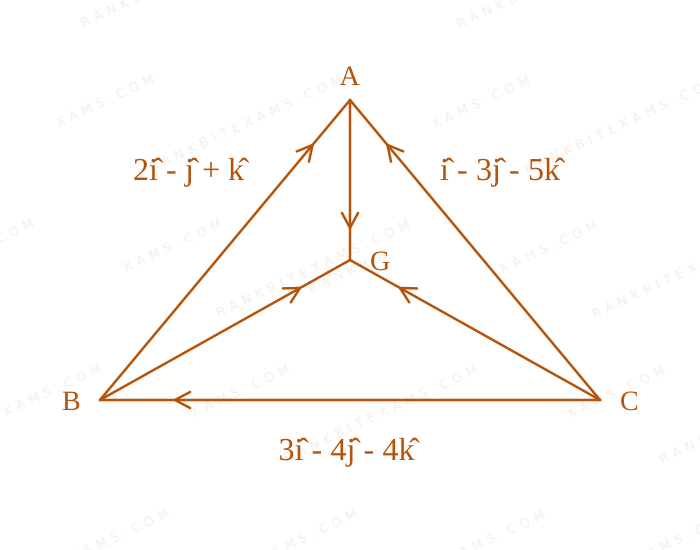
Let the three sides of a triangle ABC be given by the vectors 2hatmathbfi - hatmathbfj + hatmathbfk , hatmathbfi - 3hatmathbfj - 5hatmathbfk and 3hatmathbfi - mathbf4hatmathbfj - mathbf4hatmathbfk . Let G be the centroid of the triangle ABC. Then 6leftleft|overlineAGright|^2 + left|overlineBGright|^2 + left|overlineCGright|^2right) is equal to

Numerical Answer Type:
Enter a numerical value Answer: 164 to 164 +4 marks

Solution & Explanation

### Core Logic Let the vertices of the triangle be A, B, and C. The vectors representing the side paths are: overlineAB = 2hati - hatj + hatk overlineCA = hati - 3hatj - 5hatk overlineCB = 3hati - 4hatj - 4hatk Notice that overlineAB + overlineCA = (2+1)hati + (-1-3)hatj + (1-5)hatk = 3hati - 4hatj - 4hatk = overlineCB. This structurally validates vector addition rules.
Vector algebra diagram for Q75 - JEE Main 2025 Evening
### Step 1: Finding Position Vectors relative to A Let's set vertex A as the origin origin point (Position vector vecA = vec0): - Position vector of B: vecB = 2hati - hatj + hatk - Position vector of C: Since overlineCA = vecA - vecC = -vecC implies vecC = -hati + 3hatj + 5hatk Now, calculate the position vector of the centroid G: vecG = fracvecA + vecB + vecC3 = fracvec0 + (2hati - hatj + hatk) + (-hati + 3hatj + 5hatk)3 = frac13left(hati + 2hatj + 6hatkright) ### Step 2: Calculating Squared Lengths to the Centroid Let's find each individual vector distance block: - overlineAG = vecG - vecA = frac13(hati + 2hatj + 6hatk) implies |overlineAG|^2 = frac19(1^2 + 2^2 + 6^2) = frac419 - overlineBG = vecG - vecB = left(frac13-2right)hati + left(frac23+1right)hatj + left(2-1right)hatk = -frac53hati + frac53hatj + 1hatk |overlineBG|^2 = left(-frac53right)^2 + left(frac53right)^2 + 1^2 = frac259 + frac259 + 1 = frac599 - overlineCG = vecG - vecC = left(frac13+1right)hati + left(frac23-3right)hatj + left(2-5right)hatk = frac43hati - frac73hatj - 3hatk |overlineCG|^2 = left(frac43right)^2 + left(-frac73right)^2 + (-3)^2 = frac169 + frac499 + 9 = frac1469 ### Step 3: Final Targeted Evaluation Summing the squared values and multiplying by 6: textValue = 6 left[ |overlineAG|^2 + |overlineBG|^2 + |overlineCG|^2 right] = 6 left[ frac419 + frac599 + frac1469 right] textValue = 6 times frac2469 = 2 times frac2463 = 2 times 82 = 164 ### Pattern Recognition Setting one vector node as the origin point (vecA = vec0) heavily dampens intermediate coordinate math steps, avoiding dealing with an absolute baseline origin orientation. ### Evaluation Rubric / Model Answer null ### Chapter Mix Class 12 Mathematics: Vector Algebra

Reference Study Guides

More Vector Algebra Previous-Year Questions — Page 4

Q55 2025 Vector Cross Product and Dot Product
Let veca = 2hati - hatj + 3hatk , vecb = 3hati - 5hatj + hatk and vecc be a vector such that veca times vecc = vecc times vecb and left(vecmathbfa + vecmathbfcright) . left(vecmathbfb + vecmathbfcright) = 168. Then the maximum value of |vecmathbfc|^2 is:
  • A. 77
  • B. 462
  • C. 308
  • D. 154

Solution

### Related Formula vecu times vecv = -vecv times vecu textIf vecu times vecv = 0 implies vecu parallel vecv implies vecu = lambda vecv ### Core Logic Given veca times vecc = vecc times vecb implies veca times vecc + vecb times vecc = 0 (veca + vecb) times vecc = 0 implies vecc = lambda(veca + vecb) ### Step 1: Compute a + b veca + vecb = (2+3)hati + (-1-5)hatj + (3+1)hatk = 5hati - 6hatj + 4hatk vecc = lambda(5hati - 6hatj + 4hatk) |vecc|^2 = lambda^2(25 + 36 + 16) = 77lambda^2 ### Step 2: Expand the Dot Product Condition (veca + vecc) cdot (vecb + vecc) = 168 veca cdot vecb + vecc cdot (veca + vecb) + |vecc|^2 = 168 Evaluate veca cdot vecb = (2)(3) + (-1)(-5) + (3)(1) = 6 + 5 + 3 = 14. Substitute vecc cdot (veca + vecb) = lambda |veca + vecb|^2 = 77lambda: 14 + 77lambda + 77lambda^2 = 168 implies 77lambda^2 + 77lambda - 154 = 0 lambda^2 + lambda - 2 = 0 implies lambda = 1 text or lambda = -2 ### Step 3: Maximize |vecc|^2 Maximum value occurs when lambda = -2: |vecc|^2 = 77(-2)^2 = 77 times 4 = 308 ### Pattern Recognition Recognize the cross-product rule inversion immediately: vecx times vecy = vecy times vecz implies (vecx+vecz) parallel vecy. This linear reduction circumvents solving complex linear systems. ### Evaluation Rubric / Model Answer null ### Chapter Mix Class 12 Mathematics: Vector Algebra

More Vector Algebra Questions — jee_main_2025_04_april_evening

Practice all Vector Algebra previous-year questions →

YOUR FIRST PREP STEP STARTS HERE

We Map Every Repeating Question in Competitive Exams.

Say goodbye to generic mock test fatigue. RankBit uses smart analysis to group past exam questions into their foundational Repeating Question Types. Find chapter weightage, track repeating questions, and score higher with targeted practice.

Select Your Target Exam

Choose an exam track below to find formulas per chapter and patterns.

Syncing Exam Intelligence

Mapping formulas and patterns across all tracks…

PATH A — FULL LENGTH PRACTICE

Full Mock Test Hub

Simulate real NTA exam conditions with fully tracked mocks. Time yourself against past papers.

Under Development
PATH B — TARGETED PRACTICE

Topic-wise Practice Hub

Practice past-year questions one chapter at a time. Pick an exam → subject → chapter and get every PYQ for that topic — pulled together from all past papers — with the chapter's key formulas alongside.

Loading Questions... Browse Topics
Latest from the Blog
View all →

Loading articles...